+++*

Symbolic Forest

A homage to loading screens.

Blog : Page 6

Too long to go in a cracker

Or, what to do if you find yourself trapped by an evil inventor with a passion for marine life

“Behold!” cried the Evil Villain Scientist, his voice screeching and cracking with excitement. “My latest invention, the invention which will let me take over the WORLD! They thought I was mad! They said it couldn’t be done! They said it would break the laws of physics! But here I have it! The Marine Life Invisibility Ray!!!”

“They’ll never let you take over the world, Evil Villain,” I mumbled around my poorly-attached gag. “The Marine Life Academy just won’t allow it. You’ll never get away with your ridiculous plan.” Secretly, though, I was worried. Any evil invention worthy of that many exclamation marks was going to be tough to beat.

“They’ll never have a chance to stop me!” he chortled gleefully. “They’ll never see me coming! And you, miss, are never going to escape from here, so I may as well tell you all the details of just what this invention can do. The Marine Life Invisibility Ray can prevent anyone from seeing any sort of aquatic animal life! It becomes completely invisible to the eye. Before the week is out, I will command a whole school of invisible trained dolphins, and the Academy simply won’t be able to see what’s coming for them. In a few days, I will control the world!”

I was in a sticky situation, I could see, but if only I could keep him distracted and talking I might be able to come up with a chance to escape. “It’ll never work,” I shouted. “Your gadget is never going to handle that. It’ll burn out after one trained dolphin at most, if it even works at all.”

“You doubt me, you stupid girl?” he screamed. “My little gadget? My machine works perfectly! Let me show you!!!”

One wall of the Evil Lair was entirely of thick, smooth plate glass, a window into the Villain’s main aquarium. Every imaginable type of marine life swam peacefully across his window, one side to the other, then circling to pass back again. Octopuses scuttled along the sandy bottom, and catfish clamped themselves to rocks. The villain swung the Invisibility Ray around on its mount, twiddled knobs, and closed a large, well-polished brass knife switch with a sharp electrical crack. A quiet hum rose from bass notes to treble pitch, and I felt the hairs on my arms stand on end as every atom in the air became highly charged. A warning lamp on the gun itself started to blink, and the Villain flipped the safety catch away from the firing switch.

“What shall we show you first, you silly little spy,” he said, panning the raygun side to side. “Look! A clownfish! One button press and…” he pushed the firing switch. I felt a disconcerting leap, as if the universe had suddenly jumped a groove. “…you can’t see any clownfish now!” The hum from the device rose back from bass to treble again.

“A clownfish is one thing, Villain,” I said, “but that won’t convince the Academy.”

“You think that’s all it can do!?” he shouted. “Look! A sailfin tang!” He fired again, and the small striped fish disappeared. “A yellow wrasse!” That jolt again, and the wrasse had disappeared. “A marble batfish!” Again the strange jolt, as if I had jumped from one world to a parallel one. “It’s completely foolproof! It will have no effect, no effect at all on land life, whilst making any sea life completely unseen!”

“Any sea life at all?” I asked. “Really?”

“Really. Any. You can’t trick me!” He cackled. “You really, really can’t trick me!”

“How about…” I said, trying to sound as casual as I could, as if I was picking something at random, “…how about that there?”

“That? That seahorse? Is a seahorse marine life? Is this the Marine Life Invisibility Ray? Of course it will make it unseen!”

“I don’t believe you,” I said, trying to stay calm. “Show me. Please?”

“Why, my dear,” he said, with a wicked grin, “it would be a pleasure.” He pressed the button.

With a terrible cracking sound, the thick glass of the tank shattered into large, jagged pieces, as the foamy salt water of the tank burst from it. Through the foam, I made out a large, dark shape. A loud “NEIGHHHHHH!” filled my ears. It sounded angry and enraged, and with very good reason. Without stopping to see if the Villain survived his trampling, I fled.
Bad for your health

Or, a sudden flash of the past

The Mother has always lied, and always denied that she does. She hates being called out for her mistakes, and will flatly claim she didn’t make them. Moreover, she’s always preferred to lie rather than admit any aspect of the past she’s ashamed of. Sometimes these things come out, years later, and I start to doubt my own memory. I’m not saying she consciously gaslights people; but she will say one thing one day, something entirely contradictory a week later, and you start to wonder where the truth, if anything, actually lies. This has reached the point where she has been—possibly deliberately—not taking her heart medication, and not going to the pharmacy or the doctor when she should to get her prescription sorted. So, now and then, I go to the doctor with her, to see what she tells him and what he tells her. This woman, who has been telling me constantly that she doesn’t feel well, that she’s constantly dizzy, will tell the doctor that everything is fine. He asks her why she hasn’t been taking her medication: she tells him she ran out, even though she has plentiful stocks at home. He asks her why she didn’t come back for a repeat: she says she wants to help save the NHS money.

Since my father died I’ve been trying to help her come to terms with her grief; but that, too, has in a way been difficult for both of us. I was always aware that there was something slightly off in the atmosphere of the house when I was growing up, although as a child it was impossible to explain or analyse. My father was extremely, intensely controlling, and since his death more and more has emerged which shows what I have been feeling for a while. That, to my mind, myself and my mother were in an abusive relationship with him. She, of course, does not admit this, does not admit that he stalked her before they got together, does not admit that my traumatised memories of his outbursts of anger ever happened, does not admit that he felt anything for us other than love.

Sometimes, though, there are sudden flashes of new information, things I didn’t know, that just go to prove that she should possibly have walked away years before I was born.

As I said, The Mother has always lied. When I was small, back when smoking was much more common than it is today, she told me earnestly not to smoke, that she had never smoked. The one smoker I regularly saw in my life before I started school was the travelling butcher, who would drive round in his van and knock on the door once a week, and then sit on our kitchen stool trying to sell his cuts to The Mother, chain-smoking as he did. She would get an ashtray out for him; it was the only time the ashtray was ever used. He would leave, and she would tell me how important it was not to smoke, that she had never done it.

Later, then, I was a little puzzled when—and I can’t remember the context—she admitted she had once been a smoker, but had given it up. Another of those lies, of something she was ashamed of. I thought little of it.

Until, at the doctor’s this week, the nurse was reviewing all the personal information on her file. “‘Former smoker’, it says here,” said the nurse. “Is that still true.”

“Non-smoker for a very long time,” I interjected.

“Do you know why I stopped?” said The Mother. “It was my husband that did it, before we were married. He said he could never marry a smoker, so I stopped. He said he couild never marry a smoker, and he grabbed the pack out of my hand and threw it on the fire. And he did that every time he saw me with them. So I stopped.”

It was a strange moment. A strange moment of clarity, as to what my father was actually like, back in his early 20s. A little window. I don’t think it’s a nice one.

The astronomy calendar

It's meteor shower time again

Time for me to point out another of those regular events on the astronomical calendar. We’re just coming into the season of the Lyrids meteor shower, which should peak a week on Sunday in the early hours of the morning. So, if you fancy going meteor-spotting, next weekend is your best chance to do it until August. The phase of the moon makes it not too promising this year, but meteor-spotting is one of the easiest and simplest forms of astronomy there is, so if you fancy it and don’t mind being up in the middle of the night, go out and give it a try. The Royal Observatory Greenwich has some advice, but essentially, all you need to do it sit in a dark spot outside, look up at the sky, and relax.

More from the archives

Or, a nice photo

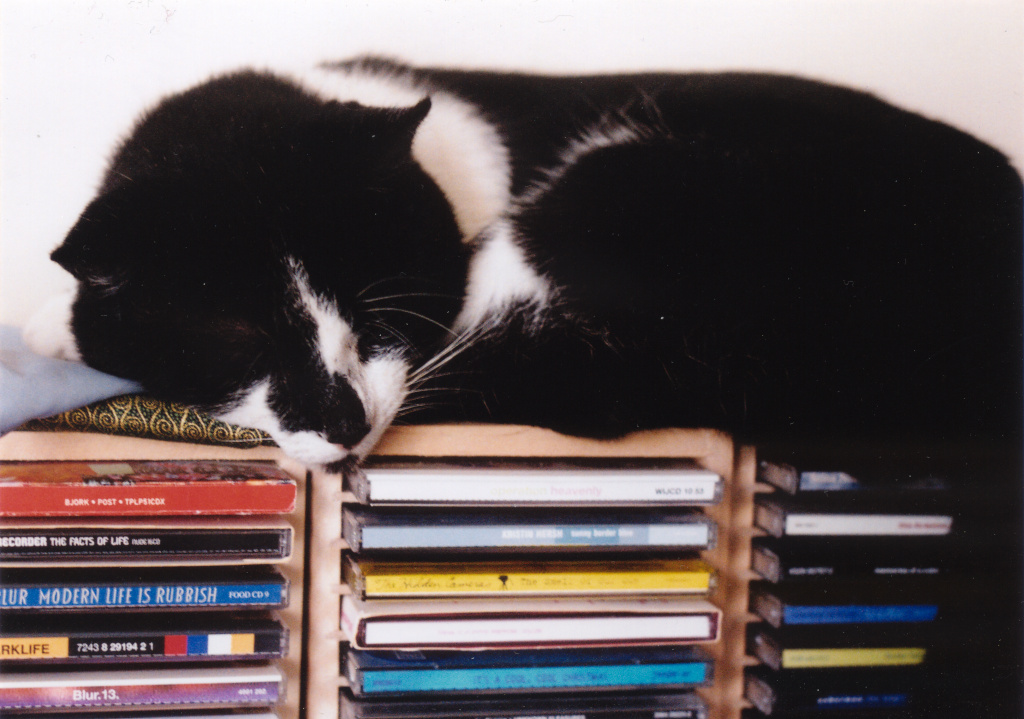
Recently, I finished editing the second month of posts from The Old Blog and published them on here. One of them included this line:

I had half an hour spare this afternoon, so I reordered all my CDs. By colour, the colour of the spine of the CD case. The plain-white and plain-black shelves don’t look that nice, but there’s a lovely graduation of the rest from dark red through orange to green and then blue.

It really was the worst way to file your CDs when you actually want to find something, but the coloured ones did look pretty. And—I thought—I’d also found a photo to prove it! I’d taken a picture, back then, of The Cat sleeping precariously balanced on top of them, showing the filing-by-colour. Or, at least I thought I had. I found the photo, and it must have been from before then. It’s still a cute photo, though.

The Cat

And as it’s a cute photo, I thought I’d show it anyway. It was probably taken on a Pentax ME film SLR originally; I do still have the negatives too.

On the map, again

Back to an Ordnance Survey anomaly

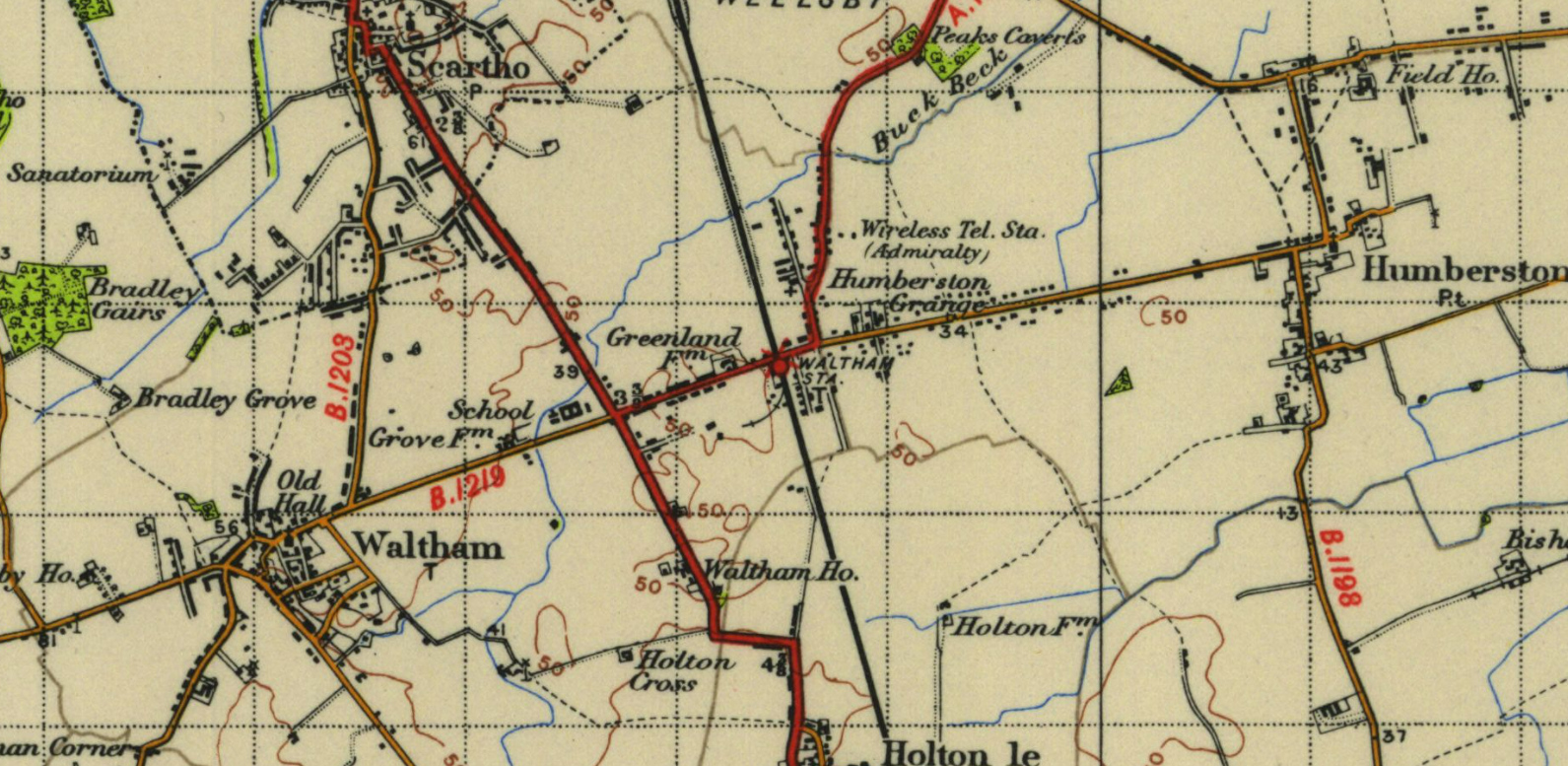
Back in 2020, I briefly mentioned a map anomaly that I was going to blog about at some point, but was going to wait until I’d done a bit more research on it. Some of that research I did do, but I still haven’t made it as far as the National Archives, which the OS themselves had pointed me towards. Nevertheless, recently some more useful information on it has been released online, so I thought it might be time to come back to it. The map in question is this one, of New Waltham in North East Lincolnshire, which when this map was published in 1947 didn’t even merit its own name on the map.

New Waltham, 1947

Reproduced with permission of the National Library of Scotland, as were the extracts below.

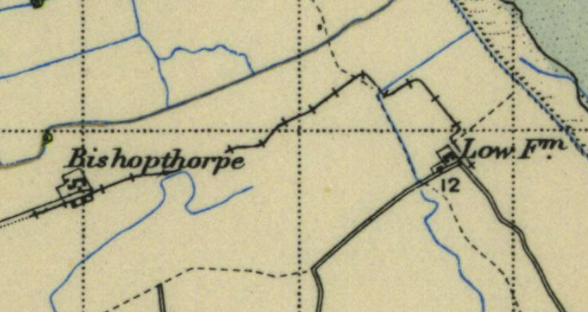
What is the anomaly? It’s at the railway station. There’s a little curving siding shown, branching off from the Down side of the line (where the station goods yard was) into a field, with a few buildings either side of it. What’s so curious about this? Well, it doesn’t appear on any other maps. At all. Including maps done shortly before or shortly afterwards. So my question was: was it something real on the ground, or was it just a copyright trap?

There were a couple of potential suggestions of an explanation. One—which I think was originally sent in by one of my old Geography teachers—was that it was a temporary siding connected with RAF Waltham (or RAF Grimsby), a nearby Bomber Command base which, interestingly, also isn’t shown on the 1947 map—it should be just on the bottom edge of that map extract, between Waltham and Holton le Clay. RAF Waltham had opened as a civilian airfield with grass strips in 1933, was briefly called Grimsby Airport at one point, and was requisitioned and given concrete runways in 1940. It closed operationally in 1945 as the hurriedly-installed concrete runways weren’t really up to long-term use, although they’re still very visible on the ground today. So was a railway siding briefly put in to help deliver materials or fuel? Well, maybe, but it’s quite a long way between the railway station and the RAF station, and there’s nothing about it in the one book I’ve seen on the history of the RAF station.

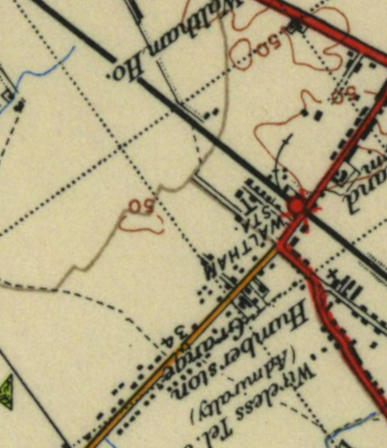
The other suggestion was that it was some sort of agricultural railway, of which there were a lot in Lincolnshire. However, there were a couple of issues with this theory. First, it’s not listed in the standard work on the subject, Lincolnshire Potato Railways by Squires. Squires’ book might not be fully comprehensive, because many Lincolnshire agricultural railways were ephemeral, short-lived things that left little trace on the ground, but it is reasonably thorough. Secondly, on the map, it just doesn’t look like an agricultural railway. This is one, a couple of miles away between Humberston and Tetney Lock.

A Lincolnshire agricultural railway

Note the differences. It’s much longer than the tiny siding at Waltham, and it doesn’t follow nice, smooth curves either. It’s laid out for a horse to pull a small wagon or two, so it’s a series of straight lines and sharp bends, likely following field boundaries.

That was the point I got to back in 2020. However, as I said at the top, something new has come up: Historic England have put their Aerial Photo Explorer online. Its collections include a cartographic-quality aerial survey of England made by the RAF in 1955; and that includes this shot of New Waltham.

On this photo, South-West is at the top, with the railway station on the right-hand side midway up the picture. If I rotate the OS map to roughly match the photo’s orientation, it might be easier to line up.

Rotated map of New Waltham

That map covers a slightly wider area than the photo, but you get the idea. The station goods yard stands out very clearly on the photo with a bright white ground surface. It the siding had existed, it would curved through the goods yard and upwards, roughly following the line you can see between two different types of vegetation. Now, although this photo is from about ten years after the siding would have existed, you can see there’s absolutely no evidence of there having been anything following the line of the railway siding on the map. Nothing at all, really, that matches up with what the map says.

So, well, there you go. Without going to look at the detailed survey records in the National Archives, I have to say I’m pretty much convinced: this railway siding was never really there. It was only ever there as a copyright trap, for the Ordnance Survey to spot as a red flag if they saw it appearing on any other maps of the area, and has likely sat there on the map almost completely unnoticed for seventy years. If any evidence comes in that it was a real feature on the ground, I’ll be very very surprised.

In the library

A Lincolnshire landmark

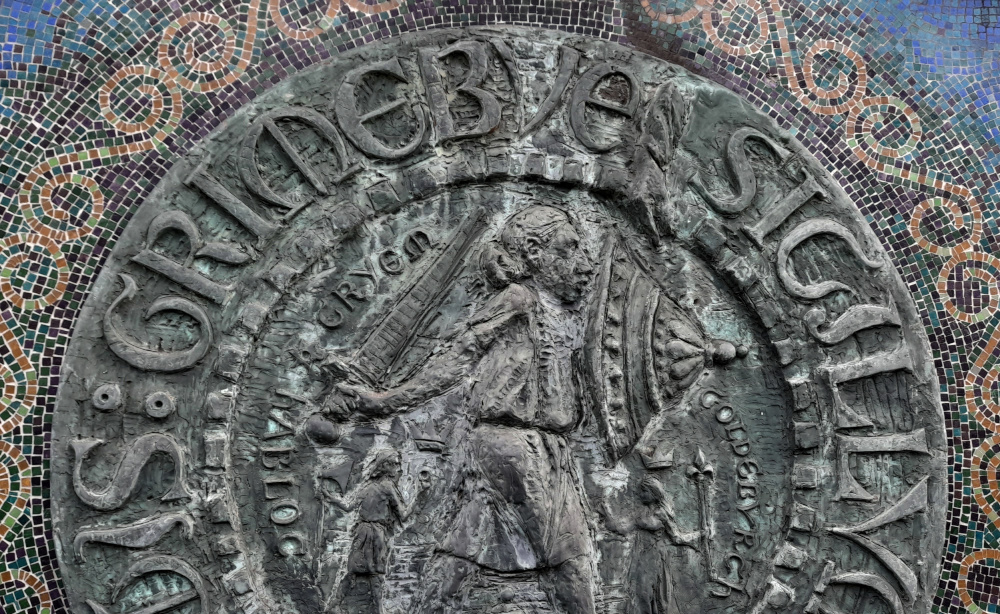
Yesterday I mentioned that the stack of unfinished and unwritten posts is still ever-growing, only, a few hours later, to come across a mainstream newspaper article discussing one of the things I’d considered writing a post about. The Guardian review of the new book from architecture critic Owen Hatherley opens with a discussion of a modernist building I’ve loved for a long time: Grimsby Central Library. In fact, I was in there only a few weeks ago, taking photos of some of the architectural details and so that I could maybe post them here at some point.

The seal of Grimsby by the library door

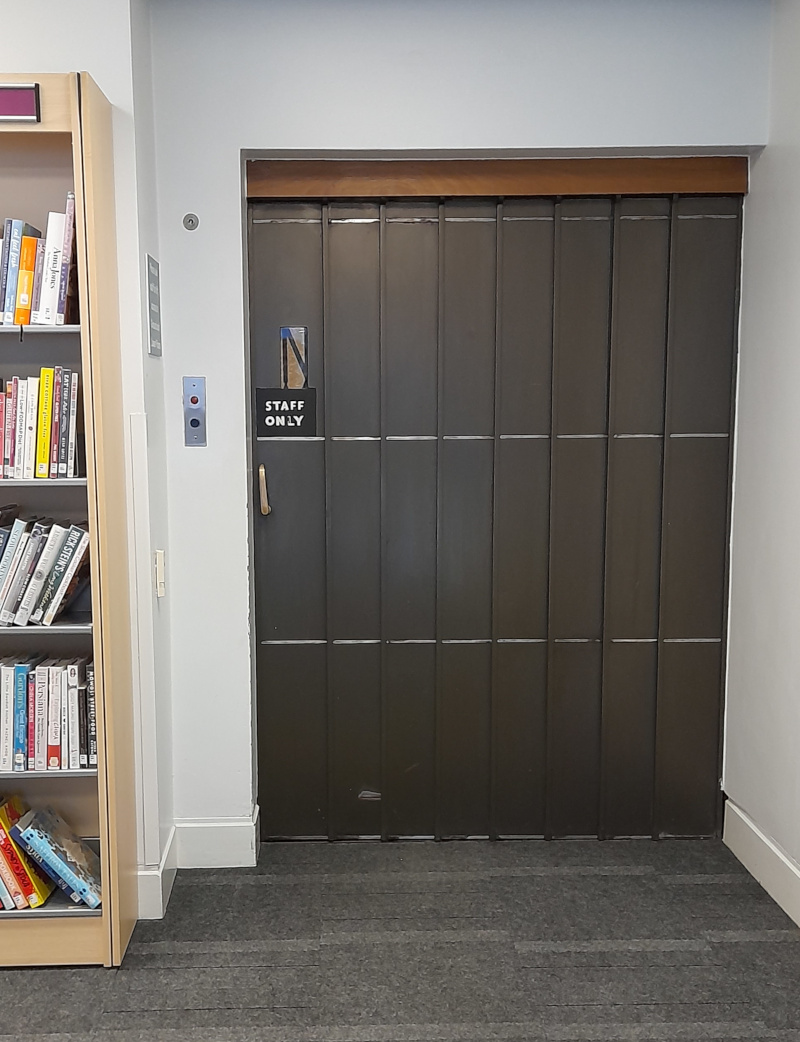
I first knew the place when I was a small child, when it still had something approaching its original layout. Children’s books in the basement, books on the ground floor, music and some of the non-fiction on the mezzanine, the reference library upstairs and an exhibition room above that. Nowadays the basement is Local History, Reference is on the mezzanine where Music used to be, and the upper floors seem to be closed and quiet, a partition blocking off what was originally a broad staircase. Nevertheless, for a 1960s building, an awful lot of the original detailing has survived. The Staff Lift looks still essentially the same as when it was installed, fifty-something years ago

Staff Lift

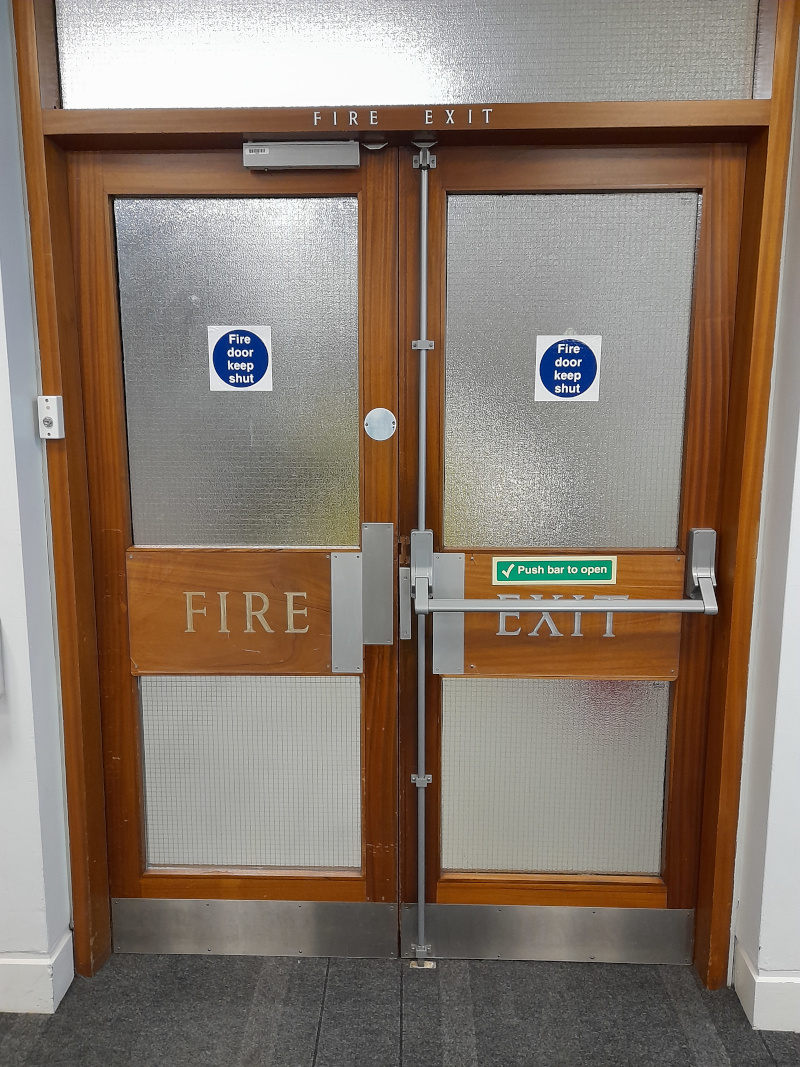
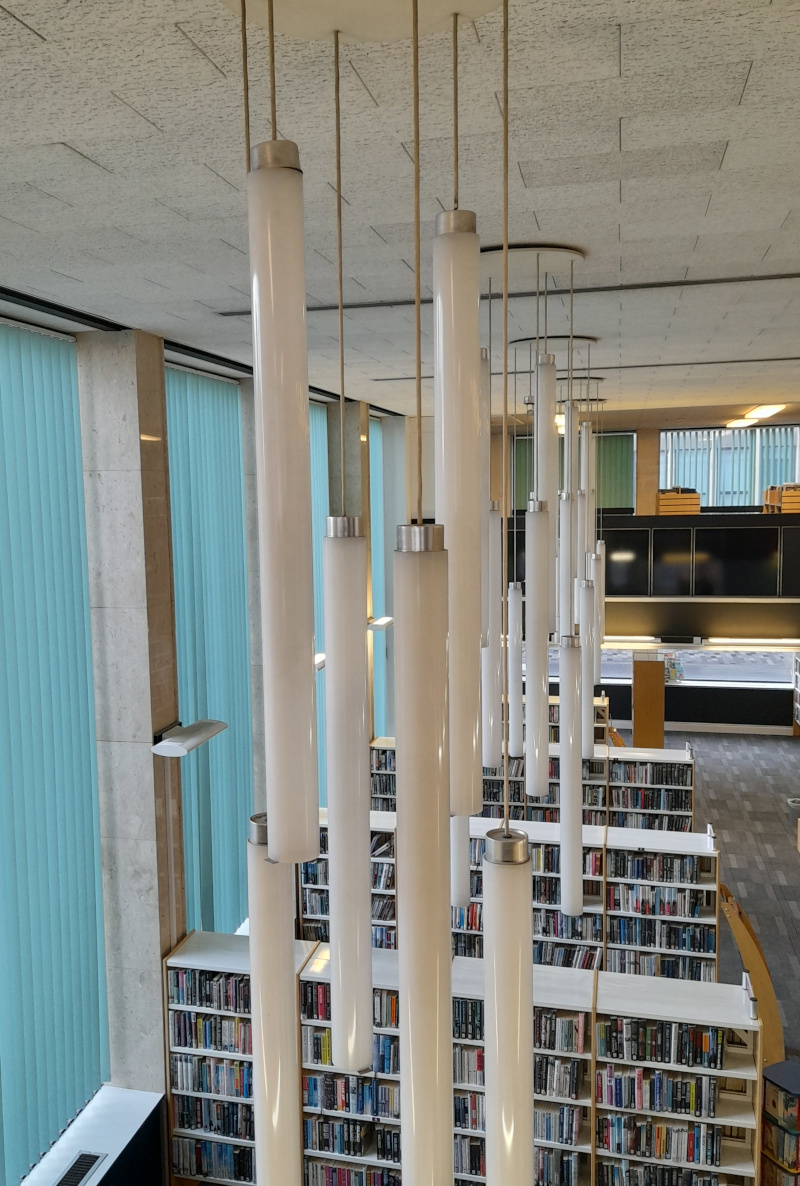
Similarly, the doors to the staff stairwell still have their original signage beneath more modern additions, and 1960 chandeliers still hang from the ceiling even if broken parts can no longer be replaced.

Fire Exit

1960s chandeliers

One thing it doesn’t have is the original shelves, which I rememeber surviving into the current century just about. They were tall, wooden, with a graceful curving profile when viewed from the side. Because of this curve, although the books at the top stood upright just as you’d expect books on a shelf to be, the books at the bottom were tipped back, tilted, so their spines were angled a few degrees in the direction of a standing reader. That little bit easier to see without bending down. I’ve never seen library shelves like them anywhere else, but I’ve always thought how ingenious they are.

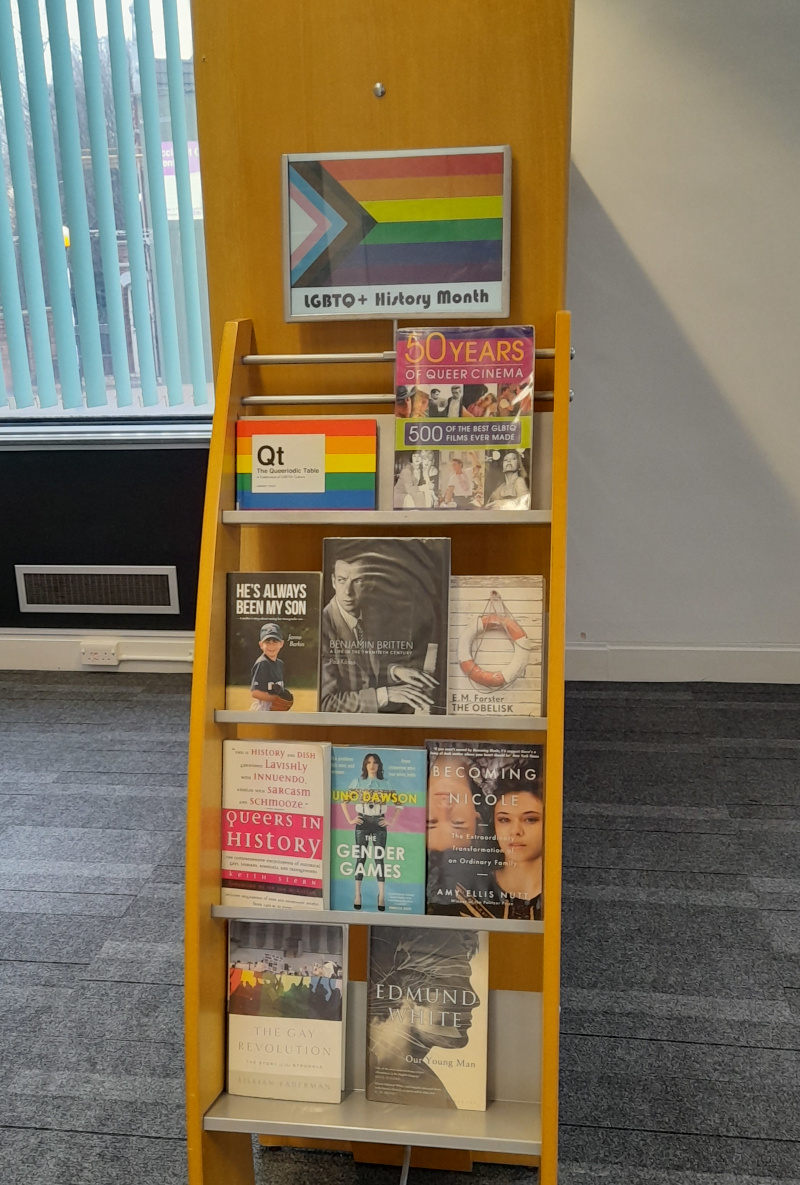
It was over a month ago I took these pictures, so the librarians had put together a small display for LGBT+ History Month. I excitedly messaged a friend who used to work in the library back when we were both teenagers, just because we couldn’t have imagined it happening back then. I realise now it’s not just that we couldn’t imagine it happening, but that before 2003 it would have been illegal for an English public library to have a display about LGBT issues. Twenty years sometimes feels a very long time ago.

Book display for LGBT+ History Month

Incidentally, all my photos here are terrible quick phone snapshots taken whilst I was wondering round browsing the shelves. However, via Twitter, I did discover a blog post written by an archictecture fan a few years ago, with a whole host of much better photos of the place, particularly of the gaunt and haunting figures decorating the south side of the building, called The Guardians Of Knowledge; but also not forgetting something I remember very clearly from childhood, the floor of the foyer! Go and look!

Update, 9th July 2022: Since writing this post I’ve taken a photo of The Guardians Of Knowledge myself.

Paddling like a swan

All quiet on the surface, but flapping away frantically underneath.

It’s been quiet around here lately, hasn’t it. Over a month since the last post, and that was just a quick note itself. As the title suggests, though, that’s because things have been busy. I’ve been pushing hard to get one of my personal coding projects to version 1.0. At work we started a new product from scratch four months ago, and it’s just had its first beta release. And in my personal life: well, it’s a long story, and if I were to write all that down it would probably turn into an entire memoir, but it’s taking up a lot of my headspace too at the moment.

Nevertheless, I still look at my list of topics to write about, my list of drafts I’ve started, and think on all the ideas I’ve had that I didn’t have the chance to write down at the time, and I keep promising myself I will come back at some point and write them, whether to publish them on here or do something else with them.

Sometimes, I do manage to make a quick note, and this post really is one of those. The other day, a conversation on Twitter with the artist Dru Marland led me to some amazing photographs of Britain in the mid-80s, taken by a Swedish photographer named Bjorn Rantil. They’re of miners and mining communities, taken in 1985 just after the end of the strike. I started with this set, taken in Treharris, Abercarn and Tilmanstone among other places, but there are a few other albums on his Flickr account. If you don’t remember the 1980s, go and look.

A brief note

Or, a number of notes played together and in sequence

Just a quick note this morning. A few months ago I went to my first gig in a few years, and saw the small, just-starting-out Casnewydd/Newport band Murder Club supporting the excellent Echobelly. Well, I’ve just realised that Murder Club released their first single last weekend, and you can buy it from Bandcamp. It’s really rather good, especially if you like shoegazy girl bands like early Lush. Go on, treat yourself.

Middle earth

Or, a trip on a steam train

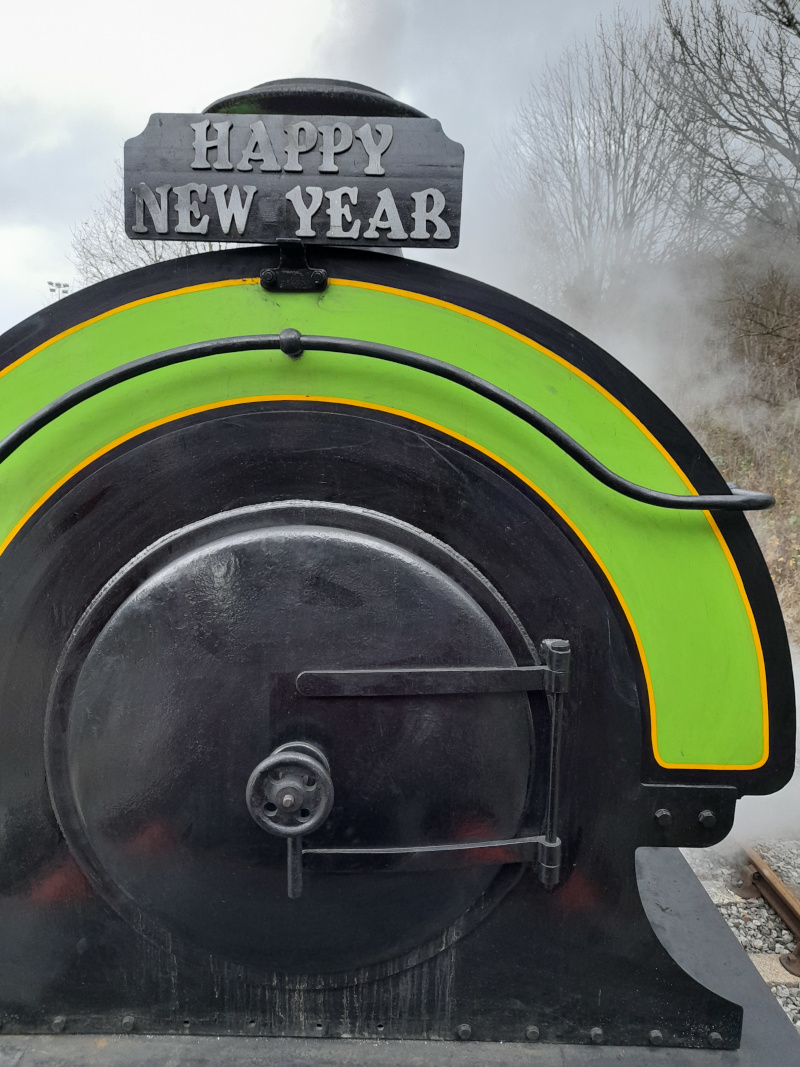
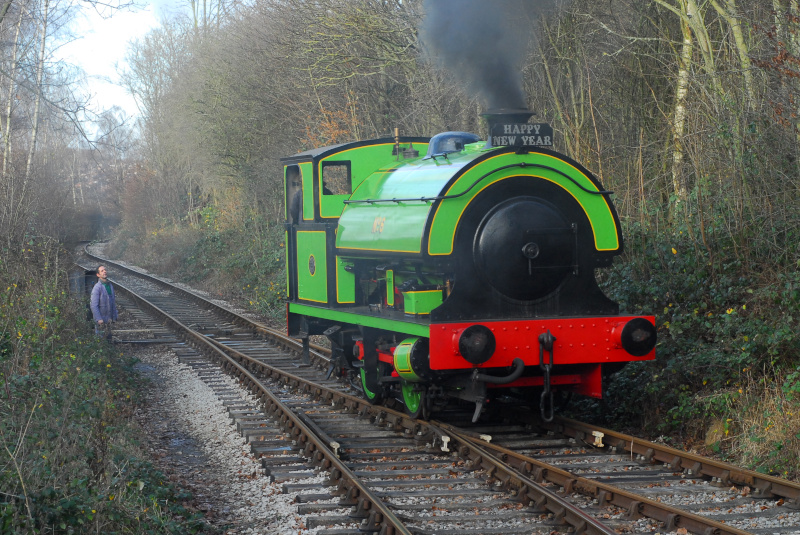
A while ago—I can’t find the exact post—I set myself a target of having more posts on here filed under Trains than I do under Political. I think I even said the target I was giving myself was by the end of last year. Well, I’m still clearly a long way off that at the time of writing (58 versus 113) but this is an attempt to make amends. Right at the start of the year, you see, I went out for a trip on the Middleton Railway.

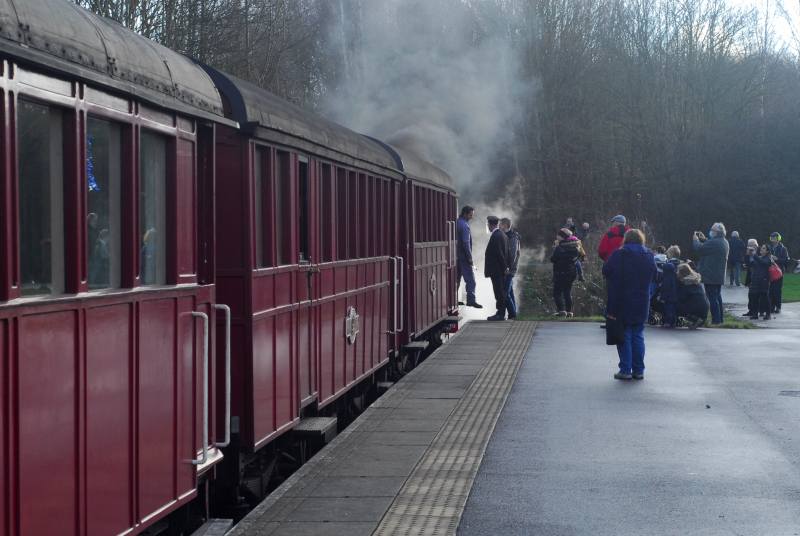
Happy New Year on the Middleton Railway

The Middleton Railway is quite an interesting little line, for its history if nothing else. There are various claimants to the title of “oldest working railway” in various parts of the UK, partly dependent on what counts as a railway and what doesn’t. If you insist steam trains have to be involved, then various branch lines around Darlington usually get the prize, as they opened in 1825 with a mixture of steam trains and horses. If you’re happy with horse-drawn trains, the stretch of the Ebbw Vale line between Rhisga and Pye Corner opened in about 1805. Both of these are lines that carry passengers in main line trains today. If you’re happy with railways that are just for freight, there’s a branch line near Dunfermline that might have had trains on it in the 1760s, although its early history is a little unclear. The Middleton Railway, by contrast, has a definite starting date, as the first railway to be authorised by Parliament, in 1758, during the reign of George II. Moreover, and something that is unusual for a volunteer-run heritage railway, it has operated continuously ever since, switching from commercial to volunteer operations in 1960.*

Of course,** none of the railways I’ve listed above really resemble their original form and the Middleton is no exception to this. In the 19th century it ran from Great Wilson St—roughly where the Crown Point branch of Pets At Home is now—and ran down to, naturally, Middleton. The furthest-south point I’ve found on a map was “Bleachground Engines”, on the 1854 six-inch map, nowadays at the very south end of Middleton where Middleton Park Avenue meets the A654. As the crow flies, it’s a distance of about 3.5 miles. The current Middleton Railway runs for about a mile, from Moor Road to the northern edge of Middleton Park. Moreover, the landscape it runs through has changed entirely, the coal mines it was built for all turned into post-industrial green spaces.

Park Halt

Being built purely as an industrial railway, the Middleton didn’t carry passengers at all until its heritage days. The first passenger trains were run using a hired diesel pulling a second-hand Swansea and Mumbles tramcar.*** Later, they needed proper carriages. Those in the picture are the underframes of old 4-wheeled parcels vans, which the Middleton has rebuilt with completely new bodies to give themselves a passenger rake.

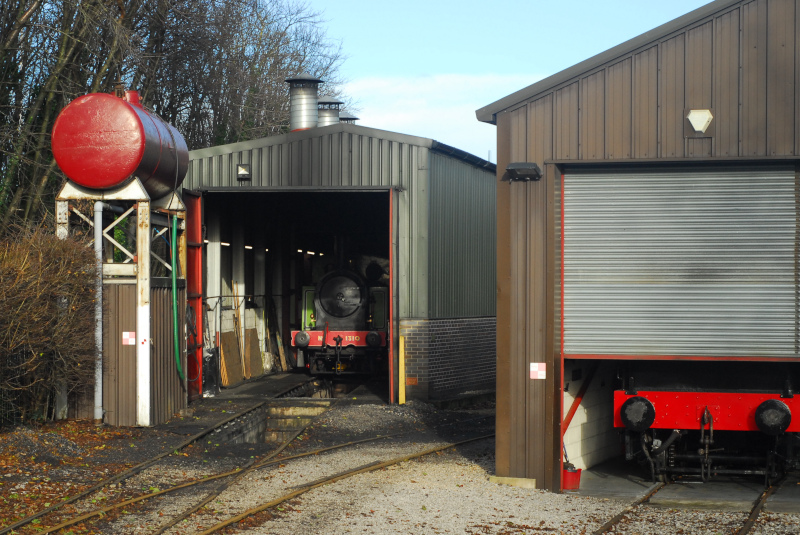
The sheds

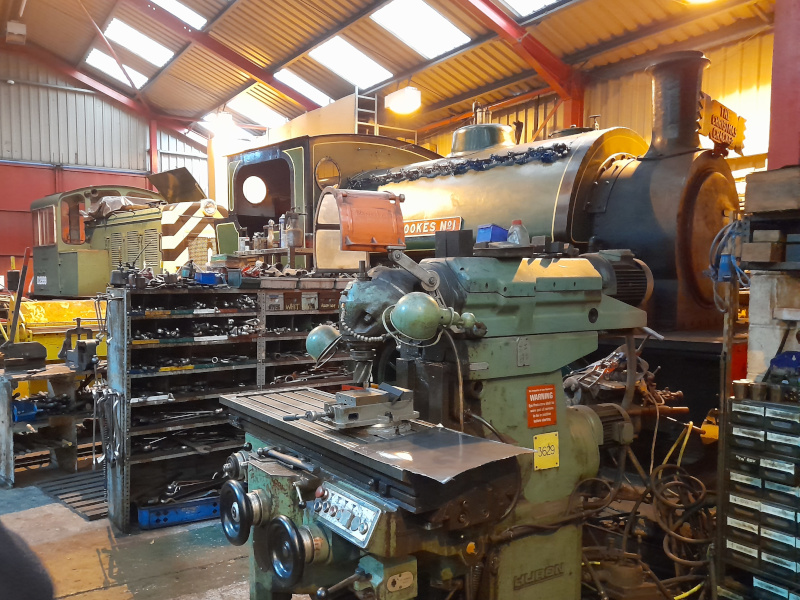
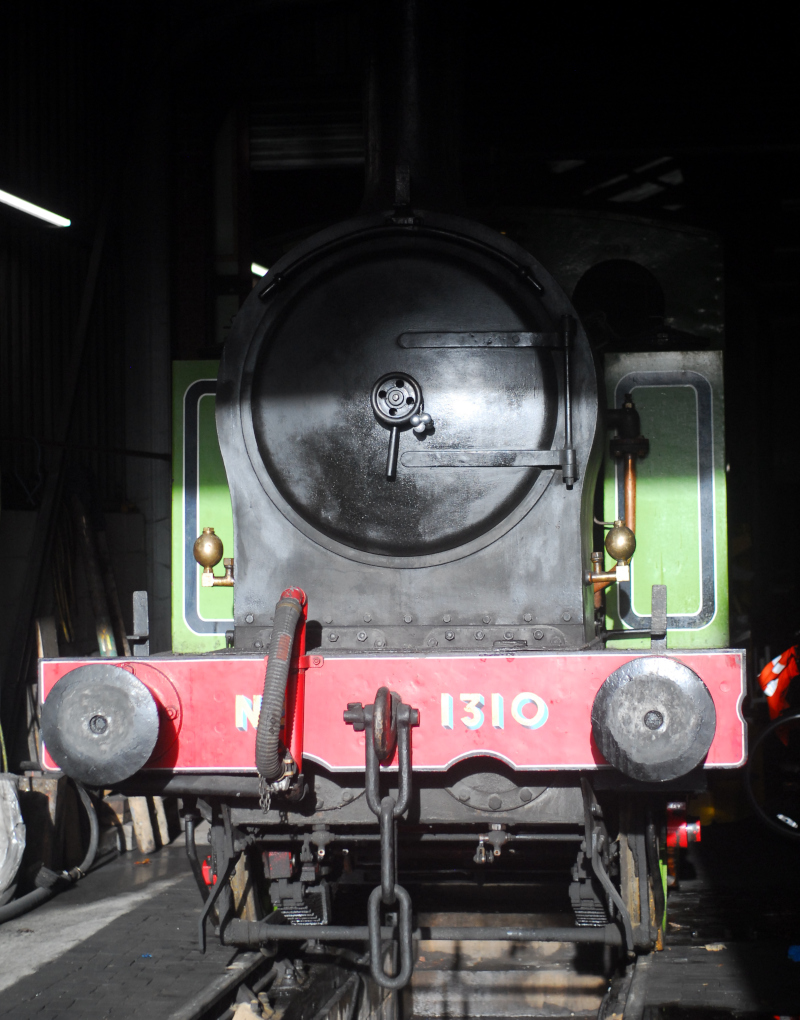
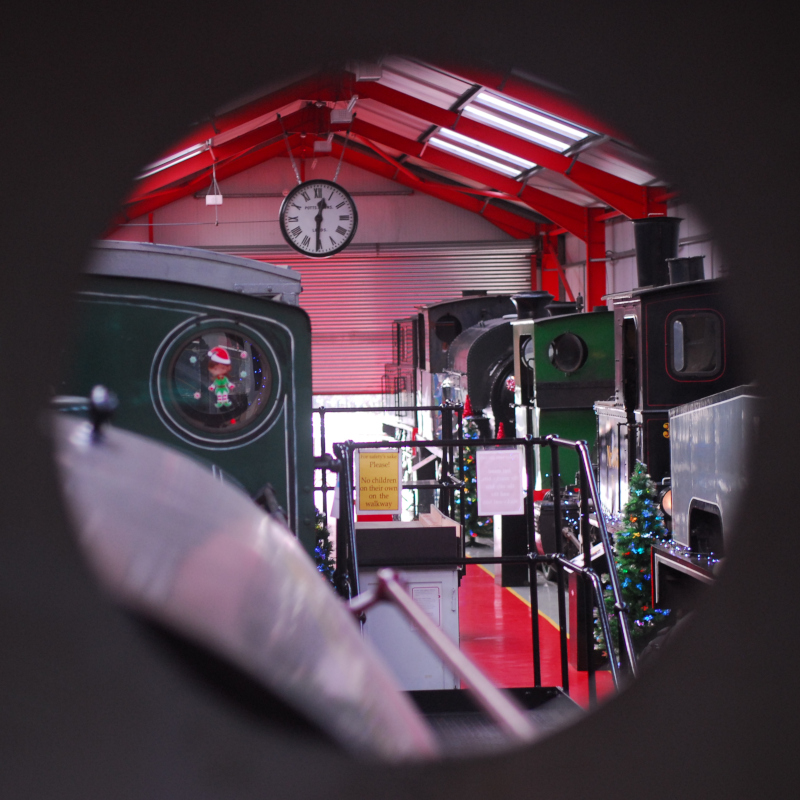
Behind the scenes, the Middleton has an awful lot crammed onto a very small site, with their workshops packed full of stuff under restoration. I can imagine shunting things to the right place in the workshop is a bit of a pain. If they didn’t specialise in small ex-industrial locos, they’d hardly have room for any. As it is, everything is jammed in rather tightly, with just enough room inside for people to move around them and actually do the work. I have an old friend who works at the Middleton; he managed to arrange for the both of us to have a little tour behind the scenes, and see the locos under repair, those undergoing major restoration, and the next carriage the railway has started to build.

Inside the workshop

Spare loco in the shed

Running round

We had a few round trips, too, shuttling back and forth along the mile of track. The Middleton Railway might be very different to its original intention, and might run now for a slightly different purpose. It’s still a fascinating place to come and visit, and was an excellent way to start the new year.

Inside the museum building

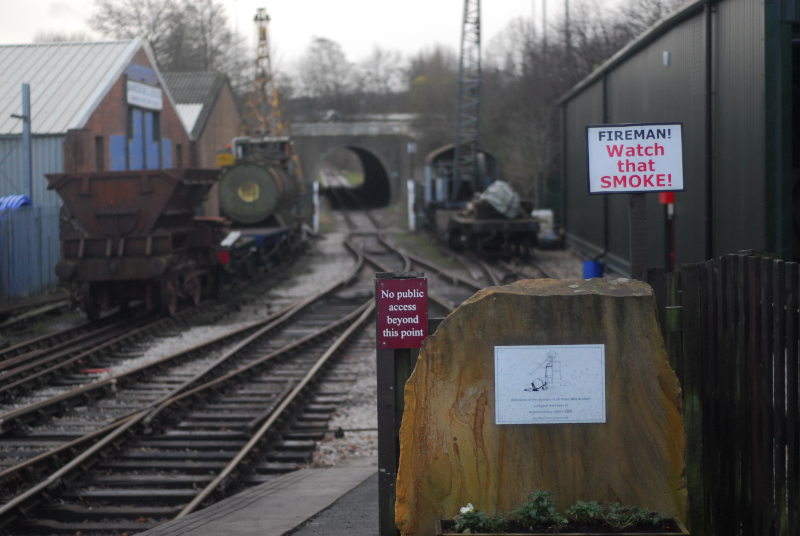
No public access

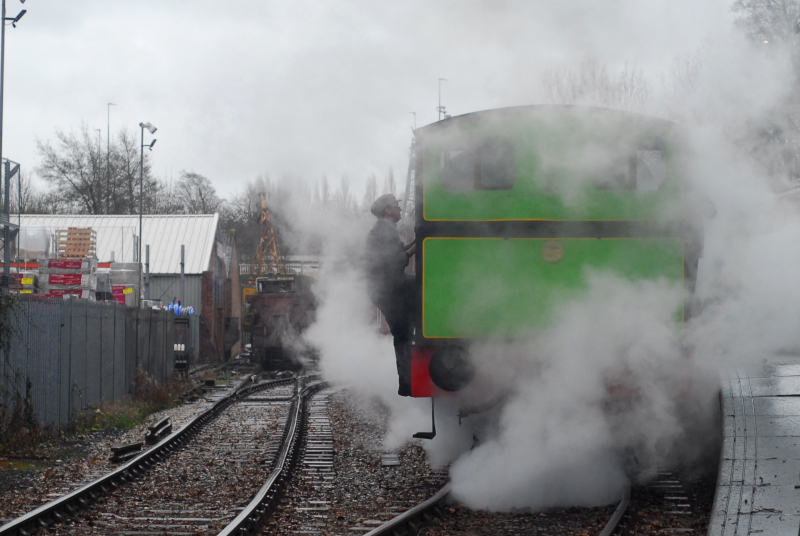
Wreathed in steam

* The only other heritage railway that can really claim this is the Talyllyn, which opened in the 1860s. The Ffestiniog has never quite closed, having leased out a short stretch of its track for former customers to use, but their claim is a wee bit of a stretch.

** And unlike the railways in the first footnote.

*** Another early railway: the Swansea and Mumbles, also known as the Oystermouth Railway, was carrying horse-drawn passengers from the first decade of the 19th century. It later essentially became a tram line, and closed just before the Middleton became volunteer-run. If you’ve ever visited the Gower, you have likely travelled by car along part of its route. The tramcar which moved to Leeds was sadly destroyed by arson.

The paper archives (part one)

Or, evidence worth keeping

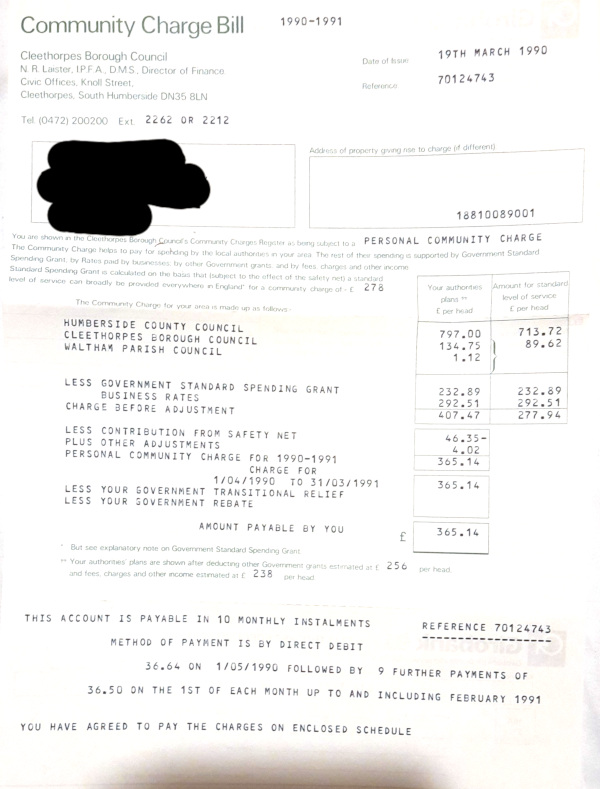
Back before Christmas I mentioned that I had finally persuaded The Mother to let me start clearing out some of her accumulated junk. Well, there’s a long way to go yet on that of course, but I’m slowly making progress. Slowly working through piles of things that really should never have been kept, sifting through them just in case there is anything important in there, like family photos in the middle of a stack of 40-year-old bank statements to give one real example. And then, there was one thing I came across, that potentially does have genuine historical interest. Well, there were two (one for each of my parents), but this is one.

A poll tax bill

It’s a poll tax bill! Even though I was only small, I remember these arriving in the post and being a little excited that something controversial and newsworthy was now in our house.

A historical note for anyone reading: the poll tax was a controversial flat tax pushed by the right wing of the Tory Party as a way to fund local government. It replaced “the rates”, a system whose origins dated back to the final years of the Tudor period* based on nominal property values, with an almost-flat system. One single amount for every adult in the same town, unless you were seeking work, in which case there was a discount. Introduced in 1989 in Scotland, 1990 in England and Wales, it was seen as extremely unfair. In early 1990 poltiical demonstrations against in turned into fierce riots; by mid 1990 it was clear there were massive problems with collection and non-payment, and by the end of the year the Prime Minister had resigned over the issue.

This—as you can see from the date—is from the first year the poll tax was introduced in England. It ran for four years altogether, from 1989 to 1993, whilst the Major government hastily thought up a replacement for it. And I am definitely tempted to keep it, as a historical artefact. I’ve destroyed all the ancient bank statements, thrown away the gas bills, but I might keep this as a tiny little artefact of the history of the 1990s. Of course, the most quaint thing now about that period in history is that we had a Prime Minister resign honourably over a disasterous policy, rather than cling on to office with every muscle of their fingers.

There will be a few more things to come from the archives, in future weeks, once most of it has been consigned to the shredder. I do feel like I’ve turned a point, though, where some of the rooms of junk no longer look quite so overwhelmed with junk as they once were. I’m not entirely sure The Mother will appreciate it, though.

The next post in this series is here

* Specifically, the 1601 Poor Law introduced the Poor Rate to pay for social security at the parish level.