+++*

Symbolic Forest

A homage to loading screens.

Blog : Page 56

Things I Have Been Meaning To Blog About

In which we list things that I am too sleepy to write a proper post on

There are a lot, but after a long and stressful day at work, I don’t really want to sit down and write any of them up.

For example: Dimitra‘s carrot cake recipe.* Photos. Photos of everything. Photographs of trains. Sitting on stiles. The Leeds Film Festival. Shopping. My really annoying pair of trousers. Other banal aspects of life. Facebook. Trees. Friendly horses. Flooding. Some books I have actually read. The ridiculous idea I heard on the radio, that all computers should by law be sold with “child protection” software on them. Cooking. They’re all in my head, in a blur together, and I can’t tease them apart far enough to build anything legible.

* I believe it’s actually her mothers, if you want to be pedantic.

Cemetery Gates

In which we find Bouch’s grave

From the recent search hits: “sir thomas bouch blog”. Somehow, I doubt Sir Thomas Bouch is likely to have a blog. For one thing, he’s dead.* Secondly, he was always more interested in building railways than writing about them, or about anything.

If you’ve never heard of him: Thomas Bouch was an English railway engineer, and some of the time he was a rather good engineer. Some of the time. He built the highest railway in England, the South Durham & Lancashire Union,** and with it the highest railway viaducts in England. He also invented the first modern train ferry, on the Edinburgh, Perth and Dundee railway, which would otherwise have been in two separate parts.*** Unfortunately, he was also rather fond of cost-cutting, building routes on the cheap, and that led to his downfall and infamy. He’s now best known for building the Tay Bridge – the one that fell down. There’s even an urban myth that the word “botch” is derived from his name. It isn’t, of course, but the rumour is hardly good for his reputation.

One day, a few years ago, I was ambling around the west end of Edinburgh. Away from all the expensive tenements,**** there’s a picturesque gorge, with a river running through the bottom, wooded sides, and grand buildings poking out from behind the trees: the back of Donaldson’s College, and the National Gallery of Modern Art. If you go up through the art gallery grounds, as I did, and through past the Dean Gallery, you can wander through the Dean Cemetery. Doing so, I randomly found: Bouch’s grave.

It’s a very bare, imposing grave. A bust of the man; the name “BOUCH”, nothing more, and the dates. It’s a very nice spot to be buried in.

* although this isn’t necessarily a bar – Sam Pepys manages it. Geoffrey Chaucer used to have one, but is now largely on Twitter.

** It closed in the early 1960s. The A66 road roughly follows its route, and runs closely parallel to it at Stainmore.

*** It was originally two separate railways, one in Edinburgh, one in Fife, which merged.

**** think Shallow Grave

Voodoo terminology

In which we speculate on understanding, and on pretending to understand

There are three types of people that I’ve always had to deal with at work. By extension, there are probably three types of people in the world, because I’m sure that none of the places I’ve worked at have been particularly unusual. There are three types of people in the world, and they can be divided like so: those who know what they are talking about; those who don’t know what they’re talking about, and admit it; and those who don’t know what they’re talking about, but are desperate to hide it.

There are two ways I could look at this. One, being uncharitable: they know they don’t know what they’re talking about, and are just trying to hide that.

The charitable view, though: I don’t think some people realise that words do have meanings, precise meanings. They’ve heard people who do know what they’re doing talking, and they want to fit in, so they string together words they’ve heard other people use, in ways that make grammatical sense, without noticing that they are making completely meaningless sentences. Maybe they think that this is the way normal humans talk. Maybe they think that if they use a word that they’re not sure of the meaning of, its meaning will change to suit them. Essentially, though, they’re behaving like small children: imitating without understanding.

These are the people who brought you the phrase “log on to our website”. They call the main case of a PC “the hard disk”. They will refer to “the system”, and expect you to know exactly what you mean. One colleague today, scrolling through her inbox looking for an email, said: “I know it’s in the system somewhere.” “That is not,” I wanted to say, “what that word means.”* These are the people who call me and say “the system isn’t working! We can’t do anything at all!” when what’s actually wrong is: they have pressed Num Lock and don’t understand why numbers are no longer appearing.** These are the people I have to work with, and the chances are, this is what the people who run the country are like too. These people, who not only don’t understand words, but don’t understand the importance of the right words, nevertheless get into important positions. And that scares me.

* She was looking for an email, because she wanted to print it out. She had called me over because her printer “was not working”. She didn’t have a printer selected in the print dialog box, and did not understand the error message she received, that said: “You have not selected a printer.” When I pointed this out, she said: “That’s never happened before. I don’t understand all these technical terms.”

** Yes, this has genuinely happened.

Aging on the balcony

In which we are the oldest people in the audience

Mike Troubled Diva recently wrote about how it feels to be middle-aged at gigs, and suchlike. I’m not middle-aged yet, but I know how he feels, because on Saturday night I went to my first gig in ages, at Leeds Met SU. It felt like: I was the only one there over 25.

We hid up on the balcony, with a small crowd of other late-20s people, and watched. Sometimes I wasn’t watching the band as much as I was watching the frenetic crowd, moshing away. They were here to see a local band, Hadouken!,* who (if you believe the NME) are part of the New Rave scene. Personally, I think the NME is only ever interested in puns on “New Wave”, but there you go.** I might not believe in the existence of New Rave as a genre myself, but the crowd definitely seemed to. The crowd of 17 year olds were wearing outfits last seen in 1989, and covered themselves in heavy trees of glowsticks. After a few minutes they started to get bored,*** and threw them all at the stage; or broke them open to drip and spray each other with luminous toxic goop.

The band themselves: well, they were energetic. Rapping with guitars, and very very loud. It definitely got me bouncing; but when my own attention span occasionally started to fade, I began to wonder: does “rapping with guitars” really deserve its own genre name? And whatever did happen to Baxendale, anyway? But then, I started bouncing again.

* the exclamation mark is part of the name, I think.

** Hands up who remembers the NWONW scene!

*** “I don’t know, kids today, no attention span at all…”

Domestic

In which I'm is baffled by foreign manuals

Well, the new kitchen is just about finished, apart from a few little bits of pelmet and so on. The only problem is: working out how to operate it all. The hob, the oven, the microwave, all have lots of buttons and switches and dials, but I’ve no idea how exactly it all fits together, what works what. The manuals aren’t much help, either, as they seem to be largely in German. I was planning lots of baking when everything got sorted out – it might have to wait until I’ve remembered where I last saw my English-German dictionary. Ah, well, I suppose that means I have time to sort out my day-by-day photos of the kitchen being rebuilt.

Interconnectedness

In which we consider the perils of an updated adaptation

When I was in my early teens, one of my favourite books – even though I didn’t really understand half of the plot at the time – was Dirk Gently’s Holistic Detective Agency, by Douglas Adams. With a plot which was cobbled together from two separate Doctor Who stories, and which relies on the works of a poet I’ve never even read, it can be a little tricky to understand.* When I heard that it was going to be on Radio 4, I had to listen, purely to see if it was adaptable at all.

They haven’t done badly so far, to be honest, although the plot has been twisted round in various ways that, with one episode to go, don’t quite make sense yet. On the other hand, they haven’t quite pulled off updating the story to the present day – some parts would have been much better as a 1980s period piece.** And they did leave in at least half of my favourite joke.***

This isn’t meant to be a critique of the series, though, especially as it still has one episode to go. This is something I’ve spotted, which Radio 4 have been quiet about so far. Radio 4 are also going to dramatise the other Dirk Gently novel.

There’s a small clue on their website: it refers to DGHDA as the “first series”. Really, it’s a standalone book – the only characters apart from Dirk who pop up in the other book, The Long Dark Teatime Of The Soul, are Miss Pearce and Sgt Gilks. What makes it so obvious, though, is that quite apart from the plot-based changes, the producers of the current radio series have made other changes to DGHDA, adding references to tLDTotS to link the two books together. I’m also pretty sure they’re going to change tLDTotS to add in characters from the first book, too, to try and present them as a cohesive pair.

Whether this will work or not is another matter. Bookwise, The Long Dark Teatime Of The Soul is rather patchier and had more plot holes than Dirk Gently; although one of the things they both have in common is that small asides, or scenes which appear to be a quick joke, can turn out to be an important plot point later on.**** I’m enjoying the radio Dirk Gently so far, but I’m not completely convinced, and I don’t know why its adapters thought they had to do more to link the books together. Maybe I should write to them and ask.

* Particularly, you have to know that Coleridge’s Kubla Khan is, as far as poems go, pretty short. Wikipedia has a very thorough and spoiler-filled plot summary, which explains most of the trickier bits.

** How many people still use tape-based answering machines, instead of voicemail? How many people still refer to “car phones”? A story with a plot revolving around people leaving messages on answering machines, and stealing answering-machine tapes, doesn’t really make sense if you move it forward twenty years

*** “There’s no such word as herring in my dictionary!” Unfortunately, unless I wasn’t listening properly, they missed out the setup line which comes many scenes earlier.

**** At the start of Long Dark Teatime Of The Soul, Dirk had recently set up work as a fortune-teller, in drag, to get some cash in – but gave it up when everything he said, however outlandish, came true. It seems like a throwaway comic scene, at first – but in actual fact it contains important hints to what is going on later in the book.

Whitby

In which we go goth-spotting

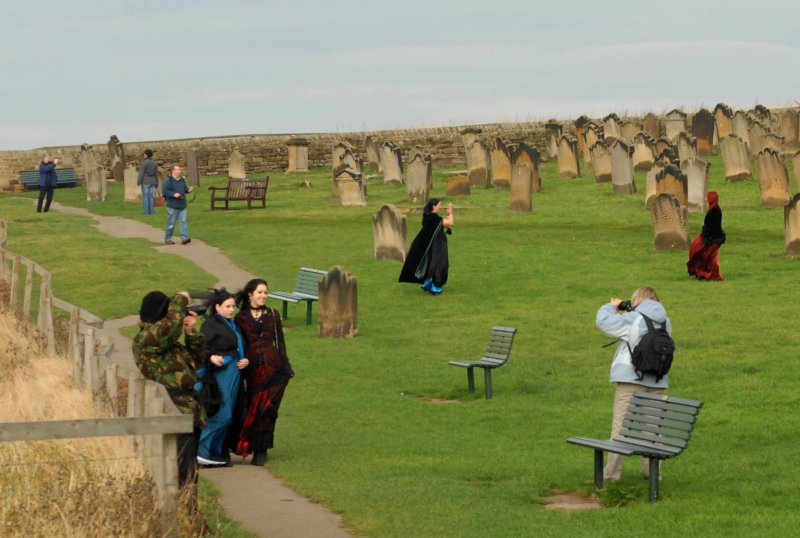
We walked up and down and around the town, admiring the scenery, admiring all the people and their outfits. I hadn’t dressed up myself. I don’t do dressing up. At the top of the steps to the abbey, we paused in the graveyard and watched people posing for photos, before turning and looking out over the sea, at the town disappearing into the mist. The weather was strange: dark, windy, but misty too. The town disappearing into winter.

Posing for photos

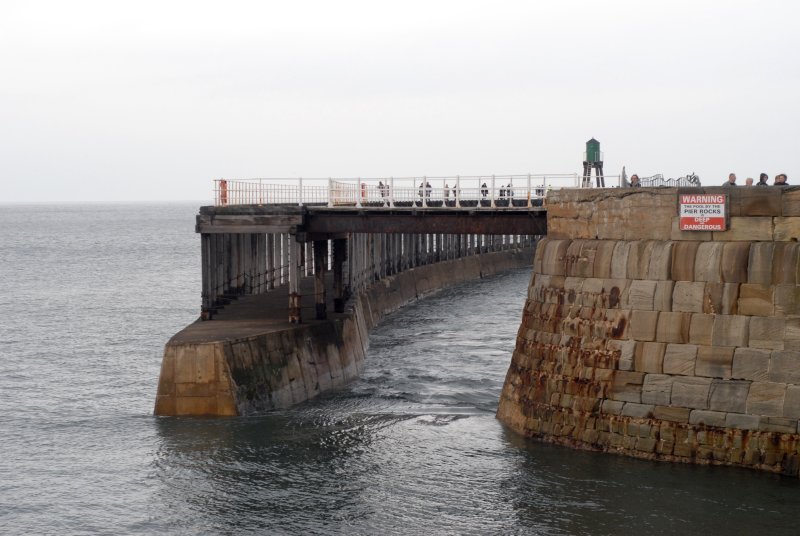
Whitby Pier

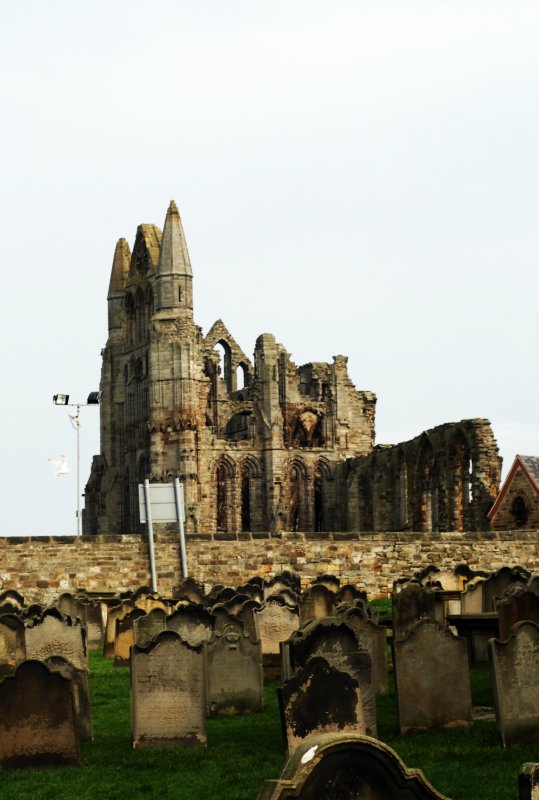
Whitby Abbey

Gravestone

Romance

In which we wonder what happened to the romance of IT

A quick news story from last week: A chap called Dr Brendan Kelly has analysed 20 random medical romance novels and spotted that they are all written to a very similar template. If you’re a romance novelist and want to bash out another, all you apparently have to do is change your characters’ names, and you’re set.

Dr Kelly noted that the heroes of these novels are generally handsome, arrogant surgeons with a traumatic past; you don’t tend to get handsome, arrogant psychiatrists popping up, for some reason. Never mind about psychiatrists, though. Where are the handsome, arrogant IT technicians? Never mind saving the lives of patients with mysterious illnesses just when you thought all was lost – where are the romance novels about data rescue and mysterious ARP caching? The world needs, clearly, an IT romance novel. I’ll let you know when I manage to get a couple of scenes down on paper.

Renovation

In which we're not looking forward to a new kitchen

Next week is going to be hell. I’m dreading it. Our kitchen – which passed its 25th birthday last winter – is being ripped out, torn up, and being replaced by something nice, new and shiny. The only problem: it’s going to take all week. The house is already in uproar, and I have no idea how we’re going to eat. Lots of dinners out next week, I think.

It’s a bit of a milestone, doing all this. I can only very faintly remember the kitchen we had before, at the old house. It had a sliding door from the dining area. Erm, that’s it. I’ve lived with the current brown cupboards, brown tiles, freezing cold green tiled floor for so long, it’s going to feel very strange living in something different. This morning, I took photos from the kitchen doorway. I’ve never taken many photos of the inside of the house, itself,* so when things do change I rarely have a proper record of them. If you want to see what our house looked like over the years, you have to look in the backgrounds and the corners. So, I took photos from the kitchen doorway, and I’m going to keep taking them next week as the old kitchen is pulled apart and the new one is built.

The mother didn’t get the point. “I don’t want you taking pictures of it and showing everybody when it’s a mess,” she said. “Wait until the new one is finished, then you can take pictures of it.” I will do. But I want pictures of it how it is now, too, because I don’t want to remember something that’s new and novel. I want to remember something that’s old, faded, and comfortable.

* except for, once, the big green Victorian mirrored ball, round, not tiled, that hangs in a corner of the dining room.

Books I definitely can't afford to read

However much I would like them

Never mind about all the books I’ve written about here, in the past, that I’ve never managed to finish reading. Now I want books I can’t even afford to read: the facsimile edition of the Knights Templar trial documents.

Going by what facsimile editions are normally like, at any rate, I’d also need new bookshelves to support the thing. As I don’t have £4000 to spare, though, it’s not a problem.* It’s slightly disappointing, too, that this would never have been headline news without Dan bloody Brown. Oh, well, maybe one day newsreaders will be interested in medieval history for its own sake. Stranger things have happened.

* although I do need new bookshelves, because I have nowhere near enough space for the books I have.