+++*

Symbolic Forest

A homage to loading screens.

Blog : Page 19

Photo post of the week

Into the woods

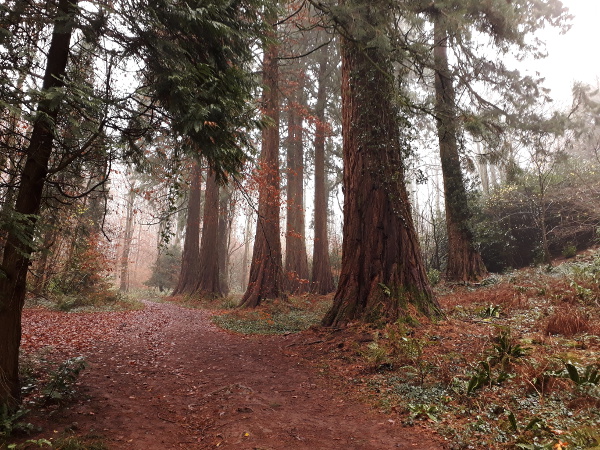
If you have a day to spare at the tail end of autumn, and the weather is all damp and misty, what better to do than go for a walk in the woods? In this case, a Forestry England wood just outside Failand, Ashton Hill Plantation. At its centre is a stand of sequoias, looking suitably mysterious in the mist. For a moment you can start to imagine you’re in some sort of supernatural horror-mystery filmed in Washington State.

Grove of sequoias

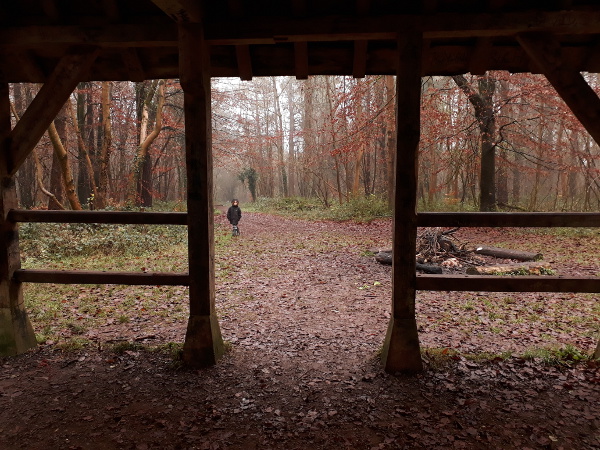
In the shelter

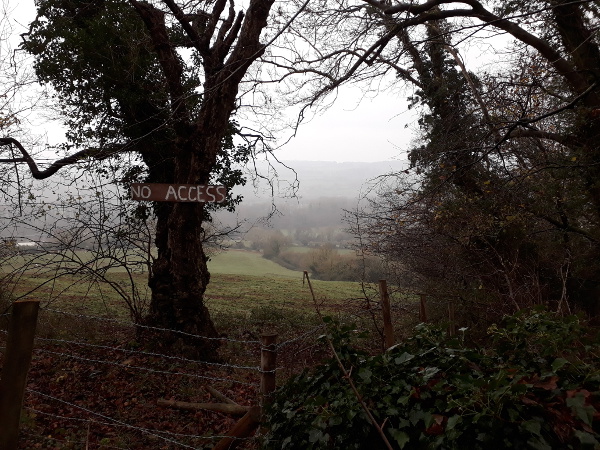
However, brief glimpses of the rolling landscape outside the woods, showing off the traditional English fear of outsiders, soon remind you where you are.

Keep out

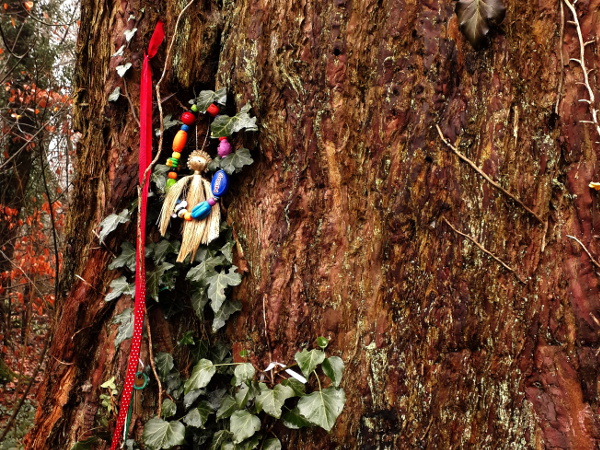
Near the edge of the wood is a fairy tree, naturally beloved by The Child Who Likes Fairies, decorated with several tiny doors and various garlands and trimmings round its base. Further up, I noticed at adult head height, something that seemed much deeper, speaking directly to the fairies themselves, not there to entertain children.

Corn dolly

A corn dolly pinned to the tree with a baby’s teething toy. Some sort of offering; some sort of old ritual; maybe some sort of prayer.

Books I Haven't Read (part eleven)

On myth, poetry, and all that

When I first moved down to South-West England, I was intrigued to note that one of the major local commercial property firms, their boards decorating every half-empty high street, was called Alder King. No doubt this is because at some point in the distant past Mr Alder and Mr King got together to form a business (their website is sadly unhelpful on the subject), but in my own private imagination I liked to think that their founder was deliberately trying to invoke a mythical archetype, implying that the cycle of closure, vacancy and opening on the High Street echoed the ancient cycle of death, sacrifice and rebirth, the brief but spiritually charged reign of the sacred king destroyed by the Great Goddess as described by James Frazer and popularised by one of the twentieth century’s best-known English-language poets. No doubt that poet, if he had lived to the 2010s and had seen Alder King’s advertising boards himself, would have thought the same. Rather, he would not just have thought “that’s an amusing coincidence of naming,” as I did: he would have thought it yet more evidence that all of his theories about mythology and prehistory were incontrovertibly, emotionally and poetically true, and that anyone who disagreed with him was probably a contemptible writer-of-prose or Apollonian poetaster with a degree from Cambridge. At least, I assume that’s what he would have thought. I’ve never managed to finish reading his book on the subject, and I’ve threatened to write a blog post about it more than once in the distant past. Today’s Book I Haven’t Read is, as you potentially have already guessed from this introduction, The White Goddess by Robert Graves.

I have a strange relationship with Graves. I’ve been intrigued with him, puzzled by him, almost obsessed with him, since I was a teenager and my English teacher loaned me his own copy of Goodbye To All That, Graves’s infamous autobiography. He wrote it in a great rush to raise cash in the late 1920s after abandoning his final full-time salaried job, and it’s a fascinating mixture of anecdote and recollection dominated heavily by the one great horror at the heart of his life. He had the bad luck to be born into the English upper-middle-class in the mid-1890s: he left public school, and was about to join Oxford University, in the summer of 1914. He became an army officer without even having to try; whilst still a teenager he was a lieutenant, and by the time he would theoretically have been graduating, he had almost been declared dead and was no longer fit for front-line service. Writing your autobiography at the age of 32 might seem somewhat precocious, but the greatest part of Graves’s is purely about his life between the ages of 19 and 23. I hadn’t even realised, when reading the book, that I was reading the now-standard second edition. It was revised by Graves when some thirty years older to take out the more controversial parts: some passages that hugely upset his close friend Siegfried Sasson, and any references to his 1920s attempt at “feminist” polyamory. The original text is a lot harder to find these days, which is no doubt what Graves would have wanted.

I have a strange relationship with Graves, but I don’t think I could ever like him, and certainly I don’t think we would ever have got on if I should happen to somehow go back in time and meet him. He was a mass of contradictions and swirling neuroses. He always insisted he was a poet, but the majority of his income was from novels and biography, books that he himself always derided as “potboilers”. He had a great skill for making stories make narrative sense, though. His retelling of mythology in the Greek Myths has almost become a standard from a literary standpoint, but he picks and chooses sources and details indiscriminately according to his own subjective view of what feels “more mythological”, or in other words, what he feels best fits the story he wanted to tell. Similarly his best-known novel, I, Claudius, is no use at all as history precisely because its point is to fit a narratively-satisfying story on top of a patch of history which Graves felt needed a better explanation than evidence alone could provide. Above all that, he seems to have been a fairly horrible person: misanthropic, homophobic, racist, and with an irrational hatred of anyone with a degree from Cambridge.*

This post, though, is supposed to be a review of The White Goddess and why I’ve never read it all the way through, or, indeed, got more than a few chapters in. Its subtitle is A Historical Grammar Of Poetic Myth, and in it, Graves first gives a very narrow definition of poetry, before explaining why his interpretation of ancient Celtic sources proves that his definition of poetry is correct in an almost geometrically-perfect circular argument. In short: poetry is verse which inspires subconscious terror, fear, and makes your hair stand on end,** because its subject is always male devotion to the all-commanding White Goddess, the triple-goddess of birth, fecundity and death, the goddess who marries her suitor the Alder King for one glorious day before he is destroyed as a sacrifice to her.

All true poetry—true by Housman’s practical test—celebrates some incident or scene in this very ancient story (p20 of the fourth edition)

“Hang on a minute, Captain Graves,” I can almost hear you saying. “I mean that’s fine for you to say, but I’ve written some poetry and it wasn’t about that!”

In that case, according to Graves’ rules, you’re not a poet and you weren’t writing Poetry. To you and me this might indeed sound like nothing more than highest-order gatekeeping, but Graves goes into great effort to explain that it’s true, much of what you might think is poetry just isn’t Poetry by the standards of Graves The Dedicated Poet. Indeed, according to his standards, the English have barely understand poetry at all.

The Anglo-Saxons had no sacrosanct master-poets, but only gleemen; and English poetic lore is borrowed at third hand… This explains why there is not the same instinctive reverence for the name of poet in the English countryside as there is in the remotest parts of Wales, Ireland and the Highlands. (p19)

So, Robert, you’re saying that the True Poets are those dashing chaps in flappy shirts like Byron and Shelley and so on, who were always saying they wanted to dedicate themselves to their muses?

This is not to identify the true poet with the Romantic poet. … The typical Romantic poet of the nineteenth century was physically degenerate, or ailing, addicted to drugs and melancholia, critically unbalanced and a true poet only in his fatalistic regard for the Goddess as the mistress who commanded his destiny. (p21)

In other words, the only true poets in the world are, really, Robert Graves and a handful of contemporaries he respected (Alun Lewis being one example he quotes approvingly). Others? Sorry, no, whatever you thought you were doing, you’re just not writing poetry by Graves’ standards. The problem I have with this is not just the way it immediately writes off huge swathes of literature, but that this is apparently done so in order to centre Graves, his neuroses and his relationships as the epitome of Poetry, the pinnacle of literature. Graves described himself as a feminist as far back as the 1920s, but his feminism was one in which in reality he was at the centre of things: in which he chose a woman, elevated her onto a holy pedestal, and jealously ensured she stayed there. An emotional masochist, he poured his creative energy into worshipping his chosen muse almost in the hope that she would make him suffer for it. In this sense, his explanation of what makes True Poetry is nothing more than a recapitualation of his personal relationships of the 1920s and 1930s, which he claims to be some sort of universal religious truth. Jealousy itself is elevated to being a vital emotion for the True Poet to have.

What evidence is there, in The White Goddess, that Graves’ inner demons really are the key to both True Poetry and to the ancient mystery religion he claims to be decoding? A dense and cryptic analysis of medieval Welsh poetry, specifically the poem Cad Goddeu, taking it like a set of crossword clues and reordering lines and stanzas in order to produce something that Graves thought made more sense than the original poem. Graves’s “poetic logic” here is much like his logic in writing I, Claudius, or his Greek Myths, or his novel about the life of Jesus: his rewrite of the poem makes a better story, because rewritten it supports his argument, and therefore his argument must be true, because the poem supports it. As a key to understanding Cad Goddeu it is not really anything other than speculation, and certainly not the self-evidently true reconstruction that Graves insists he has produced. To be fair, Cad Goddeu is a famously impenetrable poem and most interpretations of it are little more than speculation, but at least most of the people who attempt to understand it admit that they have no clue what it really consists of.

I said earlier that Graves’ life was governed and steered by the pure luck of being born where and when he was. Similarly, he wrote The White Goddess at just the right time for it to become highly influential: at precisely the time that a new religion was being created in Dorset. As Ronald Hutton has documented in The Triumph Of The Moon, Wicca arose from a seething mixture of British and Irish cultural influences from the late 19th to mid 20th centuries, and The White Goddess, coming at the very end of that period, was one of the most influential on later Wiccan development. Its goddess and its underlying Frazerian story are now widely adopted in modern Paganism, and I’m sure you can find pagans who not only worship Graves’ goddess themselves but believe the ancient Welsh did too. The book has stayed in print for many years, although I do wonder how many of the sold copies have been read all the way through.

So why haven’t I—as of the time of writing—been unable to complete it, despite several attempts? I suspect I’m just too well aware that its basic premise is wrong, or at least, fundamentally flawed. Graves seems to always have been greatly annoyed that academics in both literature and archaeology didn’t think much of it, and that any reviews that did come from academia were generally scathing. He showed it in quite a passive-aggressive way: not only did he write long letters of reply to magazines that gave it a bad review, but some are printed as an appendix to the modern Faber edition. Sadly, they largely show nothing more than his own arrogance and lack of understanding: his insistance that his own outdated knowledge of archaeology and anthropology was far more accurate than that of the professors criticising him. Given I received an introduction to Welsh myth and archaeology at university, I am well aware firstly that much of Graves’ understanding was wrong (even at the time it was written, and it has only grown more wrong since), and secondly that some of his statements make huge leaps in logic and present whole towers of assumption and supposition as if they were solid fact. The entirety of the text rests on sweeping syncretism, with claims such as that the Welsh mythological magician Gwydion is the same character as the Norse god Odin, or that Gwydion’s nephew Lleu Llaw Gyffes is the same character as Hercules and the Mesopotamian god Tammuz. The text resembles a grand conspiracy theory as any similarity between stories and people, however weak, is jumped upon as meaning an equivalence. I opened the book at random to find an example and found this passage, on the ancient Irish poem Song of Amergin:

Tethra [a name mentioned in the poem] was the king of the Undersea-land from which the People of the Sea were later supposed to have originated. He is perhaps a masculinisation of Tethys, the Pelasgian Sea-goddess, also known as Thetis […]. The Sidhe are now popularly regarded as fairies: but in early Irish poetry they appear as a real people. […] All had blue eyes, pales faces, and long curly yellow hair. […] They were, in fact, Picts (tattooed men), and all that can be learned about them corresponds with Xenophon’s observations […] on the primitive Mosynoechians of the Black Sea coast. […] They occupied the territory assigned in early Greek legend to the matriarchal Amazons. The ‘blue eyes’ of the Sidhe I take to be blue interlocking rings tattooed around the eyes, for which the Thracians were known in Classical times. Their pallor was perhaps also artificial—white ‘war-paint’ of chalk or powdered gypsum, in honour of the White Goddess, such as we know, from a scene in Aristophanes’s Clouds where Socrates whitens Strepsiades, was used in Orphic rites of initiation.

There you are: the “real identity” of the mythological Sidhe is uncovered by picking apart random coincidental parallels with things Graves had picked up in his Classical-themed public school education. It’s more like a word association game than genuine historical research. Apologies for editing out the description of the Mosynoechians; it’s impossible to tell from Graves’ account whether there genuinely were coincidental similarities between them and the mythological Sidhe, or whether Graves is being Graves and jumping to conclusions based on the flimiest of matches.

Hopefully one day I will complete reading The White Goddess. The last time I picked it up, I was tempted to live-tweet every time I came to a passage that infuriated me, but soon realised what a thankless and hopeless task this would be after just the second page of the introduction contained the line that Judaism is “a Semitic [religion] grafted onto a Celtic stock”, which is closer to conspiracy-history than anything grounded in fact. I’m certainly not ready to read it just yet. Maybe, instead, I should write something better. Something that is full of open inspirational ideas, not closed and self-justifying ones.

* As someone whose degree is from one of the Ancient Scots Universities, I don’t really have a horse in this race; but I do wonder if he generally thought that any universities other than Oxford were beyond contempt, or if it was just Cambridge specifically.

** This isn’t me colloquialising. He specifically says: a verse is a poem if it makes your hair stand on end if you recite it silently whilst shaving. I can imagine that’s quite handy if you have a dimple or tricky bits around your chin; as a test, it’s attributed to A E Housman. I can’t really imagine Housman agreeing with the rest of Graves’ thesis, and how either of them thought people who don’t shave were meant to separate out poetry and verse is, naturally, not recorded.

And another cemetery note

Or, something to read elsewhere

Coincidentally, following on from yesterday’s local cemetery post, I came across an interesting article elsewhere: a piece by author David Castleton on the 1970s Highgate vampire panic. I was vaguely aware that this story involved a classic supernatural panic of the Spring-Heel Jack variety combined with feuding paranormal investigators and self-styled vampire hunters; the article tells the full story in intriguing detail. Whether there really was a vampire striking terror into 1970s Hampstead, you’ll have to judge for yourself.

For a long time I’ve had an idea in the back of my mind, the character of a paranormal investigator who tries to stay rational even as everything around him isn’t. I haven’t actively written anything down for a long time, but every so often I come across a little bit of information about the Highgate vampire or something similar and a few more lines of notes go in the appropriate place. Maybe it will come to something one day.

As far as I’m aware, at least, there aren’t any vampires active in the Greenbank area; as a sensible rational person who has seen a dead body and has handled human bones, I tend to treat cemeteries as interesting cultural and archaeological spaces rather than as haunted nexuses of mystical power. Still, it makes me wonder slightly when I take The Children to wander round the cemetery, and when we leave they start waving goodbye to people “we’ve been playing with” who aren’t actually there.

That local cemetery again

A bit more local history

A damp, misty, gloomy November weekend: so obviously, we livened it up by taking another walk around Greenbank Cemetery!

Regular readers might recall the post a while back tracking the evolution of the cemetery through maps. When it first opened, an open stream ran to the north of it; over time, this small beck was culverted as the land either side became first allotments then cemetery. This stream is the Coombe Brook; on the 1880s map, it seems to have risen in Speedwell near the Belgium Pit colliery and ran westwards, joining the River Frome just behind the Black Swan, the infamous Easton pub/club originally built in the 17th century. The modern confluence is, presumably, somewhere in a tunnel system deep under the M32 motorway.

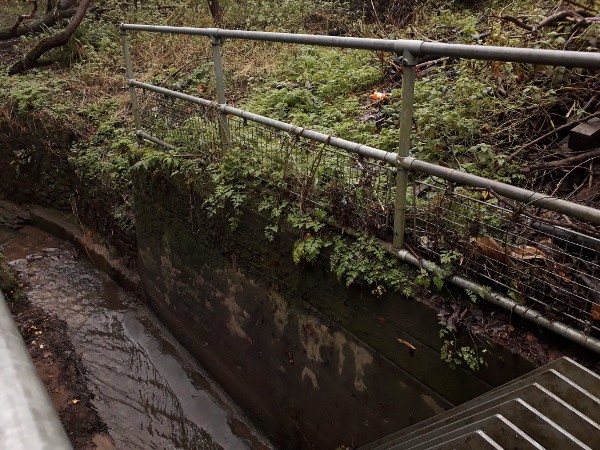
Not much of the Coombe Brook is still above-ground at all nowadays. However, if you explore Royate Hill nature reserve, just alongside the cemetery, you can find the point at which it disappears underground.

Coombe Brook

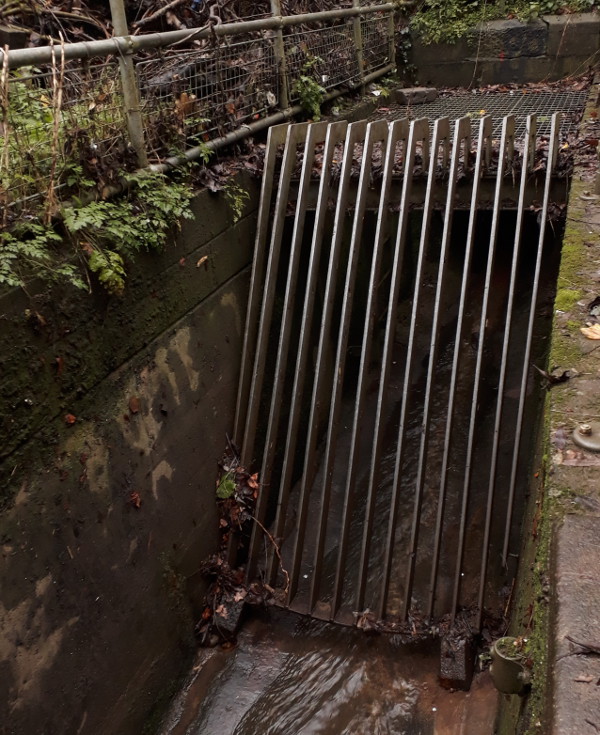
Water disappearing into this tunnel, assuming it doesn’t get syphoned off into a storm sewer, will come out into daylight again in the River Frome alongside Riverside Park. Unfortunately you can’t see the mouth of the 19th century culvert under the cemetery because it is protected behind the romantically-named Royate Hill Trash Screen.

Royate Hill Trash Screen

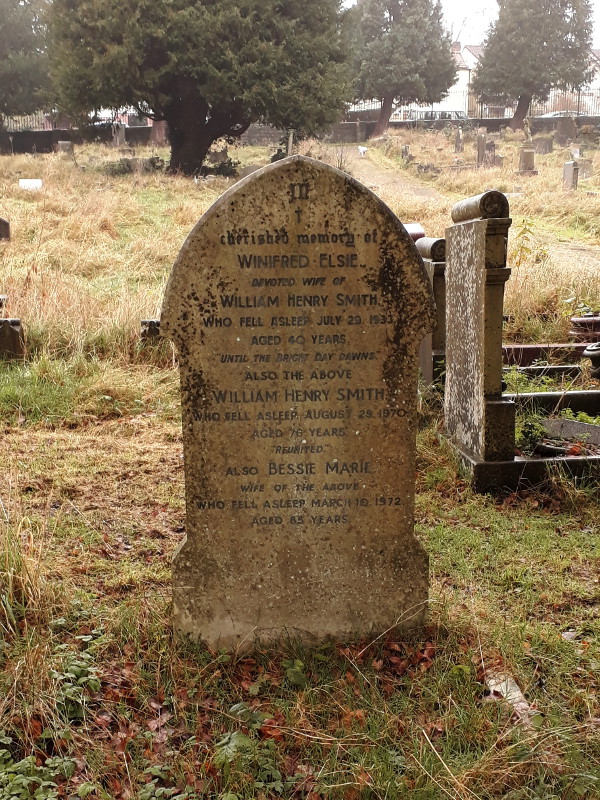
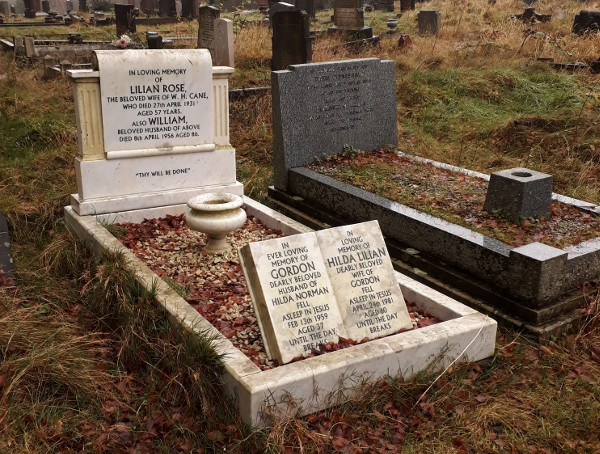
As it was a bit muddy down here today, we headed back into the cemetery. I took a few more photos of 1930s graves in the part of the cemetery that was formerly allotments: more evidence for my previous post about the cemetery being expanded a few years before the maps says. Moreover, they’re fairly interesting gravestones too.

1930s grave

1930s grave

More astronomy news

A significant event is coming up

One last astronomy post for a while, and then I’ll talk about something different, I promise: in a few weeks time, on December 21st Saturn and Jupiter will be at their closest conjunction for several hundred years.

The Plain People Of The Internet: Conwhatnow?

They’ll come close together in the sky. The closest they’ll be for a few hundred years, in fact. They’re already fairly close in the sky right now, but on December 21st they’ll be so close that to some people they’ll look like a single spot of light, although people with 20/20 vision should still be able to see they are two separate dots.

Unfortunately … I’m not sure I’ll be able to see it. They’re both on the far side of the sun from us right now, and we’re basically watching Jupiter passing in front of Saturn from our perspective on the other side of the solar system. Because of this, they’re also fairly close to the sun in the sky, which means you don’t get a very long window of opportunity to see them. They will set together in the south-west sky only about 90 minutes after the sun does, so you have a brief window of time to see them together at dusk. If you’re on a south coast then things are grand; if you’re in a town, they may well be already below your neighbour’s roofline before the sky gets dark enough to see them. Personally, our only chance will be from an upstairs window. Fingers crossed, though, the sky will be clear enough to see something of them both together.

One of our galaxies is missing!

Or, more astronomy for beginners

Yesterday afternoon, sitting at my desk as dusk was falling, the skies were clear and I could clearly see the moon and Mars rising in the sky. As soon as I logged off from work, I scampered downstairs and went outside, and saw Jupiter and Saturn just visible above the rooftops at the back of the house. “Let’s get the telescope!” I said to The Child Who Likes Animals Space. “Before they set!”

“Before what set?” said The Child, but I was already rushing off to get his telescope and set it up in the back garden.

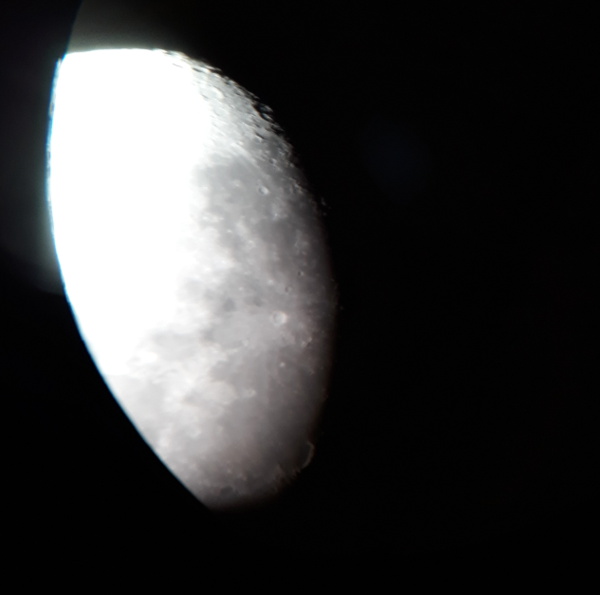
By the time I’d hoicked it out of its box, Jupiter had already gone down below the roofline, but Saturn was still there. Sadly, I could only see it when I was stood up. The telescope, sitting on a camping table, was too low down to spot it. I briefly considered setting the smaller camping table on top of the larger camping table and making some sort of rickety makeshift telescope-tower, but it would probably have ended in some sort of injury to one or both of us. So, like we’d done before, we looked at the moon, we looked at Mars, and we looked at random bright stars. “Point it at that blue thing!” he shouted. “That’s a very hot star!” This time, at least, he was a lot calmer and could stand still looking through the eyepiece without having to break off every couple of seconds to run back and forth with excitement. I experimented with holding my phone camera in front of the eyepiece. Worst. Astrophotography. Ever.

Worst. Astrophotography. Ever.

After The Children decided they’d rather go inside and watch TV I left the telescope set up; and after they’d gone to bed, the skies were still clear. Time for some telescope practice for me, I decided. Using an app on my phone to show me roughly where things were, I tried focusing on key visible stars then swinging the telescope sideways to find a nearby Messier object. The results? Not very successful, other than a possible sighting of M29, the Cooling Tower Cluster.

Getting a rough fix and vaguely hoping to spot the thing clearly wasn’t working. So, I fetched my laptop, and fired up Stellarium in Night Mode. I picked a target—the Triangulum Galaxy—and went looking for it.

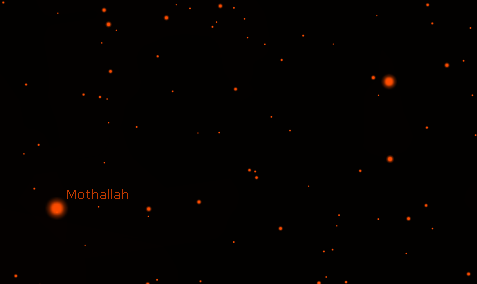
Although the skies were clear, the seeing wasn’t great. Even a newbie like me could tell that the seeing wasn’t good. Vega normally stands out to me like a sore thumb, but last night it didn’t really appear any brighter or more significant than the stars of the Northern Cross to its south, which normally are noticably fainter. Nevertheless, I could see Hamal and Sheratan, the brightest stars in Aries, and could spot the telescope nicely onto Hamal and swing it between the two. Zooming in on Hamal in Stellarium, and flicking my head back and forth from the telescope eyepiece to the dim red screen of the computer, I could slowly navigate my way upwards from star to star until I reached Mothallah, which I hadn’t managed to see with the naked eye.

Road map of the stars

From there, I could similarly hop south towards the spot where the Triangulum Galaxy should be, navigating from star to star and matching the scene in the sky to the screen of the computer. But when I reached it: nothing. Just a blank patch of sky. I found Mothallah again, then worked my way across by a different route. Still nothing. The Triangulum Galaxy has been stolen!

Let’s try the Andromeda Galaxy instead, I thought, given that it’s one of the brightest galaxies in the sky. I found Mirach by eye, spotted the telescope on to it, and walked over to where the galaxy should be. Another blank patch of sky, with a faint hazy blob in the middle of it. Hurrah! A faint hazy blob!

I’m almost glad I hadn’t found it the other day when The Child Who Likes Animals had asked me to find it, because I suspect if I had he’d have been awfully disappointed. I was a bit puzzled, though, because in theory the Andromeda Galaxy is of naked-eye magnitude. I should have seen much more than a fuzzy blob, surely?

A quick note about how astronomical “apparent magnitude”, or brightness to you and me, works. It’s a relative scale based loosely on the subjective scales used by ancient astronomers, and as it’s relative it’s written down as a number without units. The higher the number, the fainter the thing is; and a difference of five in the apparent magnitude number means “a hundred times brighter”. If you have a calculator to hand you can work out that a drop in magnitude of 1 therefore means “2.5119 times brighter”.* The star Vega, mentioned earlier, has magnitude 0, so a few things in the sky have negative magnitudes: Sirius is -1.47, Jupiter varies from -1.66 to -2.94, and Venus from -2.98 to -4.92, almost 100 times as bright as Vega.

On a good night, with a clear dark sky, the human eye should in theory be able to see things as faint as magnitude 6 or so. Last night was clearly nowhere near that: I could see Sheratan at 2.655 and Albeiro (in the Northern Cross of Cygnus) at 3, but couldn’t see Mothallah at 3.42. Through the telescope, though, I was happily stepping my way across the sky using stars of 8 to 8.4, roughly speaking, stars around 140 times less bright than the faintest I could see without it.

The Triangulum galaxy, though, is officially** of magnitude 5.72. Andromeda is considerably brighter still, around the same magnitude as Mothallah. So what was going on?

A galaxy isn’t a point of light, like nearly all stars are. Nearly every star in the sky, other than a handful of stars like Betelgeuse when seen through very high magnifications, appears to be just a single point of light to the viewer here on Earth. A galaxy, by comparison, covers a broad chunk of the sky. That small fuzzy blob I could make out in Andromeda was really just the very brightest core of the galaxy; and the rest of that 3.4 magnitude of light is spread out over an area wide enough to fill my entire eyepiece. Through the telescope, it just becomes a vaguely paler area of sky.

Hopefully at some point we will get the telescope out on a night with rather better viewing conditions, and be able to see all of these things properly. Until then, it seems strangely unintuitive to be able to see hundreds of dimmer stars but not a theoretically many-times-brighter galaxy. That, though, is just how the physics works.

* Apparently, the formal definition “five means a factor of 100” was set down by a Victorian astronomer with what I think is a great name, N R Pogson. The relationship 1:2.5119 is therefore known as Pogson’s Ratio.

** I say “officially”. I mean “according to what I’ve just read on Wikipedia”, of course.

The burial

What happens after you die

This is one of an occasional series of articles recounting the stories around my dad’s death from cancer in 2019, and what happened afterwards. More specifically, this post follows on directly from this one about his funeral service.

Personally speaking, I don’t have much experience of funeral services. At my dad’s I was steeling myself up to have to say thank you, afterwards, to all the people who had come along who I didn’t know at all. I remember as a child, being taken to church: the priest standing at the door as everyone filed out, shaking their hand and thanking them for coming. Somehow I had assumed we’d probably have to do the same thing, thank everyone for coming and for feeling suitably sad. Indeed, the undertakers asked if we wanted to stand outside the church and speak to the other mourners. The Mother, though, wasn’t ready for anything like that. She wanted us to get going as quickly as we could.

“As quickly as we could” is a bit of a misnomer for a funeral, of course. The Rector at The Mother’s church had already told us she liked to lead processions from the church to the cemetery on foot. At, it turned out, a fairly glacial pace, one step at a time. The cortege followed, and I tried to carefully drive at a matching pace without accidentally rear-ending the hearse. We crept through the village lanes linking the church and the cemetery, waiting at junctions for passing traffic, watching old men stop and remove their hats as we passed. The whole journey was well under half a mile, but it felt like an age.

Naturally, the rest of the extended family had all reached the cemetery well before us, and had all half-blocked the lane outside the cemetery with their cars to some distance either side of the cemetery gates. Not exactly knowing what to do, and with the limousine carrying my father’s frail sisters right behind us, I blindly followed the hearse through the cemetery gates and up the path. We just fitted through: but of course we did, you have to be able to get a hearse into a cemetery after all. We sailed slowly up the single path that runs up the middle of the field. The village cemetery is nearly full, with only a few spaces left available to people who lived within the bounds of the parish,* so my dad’s grave was tucked away down at one corner at the far end, a mound of wet clay marking it out. Hand-dug by a professional artisan gravedigger, because the parish council has put a ban on mini-diggers. My mind naturally wondered if this would be a selling-point in Bishopston or St Werburghs.

We gathered around the muddy hole, its edged protected with fake turf. When all of us were in place, everyone decanted from their cars, the pallbearers carefully carried the wicker coffin over and solemnly lowered it into place. The Rector said her piece, and we scattered soil; then, one by one, flowers from a bunch of white roses. The undertaker had suggested this idea, “but don’t buy them from us,” she’d said. “Go to a supermarket before the funeral and pick some up, it’ll be a third of the price we charge.” So we had dutifully stopped off at Morrisons on the way there, for a bunch of white roses to be thrown into the grave. I took them round the mourners, offering them out to my various aunts and uncles and cousins in rough order of consanguinity downwards. Behind the hedge at the edge of the cemetery, a horse started neighing. The Child Who Likes Animals was trying to get away and look for bugs and minibeasts in the undergrowth.

I took out my phone, trying to be relatively discreet, and took a photo of the coffin lying in the grave with soil and roses scattered on top. The last one. Soft rain had started, and the relatives were all heading to their cars, ready to head off to the waiting buffet over on the other side of the village. The bespoke artisan gravediggers were, I assumed, hiding somewhere round the corner ready to start their hand-shovelling as soon as was tactful, as soon as we were all out of sight. Loading the family back into the car, I gingerly reversed back down the path and out to the lane, dead slow lest there be any elderly relatives directly behind me. It wouldn’t really do to drive over somebody at a funeral.

* If you already own a plot but want to open it up to add another body, then the village council charges you about fifteen times more if the new body comes from outside the parish. Can’t be doing with outsiders moving in for eternity, I assume.

Alternate reality

When you can't use Google as a verb

Many people are concerned just how much corporate technological behemoths have embedded themselves into our lives nowadays. A few years ago now I spent a few days in meetings with some Microsoft consultants at their main British headquarters, and I entertained myself by counting the number of times I saw a pained look on the face of a Microsoft staffer having to physically stop themselves using “Google” as a verb. “We’ll just do a…” wince “…internet search for that.”*

The people I feel sorry for now, though, are the producers of TV shows. Yes, a particular website or app might be key to your plot, it might be vital to the everyday life of your characters, but you can’t use it, because no doubt its owners will be greatly upset if you do. So, for TV, thousands of working hours are spent producing mockup apps and mockup websites for the characters to use on-screen.

An award surely has to go to the producers of Australian police drama Deep Water, a rather good drama series about gay hate murders in Sydney. Their murder victim was obviously going to be using apps such as Grindr to meet guys, but they couldn’t show it on-screen: so, they invented—or, I assume they invented—an app called Thrustr for him to use instead. Now there’s a name that’s even better than the real thing.

What really made me want to write about this, though, is the Netflix series The Stranger, released earlier this year. Its not-Google-honest website is rather tasteful and well-designed, the Google screen layout but with a logo of interconnecting blue dots and lines that could, just about, plausibly be a Google Doodle that isn’t quite legible enough to make out the words of. When it comes to apps, though: they have a whole bevy of them, to fulfil whatever magical device the plot needs at the time. A phone-tracking app that uses some sort of dark-mode map layer for Extra Coolness. An app to allow the organisers of illegal raves to, well, organise illegal raves anonymously, but that also tells you where its anonymous users are. Of course, all these tracking apps always track people perfectly. They always have a mobile data signal and a good GPS fix, even in the city centre. The map view always updates exactly in real time: I hate to think how much battery power they must be using up sending out all those continual location updates.

The Stranger is set in a genericised North-West England: Cheshire and Lancashire with the place-names filed off. Because of that, it has the usual issues any sort of attempt at a “generic landscape” always has when it uses very recognisable places. The characters somehow manage to catch a through train, for example, from the very recognisable Stockport station to the equally recognisable Ramsbottom station, despite one being a busy main-line junction and the other being a silent, deserted heritage line. Talking of trains, there was also a rather fun chase sequence around Bury Bolton Street yard, although the joyless side of me has to say that you really shouldn’t crawl under stock the way they were doing. Nor can you in real life lean against the buffers of the average Mark 1 carriage and stay as clean as the characters did. Anyway. I was saying how unrealistic the GPS-tracking apps on the characters’ phones were: the one that really made me laugh out loud was when one character says that, as a given car registration is a hire car, he’ll be able to hack into the hire firm’s vehicle telemetry and get its current location in the time it takes to boil a kettle.

Admittedly, I have specialist knowledge here, because I used to be in charge of the backend tech for one particular vehicle telemetry provider’s systems. But the whole idea: assuming that they can see from the VRN which hire firm owns the car, they then have to know which telemetry firm that particular hire firm uses, and then know how to get in. Unless you do happen to have a notebook of where every car hire firm gets their telemetry services, and then have backdoors or high-level login credentials to every system, which I suppose is just about plausible for a private investigator, you’re stuffed. Getting in without that? Whilst someone makes you a cup of tea? Not feasible, at all.

Yes, maybe I’m applying unreasonable standards here for keeping my disbelief suspended. It seemed to be a particularly bad example, though, of technology either being magically accurate or terribly broken according to the requirements of the plot at any given time. Does the plot need you to know exactly where someone’s phone is? Bang, there you go. Does it need a system to be breakable on demand within seconds? All passwords to be immediately crackable as long as the right character is doing the cracking? No problem. Oh well: at least their not-Google looked relatively sensible.

* They all used Chrome rather than Edge or IE, though. Things might be different now Chromium Edge is out.

Astronomy

The art of not seeing very much (as yet)

The other day I mentioned The Children have just turned seven. As The Child Who Likes Animals has spent quite a lot of time in recent months liking space instead, watching Brian Cox’s The Planets innumerable times, memorising lists of dwarf planets, Kuiper Belt objects, centaurs and so on, and learning the difference between a red dwarf, a white dwarf and a brown dwarf. We decided, therefore, that it might be a nice idea for The Mother to get him a telescope, as a suitably grandmothery sort of present. Not trusting The Mother to judge what might be suitable, I reached out to a few astronomers I know for recommendations, and found something that both fell into The Mother’s budget and had a reasonable chance of imaging the rings of Saturn. The number of times I’ve looked down a telescope myself before can be counted on the fingers of one hand; but if I was age seven, was given a telescope, and found that it couldn’t show the rings of Saturn I’d be terribly disappointed.

Of course, I messed up to a certain extent. I’m sure I achieved my objectives, but there’s no way really that The Child Who Likes Animals would be able to actually point the telescope at something himself. So, this is going to be the sort of present that one of his mums sets up in the garden on dark nights; find out what he wants to point it at; try to point it; and then he looks down the eyepiece. Naturally, it becomes a family event, with The Child Who Likes Fairies also wanting to get involved.

As I said, I’ve hardly ever been near a telescope before, despite having books and books on astronomy when I was that age myself. So, on the few nights we’ve had so far when the cloud has at least been broken rather than blanketing, it has gone something like this: I set up the telescope outside. A child asks to point it at something, in a brief pause for breath whilst running around with crazed excitement. If it is an easy thing—the moon, say—I contort myself to the right angle to try to see through the finder, point the telescope and roughly nudge it about until we can see what we’re looking for, all the time with said thing bouncing up and down in the eyepiece as children bounce up and down on the decking. A child then steps up, instinctively grabs the telescope and knocks it out of alignment, and we go back to square one.

Eventually everyone has seen what we’re looking at, and one of them will name something else. I try to work out how to find it, with my laptop and a copy of Stellarium. I fail to find it, and end up sawing the telescope back and forth across the sky desperately trying to find the thing they have asked for. I try again with the finder, drape myself over the telescope and twist it around until the red finder dot is in just the right place; then look through the eyepiece and see nothing but haze. I look up at the sky again, and my target patch of sky, clear a few moments before, is suddenly covered in thick cloud. This cycle repeats a few times, until we either look at the moon again instead, or The Children get bored and go back into the house.

So far, we’ve successfully looked at the moon, Mars, and some random patches of sky that have lots of stars in but nothing I can actually put a name to. Oh well. I’m sure at some point we will get the hang of it, even if I end up becoming the main telescope user myself. It certainly has shown me just how non-empty an empty-looking patch of sky actually is, even living in a hazy, foggy, light-polluted city like this one. I’ll let you know if I manage to find anything less easy to spot. Or, indeed, if we do ever see the rings of Saturn.

The changing mood and the changing season

Or, something of a lull, and the strange ways in which memory works

This blog has been relatively quiet this week. Clearly, finally completing that in-depth work-related post about inclusion and diversity on Monday must have taken it out of me. There are a number of things waiting in the to-be-written queue, but all of them are the sort of posts that deserve effort and energy and research putting into them, and this week has been too tiring a week for that sort of thing.

I like to think of myself as not a superstitious person, but the truth is that there are an awful lot of Dear Diary things I could have posted but didn’t because, frankly, if I do then it might jinx them and it might not happen. There are some things that have been lurking on my horizon for a few months now, but I don’t want to think about them too much in case one thing goes wrong and everything collapses. A couple of weeks ago it all looked to be going badly; this week it’s been going better, but I still don’t want to put too much effort into hoping everything will work out in the end in case that is all effort wasted.

The Children turned seven recently, which inevitably leads into thoughts of “this time seven years ago I was doing X” variety. At least, it does if you’re me: I think I picked the tendency up from my father, who would do it at the slightest potential reason. It’s strange to think that The Children were not always exactly as they are now. I don’t know how your memory works, but when I think back to my memories of people I knew long ago my brain tends to fill the image with them as they are now, not as they actually were then, which is very confusing when I think about things that happened, say, at school. It’s almost disconcerting to see things like school group photos and think “we all looked like children!” and similarly it’s strange to look at photos of The Children as babies and see that, yes, they actually looked like babies and not the children they are now. No doubt when they’re adults I will look back on how they were now and be surprised they looked like children.

A couple of weeks ago I posted about the season changing. Enough leaves have dropped from the trees now that if I look carefully I can see trains passing the end of the street again, rather than just foliage. The skies are dark at night, and on clear nights filled and sparkling with autumn constellations. I go outside, look up at Vega, at Mars, at the cross of Cygnus, and wonder what will happen when we have turned around some more.