+++*

Symbolic Forest

A homage to loading screens.

Blog : Post Category : Being Crafty : Page 1

The impermanent way

In which we build a train set on the dining table

A few weeks ago, I posted about how I’d finally made the decision to start building a model railway, because perfection is the enemy of the possible or something along those lines.

A few days later, a box arrived.

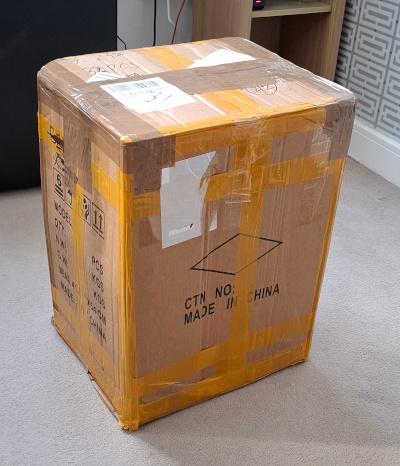
A big cardboard box, sitting on the carpet

No, I don’t know why they sent such a big box, because the contents were much, much smaller.

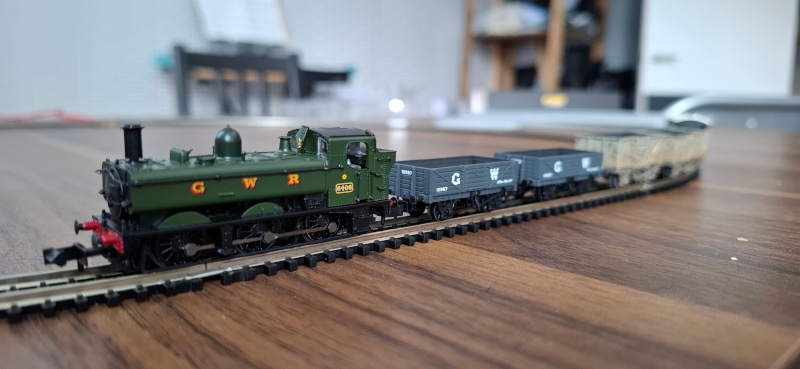
If you want to model the Brecon & Merthyr Railway in the 1950s, Great Western pannier tank locos were extremely common. Conveniently, at the moment, you can easily buy an N Gauge train set containing a Great Western pannier tank, a couple of wagons, and a brake van to go on the back. Buying a set, with an oval of track and a power unit, means you bootstrap yourself: you can get everything you need to run one train in one box, even if all you can do is send one single train round and round in a circle. I’ll do a post explaining what “N Gauge” means at some point.

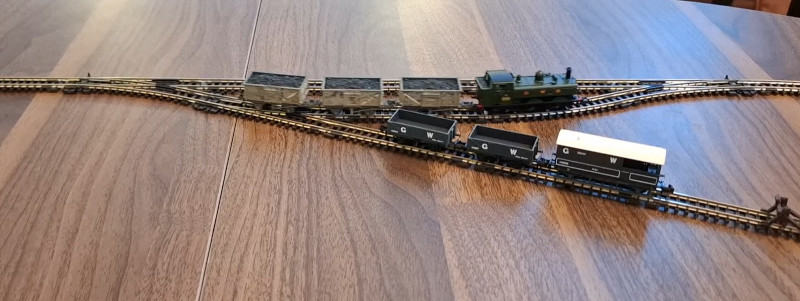
A tiny model of a Great Western Railway steam engine, pulling some wagons, on top of a dining table

Some people might point out that the loco is in 1945-47 condition, but the wagons are in pre-1937 condition; lots of wagons never got repainted though, so really they just need to look a bit dirtier and worn-looking than they are. You might notice I’ve also bought myself a few more wagons, the well known “BR 16 ton” type. Over 200,000 of them were built in the 1950s, and they were ubiquitous on the railways from the mid-50s through to the early 1980s. The ones I bought come in pre-rusted condition from the factory, so they’re really more like a wagon of the 1970s, after the B&M had closed; but, regardless, they’re still appropriate for the train.

Ever since I was small, also, I’ve read model railway advice that says “never run your train set on the carpet! There’s too much fluff!” So, this is on our dining table, which is also nice and friendly on my knees. I deserve comfort, you know.

Naturally, I wasn’t satisfied with just a single circle of track. It wasn’t long before another box arrived.

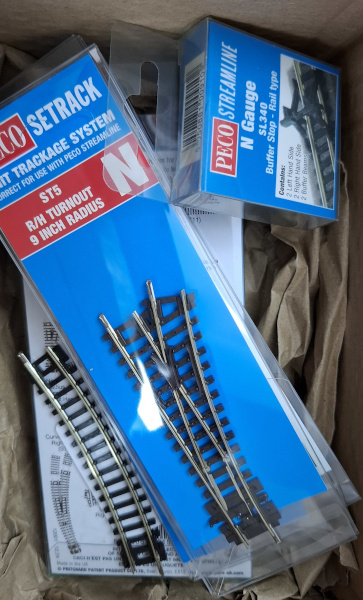
Pieces of model train track, in packaging, inside a freshly-opened cardboard box with brown paper padding

The track is a different brand to the train set, but it’s all the same track gauge, and also, all the track is the same shape: the curves are the same radius, the straight bits are all the same length. You’d think it would all just slot together, wouldn’t you?

Well, it didn’t.

Although the track was all compatible on paper, the “rail joiners” on the train set track were bigger and chunkier than the ones on the extra track. The extra track didn’t have enough clearance, between the rails and the plastic base, for the joiner on the train set track to slide on.

If this was a proper model railway and all of the track was fastened down, I wouldn’t care about this. I’d just pull all the joiners off and replace them with thinner ones. Because this is still just a train set, which has to be taken apart again whenever we want to stop playing trains and play a board game instead, that wasn’t really an option. Option two was to replace all the joiners anyway, and just hope that the new joiners stay in place. It would have done the job, but it also sounded like a lot of effort. Option three: buy more track. The original oval of train set track went in the spares box, and I just bought myself an oval from the other brand instead.

With that done, though, we had something you could imagine was a little station. It’s not much station and you need a lot of imagination, but nonetheless, you can shunt your train about!

A model railway on a table, with a loop and a siding.  The train is passing through the loop, and there are a few wagons in the siding

(This is a still from a video, so it’s a slightly blurry photo. Never mind that)

Where do we go from here? Well, there’s a few more things a full railway will need. More than one train, for one thing. I’ll post about that soon. For now though: there’s something extremely fun and simple about just being able to run your train round in a circle on the dining table, without really worrying about accuracy, authenticity, and anything else. Until we do need the dining table for something else.

Theory and practice

In which Cait once more attempts something she's always wanted

Occasionally, over the past few years, I’ve mentioned how I’d like a model railway, but there are just too many interesting railways to choose from. In fact, I’ve always wanted a model railway. My father also always wanted a model railway, but never quite managed to do anything about it either.

This has led me to an interesting place in life. I’ve always had many, many plans for different model railways. I’ve tried to start building them, and I’ve never got very far, but the research I’ve done has been immense. On the actual railway history side, I know my stuff. I know my Bristol & Exeter from my Bristol & Gloucester. I know my Midland from my Great Northern from my Midland & Great Northern. I know why the Great Western Railway had LNER-style signals, and I know where the LNER ran in North Wales and why. On the modelling side, I know my theory too. I know why cassettes are better than traversers, and the difference between EM and P4. I know who Edward Beal was, and how his West Midland Railway wasn’t the real one. I know John Ahern created the Madder Valley, that Barry Norman doesn’t mean the film critic, and that Cyril Freezer has had his day. I know that dyed sawdust is a thing of a past, and I’ve admired Copenhagen Fields. I know the theory. I’m just no good at putting it into practice.

Like any skill, though, this is a classic chicken and egg situation. I’m just no good at putting it into practice, because I don’t try.

The answer to that, of course, is to just pick something and start. And nowadays, model railways have come on a long way from where they were when I was a small girl. There’s so much more that is either available to buy off the shelf, or has been at some point and can be found on the second-hand market. You just have to be judicious what you choose to build. If you want to model something from after 1950 or so, it’s much easier than something before around 1925, just because the amount of diversity in the railway network dropped dramatically following the creation of British Railways and the National Coal Board.

That means that building a model of, say, the Brecon & Merthyr Railway in 1905, would be difficult for a practical beginner, even though it would be incredibly interesting and different to most of the model railways out there. A model of the Brecon & Merthyr fifty years later, though, would be relatively straightforward. A few obscure local locomotives were still around, but most were fairly common Great Western and British Railways types. All the obscure little 4-wheel coaches the line had in 1905 had been scrapped and replaced with ordinary GWR ones; all the colliery-owned coal wagons with hand-painted lettering had been replaced with plain grey British Railways 16 ton ones.

With that in mind… I’ve bought myself a treat. I’ve bought myself a regular train set with a few extra bits and pieces, so I have enough there and then to at least get something moving and give me the inspiration to build more. Let’s see where it goes from here!

Update: To see where it did go from here, read the next episode in this saga!

Keyboard news

In which Caitlin buys more keyboards and bits, but not too many more

A few months ago, I wrote about my first exploration into the world of mechanical keyboards, and said, at the time, “am I going to turn into a keyboard nerd?” At that point, I’d found that mechanical keyboards can be extremely practical, that I found them much, much easier to type on than a cheap stock keyboard; but I was very wary of how keyboard nerdery can turn into something expensive and all-consuming. Frankly, I already have too many expensive and all-consuming hobbies. So. Did I succumb?

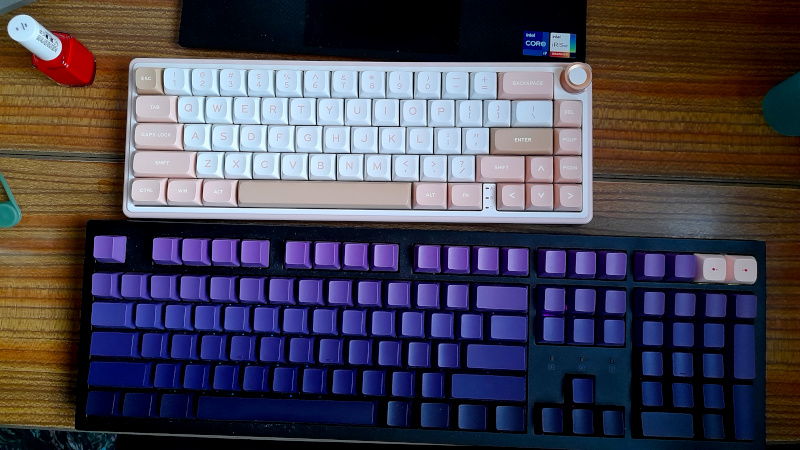
Well… sort of. It hasn’t become all-consuming, at least not yet. This, though, is how my desk looks now. Yes, that is another keyboard.

Two mechanical keyboards on my desk, one white and pink and the other black and purple

This is a slightly fake photo, I have to admit, because I’d never use both at once. The bottom one in the photo is the Keychron K10 chassis I wrote about previously, but with a prettier set of keycaps. The black pudding keycaps I bought were fine as a first set, but they weren’t really pretty. Moreover, the switches I’d fitted don’t really let enough light through for the translucent part of the pudding to work as expected. The shine-through colours were quite dim, only really visible in a darkened room. Because of this, the keycaps have been replaced by something prettier, a purple gradient set with blank tops.

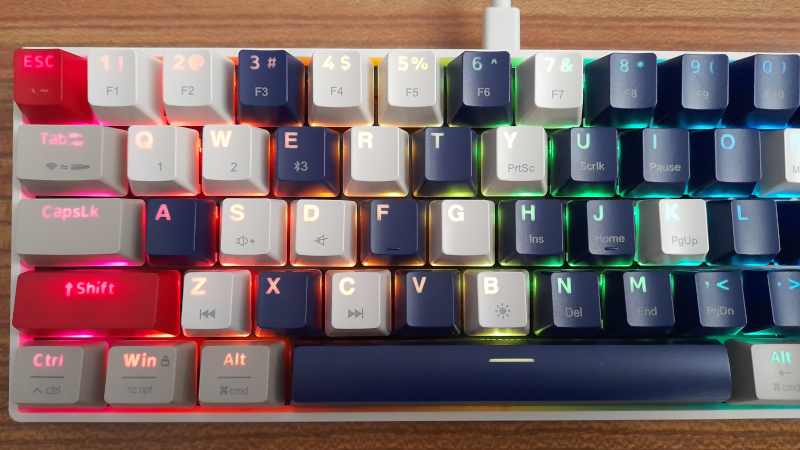
Above is the new keyboard, a Royal Kludge 65% model in a pink and white colourway, with slightly less key travel. The reason they don’t normally come out together is: this is my new “travel keyboard”, small enough to fit into my work backpack alongside my laptop. It’s wired only, so I bought a matching pink cable to go with. It’s not too loud for office use, but it’s definitely eye-catching; so far I’ve hardly had a single office trip without at least one person asking me where I got it.

“Now hang on there cutie,” I can hear you saying, “didn’t you already talk about a smaller keyboard in your last keyboard post?” Well yes, I did. But as I said at the time, that keyboard is a 60% model. This one is a 65%, and that extra five percent makes all the difference. It means this one has dedicated cursor keys, rather than have the cursor functions doubled-up. In other words, I can code without chording. It makes my life much easier. Moreover, this one is lighter and less bulky in the backpack, due to the lower travel, and is slightly quieter and less annoying to colleagues. It’s also deliberately intended to go with a new-to-me laptop I’ve been playing with, a small pink model that used to belong to The Child Who Likes Fairies, which I’ve wiped and put Gentoo Linux on, so that I can use it as a small, lightweight laptop to use if I’m ever going to be forced to use a small, lightweight laptop for any period of time—in bed recuperating from anything medical, for example. I wasn’t completely sure how well Bluetooth would be likely to work with Linux on a random laptop, which is the main reason I plumped for a wired-only model.

Are there going to be more keyboard developments. Well… maybe. The blank top keycaps on the Keychron do have shine-through legends on the key fronts, which are a bit ineffective in the same way as the pudding keycaps were. The “clicky” switch I still have on the Insert key is a transparent-body switch, by pure chance—I found it in a friend’s spares box—and I can see what a big difference that makes to the shinethrough effect. Because of that, a set of transparent-body red switches and a keyboard rebuild might be on the horizon at some point; there’s no rush, though. Aside from that, though, I do have enough keyboards now, including keeping that first one as a spare. If I find myself tempted to buy more, I really should just sit on my hands.

Crossing things off (part two)

What, continuing with a craft project instead of starting a new one?

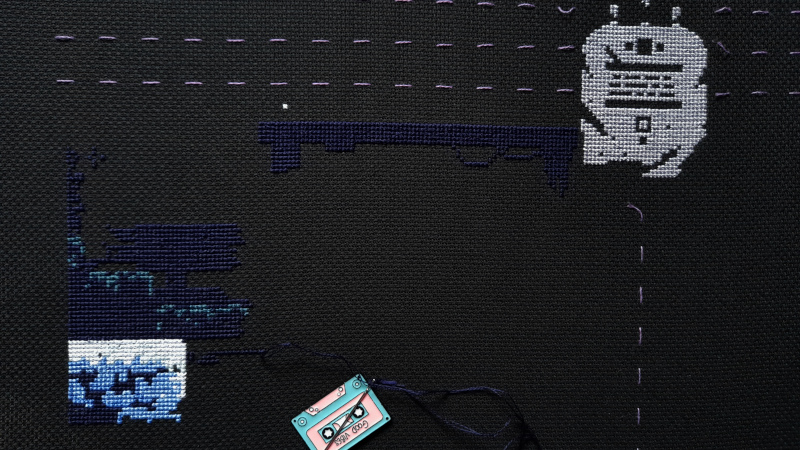
For once, I have managed to continue on with the ongoing craft projects without starting any new ones for, ooh, must be nearly a couple of months now. Most of the crafting time has been devoted to the cross-stitch project I mentioned back in July. Despite a break for my holiday—because it’s too large to go in the luggage—I’ve got on quite a way with it. Here’s the progress to date.

Progress on the new cross stitch project

It’s quite hard to take a decent photograph of, because that black background greatly confuses any camera which attempts any degree of automation. Maybe I should try telling them to use Night Mode.

Crossing things off

Finish craft projects? Nah. Start new ones? Yes please

There are still numerous craft projects somewhere in mid-flight at Symbolic Towers, and I keep slowly gathering plans for more that I haven’t even started yet. I have enough crochet patterns to keep me crocheting for several years, probably; a very large cross-stitch under way, and several other cross-stitch kits ready to start—and that’s to say nothing of the Lego or the model train kits. None of these things, really, have been posted on here, largely because I think “I’ll save them for YouTube” and then never video them either.

Despite all that, I’ve just started yet another cross stitch project!

What’s exciting about this project, the reason why it’s using up most of my crafting energy at the moment, is that: for the first time, this isn’t a kit. It’s not even a pattern I’ve bought and then found my own materials for, like most of the crochet projects. No, for the first time, this is a pattern I created myself. I saw something I thought would make a good cross stitch project, turned it (with the help of software) into a chart, and got started.

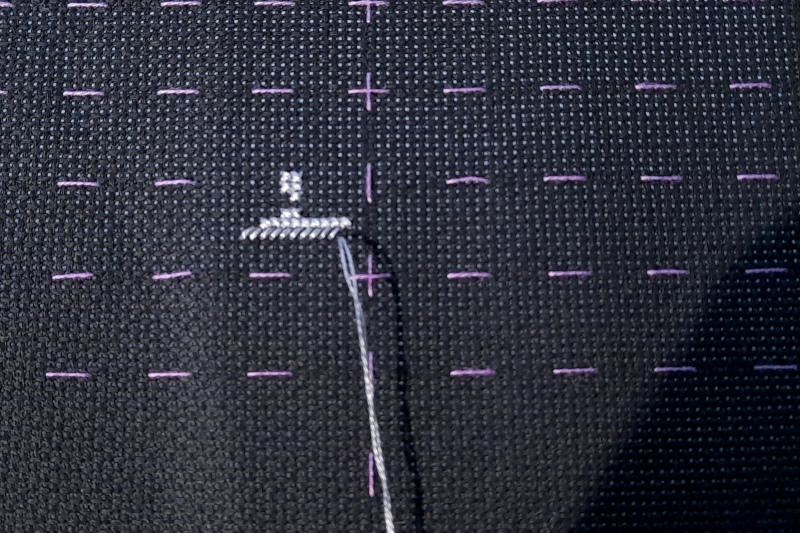
The start of a new cross stitch project

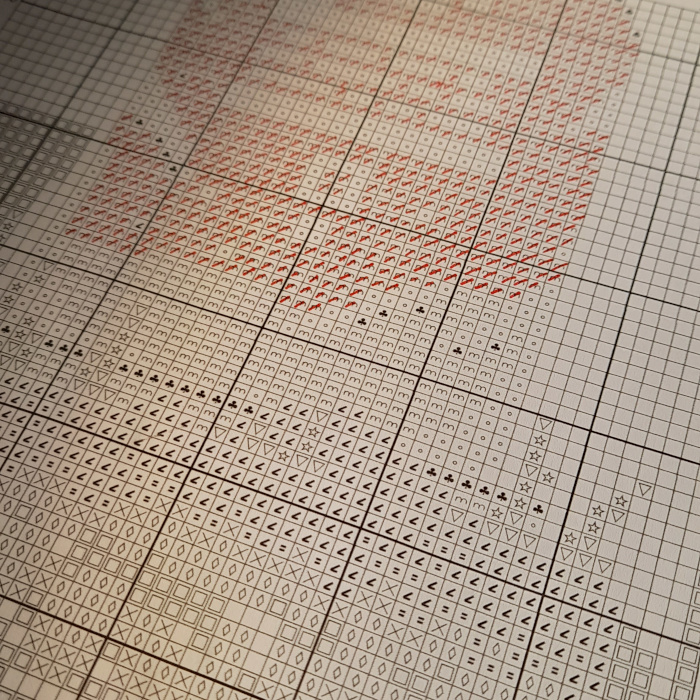
Because this isn’t something that was designed specifically for cross stitch by a specialist cross stitch designer, it does use quite a lot of colours, and it’s going to be a bit more complex than pretty much all of the cross stitch kits I’ve tried so far. Because of that, for the first time, I’ve actually started crossing off each of the stitches on the pattern as I do it—it helps that I know I can always print another copy off, of course. It is definitely going to help the further into this I get, though, especially when I get to the parts of the design which include lots of small areas of different colours, or the parts with lots of confetti—the cross stitch term for single isolated stitches scattered one-at-a-time across the background. This project will have a lot of confetti.

Crossing things off as I go

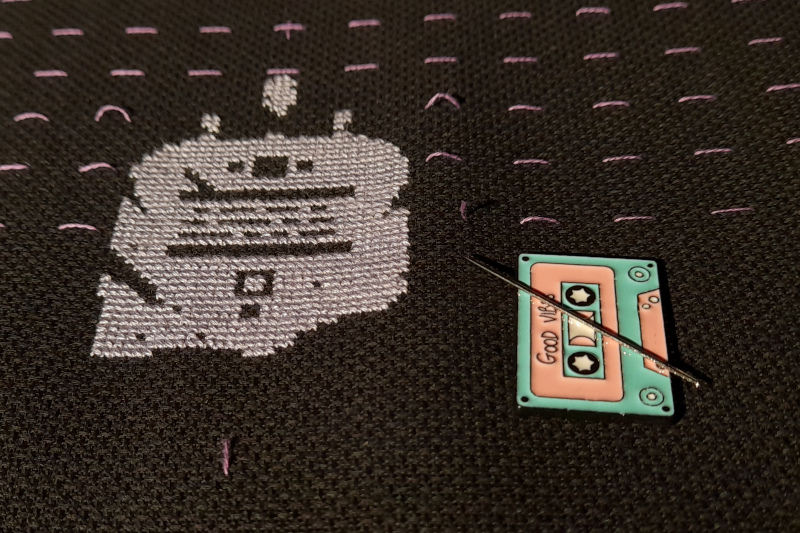
It will be some months before the whole thing is finished, even though it’s not full coverage, and even if I did deliberately avoid including any backstitch as part of the design. For now, though, new project energy is carrying me bowling along at pace. Only a week in, and already I’ve done a good chunk of the pattern’s central, focal point.

Progress, as of yesterday

That’s quite a good chunk of stitching for one week’s spare evening moments. What is it, you ask? Well, to know that…if you don’t recognise it, you’ll just have to wait and find out.

To read the next post about this project, follow this link

Typecasting

In which Caitlin is at risk of acquiring a new hobby

One stereotypical nerd gadget I’ve never seen the point of, that I always assumed was the nerd equivalent of hand-woven gold hi fi cables, was the mechanical keyboard. I assumed they were, as the phrase goes, fidget spinners for IT geeks. Something that is expensive and makes lots of fun clicky-clacky noises, but doesn’t actually change your computing experience by one tiny bit.

Well, reader, I was wrong. I admit it. Completely, absolutely, 100 per cent wrong. Switching to a mechanical keyboard has been one of the best productivity improvements I could have made to my workplace. Since I started using one, my typing has speeded up enormously. It’s definitely not just a toy. Having a decent length of travel on each key movement somehow genuinely makes it much easier and quicker for me to type; and also makes my typing a lot more confident. I’ve never learned to type properly, and I still make a lot of mistakes, but in general I’m finding my fingers skip across the keys much more freely.

This first started last summer when I was already tempted by the idea, and saw that a fairly cheap model already had been reduced quite a lot on sale. So, I bought it. And, if nothing else, it was pretty. It glowed, with rainbow light. It came with a choice of beige or purple keycaps, so being contrary I naturally changed just half of them over, trying to get a dithering kind of effect from beige on the left to purple on the right. It kind of worked. Typing, though, was excellent.

The mixed keycaps of my first mechanical keyboard, with shine-through legends on the keys

I felt like I was typing much better than I ever had on laptop keyboards, but there was something wrong. Still, I resisted the temptation to be a keyboard nerd. An enthusiast. One keyboard would be enough for me.

The problem with the first keyboard was that it was only a 60% model. In other words, it only has about 60% of the keys of a “full” PC keyboard; just the core letters and numbers really. To get all the other functions, you need a modifier key. A lot of laptops do that to access extra functions or squeeze all of the keys into a laptop case, but this was using it for fairly basic functionality like the four cursor keys. When coding, I find myself moving around with them a lot, so having to chord to use them quickly became annoying. On top of that there were other little problems: the Bluetooth connection would sometimes glitch out, particularly if the battery was low. When the battery ran low the only warning was one of the modifier keys flashing, and then when you charged it up there was no sign of how charged it was. On the good side, its small size made it nice and portable. Overall, it was a good starter.

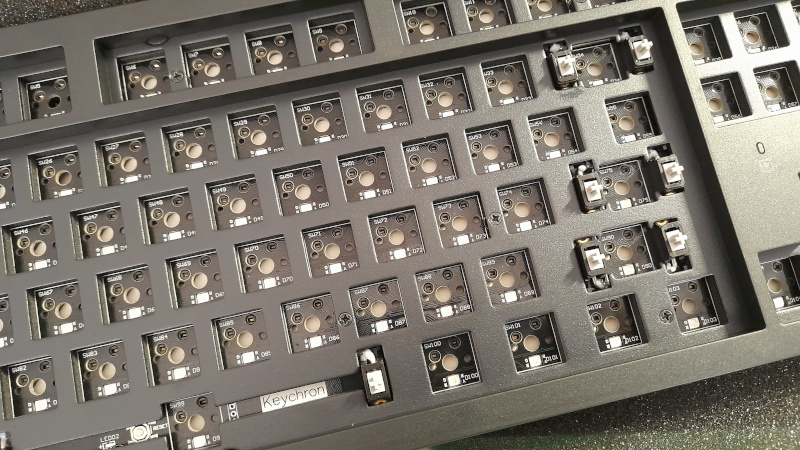
After a few months, I’d decided it was time to think about buying a full-size mechanical keyboard. And why not go all in and just buy a “barebones” model. A barebones keyboard is, well, not really a keyboard at all. It’s the core of a keyboard, but it doesn’t have any keys. You have to fit it out with keyswitches and keycaps for it to work. When it arrived, it was very nicely-packaged, it felt very substantial, solid and heavy, but I couldn’t actually start using it.

The new barebones keyboard, a Keychron K10, without any switches or keycaps

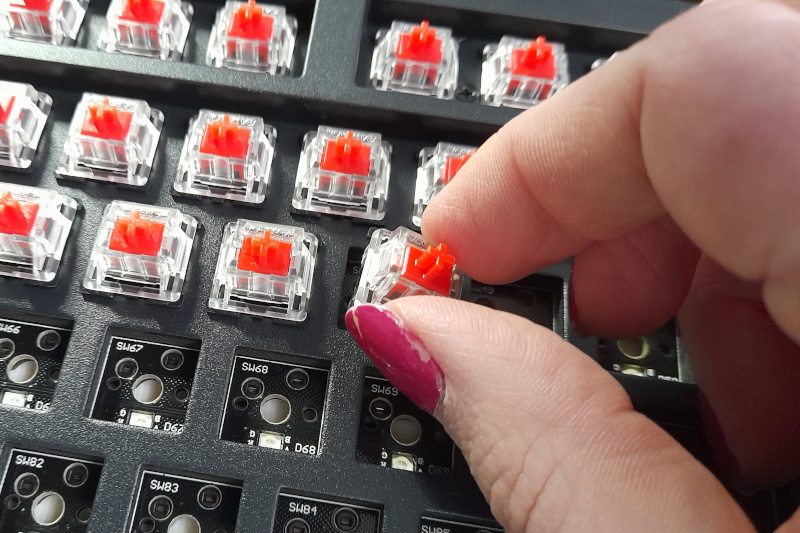
It’s a Keychron K10 model, and all you have to do to get it working is push switches into each of those sockets. You get to choose the brand of keyswitch you want, though, and switch manufacturers publish complex charts of the response and movement of different types of switch, describing them as “soft”, “firm”, “clicky” and so on. I just went for a fairly soft switch from a well-known brand, and set to work plugging them all in. It was quite a therapeutic job, pushing each switch home until it is firmly in place.

Plugging switches into the keyboard.  If I'd been planning to blog about this I'd have done my nails first

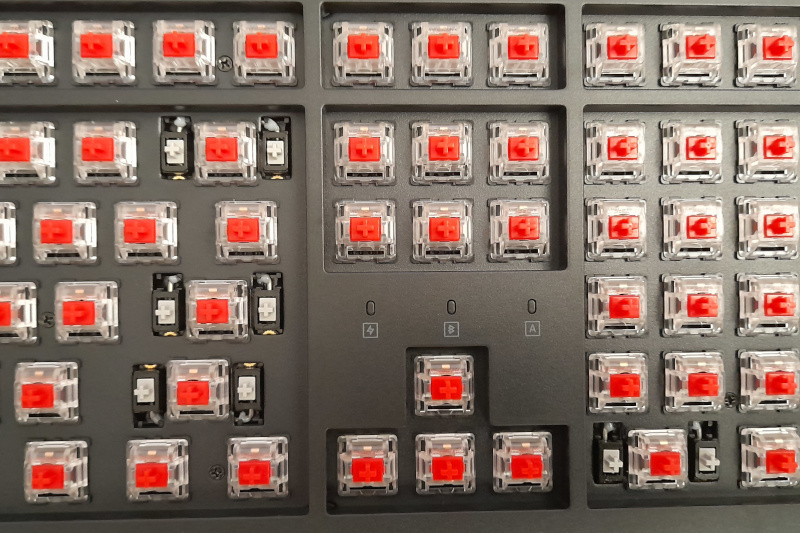
All the switch sockets nicely filled in

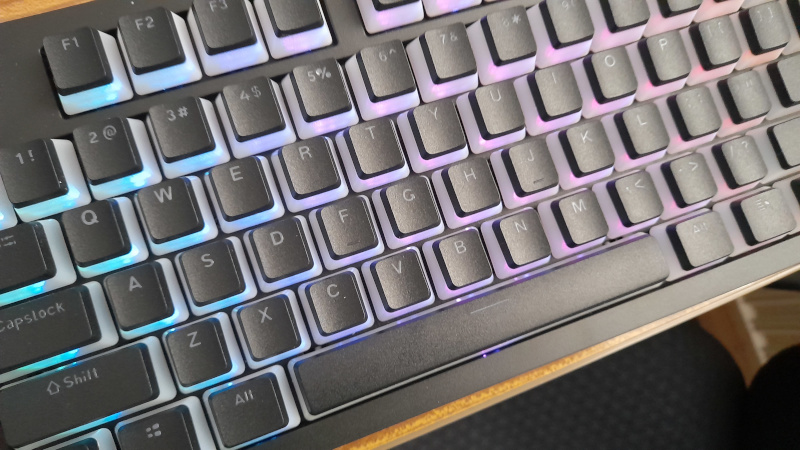
The harder part is choosing the keycaps: harder, because as well as how they feel, they have to look pretty too, and there are an innumerable assortment of manufacturers who will sell you pretty keys. And in the end, I just couldn’t decide, so went with a set of plain black “pudding” keycaps. “Pudding” keycaps have a solid, opaque top but translucent sides, so the backlights on each key shine nicely through. I’m not sure they are the right keycaps for me long-term, but they were a nice and cheap “first set”.

The finished keyboard with pudding keycaps

Am I going to turn into a keyboard nerd? Well, I’ve already tweaked it a wee bit. I kept hitting the “Insert” key by accident, not being used to having a key there, so I’ve already changed the switch on that specific key to be a much firmer, clickier one, so that at least when I do hit it by accident I notice I’ve done it. I’ll probably change the keycaps for something prettier at some point, something a bit more distinctive. I’m not going to go out and buy a lot more keyboards, because I already think this one is very nice to type on. It has a sensible, useful power lamp that flashes when the battery’s low, is red when it’s charging and goes green when it’s finished. But, overall: I admit I was wrong. This is much, much nicer to type on—I’m writing this post on it now—than a standard laptop keyboard is. For something I’ll use pretty much every day that I’m at home, it’s definitely worth the money.

Ongoing projects

As soon as something finishes, I start two more

The crafting project I mentioned in my last post is finished! Well, aside from blocking it and framing it, that is.

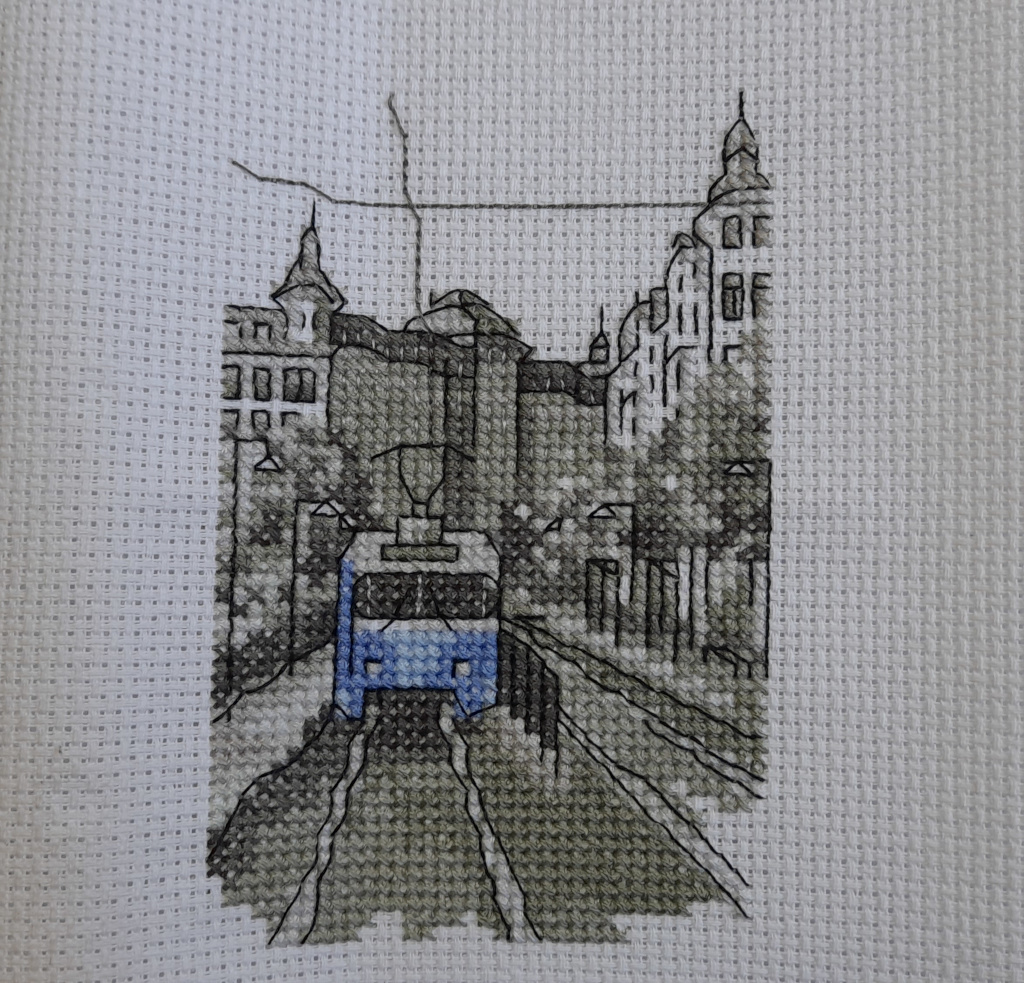
An actually completed cross stitch project of a Gothenburg tram

Me being me though, I couldn’t resist immediately starting two more. And then, of course, there’s the videos still to produce. I will get to the end of the list, eventually. In the meantime, here’s some photos of a few of the things in progress.

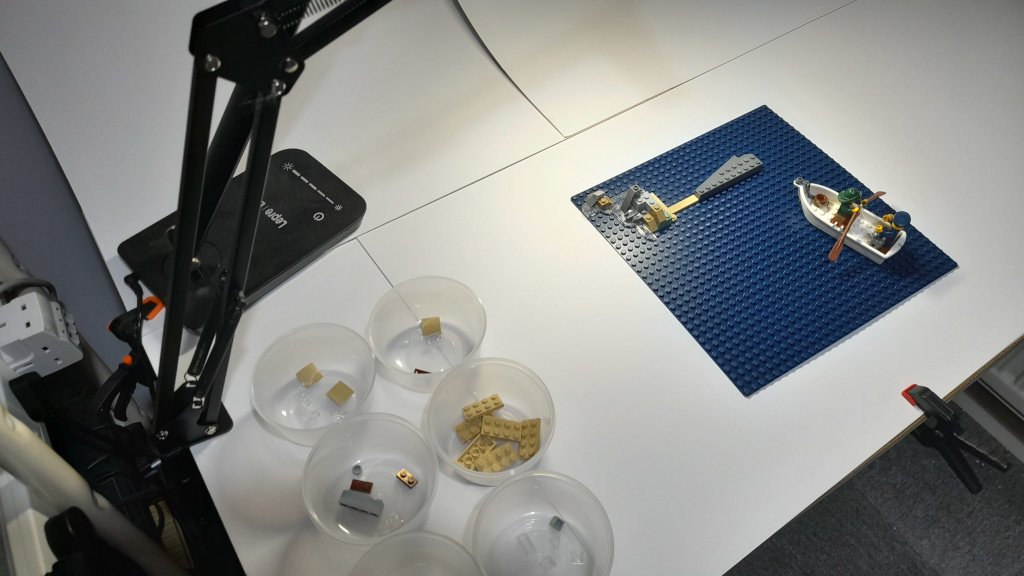
An in-progress Lego project all set up for filming

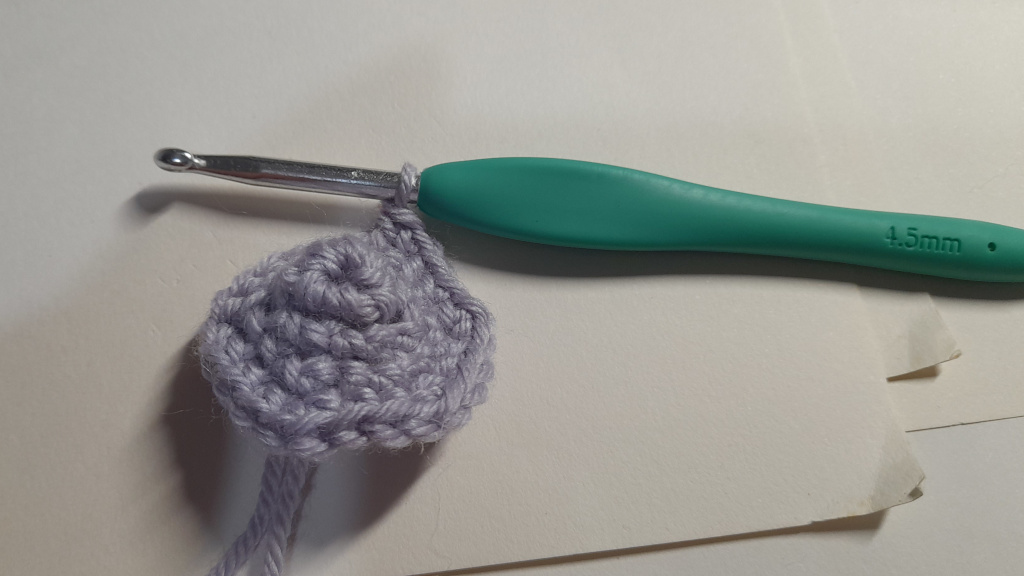
An in-progress crochet creation; this photo is from a few months ago but I still haven't produced the video about it

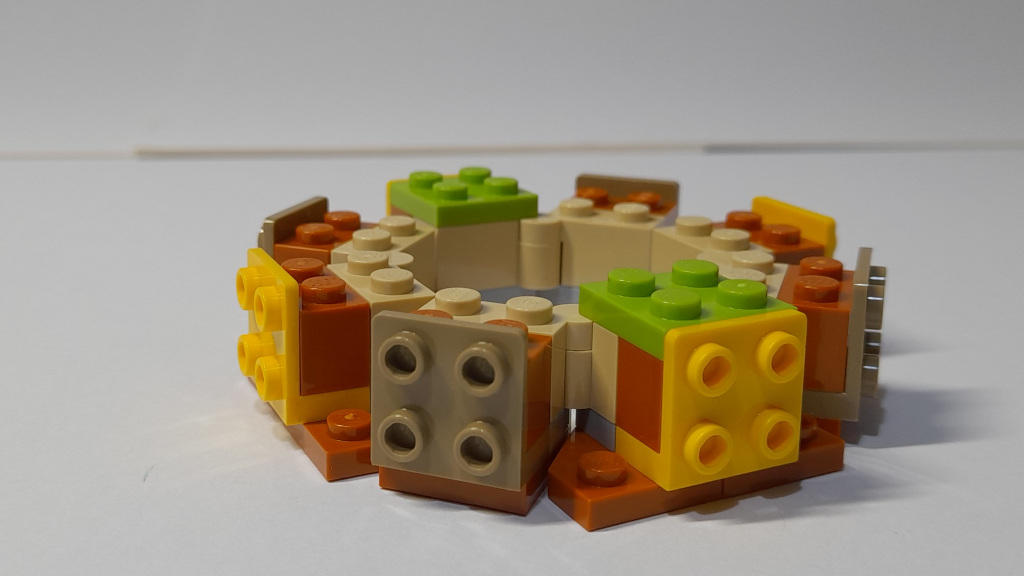
Frame from another in-progress Lego build which will probably be the first of these to hit YouTube

At some point, I promise, all of these projects will be complete and will have videos to go with them! Better make a start…

Crafting starts again

Or, a new project is embarked upon

It’s been all quiet on here for the past month, and all quiet on the YouTube front too. I do have a couple of projects waiting to be turned into YouTube videos, you see, but that means putting all the video footage together, assembling it, writing the voiceover, recording the voiceover and then cutting the whole thing so that the one fits the other. It’s a surprising amount of work if you do it like that, and I’m not sure my degree of anal perfectionism will allow me to do it any other way. Those videos will make it to an Internet near you, but not until some time in the middle of March at the earliest.

What have I been doing, then aside from that? Sorting out The Late Mother’s paperwork for one thing, naturally. But also, picking up another craft project that arrived for my birthday. I do have a massive cross-stitch project that I bought myself a while ago waiting to get started on, but this was a little tiny small one. A palate-cleanser, I thought it could be, before I start on the next big thing.

The start of a cross stitch project

It doesn’t take long, with a small project, before you start to see recognisable progress. A cross-stitch kit too, because it contains floss that’s been pre-cut into small, manageable lengths, is always very more-ish. Using a whole length only takes maybe twenty or thirty minutes, so at a weekend or in an evening, it’s always very tempting to just do another.

Further cross stitch progress

If it keeps catching your eye, then within a couple of weeks, you have all the cross-stitching itself finished.

All the crosses stitched

There’s still all the backstitch to do, to give it all some outline. This particular kit has three different shades of backstitch to put in, and I’m not convinced how well some of the very pale backstitching will show up against a background that is, frankly, mostly in shades of medium-grey. Watch this space and we’ll find out.

Self-promotion

A couple of Yuletide videos

It’s still the Yuletide season, although we’re now very much into the time-between-the-years when everybody is grazing on snacks and leftovers, has battened down the hatches against the storms, and has completely forgotten what day of the week it is.*

As it is still Yuletide, though, I thought I’d post a couple of the seasonal Lego videos I put up on my YouTube channel last week, before the holiday season had really got under way. Both of them are Lego build videos, for some seasonal sets that I picked up earlier in the month.

Firstly, a “Winter Holiday Train”…

…and, secondly, Santa’s Workshop

In a few days they’ll be going away ready for next year, but for now, I hope you enjoy them whilst you’re still feeling a little bit seasonal!

* No, don’t ask me either.

Hooked on a pattern (part two)

The crochet continues

The previous post in this series is here.

The crochet project I mentioned a couple of weeks ago has been coming along, if sometimes in fits and starts. Practicing my crochet stitches, my test piece came along quite a way, even if I did decide to pull it all down and start again because I was making my stitches far too tight, with the result that I then couldn’t stitch into them very easily on the following row, not without splitting the double-knit yarn. Before long, I had quite a substantial…um…rectangle.

A test piece

It must, I thought, be time to start on the thing itself. The first round was a little bit fiddly, but I perservered.

The first false start, and my legs

I just wasn’t happy. The shape didn’t seem right. The shape didn’t seem to match the pictures in the pattern, and I’d clearly messed up the start and stitched the second round, but only the second round, into the wrong side of the previous, so one tiny bit of the thing looked like it was inside out. So, pull it all down and start again. The second time, I got somewhat further…

That shape still isn't quite right

…and I still wasn’t happy. Because I seemed to have misread the pattern. Due, I assume, to my misunderstanding of crochet patterns. The pattern gives instructions for stitching each round, ending with “join with slip stitch”, and then a stitch count. The stitch count for each round matches up with the number of stitches produced in the main instructions for each round, minus the slip stitch at the end. Because of this, I was stitching the slip stitch into the first stitch of the round, then starting the next round by stitching into the second stitch. As a result, the whole thing was developing a twist, and as I started to do more asymmetrical increases and decreases the twist was becoming obvious. I begun again, and moreover, did the first round a number of times until I was quite happy with it. I begun again, treating the slip stitch as an extra stitch in addition to the stitch count for the round, and the shape started to make a little more sense.

Finally everything is lined up

All in all, then, it’s going quite well. I’m now thirty-something rounds into the main body of the thing, stuffing it as I go to help it take up the right sort of shape. It’s a bit lumpy compared to the pattern; it’s a bit larger too, because I’ve used slightly chunkier yarn and a slightly larger hook than the pattern suggested. But so far, I’m pleased.

Actually getting quite big

Whether I’m still going to be pleased when I’m making fiddly little decorative bits that then have to be stitched onto the main body, we’ll have to wait and see.