+++*

Symbolic Forest

A homage to loading screens.

Blog : Post Category : Geekery : Page 13

Hardware

In which my disbelief loses some of its suspension

Just recently, we’ve been spending a lot of time sat indoors in front of the telly, watching season one of The Wire, which a friend was kind enough to buy us on DVD, saying: “it’s the sort of thing you’ll like”. And, indeed, it’s very good. I’m not normally a fan of police dramas; but The Wire is good enough to stand as a drama on its own without the “police procedural” aspect of the show.

One little tiny thing, though, made me think: bah. One little detail they slipped up on: right at the start, in the opening credits. It’s the curse of knowing too much about anything, being able to spot the detail mistakes in any sort of fiction. The Wire is so named, at least in part, because a lot of the police’s evidence comes from phone tapping;* the credits features closeups of surveillance equipment,** phone-tap gear, spectroscopic voice analysis screenshots, and so on. Including this gadget:
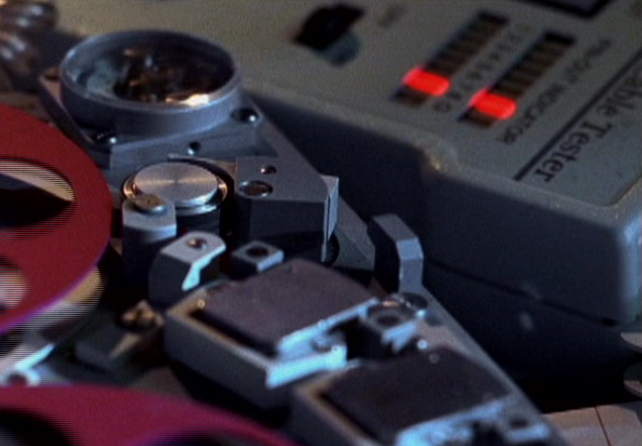
Screen capture from The Wire's opening credits

That thing at top right. It’s got lots of nice blinky LEDs – you can’t see on a still, obviously, but the lights move in a regular step. Problem is, I know, from work, exactly what that is. Lots of computer geeks will. It’s a cable tester – you can just about make out the words on it – for 4-pair cable, the sort used mostly for Ethernet.*** I keep one in my toolkit, with the cable crimps, because it’s invaluable to check if you’ve crimped a good joint. It’s also absolutely no use for tapping a public phone. Ah well. Just that one little mistake by a set dresser, and it disappointed me a little.

* Hopefully that isn’t giving too much away there.

** One thing that puzzled us: if it’s set in this decade, why do all the cops use 1970s-era Nikon cameras for surveillance, and not the equivalent digitals? Or, for that matter, why are they forced to write up reports on Smith-Coronas?

*** Or, to be fair, for some office phone systems. It’s also worth pointing out that although it’s used for Ethernet cable it doesn’t prove a cable is any good to use for for Ethernet – it’s easy to make a cable that will pass this electrical test but not work as a network cable.
Footnote

In which we debate a design detail

Regular readers might have noticed that yesterday’s post was a bit of an experiment. In case you didn’t spot what the experiment involved, here’s a clue:

Screenshot

Ever since it started, this blog has gone in for copious footnotes, on just about every post,* flagged up with stars in the usual way. One thing I’ve never been entirely happy with, though, is that the more footnotes you have, the more stars each note requires. A fifth or sixth footnote starts to get unwieldy, as some previous posts have demonstrated. So I’ve been idly thinking about other ways to indicate a footnote: symbols, numbers, or something else.

You can tell I’ve been idly thinking about it, because it’s taken me over three years to try an experiment with using numbers instead. I’m not really sure, though, whether I like it or not. K, I know, definitely doesn’t like the new numbered style; she was almost tempted to leave a comment saying “Bring back the stars!” so she must care. Or I could try out a series of different symbols, instead of a line of stars. More experimentation might be called for.

* When I first started drafting this post, it didn’t have any. “Oh, the irony”, I thought to myself, “of having no footnotes on a post about footnotes.” Fortunately, one soon came to me.

Searching

In which someone admits that SEOs are entirely pointless

An intriguing claim appeared in The Guardian yesterday, buried in its corrections column. Insurance-comparing website GoCompare has stated that there is little connection between its Google positioning and its income. More specifically: dropping from the first page of Google results for a common search term did result in a big drop in traffic, but had no financial effect on the company.

GoCompare is an internet business. As far as I understand it, they rely entirely on their website for income. What they’re claiming is: when Google lowered their ranking, they lost a large amount of traffic – but that none of that traffic, apparently, was making them any money.*

There are entire companies based solely around the premise that they will push you up to the top of Google’s pages. I’ve known marketers spend huge amounts of time and effort on it, taking common search phrases and analyzing them with a fine-tooth comb, trying to find out why they’re below their competition. I’d expect GoCompare to have been doing exactly the same thing themselves, in fact. And they’ve found, apparently, that it was all for nothing – because when Google pulled the rug from under their efforts,** they say, it had no effect at all on their income. Maybe they’re a special case because (unlike smaller online companies) they do spend a lot on irritating minimal-budget TV adverts.*** Even so, it’s intriguing. If their claim is true, there’s probably hardly any point at all in any large organisations spending much effort on search-engine optimisation. Small companies who can’t afford TV adverts, or who produce specialist products – well, that probably doesn’t apply. It probably doesn’t apply to AdWords campaigns either. But general search results? “Overall sales figures were not affected”.

* They seem to be talking about general search results. If they were talking about paid-for adverts, then the drop in traffic would also mean a drop in outgoings; but as they’re not, the change in traffic shouldn’t have any effect on their running costs.

** The Guardian had previously speculated that Google did this deliberately – it was that article which prompted the correction.

*** which, at least, aren’t as annoying as those produced by their competitor Confused.com. I’m never going to go near confused.com, no less than barge-pole distance, because their adverts are that bad. “I’m so stupid I’m trying to get money from a piece of cardboard with a cartoon cash machine printed on it! I’m confused! Dot com!”

Predicting the future

In which we worry about the weather

It’s a hard thing to do.

The other week, as there’s a long weekend coming up, I booked a camping holiday, in Wales. Only a day or two later, the news outlets started running stories about how awful the Easter weekend weather was going to be; wind, rain, sleet and snow. Oh dear.

There’s still snow on the forecast for Northumbria; but the forecast for the Welsh weather, though, has got noticeably better over the past few days. It’s gone from sleet, to showers, to sunny periods. And I’ve noticed this happening before. There seems to be a tendency now for the forecasts to be more extreme further off, before calming down as the date approaches.

Which is statistically what you’d expect, of course. Extreme weather is, by definition, unlikely, and shorter-range forecasts are always more accurate, so any extreme weather in a long-range forecast is likely to mellow as the forecast gets closer. That doesn’t stop the news jumping on any forecasts of horrible blizzards, though. I’m still worried that the snow forecast for the north Pennines is going to creep southwards over the weekend.

Joke of the week (part two)

In which a classic joke has a happy ending

“My dog’s got no nose.”

“Haven’t we been through this?”

“Shush. My dog’s got no nose.”

“How does he smell?”

Well, funny you should ask that. We’ve just joined this scheme called Smelling-Nose Dogs. You know how, in America, guide dogs are called seeing-eye dogs? My dog with no nose now has his own guide dog, who goes around, sniffs things, guides him away from odorous obstacles and generally lets him in on all the latest dog-gossip.* And it’s given him a whole new lease of life! He’s happy, and bouncy, and has a shiny coat!** He’s always bounding around and eager for his smelling-nose dog and him to go for a walk together. Completely unlike how he used to be, always moping in his basket unable to smell anything.”

“That’s nice.”

“Yes, it’s really done him the world of good.”

“Still not very funny, though.”

“Er, no.”

* You know – which dogs have urinated on which lamp-posts and that sort of thing. Which is, I’m told, very important information for dogs.

** Not that that has much to do with anything. Maybe I should be a copywriter for Evil Nestlé’s dog-food arm.

Joke of the week (part one)

In which a classic joke turns out to be rather sad

“My dog’s got no nose”

“How does he smell?”

“He doesn’t. He sits around all day getting into a deeper and deeper cycle of depression, because he can’t smell anything, in one huge cloud of nose-related ennui. He never even comes out of his basket.”

“That’s quite sad, really.”

“Yeah, I don’t know why the title says it’s a joke.”

800

In which we ponder the benefit of paying for other people's bargains

Driving to the office today, I was stuck behind a van which, like small tradesmen everywhere, proudly advertised a free 0800 phone number on the back. And – with little more to occupy my mind – I started wondering: is there any point, any more, in buying yourself a free phone number?

Who pays much for phone calls nowadays? Landline calls cost pence. Does anyone think: “Hmmm. Plumber A and Plumber B are both nearby – but it won’t cost me anything to call Plumber B! Hurrah!” Secondly, and even more important: most people use mobiles, now. Most people, calling from a mobile, have to pay more to call a “free” 0800 number than a normal geographical number.

The only people who are going to care about calling you for free are the people who are going to carefully weigh up the benefits of every single penny they spend. The very people, in other words, who are least likely to bring in money once they’ve phoned you. The very people who are going to query every single item on the bill. So who still buys an 0800 number?

Cartography

In which we wish for better maps

Maps are wonderful, lovely artefacts. I love to spread one out and read it like a book, analysing every square. Nowadays, though, I only do it for pleasure. Because, for practical reasons, if I want to plan a route or look somewhere up, it’s usually much much easier to go online for it.

There are downsides to this. Google Maps are nowhere near as good as a paper map. Their cartography just isn’t up to the same standard. They include roads, railways, rivers, and that’s about all. No buildings, no landmarks, no landscape. In Britain, Google Maps have the slightly odd habit of only including railway lines with passenger services,* and there seems to be no contours and few footpaths.

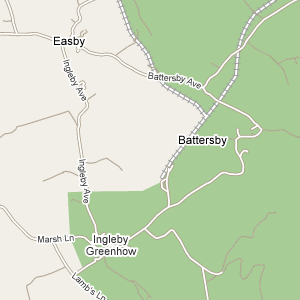
Google, though, are nowhere near as low-quality as Yahoo Maps. Since I bought a full Flickr account, I’ve used Yahoo Maps a lot, to record where I take my photos; and there are just so many places where Yahoo’s map doesn’t match reality. Take, for example, somewhere I visited recently with my camera: Battersby, on the edge of the North York Moors national park. This is Google:

Battersby, from Google Maps

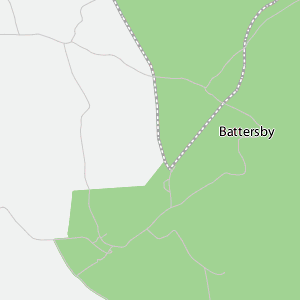
For comparison, this is the Yahoo version at the same scale:

Battersby, from Yahoo Maps

Never mind the lack of street names, and the general lack of contrast which makes it difficult to see where the roads run, especially within the National Park. Where exactly does that railway run? Where is the park boundary? The park boundary does indeed follow the line of the railway; but what shape is it? There’s a big difference there, just because Yahoo’s maps don’t include enough detail, apart from for roads, to be at all accurate when zoomed in. Rivers are just as bad, and apparently have zero width too.

If you really wanted to know the answer to the park boundary question, incidentally: it’s Google that’s right, as you can see by looking at Streetmap, who license the Ordnance Survey’s maps. Now that’s what a map is supposed to look like.

* It probably derives from the Ordnance Survey’s long-standing division between “railways” and “freight lines, sidings or tramways”, which dates right back to the start of the One-Inch series. It was bad enough when Landrangers, at I think the Second Edition, dropped the distinction between single-track and multiple-track railways. I have some First and Second Edition Landrangers somewhere, so I’ll have to check when the single-track railway symbol disappeared. First Edition were the last One-Inch maps photographically enlarged, which leads to some odd discrepancies on them;** the Second Edition were redrawn.

** for example, on the First Edition Sheffield and Huddersfield Landranger map (sheet 110), a chunk towards the south of the map is lettered in a different, older, font, which suggests that part of the map was derived from a rather earlier original than the rest of the series. I’ll scan a section some time to show you.

Update, August 30th 2020: At some point in the last 10 years, Google Maps’ coverage of railways became much better, not only including non-passenger railways, but detailing the coverage down to individual tracks, not just lines of route. So hurrah, on that point at least!

Update, October 19th 2020: Some twelve years later, I have finally got around to writing the blog post I promised in the second footnote.

Statistics and probability

In which we think about flooding and chance

In the summer, we had big floods up here, worse floods than anyone in this village could remember. It was, apparently, a once in fifty years event.

Now: we’ve got floods again, six months later. Maybe not a once in fifty years event, true, but let’s say (for the sake of argument) that this is a once-in-twenty-five year flood.

Maths time: in any 6 months, your chance of having a 1-in-50 year flood is 1/100. 1/50 for the more likely 25-year flood. The chance of having both, though, is those numbers multiplied together. 1 in 5000. Which doesn’t, at face value, look like a particularly big number; but that’s because we’re not great at judging magnitude. Something that has that chance of happening within 6 months should, on average, have happened once in the last 2,500 years. That’s once, since the start of the Iron Age.*

The problem with probability, though, is that you can’t say: this will definitely only happen once. It could happen three times within a week,** and still be within the bounds of probability. It could still happen, within the rules of our simple model; it is just highly unlikely to happen. If it does, you’ve just seen something amazing, but it doesn’t necessarily mean that your starting figures are off. On the other hand: if something happens that, according to your figures, is highly unlikely, it does make more sense sometimes to decide that the numbers you’re basing your statistics on are out of date. Suddenly, big floods aren’t rare any more.

* slightly more than once, to be honest, because the Iron Age started about 2,700 years ago.

** Hull was flooded twice, 14 days apart, in summer 2007. Some of the floodwaters in unimportant places, such as verges and parks, still hadn’t drained from the first flood when the second (and worse) flood came. That, though, means that normal “multiply the two numbers together” probabilities don’t work. The two floods weren’t independent of each other, because of all that water lying about, so the probability of the second was rather lower than it would have been.