+++*

Symbolic Forest

A homage to loading screens.

Blog : Post Category : Geekery : Page 14

Spot The Non-Difference

In which we spot France being invaded amid seaside amusements

Today’s blog is like one of those spot-the-difference puzzles where you have to spot hard-to-find differences between two apparently identical pictures. To make it a little bit different, though: here’s a carefully-prepared Spot The Non-Difference puzzle, where (for a change) you have to spot the hard-to-find connection between two apparently little-related pictures.

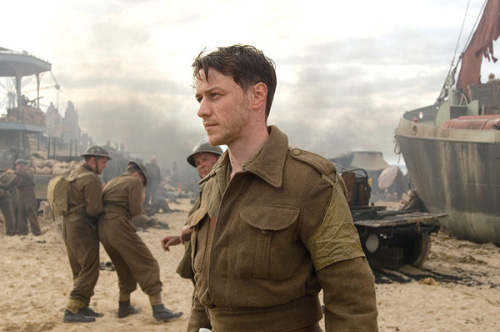
Firstly, we have a photo I first spotted in today’s Guardian. It’s a publicity still from the award-winning film Atonement, and shows James McAvoy hard at work apparently invading war-torn France:

James McAvoy in Atonement

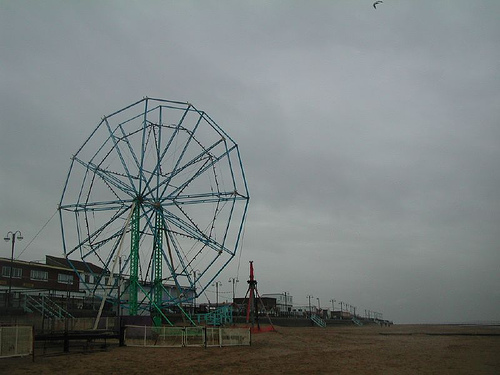
Secondly, this photo, taken by Dimitra, some years ago now:

Cleethorpes beach, December 2001

Yes, I’m pretty sure they were taken at almost the same location, although, to be quite honest, if I didn’t already know that Atonement was filmed in the Symbolic Forest area, I’m not sure I would have spotted the link between them.

Interrogation

In which we try not to be baffled

It’s nearly Yuletide, and all shall rejoice. For Yuletide means: the King William’s College General Knowledge Paper. Hurrah!

If you’ve never seen it before: the General Knowledge Paper is both an exam paper, and one of the hardest general knowledge quizzes around. Its questions are succinct, cryptic, and intriguing, and range over huge areas of knowledge.* On a quick run through it today, I reckon I scored about 32 points out of 360;** doing particularly well on London and Russians. Answers probably include I. P. Pavlov, Martin Chuzzlewit, Greyfriars School and Waterloo – unless I’m deliberately trying to confuse you.

* so much so that my friend K claims it isn’t a general knowledge quiz at all, because the answers are that obscure.

** There are 180 questions; you score 2 points per answer.

Steam trains

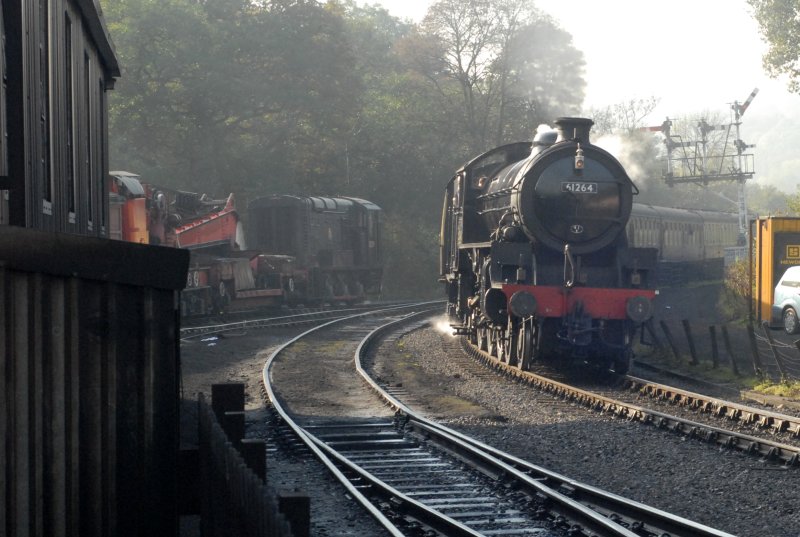
In which we visit Levisham

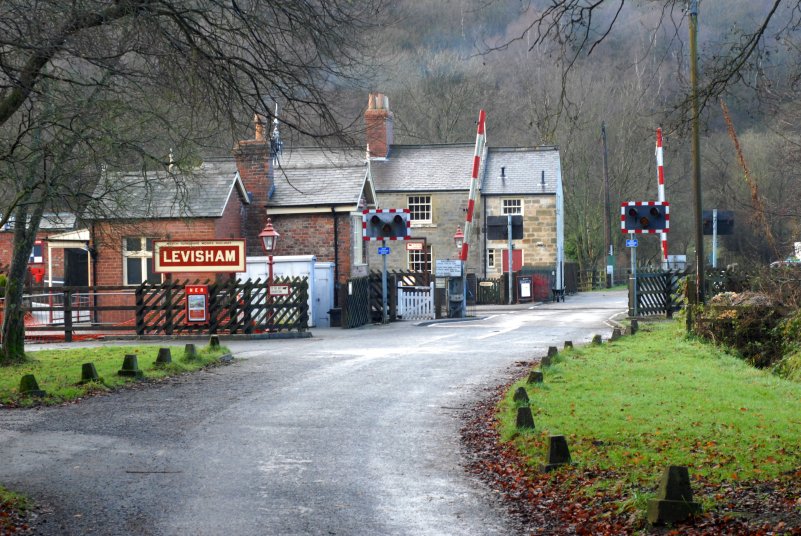
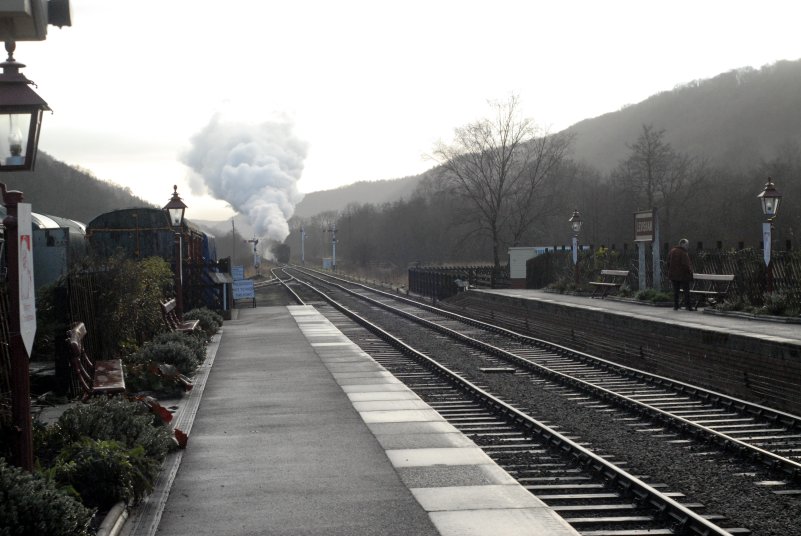
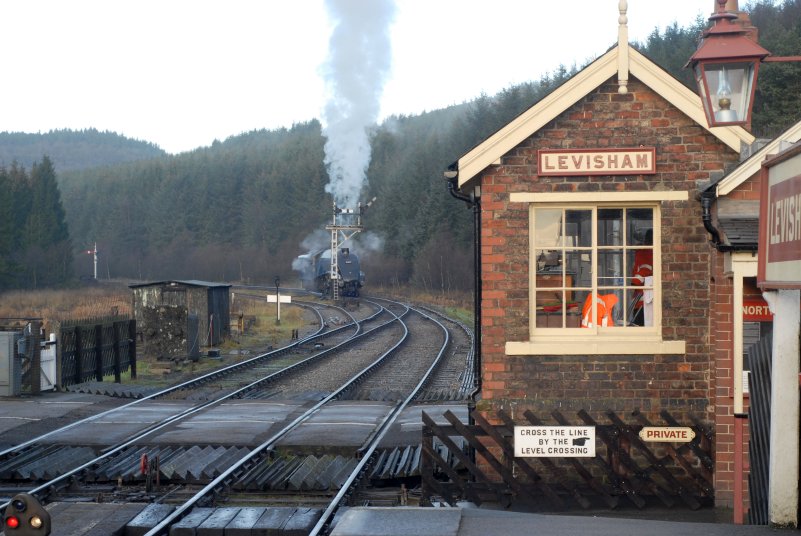
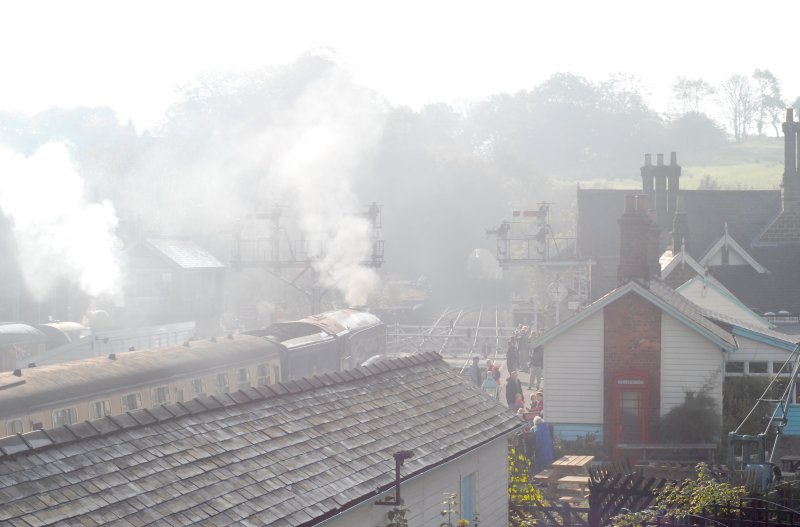
A spare weekend: we went wandering, in the car, and on foot. We drifted through the moorland village of Levisham, as untouched a village as you’ll find in Yorkshire, with one road wandering through it across a broad green. Ambling downhill, we reached the railway station. We watched a train pull in, and shunt about, great clouds of steam rising in the December cold.

Prowling around the station, we discovered its Artist In Residence, Christopher Ware, in his studio. We chatted a little while, and studied his prints of bucolic trains. He can’t have many visitors on a day like that; hopefully we were a welcome distraction for a few minutes.

Levisham station

Levisham station

Running round at Levisham

Signal wire pulley wheels

An interlocking mass of references

In which we read a meta-book

The Archers, The Avengers, Roy Of The Rovers, Quatermass, Angela Carter, P. G. Wodehouse, Giles, George Orwell. Hi-de-Hi, Spenser, Shakespeare, Crowley, Dee, The Prisoner. James Bond, Scoop!, and Bulldog Drummond. Virginia Woolf and John Cleland, all bound together on different paper stocks.

I’ve been reading The League Of Extraordinary Gentlemen: The Black Dossier, which I picked up from Travelling Man‘s Newcastle shop yesterday. And that’s only the references I spotted myself, without reading any annotations. As Ian said recently, “Alan Moore is geekier than all of us.

Cemetery Gates

In which we find Bouch’s grave

From the recent search hits: “sir thomas bouch blog”. Somehow, I doubt Sir Thomas Bouch is likely to have a blog. For one thing, he’s dead.* Secondly, he was always more interested in building railways than writing about them, or about anything.

If you’ve never heard of him: Thomas Bouch was an English railway engineer, and some of the time he was a rather good engineer. Some of the time. He built the highest railway in England, the South Durham & Lancashire Union,** and with it the highest railway viaducts in England. He also invented the first modern train ferry, on the Edinburgh, Perth and Dundee railway, which would otherwise have been in two separate parts.*** Unfortunately, he was also rather fond of cost-cutting, building routes on the cheap, and that led to his downfall and infamy. He’s now best known for building the Tay Bridge – the one that fell down. There’s even an urban myth that the word “botch” is derived from his name. It isn’t, of course, but the rumour is hardly good for his reputation.

One day, a few years ago, I was ambling around the west end of Edinburgh. Away from all the expensive tenements,**** there’s a picturesque gorge, with a river running through the bottom, wooded sides, and grand buildings poking out from behind the trees: the back of Donaldson’s College, and the National Gallery of Modern Art. If you go up through the art gallery grounds, as I did, and through past the Dean Gallery, you can wander through the Dean Cemetery. Doing so, I randomly found: Bouch’s grave.

It’s a very bare, imposing grave. A bust of the man; the name “BOUCH”, nothing more, and the dates. It’s a very nice spot to be buried in.

* although this isn’t necessarily a bar – Sam Pepys manages it. Geoffrey Chaucer used to have one, but is now largely on Twitter.

** It closed in the early 1960s. The A66 road roughly follows its route, and runs closely parallel to it at Stainmore.

*** It was originally two separate railways, one in Edinburgh, one in Fife, which merged.

**** think Shallow Grave

Readers' Letters

In which the readers speak up and demand photos

Here at Symbolic Towers, we pay attention to our readers. If they send in tips, we pass them on. Mr E Shrdlu of Clacton writes…

The Plain People of the Internet: You say what? You had a letter? From a reader? Whose name is E Shrdlu? Honestly?

Me: Shush there. Be quiet and listen.

The Plain People of the Internet: If you say so. But don’t expect us to believe it.

… E Shrdlu of Clacton, who writes:

People who liked Friday’s post may be interested in…

The Plain People of the Internet: You mean, people who like long posts about the history of the London Underground? When posts like yesterday’s get a much better reader reaction? What are you thinking about?

Me: Come on there, stop interrupting. And since when have I been bothered about reader reaction, in any case?

The Plain People of the Internet: We’re only saying. Offering a tidbit ourselves, you could say.

… may be interested in the book London’s Secret Tubes by Emmerson and Beard, which goes into all that stuff. At book length.

The Plain People of the Internet: Now, we wouldn’t mind seeing photos of that beautiful Yorkshire scenery you were wittering on about. That “unutterable beauty” stuff.

Me: It was “unassuming beauty”. And I don’t have any – the car would have rolled down the hill. Carnage.

The Plain People of the Internet: My god, that’s terrible. The joke, we mean.

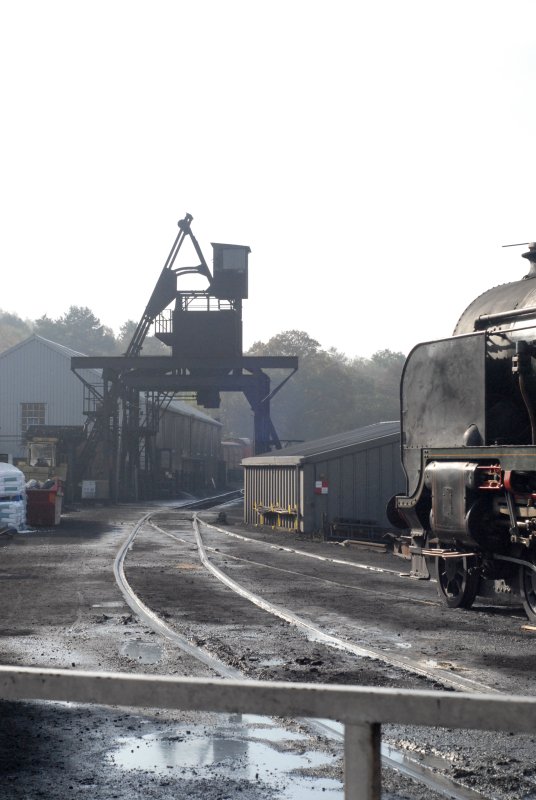
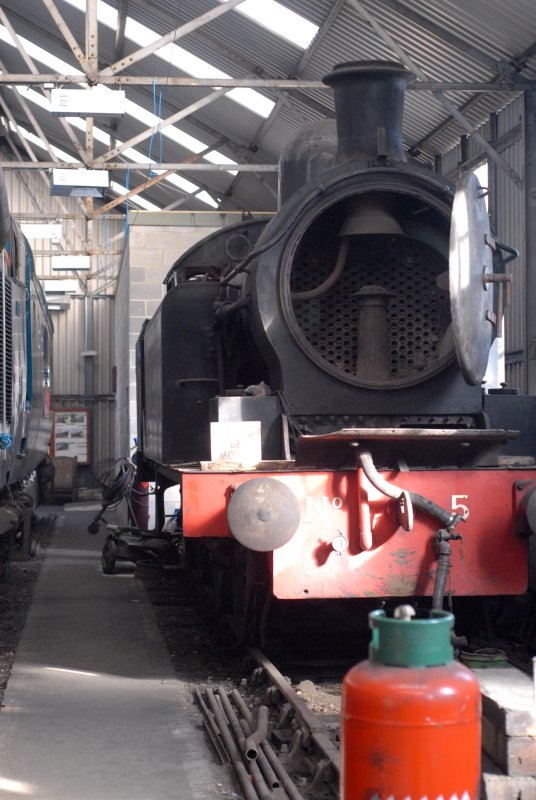
Me: If you’re so plural, shouldn’t that be “our god?”. The best I can do is photos of trains down in the mist-filled dale. And why shouldn’t there be real people called E Shrdlu, from Clacton?

The Plain People of the Internet: Flann O’Brien would sue, were he still alive.

Grosmont station

Grosmont yard

Inside Deviation Shed, Grosmont

Train passing Grosmont yard

Express

In which we look at some underground history

Talking of search hits: recently, quite a few people have been searching for “secret tunnels under london” and finding this place. I’m not completely sure why, to be honest. I don’t know of any truly secret tunnels under London. I do know of a few lesser-known ones, though – the Tower Subway, for example, near City Hall; or the nearby remains of King William Street station.

It got me thinking, though, about Crossrail. It was in the news a lot a few weeks back, because the government finally decided to commit to building it; after fifteen years or so of back-and-forth dithering between several different governments, differing plans, and a very small part of it already built (a ventilation shaft near Moorgate). Just don’t mention the Chelsea-Hackney tube line, which has been on the planning books for even longer.

Crossrail is, essentially, to be an east-west express metro for London. It’s not the first express metro plan London’s had, though, and it’s not even the closest to completion. For that, you have to look at some more of the lesser-known tunnels under the city.

Back in the 1930s, the newly-created London Underground was in an expansionist mood, helped by government job-generation grants. It unified two separate routes to create the Northern Line; extended the Central Line westwards with help from the Great Western Railway; got the LMS Railway to give the District Line’s Southend trains separate tracks as far as Upminster; and planned to take over the LNER’s lines from Finsbury Park to High Barnet, Alexandra Palace and Edgware, and from Leytonstone to Hainault and Ongar, and extend the Central line eastwards from Liverpool Street to connect up with the latter. Those plans were well under construction in 1939, when, of course, building stopped.

Before the war started, it was well known that “air war” would be a major tactic. People had seen the effects of the Gernika raid* a couple of years before, and there were widespread worries that the country was unprepared for air attack.** So, in 1940, the government started to build mass air-raid shelters underneath existing Underground stations, with the plan being that they would be dual-use: after the war ended, they would become part of a new Express Northern Line beneath the existing one.

Several of the shelters were never used for their original purpose at all; those that did open, were not used until the V-weapon attacks towards the end of the war. Others were used to billet British troops, and for British government and American army offices. As for the express line that London Underground had been promised, it never did appear, and there was never even any serious attempt to build it. It seems more to have been a sweetener for London Underground, who at the start of the war were very reluctant to allow people to shelter in their stations rather than in the official ARP public shelters. Some of their worries were justified – in 1943, 104 adults and 69 children died in a crush accident at Bethnal Green; it remains the worst accident in London Underground’s history.*** It’s interesting to wonder what might have happened, though, if it had been built. London’s own RER, in the 1950s.

The tunnels are all still there, of course, underneath the active stations. The most visible is Stockwell – the brightly-painted structure north of the station, on the other side of the road, was the deep shelter’s entrance. Most are more anonymous, but all are still there, lying quiet underneath you. Secretly.

More on these shelters can be found at Subterranea Brittannica

* Spelling pedants: that’s its official modern spelling.

** See: Nevil Shute’s 1938 novel What Happened To The Corbetts. Shute was still a professional aircraft designer at the time, and his company had been asked to supply aircraft to the Abyssinians following the Italian invasion, so he was probably more aware than most of the threat that aerial bombing presented.

*** It’s a slight irony that the worst accident on London Underground was at an unopened station, on a line under construction – Bethnal Green is on the Central Line extension mentioned above.

Recent search hits

In which we wonder what people are looking for

where do military musicians train? – at military band camp, I assume
what is healthy porn? – porn in which all the actors use plenty of fresh vegetables?
devon sandstone looks like this
meaning of “to throw a sheep at” – personally, I thought it sounded rather straightforward
memories of 1930s Herne Bay – don’t ask me, I’m too young. And I’ve never even been to Herne Bay.
victorian gothic desktop themes – I’m sure I could knock up a St Pancras Station background wallpaper or two
registry office bow road – I was at a wedding civil partnership ceremony there a while back, and it’s a very nice building. The Suffragettes used it as a meeting hall, you know
suzie dent is she married? – I don’t know, but I wouldn’t save yourself for her if that’s what you’re thinking
scary wooing noise – I personally find that wooing can make very scary noises. Although you could try:
bdsm gag – right, that’s enough of that for today.

The Unconnected

In which we bear bad news

Breaking bad news to people is always hard to do. Even if it’s something as mundane as a dead computer. I took a quick look at a machine one of the staff had brought in from home, in my lunch break; it’s vitally important she gets it working again, apparently, because it’s got all her daughter’s schoolwork on it, and they have to have a computer now to do all their assignments on.* It only needed a quick look to show that it’s not coming back to life. Its hard disk is almost certainly now a former hard disk, with no hope of getting her homework back.** But how do I tell her?

Latest addition to my RSS reader: Bad Archaeology. The navigation is a bit awkward, and their “latest news” page doesn’t seem to get archived, but there’s some very good stuff in there, if, like me, you would love to try poking members of the Erich von Däniken Fan Club with long pointy sticks. Their latest article is on King Arthur, as an example of what happens when you set out to prove a point, and try to use archaeology to do that. I’m tempted to write something longer about exactly that, soon.

In other news: I’ve been listening to Phoebe Kreutz lately. Her songs make me smile, and make me want to listen to more of her songs. So that has to be a good thing. Hurrah for good things!

* I’m not sure I believe that. This isn’t a rich town, and there must be many many children in the area whose parents don’t have a PC.

** A normal boot sequence halts with “Non-system disk or disk error”, which, if your other drives are all empty, is never a good sign. A Linux boot CD finds the hard disk, prints out lots of nasty disk hardware errors, and then says it can’t read the partition table. Not good, not at all.

Popularity

In which we wonder how useful social networking is

Chatting to Vee last night, she said: maybe she should cut down on social websites. She showed me the list of sites she’s got profiles on. Seventeen. Maybe she’s overdoing it a little. I have at least five at the last count, at least one of which lies derelict and abandoned.

Gordon, too, recently wrote about this. There are so many social websites out there that, if you’re not careful, they become nothing more than a time-sink. Or, the other extreme; you leave abandoned profiles scattered across the internet like so much silent litter.

Now, social interaction has been on my mind for the past couple of weeks, ever since my friend Maz called me an ignorant and antisocial git. This was largely because I hadn’t popped round to put up some shelves for her like I’d promised; but she’s not the only person to have complained that I don’t keep in touch with my friends as much as I should do. The solution to that, though, isn’t networking websites with long lists of “friends”. What’s missing is deep interaction. Going on Facebook to throw a sheep at someone is meaningless; writing them a letter or two is what counts.

Sites like Facebook are kind of pointless, except as an address book and a distraction. At least, they’re pointless as far as building up real, meaningful relationships are concerned. The social sites that are useful, though, are the ones which have some genuine purpose other than being a list of friends. Last.FM,* for example, or Flickr. I’ve always been too lazy to upload photos to Flickr, although I keep meaning to. I have a backlog of photos going back about a year, that are unsorted and mostly unseen; occasionally I dribble a few onto this site. So, I’m going to use Flickr more.** I’m going to spend more effort on the friends and acquaintances I already have, rather than collect more I don’t really know. I’m going to stick with the social networks I have, but only because, hopefully, I might become less of an ignorant git in the future. The only way to do that is with real interaction, not a quick Facebook poke.

* Well, it’s useful if you’re a music geek

** Partly because I’ve started playing with the maps. I love it. Photos and maps in one place – what more could a geek ask for?