+++*

Symbolic Forest

A homage to loading screens.

Blog : Post Category : Geekery : Page 12

Answers To Questions

In which we reveal things

Back at the start of the month, I published a list of facts which may or may not be true. As we’re well into April now, I thought it was about time I told you what the answers are.

1, sadly, was entirely untrue, and was merely there so that I could make a tenuous pun around “gratin catalogue”.
2 is true. So is 3, at least according to Robert Graves, whose Greek Myths is good on the myths themselves, less reliable on their interpretation.
4 is most definitely not true.
5 is probably not true, but it was an urban myth for many years in the railway enthusiast world.
6 is true, pretty much. The CPC range could show 27 colours, each referred to by a number which represented the colour’s RGB values when written in trinary. They used a 4-bit hardware palette to map between the trinary graphics chip and the binary video memory.
7 is false, even though lots of people would tell you otherwise – see Wikipedia for details.
And 8 must, if you’ve been counting, be true. Although it’s arguable what the oldest part of the Underground is, the oldest underground railway was the Metropolitan Railway – now the Hammersmith & City Line – and it was originally built to Brunel’s broad gauge standard, about 2′ 3″ wider than standard gauge track.

So, there you are. I’ll try to think up more falsehoods next April.

Performance

In which things turn to treacle

I’ve noticed, over the past few months or so, that sometimes this site seems to load rather slowly. The slow periods didn’t seem to match any spikes in my own traffic, though, so I didn’t see that there was necessarily much I could do about it; moreover, as it wasn’t this site’s traffic that seemed to be causing the problem, I wasn’t under any obligation to do anything about it.

As I’ve mentioned before, a few months back I switched to Google Analytics for my statistics-tracking. Which is all well and good; it has a lot more features than I had available previously. Its only limitation is: it uses cookies and Javascript to do its work. Because of that, it only logs visits by real people, using real browsers,* and not spiders, robots, RSS readers or nasty cracking attempts. Often, especially if you’re a marketing person, that’s exactly what you want. If you’re into the geekery, though, it can cover up what’s exactly going on, traffic-wise, at the server level.

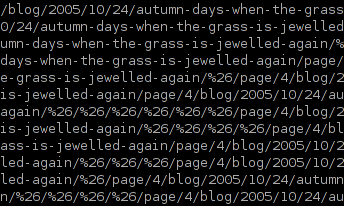
Searching my logs, rather than looking at the Google statistics, showed that I was getting huge numbers of hits for very long URLs, consisting of valid paths joined together by lots of directories named ‘&’:

Logfile extract

That’s a screenshot of a single request in the logfile – the whole thing being about 850 characters long. ‘%26′ is an encoded ‘&’ character. Because of the way WordPress works, these things are valid URLs, and requests for them were coming in at a pretty fast rate. Before long, the request rate was faster than the page generation time – and that’s when the problem really starts to build up, because from there things snowball until nobody gets served.

All these requests were coming from a single IP address, an ordinary consumer type of address in Italy.** Moreover, the user-agent was being disguised. Each hit was coming in from the same IP address, but with a different-but-plausible-looking user-agent string, so the hits looked like a normal, ordinary browser with a real person behind it.

The problem was solved fairly easily, to be honest; and the site was soon behaving itself again. It should still be behaving itself now. But if you came here yesterday afternoon and thought the site didn’t seem to be working very well, that’s why it was. I’m going to have to keep an eye on things, to see if it starts happening again.

* and only if they have Javascript enabled, at that, although I know that covers 99% of the known world nowadays.

** which made me think to myself: “I know I’ve pissed people off … but none of them are Italian!

The Detail

In which we look at the detailed plans of the Guided Busway

Long-term readers will recall that, particularly last November, I’ve been covering the local guided busway developments: to whit, the West Of England Partnership, the quango which is, you could say, the haunting ghost of Avon County Council, and its plans to turn an old railway line into a private buses-only road. Sort of. Railway lines, of course, aren’t generally wide enough for that sort of thing; so they will mostly be building half a road.

Well, all has been quiet for a while; the consultation was completed, and the Partnership wrote off to the Department for Transport to say “can we have some money, please? Oh, go on.” A reader of this site, the other day, tipped me off to the fact that WEP have published their persuasions on their website. So, finally, we can read all the details which were conspicuously absent from the public consultation documents.

Firstly, there seems to be a change as to where the money is coming from. In the past, it was mooted that this application would be to the Transport Innovation Fund,* and therefore would need to have a congestion charge element to it. That’s not the case: the application is for Major Scheme Funding. So, no congestion charge: nothing is going to be done directly to reduce traffic. All we get is a new, shiny, park-and-ride service which replaces the still-shiny existing park-and-ride service, but serving Spike Island instead of Hotwells.

Secondly, it includes documentation on service frequencies. And half of the buses using the route won’t be the shiny new “Rapid Transit” buses; they’ll be the same old buses to Weston and Nailsea that already exist. Another thing which isn’t going to make the guided busway scheme any friends: it’s being marketed to the government as the first stage of a Rapid Transit Network, in which it becomes the Ashton Vale-Emerson’s Green route. In other words, the old let’s-pave-over-the-Railway-Path scheme which attracted large amounts of protest.

One of the most interesting bits, though, is the detailed plan of the new route. We learn, for example, that the rather worn and tired old swing bridge across the New Cut is to be “refurbished” – it sounds cheaper, after all – with a new footbridge alongside it. The small Butterfly Junction nature reserve is to be flattened and paved over – it isn’t even marked on the maps – and the Bristol Harbour Railway’s stop there is to be replaced by a new one.
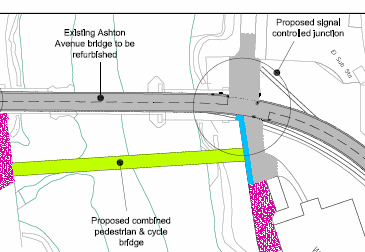
Plan of guided busway at Butterfly Junction

The Bristol Harbour Railway is where it gets most silly. The plans finally confirm what was hinted at in the consultation: it is to be turned into a tramway, with buses running on top of it. According to the bid documents:

The tracks for the heritage railway will be retained to provide for seasonal Sunday services and events such as the Harbourside Festival. When these infrequent events occur, services will run on Cumberland Road.

In other words, trains on the Harbour Railway will run on about half as many days as they do now, and along a tramway, which doesn’t quite tally with what my local councillor has told me in the past. As the railway is only just wide enough for one bus, one bus there will be; outbound buses will run along the road all the time, not just on Sundays. To squeeze under Cumberland Road and keep the cycle path, the busway will be narrowed to a single-track road/tramway with traffic lights.

One of the vaguest parts of the consultation documents was: what happens at Prince St Bridge, which isn’t currently strong enough and probably not wide enough to take buses. The consultation map was hard to read; the Evening Post reported that there would be a new bridge. Some people suspected that the current “trial” arrangement of having cars on one side of the bridge and pedestrians on the other was a taste of things to come, ready for the guided bus scheme. Well, it turns out they were right.
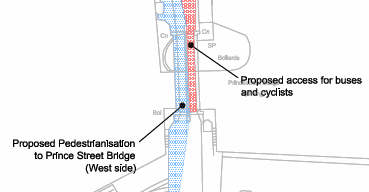
Guided bus plan for Prince St Bridge

Red in that diagram means “bus lane”. Prince St Bridge will be closed to cars; with this scheme, it will be divided between pedestrians on one carriageway, and buses and cyclists on the other. Instead of cyclists being able to run into pedestrians whilst dodging opposing traffic, as now, they’ll be able to get flattened by buses instead. It’s also quite hard to work out how much money has been set aside for Prince St Bridge works, because the costs aren’t itemised very clearly – indeed, the surveyors who reviewed the WEP costings also had trouble on that point.

I don’t think the busway scheme is going to go ahead. That’s partly because the funding bid includes a convenient “low cost alternative” scheme. It is, essentially, the same scheme, same nice new buses, new bus stops, but using the existing park-and-ride route with no new infrastructure. The funding bid says:

A key element of the [Low Cost Alternative] route is the avoidance of the main bridge structures at Ashton Avenue and Prince Street … in order to reduce the construction costs.

The infrastructure will, they say, halve travel times along the park-and-ride route. Whether the Department for Transport think that that will make it worth the money remains to be seen. I’m not convinced they’re going to go for it. In a few months, though, we will all find out.

* as you can see from this Joint Transport Forum presentation released under FOI. Thanks to correspondant Gareth for pointing me to that URL.

Foolish

In which we confuse people

As it’s April 1st, here’s some almost-but-not-quite-believable information. Some of it is true, some of it isn’t. See if you can guess which is which.

  1. A firm from Skegness once offered a mail-order service supplying potatoes sliced and braised in cream, and other similar dishes.
  2. French revolutionary politician and Terror leader Maximilien Robespierre was obsessive about wearing exactly the right sort of silk stockings every day.
  3. Some Ancient Greeks believed that beans were haunted, and that eating them could cause pregnancy.
  4. I have a tattoo of a steam train on the inside of my left thigh.
  5. The British government for many years maintained a secret stash of spare steam engines, hidden in an old quarry just outside Bath.
  6. Sir Alan Sugar’s company Amstrad once sold a range of home computers whose graphics chip used trinary, not binary, arithmetic.
  7. The term “bug” for a computer fault dates from someone finding a moth stuck in an early electromechanical computer.
  8. The tracks of the London Underground were originally about 2′ 3″ wider than they are now.

Brokenness

In which things go wrong in hard-to-diagnose ways

We go away for the weekend. We come back. And the house is cold. Turn on the hot water tap: freezing. The boiler has given up the ghost.

I turn on the PC this morning: and that refuses to come on, too. Which, to be honest, is a recurrence of a problem I was already aware of. Sometimes, on start up, it gets partway and loses contact with the disk drive. Or, sometimes, if you ask it to do too much disk-thrashing just after booting, the same thing happens. On the other hand, if it starts up all its services and is fine for 15 minutes, it will probably stay fine until it’s switched off.

All that points to something like a loose contact somewhere, if you ask me. As I say, it’s been happening for months now; but today I was in the mood to sort it. The computer now has a new hard disk cable. It booted up first time, and it’s still running. Let’s see if it still works in the morning.

The boiler might be suffering from something similar. The gas engineer came out, poked around at it, and fixed it. The chap wasn’t sure what the problem was, or how he fixed it, but fix it he did. Maybe. It’s working now, but we still have to see if that, too, will come on again come tomorrow.

New World

In which we jumble the letters up

K was digging through her boxes of zines last night, hunting for something, and came across one she thought I’d find interesting. She passed it over. It was The Dvorak Zine – “changing the world, one keyboard at a time”.

I’ve heard of the Dvorak keyboard before. It’s a keyboard layout specifically designed to make typing quicker, and easier to learn. I’d never bothered, though, to investigate it, and find out what the layout actually is. The zine, though, is cunningly designed. The back page is a keyboard map; you prop it up on your desk and start typing away.

I’m not a proper typist. I’ve never learned to touch-type. My typing is pretty fast for someone who can’t type; but really it’s nothing more than very fast two-finger typing. As a result, it’s riddled with mistakes, and I spend more time going back and correcting what I’ve done than it takes to type the words in the first place. The Dvorak keyboard, though, seems specifically designed for touch-typing – and, looking at keys that type different letters to the letters printed on them would just be far too confusing for me. So, I thought: an ideal opportunity. Why don’t I learn?

So, this morning, I set the zine up on my desk, and switched the keyboard mode over. Put my fingers on the home keys, and started typing: one letter at a time.

It was slow, of course it was. But, as promised, it was surprising how quick it was to pick up. Within a couple of hours, it was quicker to type without looking at the keyboard map than to use it. This might actually work.

To be honest: I haven’t used it to type this. I did want to get something productive done today, so after 3 hours or so of Dvorak typing I switched back to the traditional layout. I don’t want to lose my ability to type the old way, after all: we don’t have a Dvorak typewriter and we’re unlikely to find one. I’m very pleased with how quickly I’ve been able to pick Dvorak up, though. What mostly slows me down is: like most people, I think in terms of words rather than letters. I seem to mostly type using my muscle memory of whole words and word fragments. Switching to Dvorak, I can easily remember where all the common letters are and which finger to use for them: but then I have to spell each word out in my head to type it. Training myself to type in words, without thinking about the spelling, will take some time.

The size of things

In which we measure monitors

The redesign is now almost done, which means that soon you’ll be saved from more posts on the minutiae of my redesign. It’s got me thinking, though: to what extent do I need to think about readers’ technology?

When this blog first started, I didn’t really worry about making it accessible to all,* or about making sure that the display was resolution-independent. It worked for me, which was enough. Over time, screens have become bigger; and, more importantly, more configurable, so I’ve worried less and less about it. When it came to do a redesign, though, I started to wonder. What browsers do my readers actually used.

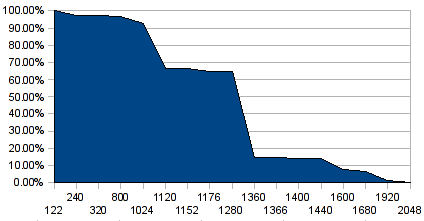
Just after Christmas, for entirely different reasons, I signed up for Google Analytics, rather than do my own statistics-counting as I had been doing. Because Google Analytics relies on JavaScript to do its dirty work, it gives me rather more information about such things than the old log-based system did. So, last week, I spent an hour or so with my Analytics results and a spreadsheet. Here’s the graph I came up with:

Browser horizontal resolutions, cumulative %

The X-axis there is the horizontal width of everyone’s screens, in order but not to scale; the Y-axis is the cumulative percentage of visits.** In other words, the percentage figure for a given width tells you the proportion of visits from people whose screen was that size, or wider.

Straight away, really, I got the answer I wanted. 93% of visits are to this site are from people whose screens are 1024 pixels wide, or more. It’s 95% if I take out the phone-based browsers at the very low end, because I suspect most of that is accounted for by K reading it on the bus on her way home from work. The next step up, though, the graph plunges to only 2/3 of visits. 1024 pixels is the smallest screen width that my visitors use heavily.

Admittedly there’s a bit of self-selection in there, based on the current design; it looks horrible at 800 pixels, and nearly everyone still using an 800×600 screen has only visited once in the two-month sample period. However, that applies to most of the people who visit this site in any case; just more so for the 800-pixel users. Something like 70% of visits are from people who have probably only visited once in the past couple of months; so it’s fair to assume that my results aren’t too heavily skewed by the usability of the current design. It will be interesting to see how much things change.

I’m testing the new design in the still-popular 1024×768 resolution, to make sure everything will still work. I’ll probably test it out a fair bit on K’s phone, too. But, this is a personal site. If you don’t read it, it’s not vital, to you or to me. If I don’t test it on 800×600 browsers, the world won’t end. The statistics, though, have shown me where exactly a cutoff point might be worthwhile.

* For example, in the code of the old design, all that sidebar stuff over on the right comes in the code before this bit with the content, which does (I assume) make it a bit of a bugger for blind readers. That, at least, will be sorted out in the new design.

** “visits” is of course a bit of a nebulous term, but that is a rant for another day.

Books I Haven’t Read (I’ve lost count which part)

In which we compare two David Crystal books with the inside of my head

Yesterday’s post, about how we can’t stop ourselves buying books, segues quite nicely into today’s. We didn’t just buy books on Saturday; we bought more on Sunday, from the weekend bookstall outside the Watershed that I remember mentioning not that long ago. I picked up a copy of By Hook Or By Crook by David Crystal; and then, thought to myself, should I really be buying a David Crystal book when I already have a book of his on the shelves that I haven’t yet read? I didn’t pause for long, because “you’ve already got one by him” is hardly a very good reason for not buying a book, but it’s true that the one Crystal book already on our shelves is one that I’ve never been able to get very far with. It is: The Stories Of English.

I find the language fascinating: both in use and in history. It’s such a playful thing, can be twisted and swerved, can be squeezed and stretched, and can be bent into truly awful puns. I love playing with it, I love its richness and I love its history, its constantly fluctuating and mercurial history. And so, I thought – rightly – that The Stories Of English would be an extremely interesting book. Crystal, moreover, is a very engaging and lighthearted writer. He’s very easy to read, very interesting, and clearly knows what he’s writing about very thoroughly.

So why, then, is it that I’ve never managed to get past the Middle English chapters? I’ve tried to read it several times, I’ve always enjoyed the sections I have read immensely, but I’ve never been able to get through Middle English. Every time, my enthusiam’s petered out somewhere in the fourteenth century, I’ve not come back to the book, and its later chapters have remained untouched. And so – given the number of times I’ve made an effort to read it – it definitely counts as a Book I Haven’t Read, even though it’s actually very good.

There’s one thing, only one thing, I can put my finger on. It’s quite a non-linear book. There are excurses and diversions. There are lots of box-outs. This is understandable. All histories can be highly non-linear, and The Stories Of English is deliberately written in a non-linear way, to take account of the parallel histories of different dialects of the language. I’m used to reading non-linear texts, or in a non-linear manner when I’m online and going down a Wikipedia hole, or when I’m researching something: flipping between tabs in my web browser, or shuffling through several open books on my desk, comparing pages and stopping to take notes. Only the other week, for example, I was sitting in the city reference library comparing passages in several books of railway history and taking notes on the development of Great Western Railway Wagon handbrakes. When I sit down to read a book for pleasure, by contrast, I’m not used to doing that. I expect my books to have a beginning, middle and end; a linear structure if not a linear narrative; flipping back and forth, both physically and mentally, needs more concentration. Crystal’s straightforward writing style, in this context, is deceptively easy to read. Especially when you reach the Middle English period, and the stories of English really start to get complex, purely because the amount of evidence available on the history of the language becomes much, much more comprehensive, it needs a lot more mental effort to keep track of things than you might think you’d need when you open the book.

By Hook Or By Crook, by contrast, is structured in a linear way, but one that’s orthagonal to its linguistics. It’s a road-trip book, essentially, with Crystal musing on anything of linguistic interest – or of any interest to him at all – which he comes across on the way. And it’s ideal for me to read, particularly because that’s the way my own brain works. Like him, I’m exactly the sort of person who would do an emergency stop and jump out of my car to photograph a misspelled sign at a level crossing. I’m racing through it, and I’ll probably have read it by the weekend; and I’ll probably read it again and again over the years. Its mode of writing complements my own favourite mode of reading, and my own favourite mode of thinking. It must also help that I know some of the places he writes about: for example, when I first opened the book at a random page I saw a photo of the Boston Lodge toll house apparently taken from a passing train.

The Stories Of English, by comparison, is something I have to concentrate on to get my head around. That, I suspect, is why it’s a Book I Haven’t Read. Yet.

Photo post of the week

In which I spot a train

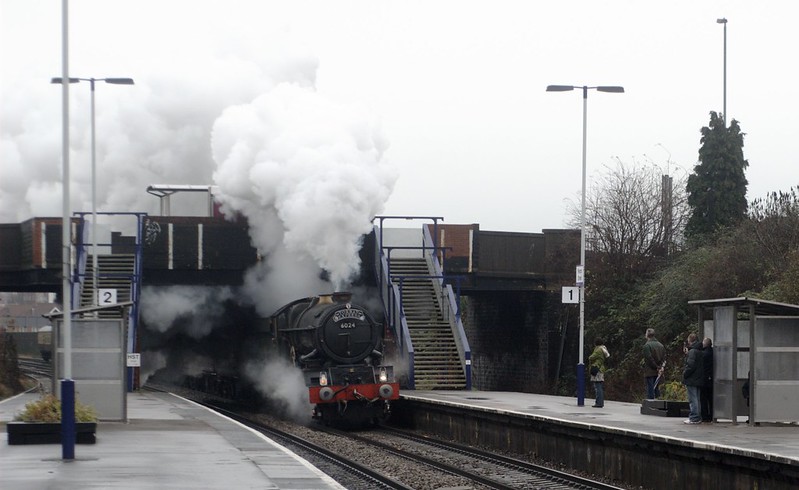
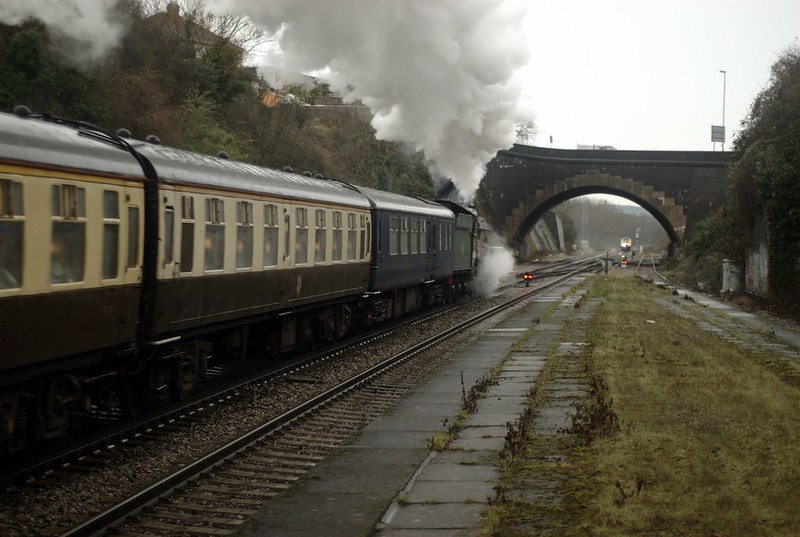
We discovered, the other week, that occasionally, just sometimes, if you drag yourself out of bed early on a Saturday morning and get down to our local railway station (1 train an hour if you’re lucky, to Weston-super-Mare), you can see something a bit more interesting than normal…

The Torbay Express passing Parson St station

The Torbay Express passing Parson St station

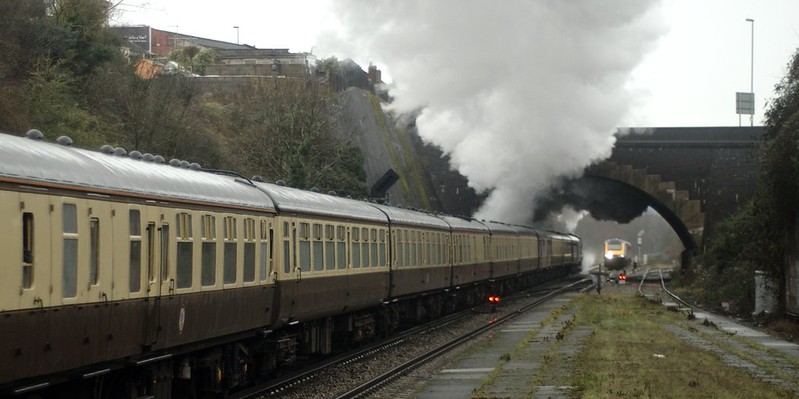
Two Torbay Expresses passing Parson St station

Two Torbay Expresses passing Parson St station

If one of the trains had been travelling a few seconds later or earlier, I’d have got a great photo of the equivalent 1930s and 1970s express engines passing each other.* As it was, the modern train is a blob in the distance. Ah well. Maybe I’ll get up early tomorrow too.

* With the added, slightly confusing detail, that both of the trains involved (not the engines) have the same name.