+++*

Symbolic Forest

A homage to loading screens.

Blog : Post Category : Geekery : Page 11

Secret Passage

In which we look for some Parisian history

Every so often, search requests come in for things like “disused stations on the Paris Metro”. I’m not entirely sure why, because this site doesn’t have very much content at all on that topic. All there is, in fact, is this post from a few years ago, which wasn’t really about disused Paris metro stations at all: it was more about all the various interconnection lines and mysterious secret underground depots that you can see from a passing train.

When I was in Paris the other week, though, I kept an eye out. Because there are the odd one or two disused stations on the Metro, even if there are fewer than on the London Underground. I kept my eyes open, and I spotted a couple.

Firstly, if you head north along Line 5, across the Seine and through Quai de la Rapée station, you will find that the line quickly disappears underground on its way to Bastille station.* Once in the tunnel, well-lit and easily spotted, there is a stretch of broad station tunnel, heavily graffitied like almost everything on the Paris metro. This is the remains of Arsenal station: off the top of my head, the only Paris Metro station to share a name with one on the London Underground.

Secondly, turn around back to Gare d’Austerlitz, then head westward on Line 10. Past Odéon, there’s a complex network of underground tunnels linking Line 10 to various other routes; the modern line has a complex history. And somewhere in-between all the various connections, past Mabillon station, there is another secret. Croix Rouge station, originally the terminus of the line. It’s harder to spot than Arsenal, but it is there.

Hopefully, then, if people come here looking to spot disused Parisian underground stations, here are a couple of hints. If you want to see what they look like inside, there are photos on the web, of course: where doesn’t have photos on the web nowadays? Alternatively, you might prefer it the other way: sit on the Metro, ignore the buskers and the beggars, and look out the window for a flash of abandoned platforms.

* incidentally, foundations of the original Bastille fortress are visible on the Line 5 platforms at that station.

Subtlety

In which something is hard to understand

Both K and I now have big stacks of books we collected over Christmas. As there are some books I had last Christmas that I haven’t read, yet, there’s plenty now to keep us both going for a few months.

As mentioned the other day, one of the books I received this year was Gödel, Escher, Bach, by Douglas R Hofstadter. I asked for it specifically, but in doing so, I was already aware that it may well end up on the “Books I Haven’t Read” review list. Because, after all, its reputation precedes it. It’s a long book, a complex book, and it deals with some complex and subtle ideas.

Luckily, though, it’s also a very readable book. With its detours and its playfulness, it reads almost like a more complex, grown-up version of a Royal Institution Christmas Lecture series. It’s definitely not going onto the Books I Haven’t Read pile, because I’ve almost finished the whole thing. However, I might have to start a new pile specially for it: the Books I Don’t Think I’ve Properly Understood pile. Many of its arguments are rather gentle and subtle, others are brutally subtle, and others I admit to having to skim over. This may well, according to some of its arguments, prove that I am indeed conscious and intelligent. Either that, or I’m slightly tortoise-like in my thinking. I’m not, as yet, sure which.

Twenty percent of evil

In which we discuss The Turn Of The Screw Coupling

It being Yuletide, there’s nothing quite like a ghost story. Was it Dickens who started the Christmas ghost story tradition, or is it more down to BBC schedulers of the 1970s? Never mind. It being Yuletide, we sat down in front of the telly to watch the latest BBC version of The Turn Of The Screw, by Henry James. It seems like only the other day that it was last made for the TV; but here it is again.

I should admit, I’m not particularly a fan of The Turn Of The Screw, the book, thinking it rather dense and over-written, too wordy to be frightening or atmospheric. Partly this might be because I first read it in a less-than-ideal place: while working in a call centre, between calls. Being interrupted every few minutes by the phone chiming puts a slightly different perspective on your comprehension of mysterious horror and pernicious evil. The book itself begins with a properly seasonal framing story, which the new version ignored entirely, ripping the meat of the story out and sandwiching it within an entirely different framing story set some decades later. It’s now a 1920s tale told to some kind of doctor or detective by some sort of inmate – the narrator of the story proper.

I’m not going to delve into the whole thing; a summary is that the governess of two children becomes convinced that two evil ghosts are trying to attract her wards into their own world. These ghosts were evil when they were alive, we are told, are trying to cast the children into their moulds, and seem to be succeeding: one of the children has just been expelled from school for being unspeakably naughty. But while the governess starts to see the ghosts more and more frequently, and is convinced the children can see them too, noone else in the household thinks that anything at all is amiss. Thousands upon thousands of essays, papers and texts have been devoted to the question of: are we meant to think the ghosts are real, or meant to think they are in the narrator’s imagination. Whole critical careers have been staked on one side or the other of this argument.

For TV, though, subtlety is abandoned. The camera shows us: the children, possibly more of the household staff, know that the ghosts are there and have some idea what they are up to. The nature of Ghost One, Peter Quint’s evil, too, is much more explicit: he’s a Bad Man who has his wicked way with all the ladies. Because that’s often not thought so much of a Bad Thing these days, he’s violent to them too. The nature of the boy Miles’s evil is still left vague and mysterious. Peter Quint is trying to bring him up in Peter Quint’s image, so presumably he’s turning violent and misogynistic; but why would that get him expelled from a 1920s public school?* There’s not really a clear answer to that one, which is presumably why the film-makers left it still unexplained. It’s about the only thing that was.

Now, book and film/TV are different media, and it’s unfair to gripe purely about the fact that they are different media. Adaptations can’t be made unchanged, otherwise we’d hardly need the term “adaptation”. Anachronism, though, gets on my nerves a little bit. There were a couple of scenes in which the governess arrived or departed at their local railway station; I’m fairly sure it was filmed at the very scenic Cranmore station, on the East Somerset Railway, not too far from here.** This is the 1920s, so we should have a 1920s train turn up; at Cranmore, of course, that would be a GWR country branch train in the appropriate GWR dark maroon carriage livery.**** What train does the governess step out of? A 1950s British Rail carriage in 1950s chocolate-and-cream. It’s hardly very suitable; it’s just as anachronistic as a big diesel like this would have been. Or, indeed, as if Peter Quint had worn a James Dean jacket and shades. What’s the point of period drama if you don’t bother with a period set?

* we can presume, from his angelic tousled face, that he’s as yet too young to impregnate his house’s maid, which would be a very Peter-Quintish thing to do.

** At the Shepton Mallet end of Cranmore’s platform there’s an incomplete GWR “cash-register” signal, being slowly-but-carefully restored by the East Somerset Railway’s small signal-restoring team. You can see a picture of part of it here; it’s called a cash-register signal because, at the pull of a lever, a choice of signs will pop up from the black box. I’m fairly sure I noticed it pop up*** in the background of the station platform shots in The Turn Of The Screw, along with some platform buildings that looked rather Cranmoreish.

*** The signal itself, not the signs. Like I said, it’s not finished.

**** I forget the term for the colour; but then, most GWR fans tend to forget about it too.

Strange Loop

In which things get into a circular reference

Things go around in circles. This site has been quiet for a while in the past, more than once, and it will probably happen again in the future at some point. I can’t tell when, but it will probably happen.

Still, a new year is as good a time for a new start as any, even though I try not to believe in arbitrary starting-points. It’s hard to avoid it at this time of year, though: forced to stay away from work, expected to visit the family, exchange gifts, rest for a week and recover ready for the new year’s start. I’ve been staying in and reading one of the books I received for Christmas: Gödel, Escher, Bach: an Eternal Golden Braid, by Douglas Hofstadter. It’s a long book, a complex book, and I haven’t finished it yet: but its essence is in loops, looping, and self-referentiality. How self-referentiality is necessary, as a minimum, before self-awareness can occur. It seems like an ideal thing to talk about on a blog which has always been highly aware that it’s a blog, but I’m not sure if I’ve taken in enough of the book to write about it yet. “It’s got a lot of equations in it,” said The Mother, giving it to me. It does have, true; it also has some truly awful puns, intertwined and nested ideas, and dialogues between fictional and/or appropriated characters who butt into the discussion on a regular basis.

Funnily enough, a letter came the other day from regular reader E. Shrdlu of Clacton-on-Sea…

The Plain People Of The Internet: Hurrah! We were wondering when that chap would pop up again. We were worried he’d got stuck putting shapes into boxes, or analysing what kind of linoleum he has in his kitchen.

Hush, you. As I was saying, a letter came, from semi-regular reader E. Shrdlu of Clacton-on-Sea:

“Gödel, Escher, Bach” is quite a work to try to emulate, isn’t it? Maybe you should try something simpler. Never mind the parallels between human consciousness, a baroque composer and a 20th-century artist: have you thought about the links between something simpler, like TV ghost stories and the British railway preservation movement? Or maybe: the parallels between the work of Robert Graves and books like “Holy Blood, Holy Grail”. Something nice and straightforward like that.

It’s an interesting idea there. Maybe I should indeed be starting off along those lines. Over the next few weeks and months, I’ll be writing a critique of a piece of writing I read for the first time a few days ago. It starts like this:

Things go around in circles. This site has been quiet for a while in the past, more than once, and it will probably happen again in the future at some point. I can’t tell when, but it will probably happen.

Still, a new year is as good a time for a new start as any, even though I try not to believe in arbitrary starting-points…

Somehow, I think I might be onto something.

Steamy

In which we dream of speed and vampires

August is, as you can see, another quiet month.

A strange dream awoke me last night, so strange I was tempted to turn it into some kind of ghost story. It involved a pair of fu dogs, possessed by a pair of non-human, vampiric, shapeshifting creatures. The dogs themselves would move, when nobody was watching them; and bringing them into your house brought untold dread along with them, because the vampire-type creatures needed them and would do anything to get them back.

In other news: I rather liked the news story, the other day, about the team who broke the world steam car speed record. I like slightly quixotic challenges like that one. 139mph, with all the team’s modern technology, is only 12mph above the previous, hundred-year-old record. For that matter, it’s only 13mph above the 1938 steam train record, set by Joe Duddington of the London & North Eastern Railway on a special test run with the A4 class Mallard. The train had a slight advantage: nobody, when computing train speed records, has ever bothered about the effect of hills or slopes, so Mallard was going hell-for-leather downhill. It did have rather more work to do than the Inspiration, though, weighing 167 tons itself and pulling a six-coach train behind.

Photo Post Of The Week

In which we look at an old diesel train and a newer steam train

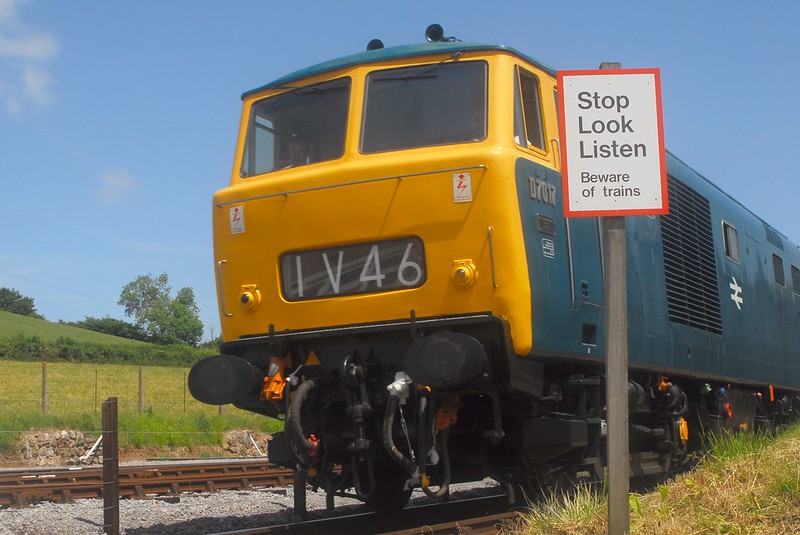
Another thing I mentioned that I hadn’t posted really: some pictures of old trains. Which, I know, isn’t something unusual for this site. But I did rather like this one:

Hymek passing Washford, Somerset & Dorset Railway Trust

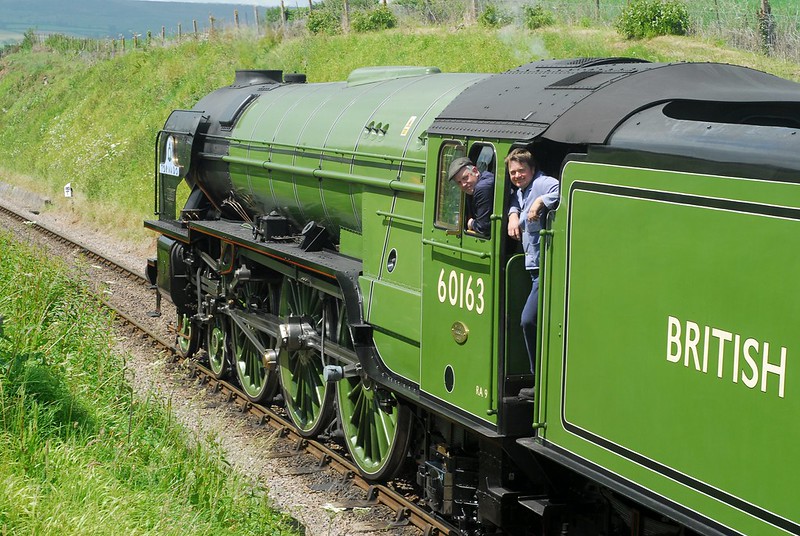
Which, I like to think, could almost be a Western Region publicity poster – or rail safety poster, maybe – from around 1964. The impressive new Hymek diesel-hydraulic, made in Britain with the latest German mechanical technology, sweeping past Washford with a non-stop express to Minehead. Here’s some more, and a rather newer steam engine.

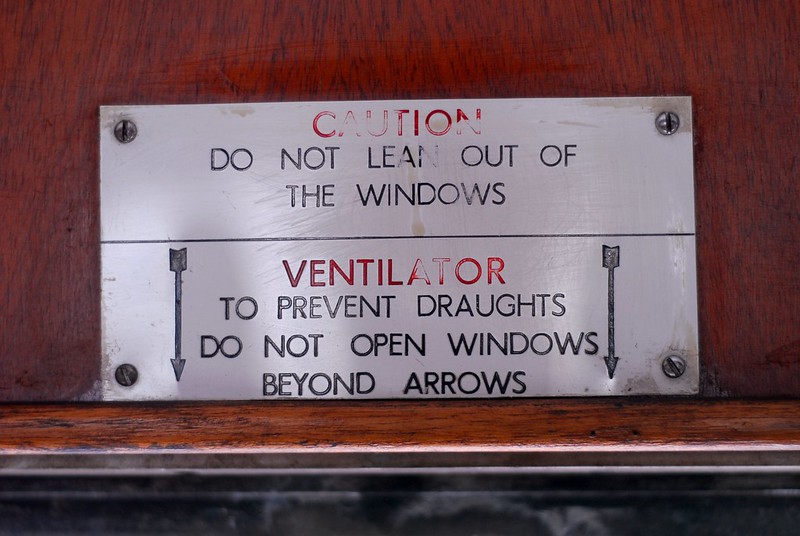
Carriage window

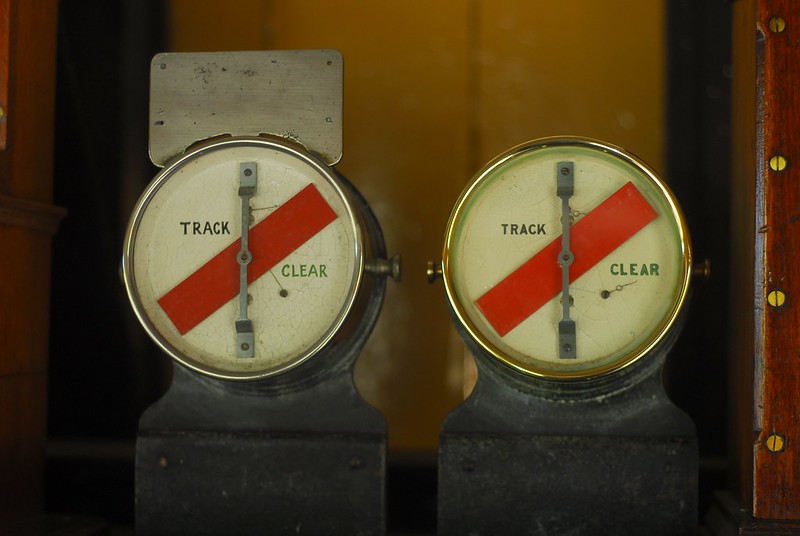
Track circuit indicators, SDJRT, Washford

60163 Tornado at the Somerset & Dorset Railway Trust, Washford

High Speed News

In which we look at trains and the money behind them

Today’s big news story: the East Coast rail franchise is to be temporarily taken into state hands, because the company running it, National Express, has decided that they can’t make the huge wodge of cash that they have promised to pay. Which, to be honest, many many people could have told you was a little unlikely.

The East Coast route has always been seen as a bit of a cash cow, ever since it has been operated by a single company. Back in the 1930s the LNER, the aforesaid first company to own the route from end to end, was struggling somewhat, as most of its profits came from servicing the declining heavy industries of the North-East. So, it negotiated itself away from the non-compete restrictions which hampered its London-Scotland timetable,* and started to introduce faster, record-breaking, headline-grabbing expresses. They introduced the longest regular non-stop train service in the world, and the fastest type of steam engine in the world; and introduced innovations such as at-seat radio services, and the “in-flight movie”. The route has stayed at the forefront of speed, technology and publicity ever since, and at several times has featured the fastest trains in the country.**

By the time privatisation came along, the East Coast route was one of the few profitable rail services in the country. It was quickly grabbed, by Sea Containers, the shipping company which had already bought British Rail’s Sealink shipping line. And everything went smoothly, for some time, because the route did indeed make plenty of money.

In this decade, though, there were problems. As the line was seen as a cash cow, other companies started running competing services over what was already a very crowded and busy route; and their franchise payment went up to £130million per year. Sea Containers tried to bring a court case arguing that there wasn’t enough room for anybody else’s trains on their line, but the case failed. The company started hinting that it was having trouble making money on the route, and that its position was financially unsustainable. In October 2006 the company filed for bankruptcy protection in the USA, and told the British government that they would walk away from the East Coast route if not allowed to renegotiate their contract. A month later, the government told Sea Containers that their franchise was being withdrawn.

In the auction for the rights to run the route from 2007 onwards, Sea Containers played little part, holding a 10% stake in a joint bid made in the names of Virgin and Stagecoach. The winner, though, was National Express. They promised to pay £1.4 billion in total, to operate the route from 2007 through to 2015. Rather more, in other words, than the £130 million per year that Sea Containers had had trouble meeting. You have to wonder what was going on in their decision-making. It must have been obvious to them that the line would have trouble generating that much money. Did they really think they had enough spare cash elsewhere to prop it up with?

It’s not surprising at all, then, that they haven’t managed to keep the line running. It’s more surprising, though, that it apparently took National Express 18 months to realise that their sums were a bit off. Never mind the recession: passenger figures were already falling well before National Express took over, which was partly why Sea Containers had trouble. Maybe they thought they could get things to turn around faster. Evidently, though, they made a mistake somewhere. That still leaves this, though, as one of the more predictable news stories of this part of the decade.

* ever since the mid-1890s, the East Coast and West Coast companies had had a minimum-time agreement restricting the point-to-point average speed of their trains to around 50mph, following the dangerous “Race To The North” competitions of 1895.

** For the past 20 years almost it has had its own specially-designed trains which are capable of 140mph, until recently beating every other domestic train in Britain – but for the whole time, it’s been in the slightly silly position of having a top speed limit of 125mph, leaving that speed advantage unusable.

Photo Post Of The Week

In which we compare analogue and digital

It took me a while to catch on to the idea of digital photography. “Bah,” I thought, “you can’t spend hours in the darkroom with a digital photo. And I’ll always need to keep buying more and more disk space.” Both slightly false excuses, to be honest: it’s years since I’ve had easy access to a darkroom, and the disk space doesn’t get burned up that quickly. Generally, though, it was a good thing that I didn’t rush into it; I saved up, until I could afford a good camera, rather than jump in at the cheap end. And I’m pleased with what I got.

This post, though, follows up from the previous Photo Post Of The Week, in which, as I said, K and I walked up through London from Tate Modern to Clerkenwell, retracing a route I’d done a few years before. Both times, I took photos. Three years ago, I had my cheaply-grabbed-on-Ebay Nikon F801 with me. Here’s one of the photos:

Grand Avenue, Smithfield

This time, we took K’s nifty little compact Panasonic. Remembering the last trip, I deliberately retook that last photo with it:

Grand Avenue, Smithfield

I can see straight away which is the better photo. That doesn’t mean I regret waiting until I could afford a good digital camera; but it does make me wonder what opportunities I missed, and what I could have improved with my film shots.

Local Transport

In which we consider the Wensleydale Railway

Sometimes, when we’re idly sitting on the sofa after work, we put the telly on and can’t even summon the energy to change the channel. Instead, we leave it showing things we’d never normally bother watching; but sometimes that throws up an interesting gem. Like tonight’s One Show for example. We wouldn’t normally watch The One Show, but occasionally it does have some interesting inserts. Tonight: an item on the Wensleydale Railway.

Coming from Oop North, I’ve been on the Wensleydale Railway a couple of times. It’s pretty long, for a private railway, pushing the length of busy, popular private railways such as the Ffestiniog or the North Yorks Moors.* Unlike those railways, though, it’s something of a quiet backwater, slightly ramshackle, with a sparse service operated mostly by 1950s diesel trains which main-line companies retired in the 90s. Being a bit of a backwater, appearing on the telly will hopefully be a big boost for it: not many people tend to know it’s there. It may be in the Yorkshire Dales but it stops just short of the National Park; it may be on the A1, but it’s damn hard to notice from the road.

One of the Wensleydale’s directors appeared on The One Show, and told the world what a unique railway it is; and how it performs a vital link in the community, and in Wensleydale’s regeneration, providing services to commuters and enabling them to get to major regional centres. Neither of those claims, really, are true. The director carefully skirted around the issue of whether the Wensleydale provides those services right now. Certainly, they’re hoping that it will do: that the company will be able to connect to the main line at Northallerton, and thence provide a connection to Newcastle, York, Teesside and Manchester. Right now, though, it stops short, and completing the connection seems to be on a distant horizon. When it does, the company will need a fuller timetable to be a reliable link: at present it operates three trains a day, on about 185 days of the year. The first one starts moving just after 9 o’clock; the last has stopped by 5.

Running a community rail service is hardly a unique aspiration to have, too. In fact, almost every private, preserved, or steam railway in the country has aspired to run a commuter and/or community service at some point. Very few have even got as far as trying it; the Worth Valley Railway did, in the late 1960s, and rapidly found it to be unviable. One private railway has done it successfully: the Romney, Hythe and Dymchurch, operating services for schoolchildren. They do not, unlike most private railways, rely on volunteer workers to operate. The Ffestiniog also provides a genuine service for local residents; but it is strongly subsidised by their tourist revenues, which the Wensleydale doesn’t have.

There are two big problems with trying to operate a community service; well, make that three big problems. Firstly, there are two connected problems: price, and workforce. Railways are workforce-intensive, and private railways have to either pay staff, or get volunteers to turn out every day. Moreover, if they want to run a commuter service, they have to persuade those volunteers to start very early in the morning. Paying the staff, and the running costs, is very expensive; when you’re operating a railway which was considered too expensive to run at a profit, you end up charging fares which are too expensive for commuters. A return ticket on the Wensleydale already costs over £10, for the full line.** Moreover, there’s a third problem: speed. Nearly all private railways have to operate with a blanket speed limit of 20 or 25mph. Over the sort of distance the Wensleydale operates, that means a long journey. Fine for a summer jaunt; not good for serious travel. It’s the speed, more than anything else, that makes the Wensleydale’s long-term aims rather impractical.

There’s nothing wrong with the Wensleydale aspiring to their aims, of being a community railway operating a non-tourist service. I would be very surprised, though, if they do manage to complete them, purely because so many have gone before and so many have failed. If the Wensleydale think they are unique, and if they don’t realise that they are treading down a well-trodden path once more, they are very unlikely to reach that path’s end.

* The Ffestiniog will shortly have the largest steam railway network in the country. At the time of writing it operates two routes, the original Ffestiniog Railway (Rheilffordd Ffestiniog) out of Porthmadog and the new Welsh Highland Railway (Rheilffordd Eryri) out of Caernarfon; the project to complete the link to join the two lines together via Beddgelert is already under way.

** The Ffestiniog gets around the price issue by having local residents’ discount cards.

Recent Search Requests

In which we know what you’re looking for

From the past month or so:

1/64 scale castle. 1/64 scale is also known as “S Gauge” in the model train world. I have some photos of an S gauge model train on here; no castles, though.
addicted to prostitutes grimsby. I’ve seen what Grimsby prostitutes are like generally, and, well, grim is the word.
describe a seaside town in winter. “Grey” would be a good start, usually.
did horne and corden write there new sketch show?. If they didn’t, they should consider asking for a discount next time.
evening post crash bedminster. The junction of Winterstoke Road and Bedminster Down Road is still covered in flowers and mementos, after a woman died when a car crashed into a stone wall there late one night recently. I should pop down and take photos of it all before it rots away.
finding a deat bat meaning and symbolism. Well, I know what to do when you find a dead bat on your doorstep, if you’re British at least. Its meaning: erm, the cat managed to kill a bat, I think. As for symbolism, I’m at a bit of a loss.
mark bradshaw replacement bedminster surely has to be a bit of wishful thinking, because it’s a couple of years until Bradshaw (one of Bedminster’s city councillors) is up for re-election. He’s recently been tipped as an ideal Bristol Labour leader, although his pet projects have a reputation for releasing misleading press releases.
men diamler did a very good performance and DJ set at The Cube on New Years Eve, despite being (by his own admission) the most alcohol-infused act of the evening, as I mentioned at the time. Still, as I said: rather good.
naked forestmen. That’s enough Recent Search Requests, I think.