+++*

Symbolic Forest

A homage to loading screens.

Blog : Post Category : Dear Diary : Page 12

Heart of stone

Or, taking The Mother shopping

The other week, I said how you can’t just bury a dead body without there being an awful lot of paperwork involved, at least not in any sort of above-board way. Moreover, one thing I didn’t even get to was that: when you do bury a body, you can’t just pop the gravestone up at the head of the grave there and then. The rules vary from place to place, but to avoid causing some sort of tragic subsidence-induced gravestone-toppling accident, you have to leave the grave to settle for a number of months with some sort of temporary grave marker in the ground instead. Then, some while later—and potentially when you’ve saved up the money, because gravestones are expensive—you can pull up the temporary cross or whatever and replace it with the final thing.

As the months pass after the funeral, then, you can slowly start thinking about what style of gravestone you might like. The Mother, naturally, was all for just going through the catalogue the undertaker had sent her in the post, but I thought it might be a bit nicer to see if we could find a local independent business to work with, instead of a faceless national chain. “I bet all the ones in the catalogue are hugely overpriced,” I said, appealing to her miserly side. “Why don’t we find a local stonemason instead, who you can go and talk to?” But of course I knew we couldn’t get a gravestone put up until May, and in May it would have been impossible to go looking for one. Eventually, though, I realised that we should probably start thinking about getting one before it became impossible again. So, I made the trip up to The Mother’s house, so I could get the wheels in motion.

I was all prepared to go with the “this will be cheaper than the undertaker” line again, but it turned out she had lost their catalogue anyway. “It doesn’t matter how much it is,” she said, “if it’s for your dad.” If only he’d had the same attitude about me, I thought, and didn’t say.

The other thing I didn’t say, but which to my mind was constantly hanging in the air, was: do that many people choose their own gravestone? It must be all people like The Mother, widows and widowers. How much do they actually think to themselves: this will be my gravestone one day? Do they revel in it, or do they just try to blank it out of their mind? I’m sure The Mother, who has been blanking things out of her mind and refusing to talk about them her whole life, will be doing the latter almost without thinking about it, as she’s had so many years of practice.

It’s strange how many Elderly Person tropes The Mother has seemingly adopted. I wonder at what point do they suddenly become the logical way, in your mind, to behave. Her current preferred way to pay for things seems to be to carry around one or two empty coffee jars filled with coins, and complain about how heavy they are. She can’t walk unsupported for more than a few yards without being at risk of toppling over. “You should get a stick,” I said. “The doctor told me to get a stick. Your uncle’s going to make me one from a Brussels sprout plant.” I tried to explain, firstly that he’s probably thinking of a Jersey cabbage; secondly that she doesn’t want an all-natural grown-in-the-ground wooden stick, she wants a nice light sturdy and easy-to-grip medical grade one; and, thirdly, she wants a stick now, not whenever my uncle manages to harvest and dry out a cabbage stem. Nevertheless, without a stick, I still managed to get her to the stonemason’s showroom without her toppling over at any point.

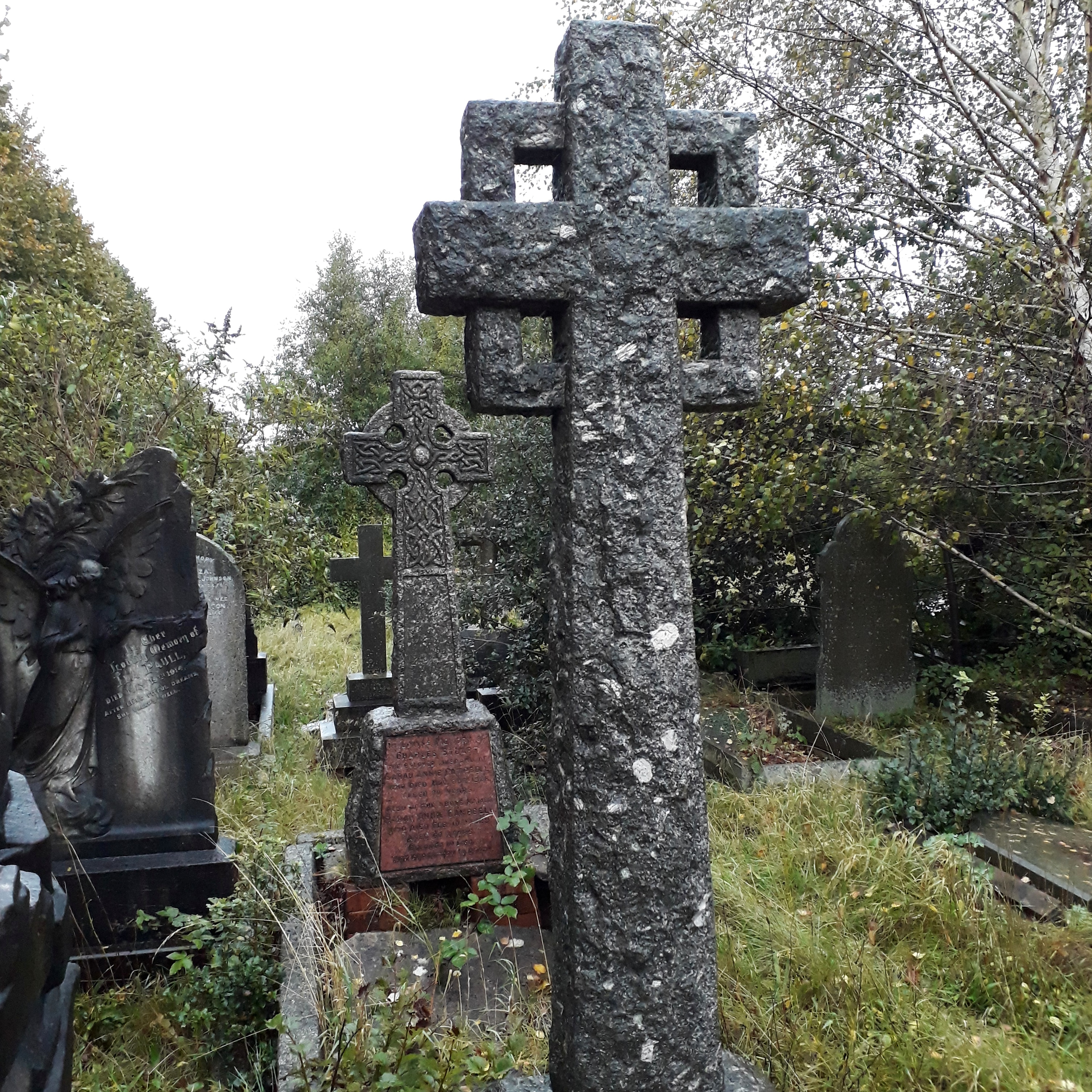
When I was a student I spent a number of weeks making site visits to various disused graveyards around the Isle of Lewis, and I remember thinking at the time: they must be terrible places for family history. Not much of the local stone on the Isle of Lewis is actually carvable; it’s too hard for that. So, most of the grave markers from say 150 years or so ago are plain, rough, uncarved pieces of rock that just happened to be roughly the size and shape of a gravestone. If you wander round one of those graveyards, all you can see are these rough teeth, no inscription, no date, no information. No risk of that now, of course. Moreover, graveyards all seem to have extensive lists of what you are and allowed to put up. I say “all graveyards”; I can quite believe that The Mother’s parish council are particularly pernickity and snob-nosed about it, going by the tone of the signs at the entrance. So, we’re not allowed anything more than 42 inches high; no life-sized angels for Dad then. No kerbstones around the grave, just a headstone. All the inscriptions and designs must be approved by the burials clerk. No inscriptions on the sides or back of the headstone. Incidentally, if you go and have a look around the cemetery you’ll see plenty of graves that do contravene the modern rules.* Clearly, they were erected in a more liberal and tolerant time than we are in now. The modern within-the-rules graves, though, are certainly much more legible than the older ones, to say nothing of those ones I saw on the Isle of Lewis, because they all tend to be in polished black marble with gold or silver inlaid lettering. And, indeed, that was the sort of product the stonemason guided us towards. “It weathers well,” she said.

“Won’t it get dirty from the rain? From all the pollution in the rain?” said The Mother.

“No, it’ll discolour a lot less than a paler colour,” said the stonemason. I’m not sure why The Mother thinks she has particularly dirty rain.

“I hate to be blunt about this,” I lied, “but we do want to plan ahead because eventually my mother will be, you know, using it too.” She looked at me, her expression cold, just as always.

“Oh yes,” said the mason, “a lot of these stones will have space for two inscriptions.” At least we definitely can’t have any of the tacky heart-shaped ones, I thought. “Or you can have one that has two halves, and we will leave one half blank.” My grandparents’ headstone is like that, in the shape of a book; but they died three months apart so the thing came along in one go. It would look a little odd just to fill half of it in for now.

In the end, to be honest, I think it went relatively well. The Mother will be happy with a nice, straightforward, classic design. It might look like most of the other graves in the cemetery, but at least it will look reasonably aesthetic, at least I don’t have to guide her away from something awful, which is mostly what I was expecting to happen.

“Typical,” she huffed, as we got back into the car and I pulled away.

“What?”

“That solicitors over there,” she said. “The first thing it says on their sign is: we can help you with divorce!”

“It’s something a lot of people need,” I said. I often thought, when I was a teenager, that The Mother would have been much happier if they had divorced, when I saw the effect my dad’s frequent sulks and rages had on her.

“Yes, well,” she said, “they shouldn’t.” I turned the stereo on, so we didn’t have to speak.

* I can’t be sure about that last one off the top of my head, to tell the truth. In Greenbank Cemetery, which I wrote about recently, it seems to have been standard practice to put the family surname on the back of each headstone, which must have made navigation an awful lot easier.
The bureaucracy of death

Or, negotiating the process

This is another post in a vaguely-connected series about my dad’s death, just over a year ago now, and the various events and processes that followed as a result. If you haven’t had to deal with a death in the family yourself: you might be vaguely aware of some things, less aware of others, but some parts of it will no doubt be a complete mystery, as they were to me. Moreover, if you do have to deal with a death in the family, then most likely everything you do is through a fog of stress and uncertainty. It has taken me a year to write down some of the things here, partly because of how much work all the things listed here were to do.

The first post on this—which was written shortly after the events—ended with me and The Mother leaving the hospital, Dad being wheeled down to the mortuary carefully out of sight of all of the patients and visitors, the hospital staff not entirely sure where we should be collecting the death certificate from. Probably, though, the Bereavement Office. “Phone ahead first,” they said, “they can take a while to do it.”

What’s the process after that? Well, that’s fairly straightforward to find out, as indeed it should be. You collect the Medical Death Certificate. You take the Medical Death Certificate to the local Register Office,* local to where the death happened rather than to where the dead person lived, incidentally. The Registrar fills out the Death Certificate itself, hopefully with a nice pen, and you sign it. It then gets filed away to be bound into the register proper, and they print out as many printed copies as you’re willing to pay for. These are the things people think of as death certificates, and they are the things you need to send off in the post to the dead person’s bank, building society, and so on and so forth, to kick off all their death-related processes in turn.

May as well get the ball rolling early, we thought. As I mentioned previously, we popped into the undertakers, who were lovely and friendly and helpful in many ways, but explained that they couldn’t officially act on our instructions until we gave them a green form that the Registrar would write out for us, giving us permission to carry out a burial. We phoned the Register Office to make an appointment. “Have you got the Medical Death Certificate yet?” said the receptionist.

“Um, no. The hospital said they would have that for us later. Or tomorrow.”

“You can’t make an appointment until you actually have a Medical Death Certificate.”

I was tempted to phone back and lie, but it wasn’t really worth the effort. I tried phoning the hospital; they’d gone home already.

The next day, we called and called and eventually the hospital Bereavement Office did pick up and say that yes, they’d written out the Medical Death Certificate, we could come and pick it up at any time that they were open, or weren’t having a meal break, or a tea break. “Oh, and we close at 2 most days.” We hotfooted it back down to the hospital straight away, to have a reasonable chance of catching someone in the office, and wandered around the hospital corridors trying to find the place. I half-expected it would be next to the hospital chapel for efficiency. It wasn’t, but inside there was a churchlike air of slow-moving peace and eternal silence.

We explained why we were there, and the woman behind the counter started shuffling through large boxes of uncollected death certificates (medical). And then shuffling through them again. This wasn’t a good sign.

“What did you say the name was?” A third shuffle. “It’s not here. Have you tried the ward he died on? We might have sent it up there.”

So, upstairs again to the ward we had spent so much time in the day before. Onto the ward by tailgating behind somebody else, as usual: so much for physical security. And to the nurses’ station, where some of them did indeed recognise us. “Oh, I don’t think they’ve sent it up here.”

They had, however, and after much rooting around under more paperwork and through various files lying about at the nurses’ station, we finally had a Medical Death Certificate. What did it say? I can’t tell you. We couldn’t see it. It consisted of a sealed envelope. “Don’t open it,” said the nurses. “You have to take it to the Registrar.” And, indeed, it said the same on the envelope. Deliver to Registrar. Do not open, unless you are said Registrar. Do not pass Go or collect £200, either.

To recap a moment: we didn’t have a choice of Registrar. All deaths at this particular hospital, had to be registered at the same place. Big cities might have more than one—Bristol has an outstation Register Office at Southmead Hospital that only does births and deaths, so if someone is born or dies there it can be registered on-site—but Dad didn’t die in a big city, so we didn’t have a choice. We also couldn’t look at it. Why, then, do the dead person’s family have to courier the Medical Death Certificate around themselves, sealed, with all the associated goings-on with finding out exactly where in the hospital it is?

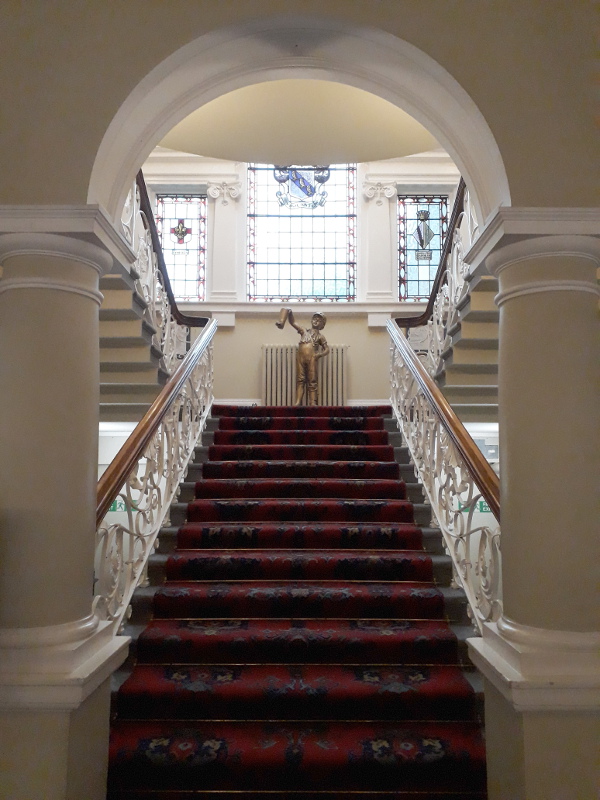
The registration itself was relatively uneventful. It was in the Cleethorpes Old Town Hall building, by the seafront, not needed as a town hall since Grimsby and Cleethorpes merged into a single borough back in the 1990s. No doubt the big formal rooms are now used for weddings; births and deaths are tucked away downstairs. Naturally, I took the opportunity to take a quick snap of the architecture.

Inside Cleethorpes Town Hall

The Registrar left us to wait for a while whilst she looked at the secret contents of the envelope, I suppose in case it said “They did it!” inside. When happy that everything was normal and above-board she invited us in, explained how death certificates are written, took us through what it all meant and asked who wanted to sign it as the Informant. “I don’t think I could write straight,” said The Mother, “my hands are too shaky,” so I signed the register with, as expected, a very nice fountain pen. We collected our copies, warm from the printer, and paid up. We were given the “very important” green form, the one the undertakers were waiting for, the one that said the Registrar definitely wasn’t going to get the Coroner involved in anything, so we were allowed to bury one body. Cremations, apparently, have a lot more paperwork: that nice Dr Shipman’s fault. And then, we were done.

We had a look through all the various RAF memorial boards in the entrance, collected from some of the many closed RAF stations in the surrounding area, just in case Dad’s uncle, who died whilst trying to drop bombs on Frankfurt, was listed; he wasn’t. We went back outside, into the cold wind coming off the sea. Death registered. Achievement unlocked.

* Yes, most people call them Registry Offices. They’re actually called Register Offices. I don’t know why most people call them Registry Offices.

The railway in the woods

Or, some autumnal exploration

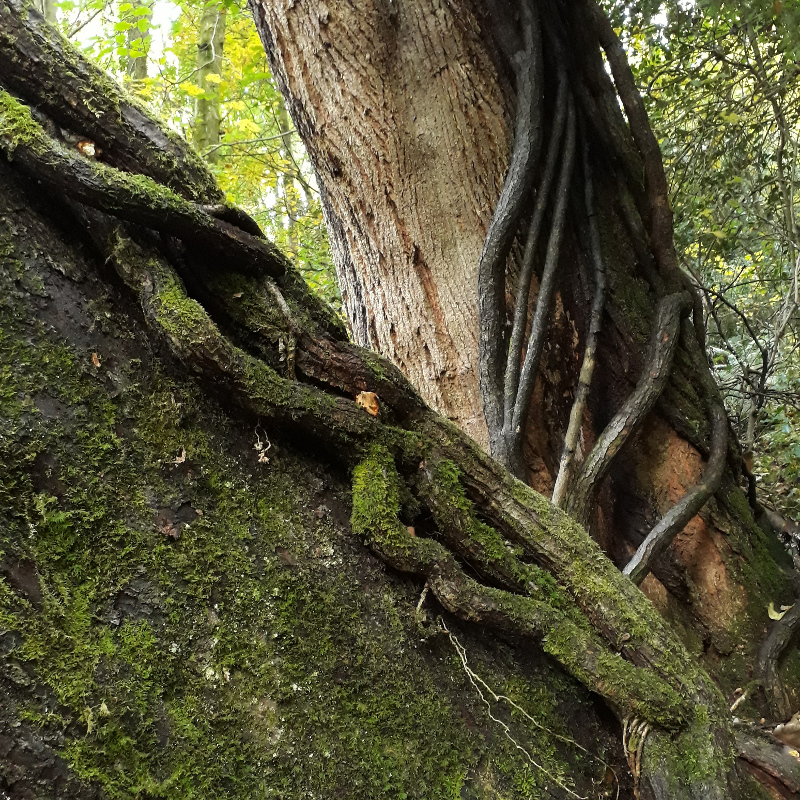
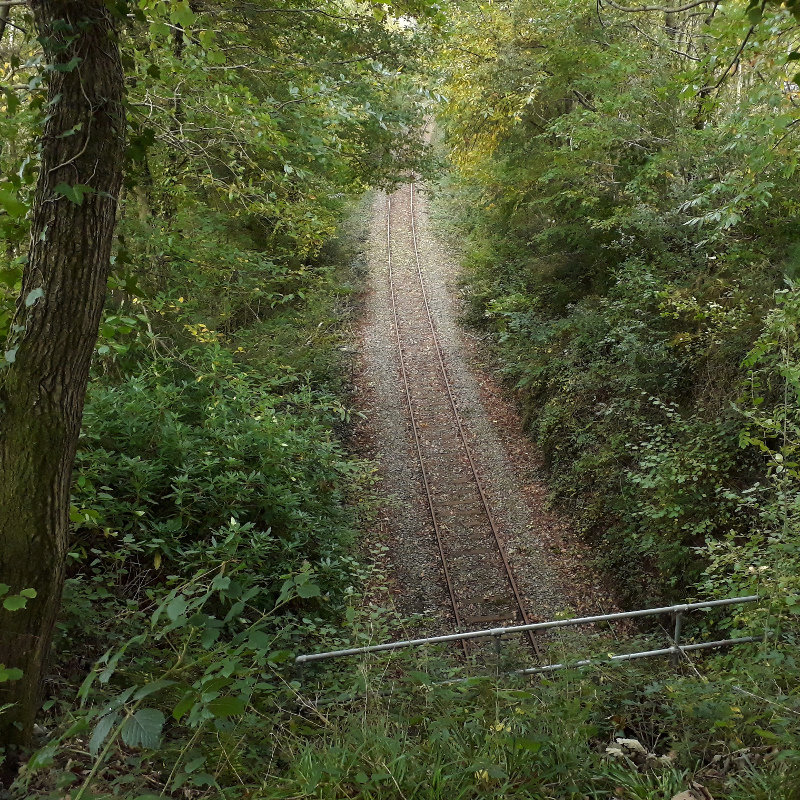
Today: we went to wander around Leigh Woods, just outside Bristol on the far bank of the Avon Gorge. It’s not an ancient woodland: it is a mixture of landscapes occupied and used for various purposes for the past few thousand years. A hillfort, quarries, formal parkland, all today merged and swallowed up by woodland of various forms and patterns, although you can see its history if you look closely. I love walking around damp, wet countryside in autumn; although today was dry, everything had a good soaking yesterday and earlier in the week. The dampness brings out such rich colours in photos, even though I didn’t have anything better than the camera on my phone with me.

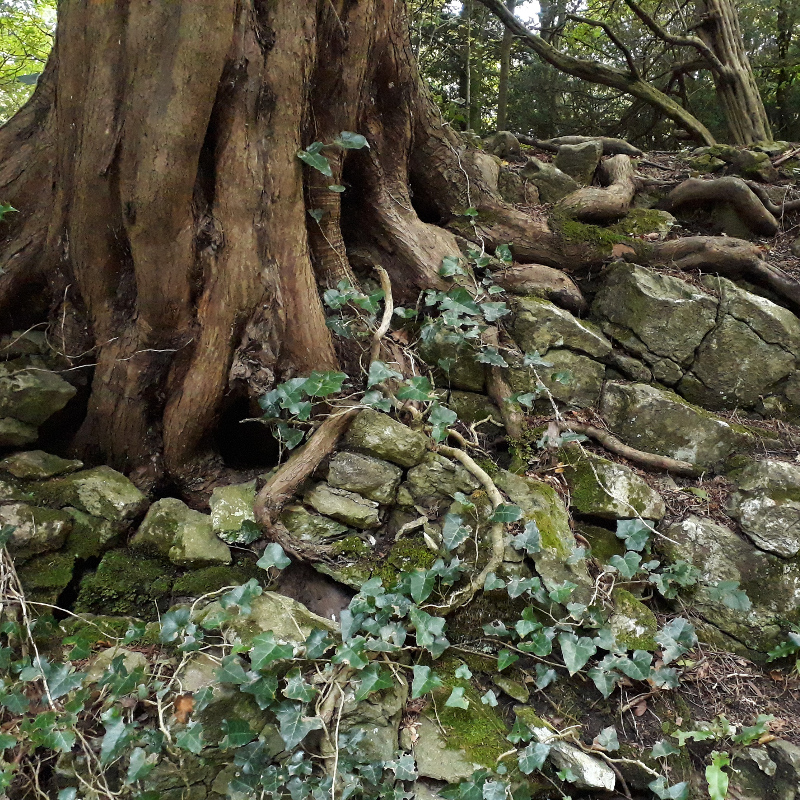
Twisted roots

Twisted trunks

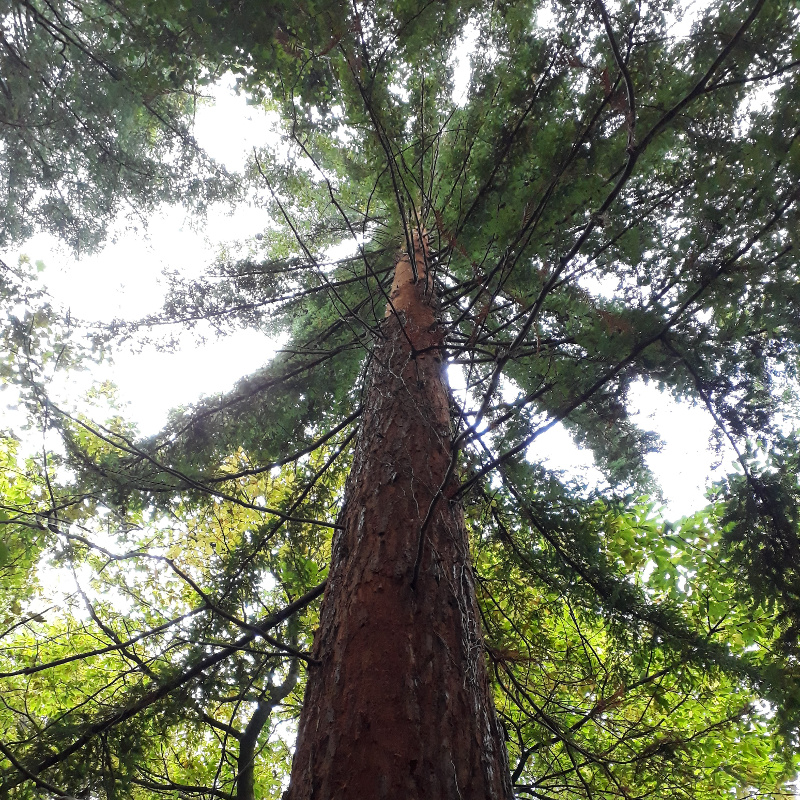
Part of the woods, “Paradise Bottom”, belonged to the Leigh Court estate and was laid out by Humphry Repton, the garden and landscape designer who should not be confused with Boulder Dash. It includes a chain of ponds which are now very much overgrown, their water brown and their bottoms thick with silt; and some of the first giant redwood trees planted in Britain, around 160 years ago now.

Redwood, of not inconsiderable size

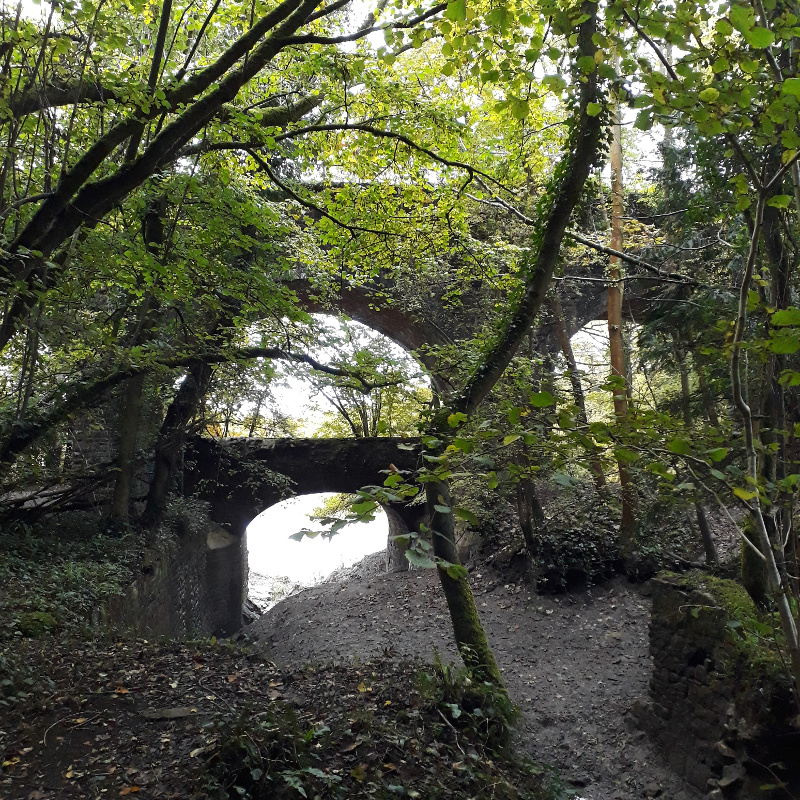
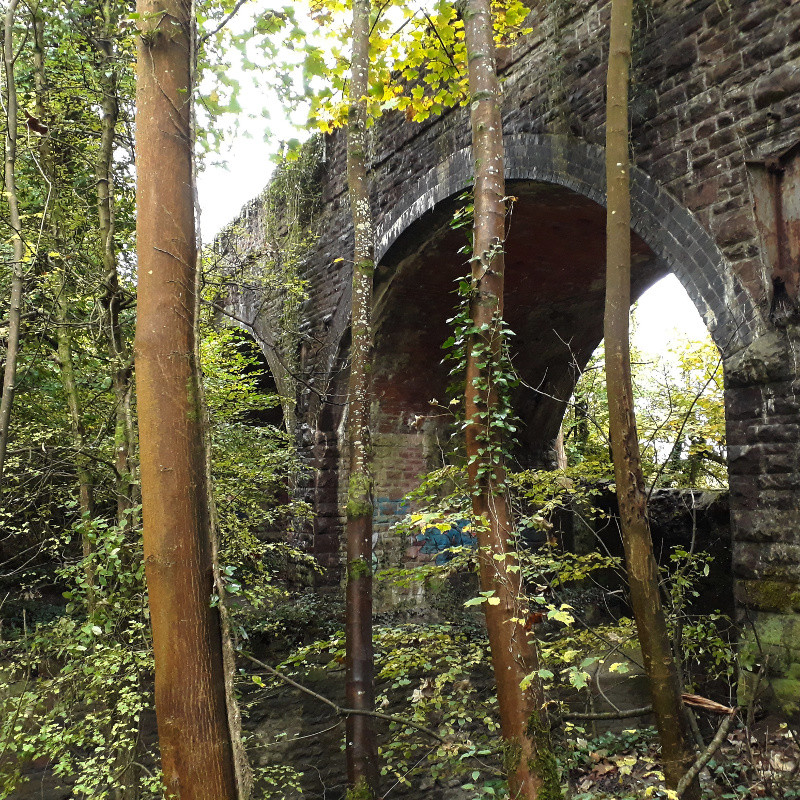
The ponds drain into a sluggish, silty stream which trickles through the woods down into the Avon, the final salt-tinged part of the stream running under a handsome three-arched viaduct built by the Bristol & Portishead Railway, back when when the redwoods were newly-planted.

Railway viaduct

Railway viaduct

If you’ve heard of the Bristol & Portishead, it may be because of the ongoing saga of when (if ever) it will reopen to passengers again. It closed to passenger traffic back in the 1960s, freight in the early 1980s, but unusually was mothballed rather than pulled up and scrapped. At the start of the 21st century it was refurbished and reopened for freight trains, but not to full passenger standards. Although there have been plans on the table for ten or fifteen years now to reopen it to passenger traffic, years have passed, the leaves in the wood have fallen and grown again, and nothing keeps on resolutely happening. The main issues are the signalling along the line (token worked, I understand, with traincrew-operated instruments) and its single track, which limits maximum capacity to one train each way per hour at the very most. Aside from putting in a station or two, these are the main factors which at present prevent it from being reopened to passengers.

When I moved to Bristol, over ten years ago now, the Bristol & Portishead line was busy every day with imported coal traffic. Now that that is fading away, the line itself is much quieter, and indeed can go for days at a time with no trains at all. Its railheads are dull, not shiny, as it curves through the lush green woodland. I walked up to the top of one of its tunnel mouths, and looked down upon it silently.

The railway in the woods

The spread of death

Or, exploring some local history

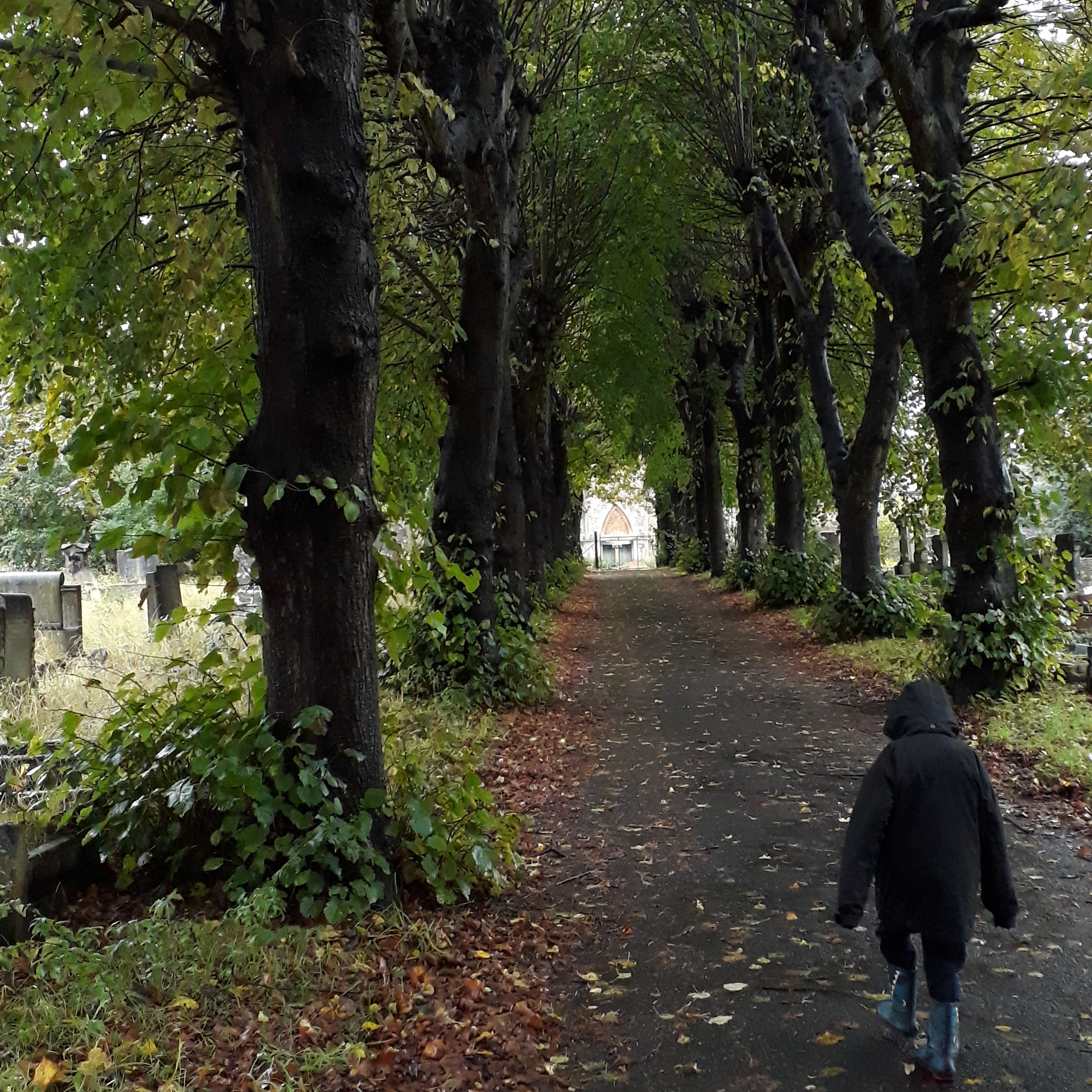
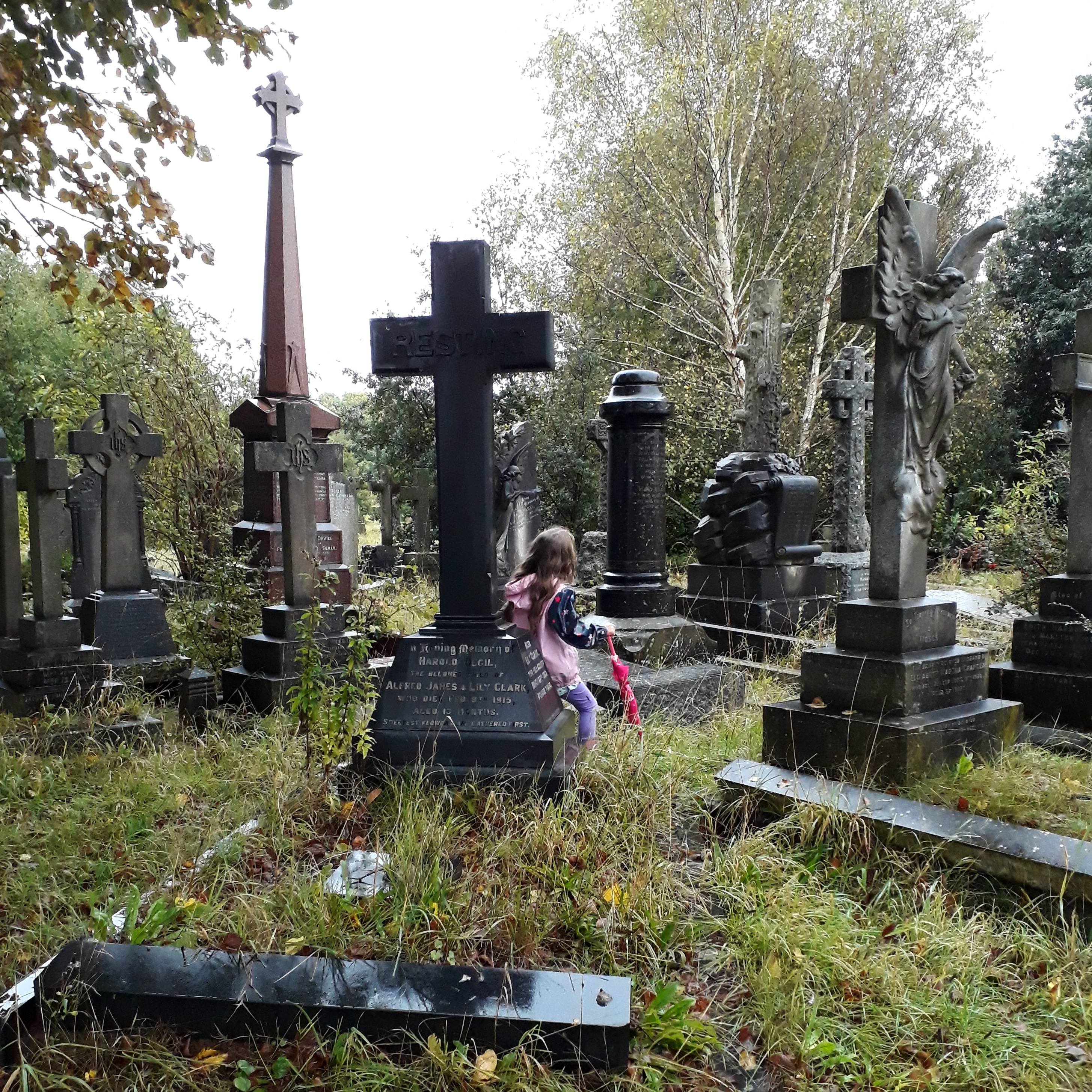
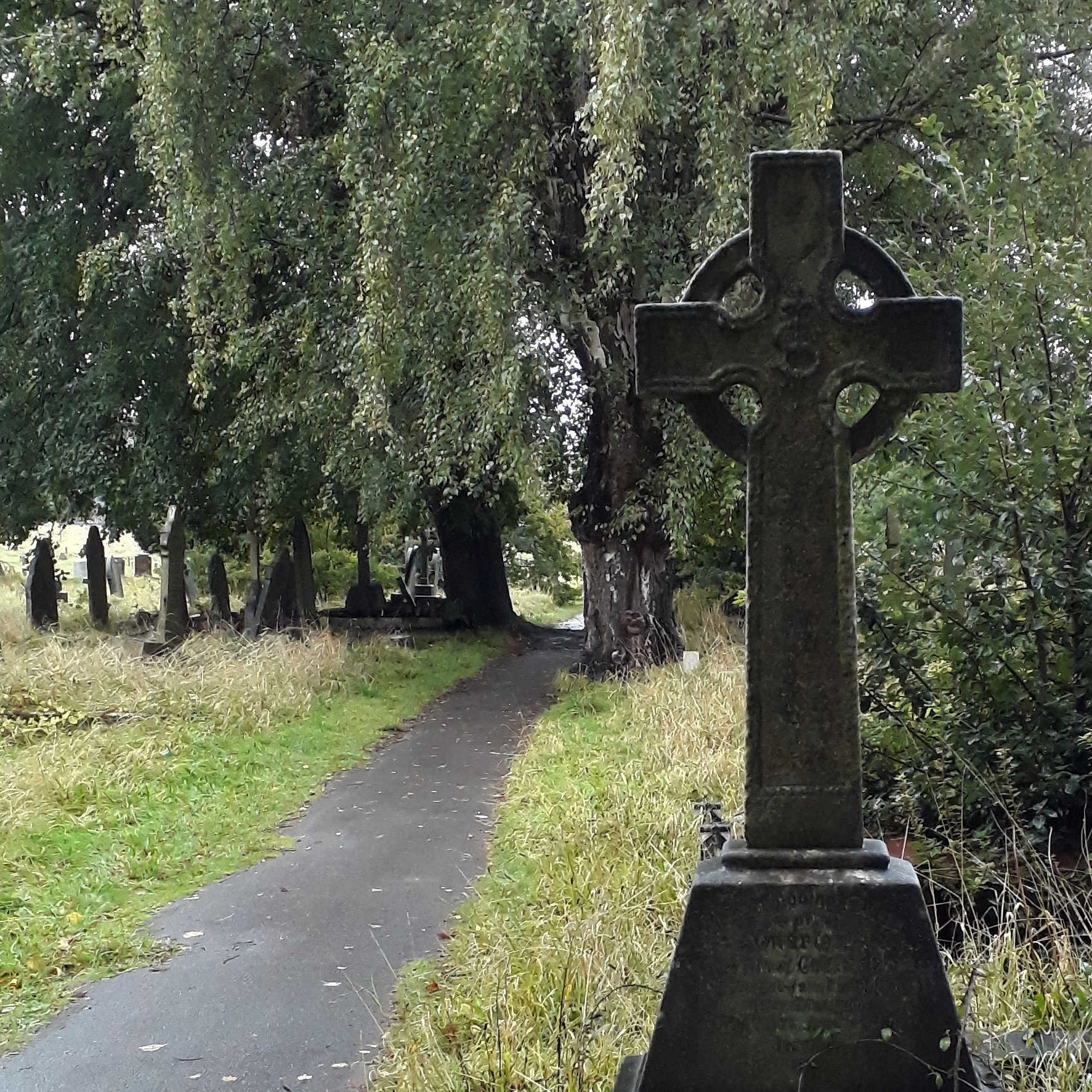
Yesterday, after the rain had stopped, we went for a walk around Greenbank, the local Victorian garden cemetery. It’s a lovely place to visit whatever the weather, but on a cold day, after a rainstorm, with drips coming from every branch and all of the colours having a dark rain-soaked richness, it is a beautiful quiet place to wander around. Even when the children are pestering you to turn around and head back home so they can have some hot chocolate and watch TV. “It is a very hot chocolate sort of day,” said The Child Who Likes Fairies.

Wandering down the avenue

Exploring the graves

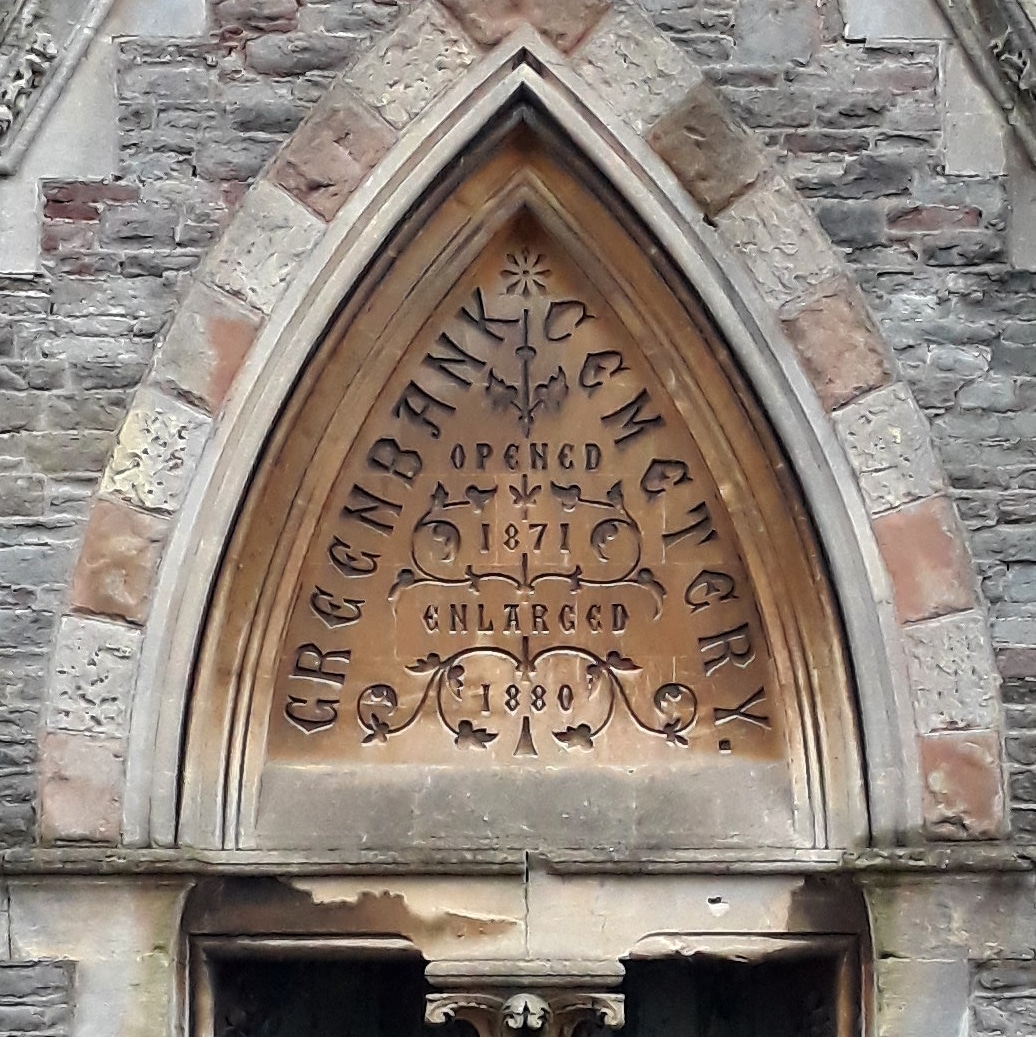
At the centre of Greenbank Cemetery is a connected pair of mortuary chapels: one for Anglicans, and a separate but identical one for other forms of Protestant. They have been derelict and fenced off for a long time, and their central wooden spire was taken down sixty or seventy years ago, but they are still surviving despite the failure of plans a few years ago to restore them and make them usable spaces once more. Above the entrance to the central atrium, between the two chapels, is a finely-carved inscription. “Opened 1871. Enlarged 1880.”

Greenbank Cemetery, Opened 1871, Enlarged 1880

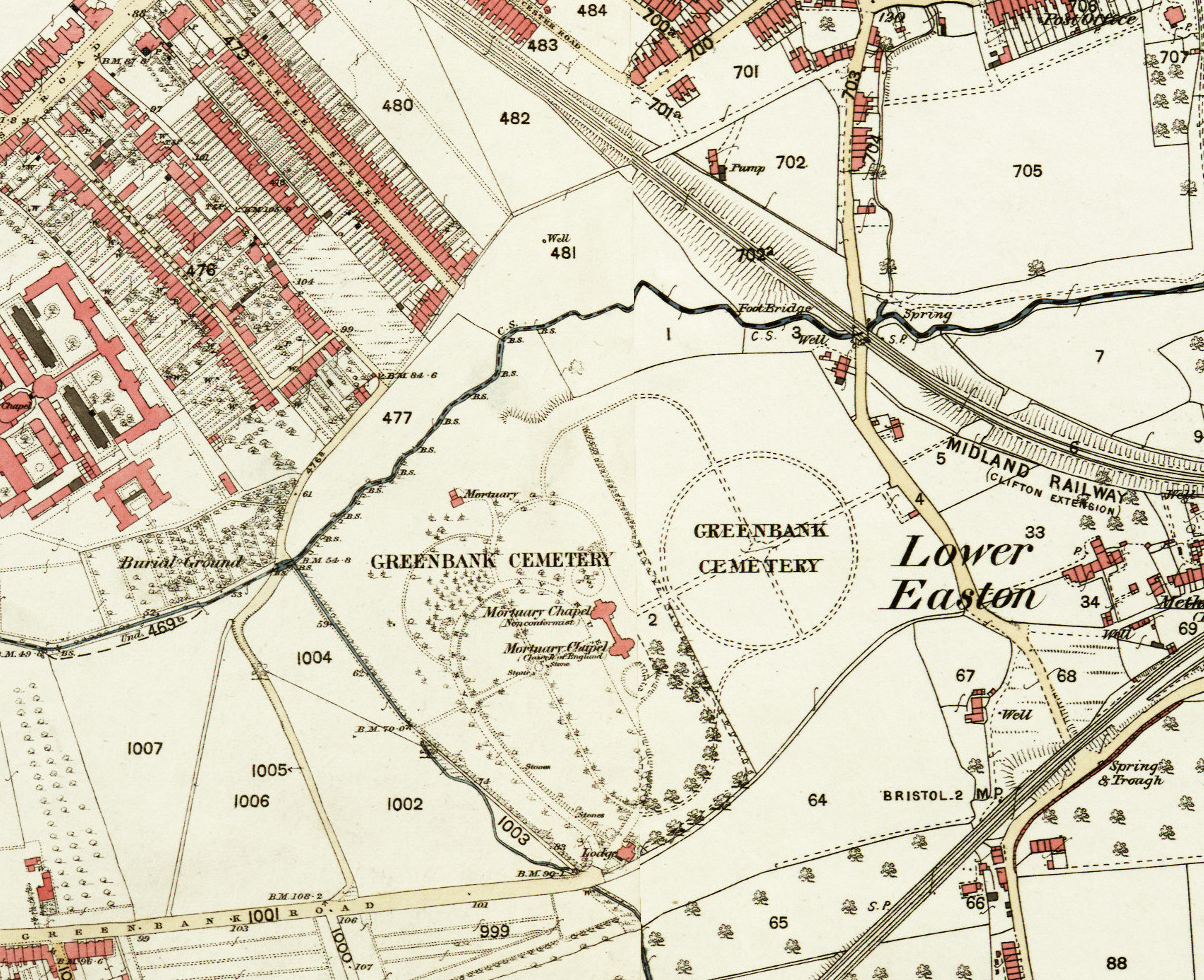
Nowadays when you look at Greenbank on a map it’s surrounded in many places: by roads, by housing, on one side by a disused railway line. So I thought I’d dig into the archives to find out what its original groundplan was, and which parts were extended. Luckily, thanks to the fantastic work of Know Your Place Bristol and their maps, this was relatively straightforward to do. This first map is dated to 1880-81, so it seems to be after the first phase of enlargement of the cemetery. If you don’t know the area, note that it is bounded by an open stream to the west and north, and that Greenbank Road goes up to the cemetery gates and no further. I assume the original area of the cemetery was the part centred on the chapels, and the extension was the area east of the line of trees.

Greenbank Cemetery, c. 1881

In many ways, even without the big garden cemetery this would be a typical landscape for the fringes of a growing Victorian city: a hotchpotch mixture of farmland and unplanned speculative terrace-building. There are rows of houses without proper streets in some parts, streets laid out without houses in others, and a city-sized workhouse with its own private burial ground behind it. If I’d extended the map to the north or to the south, you’d see a typical Victorian park: Eastville Park on one side and St George’s Park on the other.

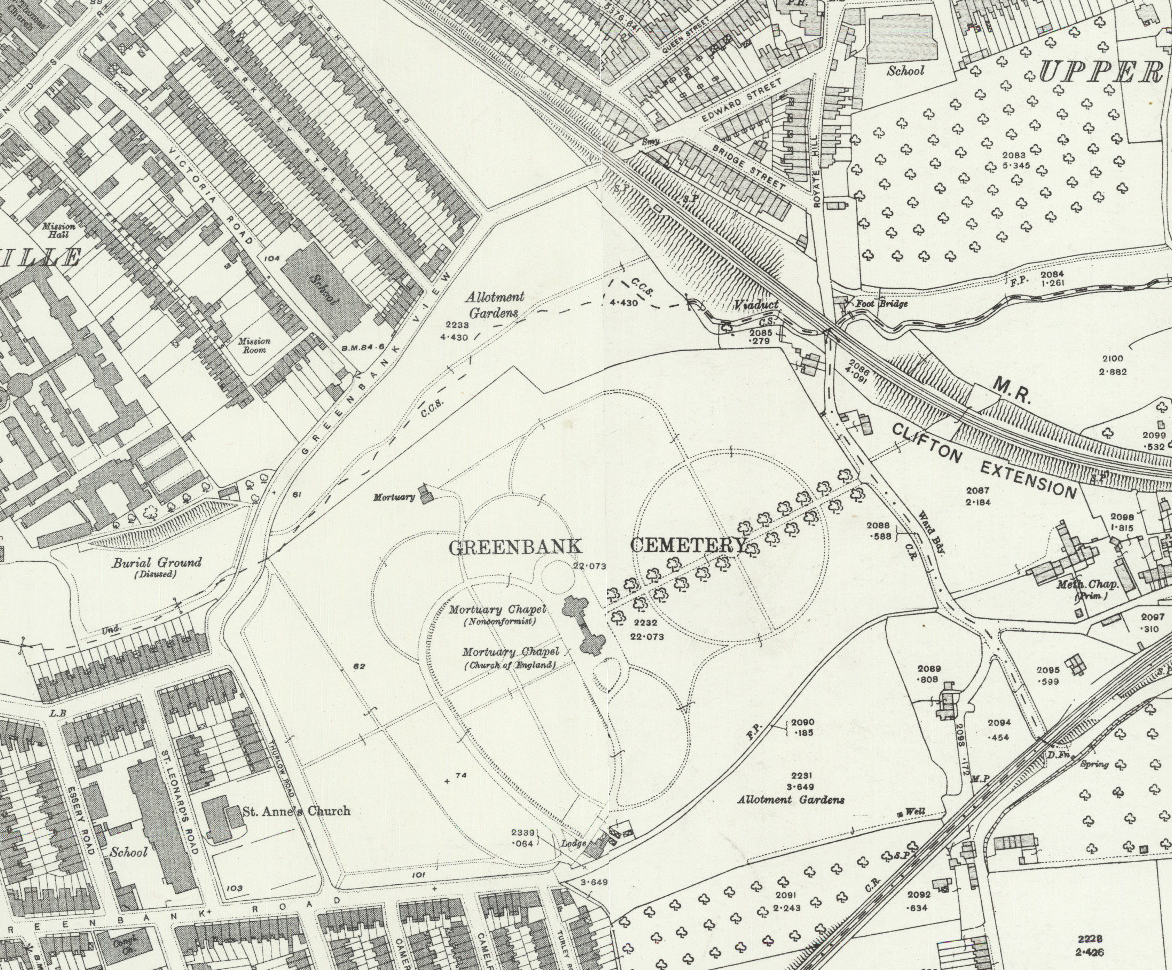
If we skip forward thirty years or so, we can see how much the landscape has “filled out”. Moreover, we can see how the cemetery has been expanded to the west. The stream has been culverted; the land to the north and south of the cemetery has been taken by allotments. This map is from 1912; I’ve traced a map from 1902 which doesn’t show this, so we can assume this expansion took place some time in the Edwardian period, more or less.

Greenbank Cemetery, c. 1912

In that thirty years huge parts of Easton which previously had just been sketched out for development have now become packed terraced streets, and some of the terraces which were built along narrow paths now have proper roads to them. Schools have been built, and a church. There’s a lot less open space, but there’s still some, here and there. Fishponds Road has acquired trams, up in the top-left corner; and the workhouse have stopped burying their dead on their own land.

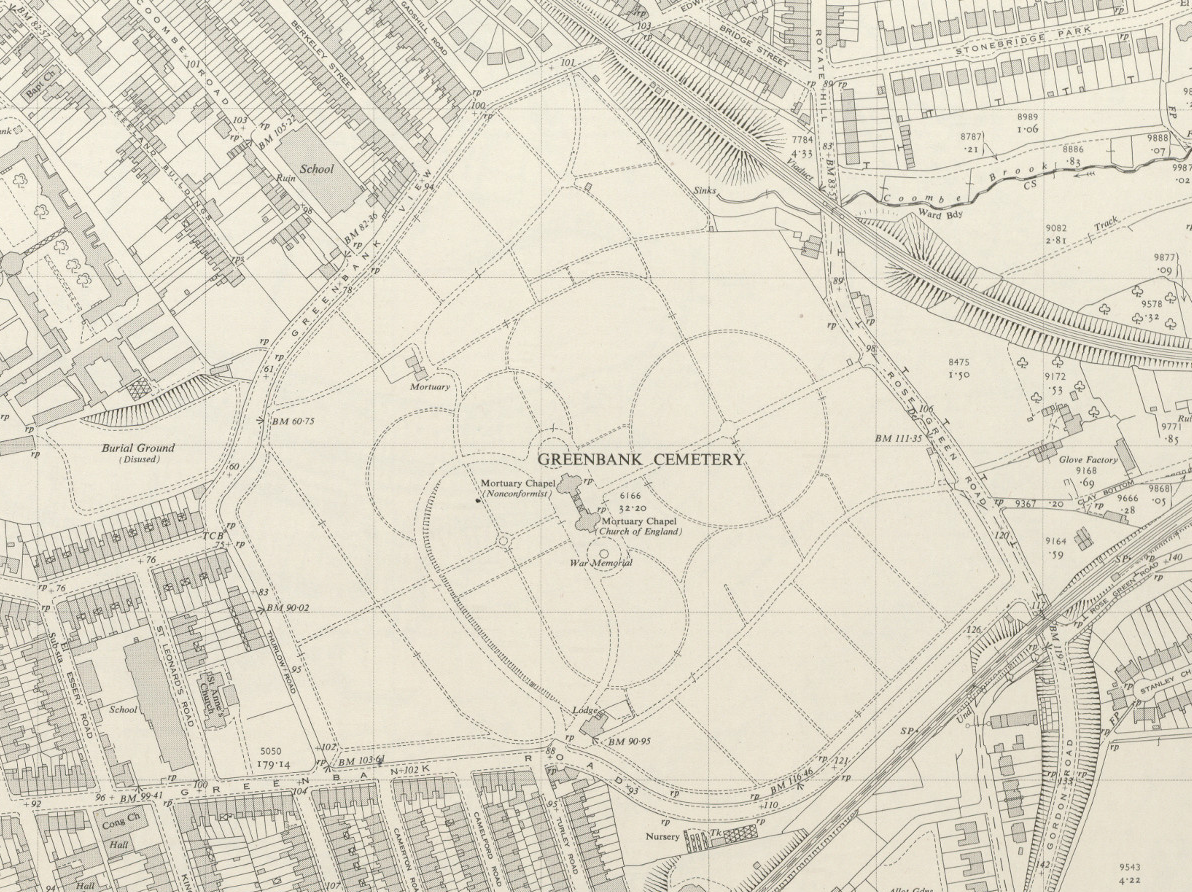
If you know the area, though, you’ll know that it does still look a bit different today. To see the modern layout of the cemetery, we have to move forward to a 1950s map.

Greenbank Cemetery, c. 1955

This is the boundaries of the cemetery as it is today. Greenbank Road has been extended, and Rose Green Road has been widened to take traffic. The cemetery has swallowed up the allotments on either side of it, stretching out to reach the roads. This must have happened some time after 1938, as a 6-inch-scale map revised that year still shows the allotments. However, it can’t have happened very long after, going by the dates of some of the graves on the ground. These sections of the cemetery include a number of graves from the Second World War, including civilian victims and enemy prisoners.

What’s always puzzled me about this, though, is that still to this day the emptiest parts of the cemetery include some of the areas which were included in the original 1871 cemetery right from its opening. The north-western side of the original cemetery, which slopes quite steeply down to the course of the brook which marked the original boundary, is still empty of graves. It’s one of the areas being used nowadays for interment, along the line of a path which was put in place when the cemetery first opened. Meanwhile, the late-Victorian and the 1930s extensions are jam-packed with graves, many of them now overgrown and abandoned.

This is the point at which a proper essay on local history would be drawing to a conclusion and discussing what conclusions we can draw about the growth of cemeteries in provincial English cities. As for me, I just like looking at old maps. I think it’s a fair assumption, though, that that city council deliberately bought additional land around the cemetery with the aim of expanding the cemetery into it when required, and in the interim used it for allotment space. Of course, I also like wandering round a cold, damp cemetery, too.

Greenbank Cemetery

Greenbank Cemetery

Greenbank Cemetery

At some point I’ll have to write more about that other burial ground marked on the map. That’s not just disused: for many years there was no sign of it at all on the ground, until a memorial was erected relatively recently. That, though, will be a story for another day.

Update, 2nd November 2020: We went back to Greenbank the other day, with my proper camera this time, to try to see if I could track on the ground any of the cemetery’s history of growth. Indeed, you can, if you know what to look for: however, it doesn’t quite marry up with the dates of the maps I’ve found. The new post about the cemetery’s history is here.

Evidence of ritual activity

Neu, es i fwyta pysgod a sglodion

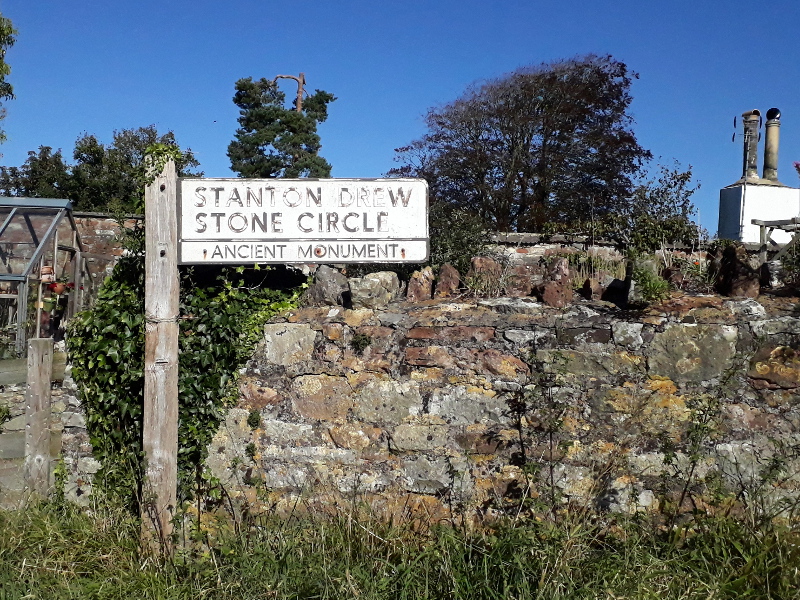
Sunday: a trip out to Stanton Drew stone circles. They are a mysterious and imposing group, relatively little-investigated and therefore with little certainty about them. The Great Circle, second in size only to Avebury, appears to be the remains of a complex henge monument containing multiple concentric circles of wooden posts and an avenue down to the nearby river: rather like Woodhenge, if you know it. The precise date or sequencing, though, is very unclear; it is almost certainly at least four thousand years old, possibly five thousand or more, a range of timescales which in the modern day would easily encompass both a medieval cathedral and the latest office blocks with a huge amount of room to spare.

Pointing to Stanton Drew

We have no real way of knowing what sort of rituals were held here, just that some sort of ritual presumably was, and that over time it will have changed radically. To the last prehistoric people to carry out a religious act here, it might have said to have been immeasurably old, here before the start of the universe; or it might have said to have been built just beyond the touch of living memory, in their fathers’ mothers’ fathers’ time. What we do know is that in reality it may well have been in continuous use for fifty generations or more. In that time there may have been considerable change in language, belief and ritual, or it may have been relatively static. Modern reconstructions of the site, which you can see on the English Heritage website, show an almost-alien forest of posts, completely foreign when compared to any modern-day religious rituals or structures.

Of course, people still carry out religious rituals at Stanton Drew today. They have no real relationship with the religion the site was originally built for, but they do have a deep spiritual and emotional connection to the site itself, as we today see it: to the land, the landscape, and the goddesses and gods that the people of today call upon.

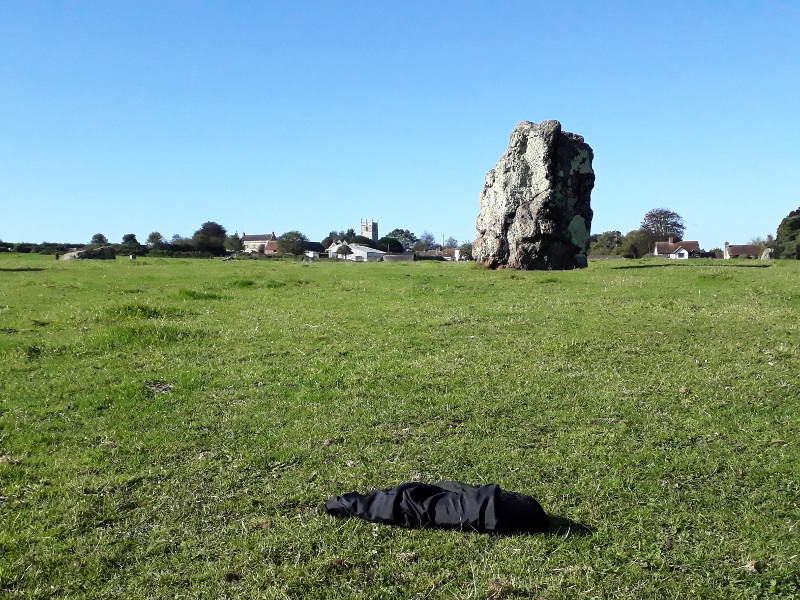
Walking around and exploring the site, we looped around two-thirds of the Great Circle and wandered over to the North-East Circle, much smaller and on a much more human scale. It, too, had its avenue down to the river, and may have had some sort of four-post structure in its centre. Today, at its centre, we found a dead crow. Wrapped in black silk and placed there carefully face-down.

Crow in the circle

We had no way to tell if it had been sacrificed deliberately, or had died a natural death. We had no way to tell who had placed it there, or why, other than that they clearly cared, that it clearly meant something, to place it directly in the centre of the smallest circle, its head facing north. “Insects will eat it and turn it into a skeleton,” said The Child Who Likes Animals, and, indeed, we could see small flies on its soft feathers already getting to work and returning it to the soil. We stood back respectfully and let it go on its way, just as the brambles still ripening in the hedge at the corner of the field will in a few weeks time wither up probably still on the plant.

Stone circle brambles

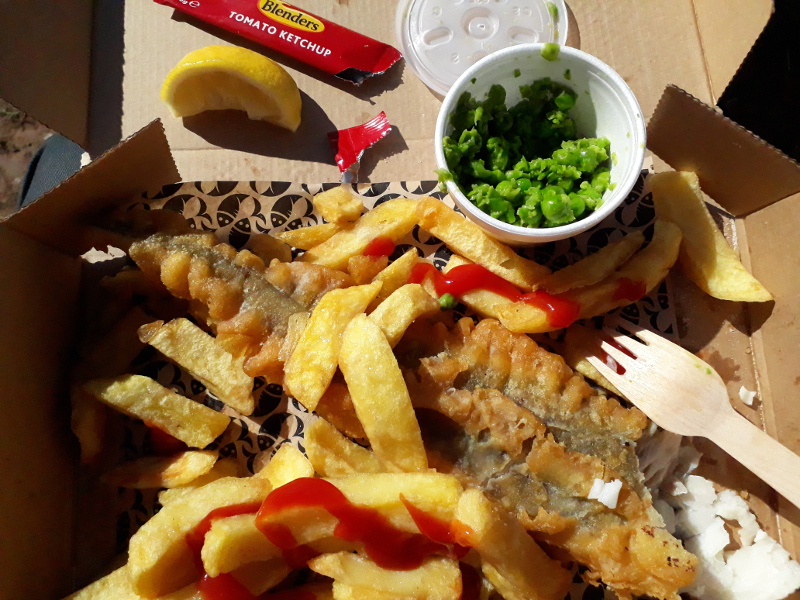
And then, as it was barely even lunchtime, we headed off to the fish and chip restaurant at Chew Valley Lake to dine in style from cardboard boxes and with wooden forks.

Fish and chips

Hurrah, even if the peas are a bit too fancy to be proper mushy peas.

Black comedy

On death, and its absurdity

Almost a year ago, give or take a week or two, my dad died. I wrote, a few days later, about the experience, or at least part of it. Starting from being woken in the middle of the night by a phone call from the hospital, and ending with myself and The Mother walking out of the hospital, wondering what would happen next. I scribbled it down a few days later, after I had had a couple of days to process it, but whilst it was still relatively fresh in my head. The intention, naturally was to write more about the experience of being newly-bereaved, the dullness of the bureaucracy, of everyone else’s reactions to you, the hushed voices and awkward moments. Of course, none of that ever got written. Nothing even about his funeral. Much of it has now faded. I was thinking, though, now that I’ve relaunched this blog once more, maybe I should go back, go back over those few weeks last October, and try to remember exactly what it did feel like.

What first struck me at the time, though, is how darkly comic it all seems. I touched briefly in that previous post about some aspects of the bureaucracy, how hospital staff, when it happens, silently upgrade you to being allowed to use the staff crockery and unlimited biscuits, at the same time as quietly closing doors and shifting barriers around you to try to stop everyone else noticing there has been a death. Afterwards, though, it continues. The complex arrangements of paperwork that must be shuffled round to make sure the burial is done legally. The way customer service agents on the phone switch into their “condolences” voice, when for you it’s the fifth call of this type in a row and you just want to get them all over with. On that note, at some point I really should put together a list of how well- or badly-designed different organisations’ death processes are (the worst were Ovo, whose process involved sending The Mother a new contract that they had warned us would be completely wrong and should be ignored, but that they had to send out).

The peak of dark comedy, though, has to be everything around the funeral arrangements themselves. Right from our first visit to the funeral home, a tiny bungalow just next door to The Mother’s favourite Chinese takeaway. Like probably most funeral directors in the UK now, it used to be a little independent business but was swallowed up by one of the big national funeral chains when the owner retired. Because of this you can’t phone them up: all calls are routed via some impersonal national call centre. They have two people locally staffing the office, and they work alone, one week on, one week off. You have to admit that that’s a pretty good holiday allowance, but it is for a job in which you spend most of your time alone, apart from potentially with a corpse in the next room to keep you company. At the time of course, we knew none of this, so just decided to pop in to the office as we were passing on the way back from some other death-related trip.

Now, if I had written all this down at the time, or at least made notes, I’d have been able to recount exactly what was so strange about the little office. Such a hush inside, almost as if something had been planted in the walls to soak up sound. The cautious, tactful way the woman behind the desk asked how she could help us, and in my mind, the dilemma of how exactly to say. “We need to bury someone” just sounds that little bit too blunt, but equally, I didn’t want to dance around in circumlocutions all afternoon. She sat us down and took us through all the details, each one laid out in a glossy catalogue sent by Head Office. None of the prices, of course, were in the catalogue, and looking through I found it almost impossible to tell which ones were meant to be the cheap ones and which the expensive. Indeed, anything as vulgar as money was carefully avoided for as long as possible, and when it really had to be mentioned, the undertaker wrote down a few numbers on a piece of paper and passed it over to us, rather than do anything as shocking as say a price out loud.

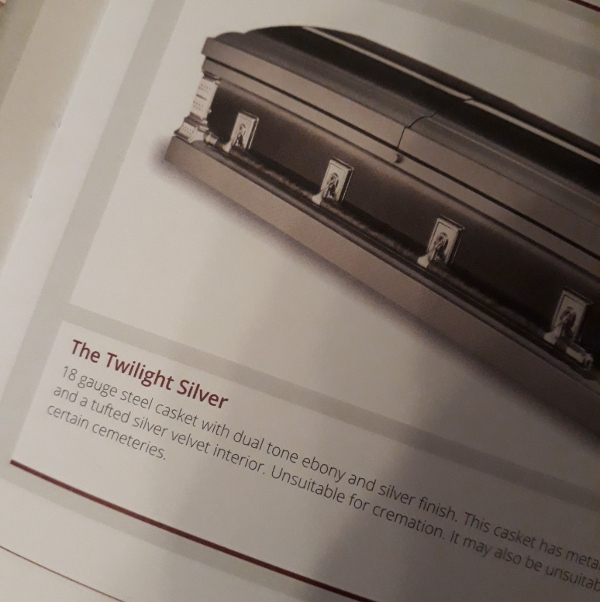
The thing that I really couldn’t stop laughing at, though, I didn’t notice until after we took the brochures back to The Mother’s house. It was a small, three word sentence in the details of one particular coffin in the coffin catalogue.

Steel coffin

Yes, you can have a solid steel coffin if you like, in chunky thick blackened-finish steel. At a rough guess the steel in that coffin must weigh somewhere around 60 or 70 kilograms, so you might want to warn the pallbearers first. What made me laugh, though, is the thought that maybe, until they put that line in, someone somewhere didn’t realise that maybe it wasn’t a good idea to cremate a sheet steel coffin. Maybe they didn’t even realise until they opened the oven and found it, glowing a dull red still, all stubbornly in one piece, the contents turned to charcoal instead of burning.

Equal and returning

In which we pass a turning point

Autumn is almost here, although this year feels as if it didn’t really happen. I have been working away at a little desk in an eyrie of Symbolic Towers since March. At the start, I could see trains passing the end of the street; before long, they were hidden by the leaves on the trees, and soon, I will be able to see them again. In all that time, no time seems to have passed. At work staff have come and gone on my project, staff have come and gone in the wider company, we have rolled out major pieces of work into the real world, and in all that time, no time seems to have passed. The children have flipped back and forth between holidays, home-school, part-time school, and back at school again, and in all that time, no time seems to have passed. And tomorrow, the autumnal equinox is upon us.

Whether time will seem to start passing normally, of course, is another matter entirely. Right now, it seems like that won’t start happening for a long time on the human scale. On the scale of the stars, though, the world keeps turning, and the moon and the planets are still moving in the skies.

Maybe I will still be sitting at my desk in Symbolic Towers when the leaves start falling so I can see the passing trains again; and then when they start growing to conceal them next spring. We will see. I shall try to be optimistic, that the ever-turning world and the ever-turning skies show that life will endure, and that though some things will inevitably change, others will circle and return to their starting point.

Trains and levers

Or, a brief pause for relaxation

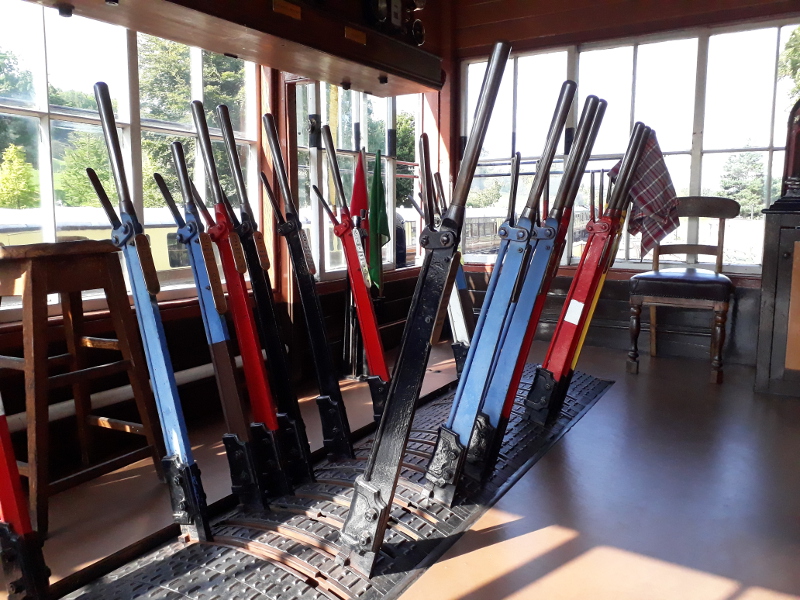
To the Severn Valley yesterday to play with trains, possibly for the last time in a while. I’m not on the roster for next month, and as the pandemic appears to be getting worse again, who knows what will happen after that point. The pandemic timetable makes it a quiet day, just four trains in each direction, and only one crossing move. Here it is, with one train waiting in the station and all the signals pulled off for the other to have a clear run through.

Signals off

In-between trains I sat and read a book of Victorian history, Mid-Victorian Britain 1851-75 by Geoffrey Body, and almost melted in the heat. It was windy outside, but hardly any of it came through the signalbox door. I watched a buzzard (I think) circling overhead, soaring slowly and sending the crows into a panic; heard pheasants and partridges squawking in the undergrowth, and listened to the frequent sound of semi-distant shotgun fire. It has been much in the news this week that shooting parties are allowed to be larger than other groups of people,* and all of the Very Online naturally have been joking about getting the guns in for their family parties; but yesterday in Shropshire and Worcestershire it felt as if people were genuinely doing just that, so frequent were the hunters’ gun-blasts.

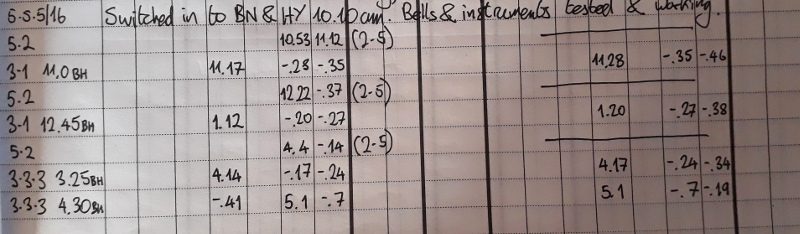
And in small victories, at the end of the day I was proud. For I had filled in the Train Register for the day and not needed to cross any bits out. It may have been a quiet day with few trains and no unusual incidents to record; but, as I said, small victories.

Train register

When I was going through and reviewing all of the previous posts on here as part of the big rewrite, I realised the utter pointlessness of writing about some rubbish that’s on TV purely to say that I’m not going to watch it because it’s probably going to be rubbish. So, I’m not going to do that even though “some rubbish will be on TV in a few months” is all over the internet today. If you like watching rubbish then go and watch it, I’m not going to stop you. Me telling you I’m not is really just exclusionary boasting. So that’s that.

* Obviously, if you’re reading this now, just after I wrote it, you know this already. If it’s now five years in the future, you’ll have completely forgotten.

Relaunch!

It's a new day, and so on

Well, hello there! Time to start all this up again.

This blog has been dormant, for, what, the best part of a decade I think. I started a second blog all about gardening in the hope it would get me to write more in general, but this site stayed quiet. I started a Tumblr, and even managed to post things semi-occasionally, but that faded away much as the whole Tumblr community has faded too. I thought, though, midway through a rather unusual year, that it might be time to get this site going again.

My biggest motive this time, really, is that I don’t like the way the internet has been going over the past ten years ago. The old, open Web has been closing down, drifting instead toward megacorporation-owned walled gardens where you are trapped inside a corporate app that discourages you from leaving. When those walled gardens start to shrivel up and wither, what happens? Look at Facebook; look at Twitter; look at Tumblr and its steady decline. The days of the independent blogger are gone; most people now who do want to do some form of blogging will go to Wordpress.com, or Medium, or to a site like Dev.to if they’re technically minded. So me, being contrarian, decided to become an independent blogger once again.

A few things have changed. I’ve redone the design to hopefully look reasonable on a phone, because that’s what most people use for their casual reading nowadays. I’ve taken away comments, for a few reasons: it saves me the effort of worrying when people leave controversial ones, and it saves me the sadness when they inevitably don’t leave any at all. On the technical side, I’ve ported everything over to a static site generator, so everything loads in a flash. At some point I’ll write…

The Plain People Of The Internet: My lords! Will they eversomuch be bothered about all that technical gubbins? Or is it all so much tumty-tumty verbiage, like?

Me: I wondered if you lads were still around, you know. I’m sure some people might be interested.

The Plain People Of The Internet: Lads? Lads? Now there’s not very inclusive of you, is it.

Me: Fair point, Plain People.

As I was saying, I’m sure some people out there will be interested in long technical posts about how the site is now built and structured, and although most of my technically-minded blog posts end up on my employer’s website nowadays, it may well be that some technical topics are more suited to this place. In general I suspect there will end up being more of the longer, more considered essay-type posts on here, and fewer of the one-liner posts about how I don’t have anything to say. And, as you’ve already seen, I’m sure that if my meanderings start to become too diffuse and unfocused, they will be interrupted by the Plain People Of The Internet, who at some point in the distant past escaped from a Flann O’Brien newspaper column and now seem to live somewhere in the collective hive-mind of the global internetwork.

The Plain People Of The Internet: Now there’s a word you don’t hear very often. Fair rolls off the tongue.

A whole load of the aforementioned one-liner posts have already been culled from the archives. This isn’t exactly the British Library or some great tome of record, so I’ve removed things from back in the mists of time where I was only posting to meet some arbitrary and self-imposed target of posting on a certain schedule. I’ve also gone through and cleared out a whole heap of dead links, and spotted a host of spelling mistakes that have been sitting there out in the open for everyone to see for years. There are probably many more dead links I missed checking, and many more spelling mistakes I’m still to notice, but I’m reasonably happy with the state of things as they stand. As well as deleting a pile of stuff that was here previously, I’ve also added stuff that I’d previously posted to Tumblr, such as my thoughts on what Amsterdam is like, or the experience of watching my father die. Hopefully, some people other than me will think these things were worth saving.

I’m aware that previously I’ve posted things that say: “Well, hello there! Time to start all this up again,” and then have stuttered slowly to a stop within a few days or weeks. Let’s see how it goes this time.

The Plain People Of The Internet: By sure, we will.

Entrousered

In which I visit my tailor

Today was: funeral outfit shopping day. I don’t have anything suitable for funeral-wearing at all in the wardrobe; the only time I ever wear something really formal is for job interviews, and my job interview suit isn’t exactly funereal enough for the occasion. So, down to Debenhams on my lunchbreak to find something that vaguely fits me.

I found a pair of trousers of the right length, after trying what seemed like an excessive number of pairs. I found a few pairs of trousers of the right waist. Of course, the ones that were the right length weren’t among them: the ones that fitted my waist were either just that bit too long or just that bit too short to really work. “Don’t bother ordering the right ones,” said the shop assistant, “they won’t get here in time if you need them for next week. Buy the long ones with the right waist and go to the tailor’s round the corner.” So I bought the trousers, and headed round a corner and down an alleyway to find that squeezed between a decent unisex hairdresser and a sex shop is: a tailor’s shop. Either I’ve never noticed it before, or it’s one of those shops that just appears by magic at just the right time to aid the protagonist in their quest. It’s a traditional sort of place, with no concessions to show, to ornament, to tidyness, just a big workbench, a cash register, and racks and racks of clothes being worked on. I go in, put the trousers on, the tailor pins them to the right length and says “when are you coming in to collect them?” He didn’t take my name, my number, my email address, just gave me a card with a number on it and a promise they would be done in plenty of time.