+++*

Symbolic Forest

A homage to loading screens.

Blog : Post Category : Dear Diary : Page 1

Folklore in the rough

Or, the evolution of tradition. But for real. And almost with sausage rolls.

Folklore is… something we had, right? The things people used to do, especially all those people who lived out in the country and whose lives were devoted to threshing and winnowing and all those sort of rural verbs we just don’t use in the modern world. Folklore is all that stuff, from the ancient Static Past that never changed.

This view is nonsense, nowadays, among historians and folklorists, but it used to be their genuine assumption, say a hundred years ago, and as a result I have a feeling it still lurks in the back of a lot of people’s minds as a kind of default opinion if they ever think about the topic. In reality, folklore was always fluid and adaptable; we’re just missing a lot of it, because it was only about 150 or so years ago that people started writing it down, and saying “I guess this is what the peasants have always done since Time Immemorial”. Folklore is still around us today, and it’s still changing and growing too.

The reason I’m writing this, though, is that last weekend we went out and committed an act of folklore. We—me, R, and the Two Children—went into Newport, to see the Newport Mari Lwyd.

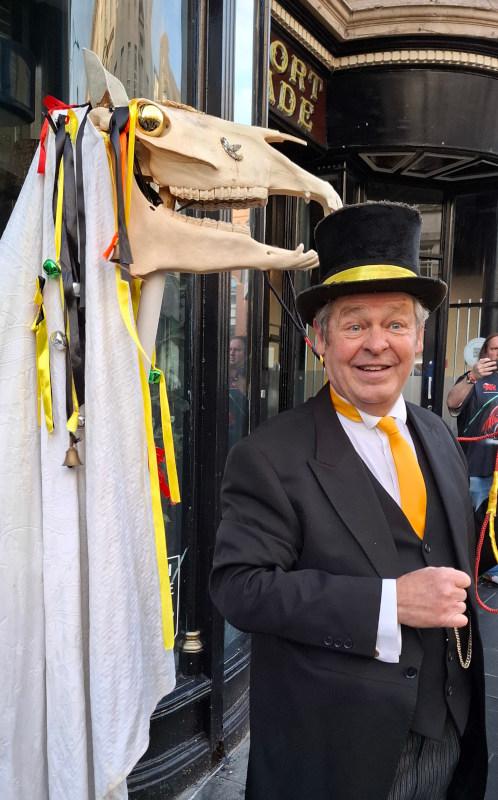
The Mari Lwyd is Welsh, as you might guess from the name. Specifically, it’s a South Wales tradition, from the time around the New Year. The Mari itself is a horse skull on a stick, carried around by someone hiding under a white sheet, like all the best ghosts. It’s led around by a Leader, smartly dressed in a top hat. And it’s great fun. We still sometimes call it by the name The Child Who Likes Fairies used when she couldn’t pronounce Welsh very well: the Ghost Pony.

The Newport Mari Lwyd, a decorated horse's skull on a stick, held by a man under a white sheet, with her Leader in a smart suit and top hat

The Newport Mari Lwyd is done by the Widders Border Morris, from Chepstow. For about an hour or so, the Mari is lead around the centre of the city, with stops for morris dances. Between the stops, the Leader is the MC of proceedings, interprets for the Mari, and generally “holds her back” when she wanders into shops to terrorise people. If you don’t mind being terrorised by a very large skull on a stick, it’s great fun.

We followed all the way from start to finish: into Greggs in search of a sausage roll, into the pet shop for more food, or the slightly mouldy greengrocer, or the Arcadia coffee shop. We stopped outside a pub, with a guy stood outside it holding a toddler in his arms. The Mari bent down so the wee boy could stroke her nose like a real horse, and the boy did, looking confused and baffled but treating her entirely like he would a living horse. The followers all had their phones out recording, or their SLRs, some with selfie sticks to get their phones up above the crowd. And of course all the time we were passing people who weren’t part of it, who hadn’t come along specially, some of them jumping in fright and getting away, some of them intrigued and coming to stroke the Mari too.

This isn’t, of course, what the Mari used to do. The organisers specifically describe it as an Urban Mari Lwyd, in this form because it works well in a city centre, popping her head into all the shops along the way then finishing in the record shop in the arcade to ask the owner to play “Crazy Horses” by The Osmonds.

When the “original” Mari Lwyd tradition was recorded, the Mari would go around knocking on the doors of houses. At each there would be a battle of riddles with the person who opened the door; and when the householder lost, the Mari’s party would go inside and cause havoc: eat the food, drink the beer, grope the women, rake out the fire. And then, on to the next house. The party would often include people in blackface, and a Mr Punch. By the time it was written down, it was almost gone, and by the 1930s the tradition was effectively extinct. A few decades later it came back, as a deliberate revival, much as many “folkloric” aspects of British life were. In the early 1970s, a form of the Mari appears as an evil antagonist in Susan Cooper’s young adult fantasy novel Silver On The Tree, which I quoted here previously. Cooper’s Mari is almost untirely unlike the real one, and pops up in a part of Wales in which she wasn’t a tradition. Nowadays, many places in Wales have some sort of modern Mari Lwyd, like the Newport one. Going into private houses: out. Actually taking people’s food: out. Groping people: very definitely out. The modern Maris (Mariau?) are all suited to the modern world, frightening people only if they like it.

Being a skull on a stick, the Mari comes across as a very gothic, a very pagan figure. That’s probably not really true originally either. The name Mari might very well come from the Virgin Mary, although there’s an alternative explanation that, being a horse, it’s just from the English word “mare”. As a tradition, like other British hobby horse traditions, it probably doesn’t date back any earlier than the 16th century. It’s become a very Welsh icon—there was a large Welsh flag being carried by someone at the Newport one this year—but very similar traditions are found in other parts of Britain too with different variations. In Derbyshire they used a ram’s skull instead of a horse, which is why Derby County football club still has a ram as its symbol. That, though…in folklore, that’s kind of irrelevant. Mari Lwyd might have been different in the past, but the Mari Lwyds happening now, like the one we took part in, are very real and just as genuine. They’re still folklore, but folklore being endlessly created and recreated, today and in the future. Some day, in years to come, a folklorist will write down that the song “Crazy Horses” is deeply associated with “the Newport Mari tradition”, as an ancient survival; until someone else points out the song was only released in 1972, in summer, so really shouldn’t be associated with a seasonal winter tradition.

In a sense, all this is unimportant. We were carrying out a Welsh pagan tradition, because we made it one. And moreover, as I said near the start, it’s great fun for the participants. Even if the Mari never did get her Greggs sausage roll.

So this is the new year

In which we reflect on the past and the future

Welcome, 2026!

I opened up the blog to post that, and suddenly realised that, well, it’s nearly a year since the last blog post. Every few weeks I’ve opened up an editor, and pondered writing something from the to-do list, but something else has always come up. And so, the archives menu has no entries between January 2025 and January 2026.

That’s partly, to be honest, because 2025 was such a big year for me. It had its ups and it had its downs, but more than anything, it was busy. I felt I was constantly on the road. Days when I was in Leeds for a work meeting in the morning, but had to leave mid-afternoon for a medical appointment multiple hours away. I barely spent a single weekend in my own house.

It was all for good reasons though. It wasn’t just work or medical things. There were trips to museums; trips to pick lavendar; trips to meet internet friends; trips to visit my partner’s family; trips to ride behind steam trains; trips to go swimming in the sea. The main problem, in fact, was knowing how to fit in everything we wanted to do.

I said “partner” there, didn’t I. I haven’t really mentioned relationships on this blog for a few years, I don’t think. At the start of last year, though, I’d just met someone new, someone who went from “internet friend” to “lover” to “life partner” within the space of a year. In the middle of the year she moved house, and by the end of the year we were getting joint Christmas cards from her family. We spend most of our (non-work) time together, largely playing board games.

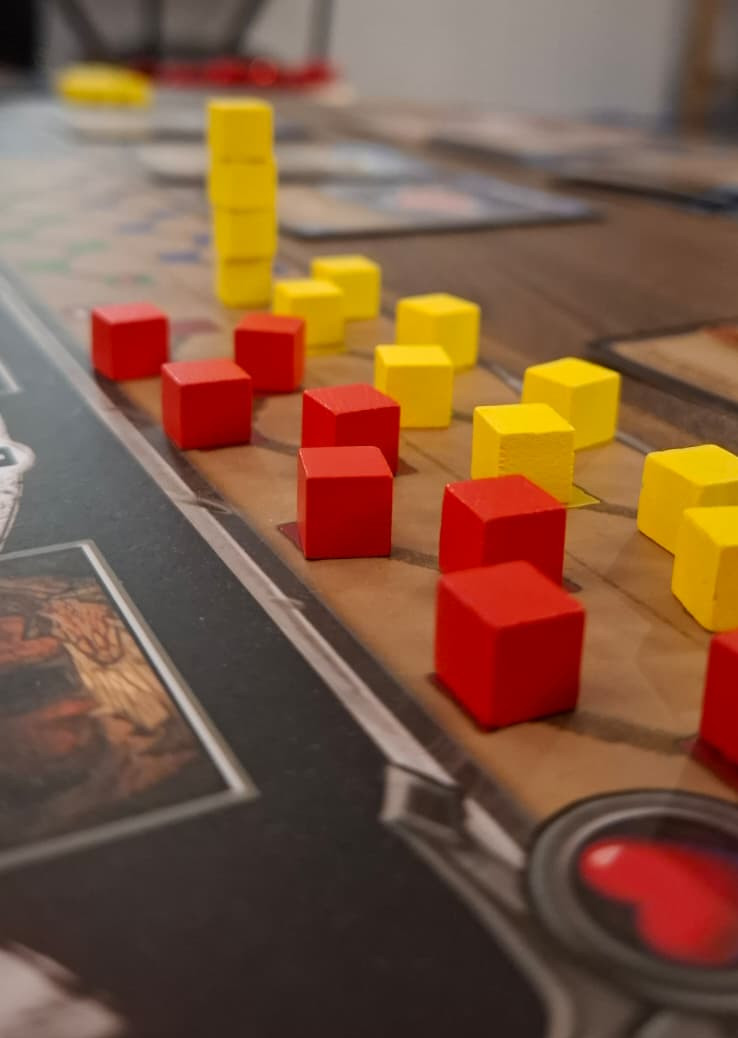
Close-up of the corner of a board game board, on a dark table.  There are small coloured wooden cubes in two zigzag lines, one red and one yellow.  The yellow line is longer and turns into a vertical stack of cubes at the end.  A board game fan might recognise it as the game Clank! at or very near the end, after the yellow player has died.

I’ve been introducing R to trains and my favourite board games; she’s been introducing me to her hobbies and her favourite board games, and I wish I could put into words more about just how amazing she is. The future is bright; but even busier than before.

Still, I do want to try to post more often on this site again, in between going to work, sorting out the rest of all my inherited junk, holding board game nights with our friends, and everything else that goes along with both having a partner, and having kids with an ex. There is, after all, a long long list of things I’ve been planning to write, some of them lurking on the list for years. There are going to be lots of new ideas too, I’m sure. I can’t promise it will work, I can’t promise I’ll keep writing, but I do want to keep trying to write.

So, this is the new year. Hello 2026. And to the blog: welcome back!

Keyboard news

In which Caitlin buys more keyboards and bits, but not too many more

A few months ago, I wrote about my first exploration into the world of mechanical keyboards, and said, at the time, “am I going to turn into a keyboard nerd?” At that point, I’d found that mechanical keyboards can be extremely practical, that I found them much, much easier to type on than a cheap stock keyboard; but I was very wary of how keyboard nerdery can turn into something expensive and all-consuming. Frankly, I already have too many expensive and all-consuming hobbies. So. Did I succumb?

Well… sort of. It hasn’t become all-consuming, at least not yet. This, though, is how my desk looks now. Yes, that is another keyboard.

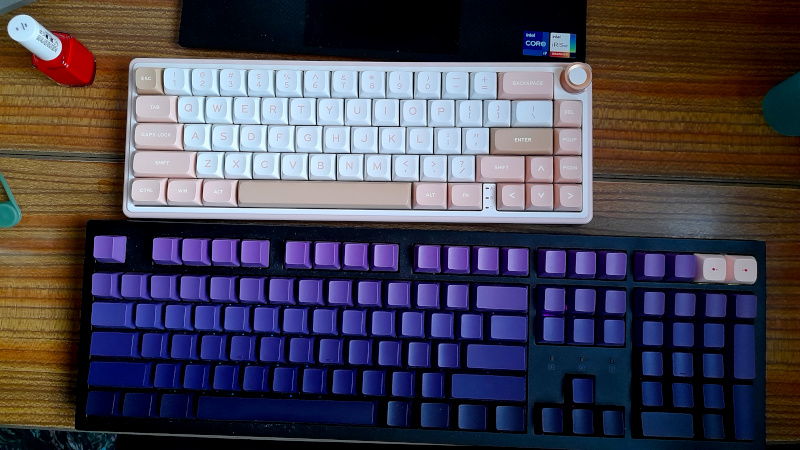
Two mechanical keyboards on my desk, one white and pink and the other black and purple

This is a slightly fake photo, I have to admit, because I’d never use both at once. The bottom one in the photo is the Keychron K10 chassis I wrote about previously, but with a prettier set of keycaps. The black pudding keycaps I bought were fine as a first set, but they weren’t really pretty. Moreover, the switches I’d fitted don’t really let enough light through for the translucent part of the pudding to work as expected. The shine-through colours were quite dim, only really visible in a darkened room. Because of this, the keycaps have been replaced by something prettier, a purple gradient set with blank tops.

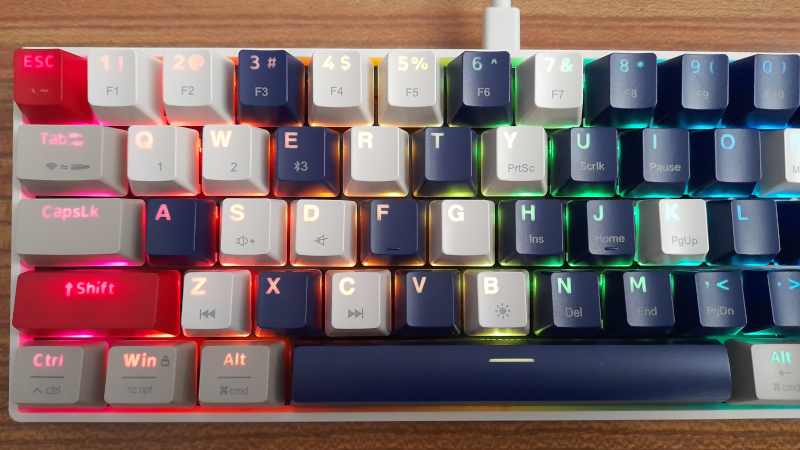
Above is the new keyboard, a Royal Kludge 65% model in a pink and white colourway, with slightly less key travel. The reason they don’t normally come out together is: this is my new “travel keyboard”, small enough to fit into my work backpack alongside my laptop. It’s wired only, so I bought a matching pink cable to go with. It’s not too loud for office use, but it’s definitely eye-catching; so far I’ve hardly had a single office trip without at least one person asking me where I got it.

“Now hang on there cutie,” I can hear you saying, “didn’t you already talk about a smaller keyboard in your last keyboard post?” Well yes, I did. But as I said at the time, that keyboard is a 60% model. This one is a 65%, and that extra five percent makes all the difference. It means this one has dedicated cursor keys, rather than have the cursor functions doubled-up. In other words, I can code without chording. It makes my life much easier. Moreover, this one is lighter and less bulky in the backpack, due to the lower travel, and is slightly quieter and less annoying to colleagues. It’s also deliberately intended to go with a new-to-me laptop I’ve been playing with, a small pink model that used to belong to The Child Who Likes Fairies, which I’ve wiped and put Gentoo Linux on, so that I can use it as a small, lightweight laptop to use if I’m ever going to be forced to use a small, lightweight laptop for any period of time—in bed recuperating from anything medical, for example. I wasn’t completely sure how well Bluetooth would be likely to work with Linux on a random laptop, which is the main reason I plumped for a wired-only model.

Are there going to be more keyboard developments. Well… maybe. The blank top keycaps on the Keychron do have shine-through legends on the key fronts, which are a bit ineffective in the same way as the pudding keycaps were. The “clicky” switch I still have on the Insert key is a transparent-body switch, by pure chance—I found it in a friend’s spares box—and I can see what a big difference that makes to the shinethrough effect. Because of that, a set of transparent-body red switches and a keyboard rebuild might be on the horizon at some point; there’s no rush, though. Aside from that, though, I do have enough keyboards now, including keeping that first one as a spare. If I find myself tempted to buy more, I really should just sit on my hands.

Rooted by the sea

In which we take another trip to the seaside

This year, I’ve tried to hold myself to posting at least one post per month on this site. I’ve mostly, but not quite, managed it. Nevertheless, there have still been so few that at present, with ten posts on the home page, if you scroll down to the bottom you’ve gone back almost a year. The bottom post on the home page right now is this one from last August, about my summer holiday to Hastings.

Exactly a year later, the week before the August bank holiday weekend, I’ve just been to Hastings again.

The Children are quite fond of repetition. It’s a form of comfort, I suppose. Their first choice for a summer holiday this year was: can we go back to the same place again please? I can understand it: as I said before, I went to Hastings on holiday myself pretty much every year between the ages of 3 and 13. But also: it’s a nice-sized place. It’s a small town, but it’s still got plenty of things to do, it’s got things they can enjoy doing over and over again, and it’s within reach of cities like Brighton or London if you do want a day out somewhere bigger. This year, we had a day out to Brighton, we had a day out to Pevensey Castle, but aside from that we just hung out in the town, going in the sea or poking in all the little shops. I was quite pleased I managed, once we’d arrived, to have a no-driving-at-all holiday.

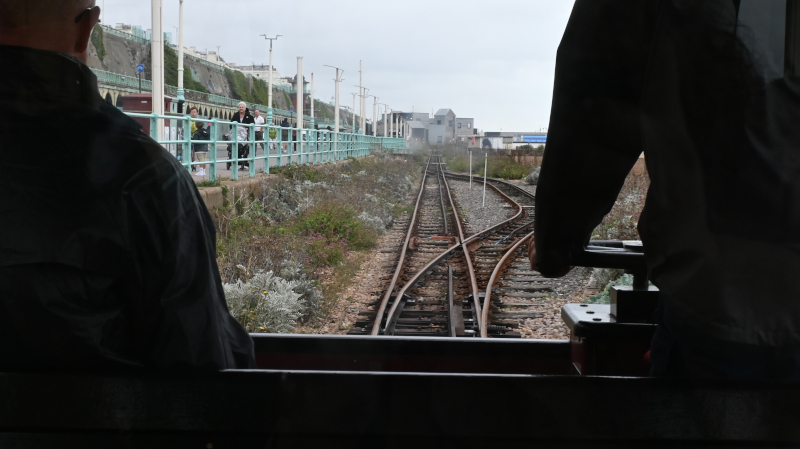
Taking a trip on the Volks Electric Railway in Brighton, on a day of sideways drizzle and very heavy seas

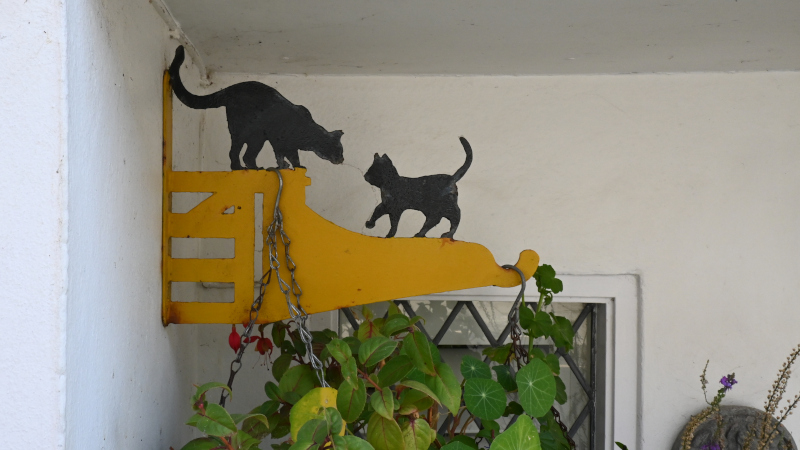
A cat-themed hanging basket bracket in Hastings Old Town

Naturally, as we were staying within walking distance of the seafront, as soon as we had unloaded the car we wandered down and discovered it was the Bottle Alley Art Market. The Child Who Likes Animals was able to buy his first pieces of original art, an exciting moment, at least for his mums. It set the seal, though, on the idea that this was a good place to come because it is “our sort of place”, the sort of town where you do just come across random art but that is also welcoming and friendly to all visitors, not “artistic” in a snobbish or exclusive way.

The Children exploring Bottle Alley on a quieter day

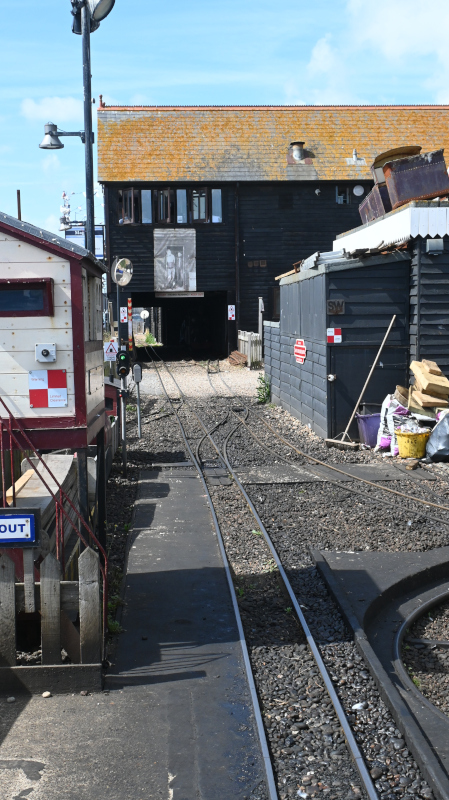
Hastings Miniature Railway, which we ended up visiting several times

I’m still getting used to using my “new” camera, that I’ve had for over a year now: because of that, my holiday photos are all a bit patchy. It doesn’t have a viewfinder, just a rear panel; so taking photos in bright daylight, it can be very hard to be confident I am actually framing my shot properly, never mind getting the exposure or the focus right. It does, however, slip nicely into my big handbag, so I’m wary of buying a larger model. The main thing may well just be practising more. In the meantime, some of the photos, at least, have come out tolerably well enough to post online.

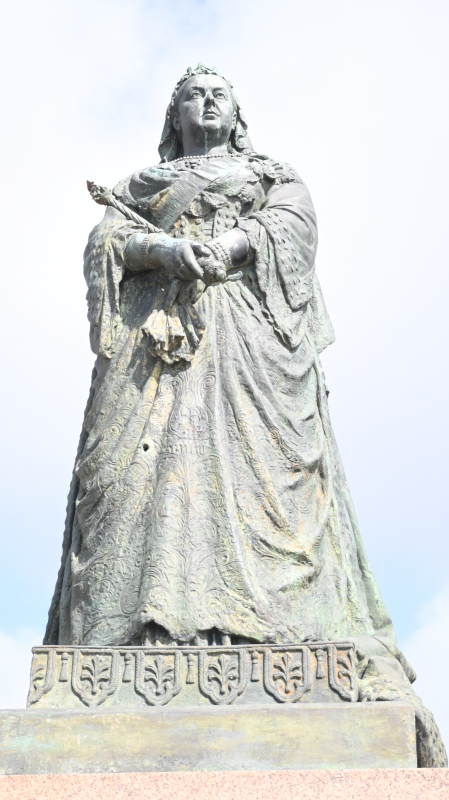
Statue of Queen Victoria in Warrior Square - a slightly overexposed shot

The children are quite fond of repetition, so we may well end up going back to Hastings again next year. They were both frightened and intrigued, though, by one aspect of family history I revealed to them. After touring the exhibition about Sussex and Kent smugglers in Hastings’ caves, high in the cliffs above the beach, they were somewhat scared to hear that their own Georgian ancestors were wreckers and smugglers—not from Sussex, but from Cornwall. I can see us having to go to Cornwall for a holiday now, just so they can see where their distant relatives came from.

From the chrysalis

A coming-out story. At least, one small fragment of a coming-out story

Since the Great Pandemic, our lives have changed so much. Being forced to leave the office, we realised that to a great extent we didn’t need to be in offices. Our jobs didn’t even need to be near home, at all, except when we still needed to visit the office for meetings or when we had something to say face-to-face. That’s why I found myself, at 5am on a very dark morning after lockdown had ended, getting in the car to drive from Lincolnshire down to The South. A straightforward four-hour journey, at the most. Within five minutes of setting off, though, it had started to snow. Gently at first, but getting thicker. Within ten minutes, I reached a hill where the car’s wheels just spun to a halt on the fresh, wet snow beneath them. I paused, let my heart stop racing, and gently tried to turn the car round. This office trip had to be made. It was the last day in March, but the date was purely coincidence.

This is not a memoir, at least, not a coherent one. It is a series of little vignettes, memories, a palimpsest of moments which have made me the woman I am today. This is not even the most significant one. It is something, though, that is officially supposed to be considered significant.

Being transgender is not, itself, a medical issue. It’s just who you are, something you have to live with, like poor eyesight. Getting things to help you live with it, though, can be a medical issue. If you have poor eyesight, you can change your lifestyle by changing all your books to large print and increasing the font size on your devices; or you can turn to more medical solutions, have the defects in your eyes objectively measured, get yourself glasses or surgery. If you’re trans, nobody can stop you changing your wardrobe or changing your name, but you need to turn to medicine to start making significant changes to your body to mould it into the right sort of shape. In some countries, a friendly GP will prescribe you hormones as long as they are sure you understand the consequences. In the UK, you can only get a hormone prescription after you’ve had a psychological diagnosis of “gender incongruence”, and in order to get that diagnosis, you have to go through various stages, all of them essentially compulsory. It used to be called the “Real Life Test”, the idea being you have to demonstrate, conclusively, that you are trans in order for doctors to help you, because they have no better diagnostic tool available.

One of the key steps, in all this, is making sure that all the people around you know who you really are. That includes coming out and being your true self in the workplace. Understandably, for many people, that’s one of the most stressful parts. After all, you don’t necessarily get on well with the place where you work, and you often can’t exactly control who you work with.

So, to fit in with the plan, to step along the programme, this is what I had to do.

What I am about to say is not true in detail, only in the broad general sense, but coming out becomes easier the more you do it. The first time feels like it is impossible. The more people you tell, each time becomes slightly easier. Even so, it was still difficult, by the time I reached the point of telling work, to ping the head of HR and tell her I needed a chat. It was a fairly small organisation, everyone knew each other, but nevertheless. The important thing, I knew beforehand, was the phrasing. No “I think I am…”, no “I would like”. No. I used firm, bold, positive statements. “I am transgender. I am transitioning. I’d like us to agree on how we tell the rest of the business this. What do you suggest?”

And, as I had expected, she was entirely lovely about it.

We agreed our plan of action. We would tell my manager. He would tell the rest of senior management. As for the rest…at our quarterly all-hands face-to-face meeting, I would tell people in person. So that’s why I had to make it to the office that day, despite the unexpected snow. I couldn’t go back. I couldn’t even look like I was going back. The announcement had to be made.

By this time all my old masculine clothes were already out of the wardrobe, and androgyny was in. I’d been painting my nails for a few months. I wondered how obvious it was; I wondered how many of them might have guessed. Probably none. As it happened, just one person had, or said they had, because they’d spotted my nail polish. They hadn’t spotted all the other hints I’d slowly dropped.

In the end, it was all something of an anticlimax, and everyone else was also absolutely lovely—which is entirely as it should be. We had various meetings set up, with various groups of people, all set up for the purpose of being able to say “oh yes, there’s something else [deadname] wanted to tell you.” Most people were barely bothered, aside from a few kind women who made a point of immediately striking up conversation with me about femme things, doing their best to make me feel included. And from then—that was that. Within a few days, my deadname had ben wiped from the systems.

Why am I writing this? In part, because it seemed like such a big step beforehand, and seems like such a tiny thing in hindsight. In part, also, because the rest of the world seems to place such a large emphasis on it being a major step in your transition journey. For me, though, it seems awfully irrelevant in hindsight. An event that was more important to everyone around me than to me myself. There are many more stages in my transition that mattered much, much more. Maybe that’s why I’m starting with this. Starting with the unimportant first.

You can't go home again

CW: death. Sometimes you don't even feel grief when someone is gone

It’s over eighteen months now since The Mother died, and I’ve barely even talked about it here, aside from one piece I wrote about burying her. There are a whole heap of reasons for that. For one thing, the posting rate here has slowed down to one post a month if that, due to all the various other things making demands on my time. For another, a whole heap of the experiences I had around my mother’s deah pivot on it being, when it happened, less than a year into my gender transition. As I wasn’t open about being transgender on this site until this March, I could hardly recount a lot of the things that happened, from the excited curiosity of the funeral arranger, to the cold stares some of my mother’s friends gave me as I walked into the church behind the coffin.

Some of this, though, is down to how I feel about the death. I don’t feel grief at the death of my parents. Rather, I feel anger, a low, slow-bubbling anger that they let me down in life. And that is all rolled up in my gender too, to some extent.

My parents never supported me. Financially, yes; emotionally, no. I came out to my parents as trans when I was in my early 20s, and they were universally unsupportive about it. My mother cried. Prayed. Said I should start going to church, or take up a new hobby like playing bass guitar, and that would take my mind off the idea. When I started to seek medical support, she kept telling me I didn’t have to go through with anything, at every turn.

So when I decided to stop putting my life on hold, when I decided twenty years later that yes, I needed to transition, that I would never be myself if I did not: I also decided I wasn’t going to tell her. After all, I’d already come out to her once. She didn’t deserve to put me through that a second time. I came out to everyone else; I started wearing nail polish; I changed my whole wardrobe. I did it all right in front of her, and just let her watch and work it out for herself this time.

She died about ten or eleven months into that process.

By the time she died, she knew my name, even though she always claimed she had forgotten it. She even used the right pronouns for me, some of the time. When I am still sorting out her belongings, cursing the state she let things get into, I am also always, in the background, angry that none of that happened until the last few months of her life, until she knew she was on her own apart from me. I wish I’d had the strength and the bravery to cut both of my parents out of my life, and find my own way forward. It would have been very different.

This all sounds quite bitter and nasty, but I’m posting this now because this is June, this is Pride Month, this is the month that for queer people, is supposed to be all parties and parades and excitement. I’m proud of who I am every month of the year though, which is why I’ll always still be angry at the way my parents treated me when I needed them. I wish my mother could see me now, so she could see just how much I’ve changed since she died, and see just what I missed when I was younger.

Eventually, I will write down all those stories, about the dark comedy of the Accident and Emergency ward where half the staff couldn’t get through the doors, and about lying on a bed, half asleep, listening out for the ambulance I had asked for three or four hours before. I’ll have lots of other stories to tell, too, all those fragments and pieces by which I realised I was transgender and started trying to do something about that. Those are important stories. They’re not just for June.

Typecasting

In which Caitlin is at risk of acquiring a new hobby

One stereotypical nerd gadget I’ve never seen the point of, that I always assumed was the nerd equivalent of hand-woven gold hi fi cables, was the mechanical keyboard. I assumed they were, as the phrase goes, fidget spinners for IT geeks. Something that is expensive and makes lots of fun clicky-clacky noises, but doesn’t actually change your computing experience by one tiny bit.

Well, reader, I was wrong. I admit it. Completely, absolutely, 100 per cent wrong. Switching to a mechanical keyboard has been one of the best productivity improvements I could have made to my workplace. Since I started using one, my typing has speeded up enormously. It’s definitely not just a toy. Having a decent length of travel on each key movement somehow genuinely makes it much easier and quicker for me to type; and also makes my typing a lot more confident. I’ve never learned to type properly, and I still make a lot of mistakes, but in general I’m finding my fingers skip across the keys much more freely.

This first started last summer when I was already tempted by the idea, and saw that a fairly cheap model already had been reduced quite a lot on sale. So, I bought it. And, if nothing else, it was pretty. It glowed, with rainbow light. It came with a choice of beige or purple keycaps, so being contrary I naturally changed just half of them over, trying to get a dithering kind of effect from beige on the left to purple on the right. It kind of worked. Typing, though, was excellent.

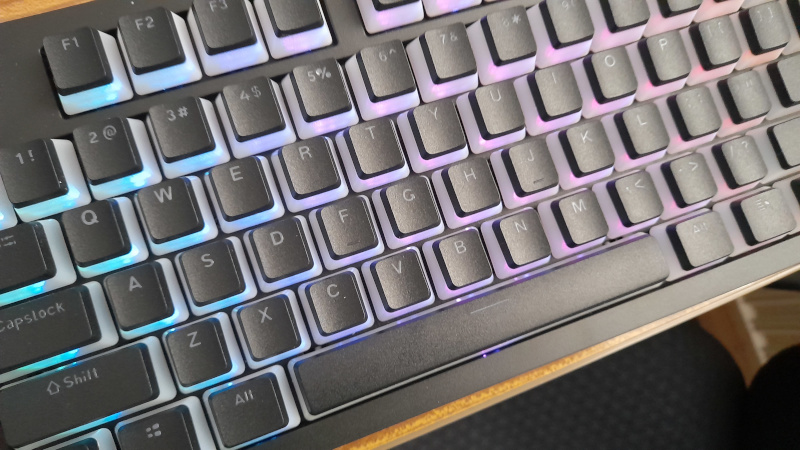
The mixed keycaps of my first mechanical keyboard, with shine-through legends on the keys

I felt like I was typing much better than I ever had on laptop keyboards, but there was something wrong. Still, I resisted the temptation to be a keyboard nerd. An enthusiast. One keyboard would be enough for me.

The problem with the first keyboard was that it was only a 60% model. In other words, it only has about 60% of the keys of a “full” PC keyboard; just the core letters and numbers really. To get all the other functions, you need a modifier key. A lot of laptops do that to access extra functions or squeeze all of the keys into a laptop case, but this was using it for fairly basic functionality like the four cursor keys. When coding, I find myself moving around with them a lot, so having to chord to use them quickly became annoying. On top of that there were other little problems: the Bluetooth connection would sometimes glitch out, particularly if the battery was low. When the battery ran low the only warning was one of the modifier keys flashing, and then when you charged it up there was no sign of how charged it was. On the good side, its small size made it nice and portable. Overall, it was a good starter.

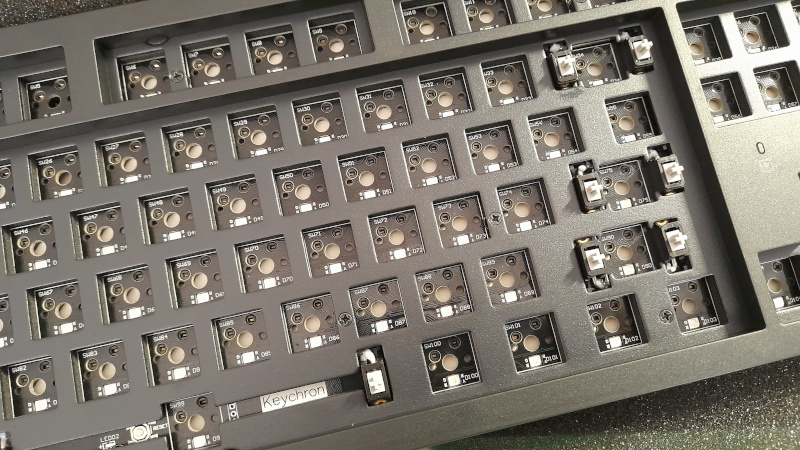
After a few months, I’d decided it was time to think about buying a full-size mechanical keyboard. And why not go all in and just buy a “barebones” model. A barebones keyboard is, well, not really a keyboard at all. It’s the core of a keyboard, but it doesn’t have any keys. You have to fit it out with keyswitches and keycaps for it to work. When it arrived, it was very nicely-packaged, it felt very substantial, solid and heavy, but I couldn’t actually start using it.

The new barebones keyboard, a Keychron K10, without any switches or keycaps

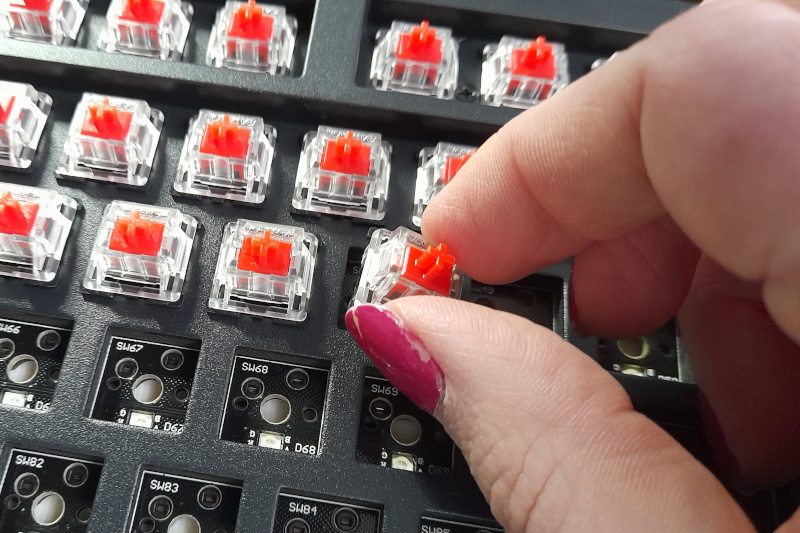
It’s a Keychron K10 model, and all you have to do to get it working is push switches into each of those sockets. You get to choose the brand of keyswitch you want, though, and switch manufacturers publish complex charts of the response and movement of different types of switch, describing them as “soft”, “firm”, “clicky” and so on. I just went for a fairly soft switch from a well-known brand, and set to work plugging them all in. It was quite a therapeutic job, pushing each switch home until it is firmly in place.

Plugging switches into the keyboard.  If I'd been planning to blog about this I'd have done my nails first

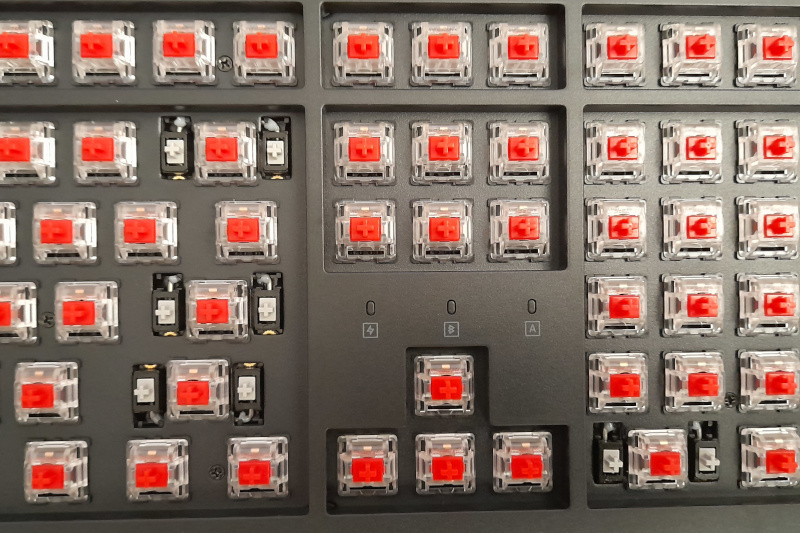
All the switch sockets nicely filled in

The harder part is choosing the keycaps: harder, because as well as how they feel, they have to look pretty too, and there are an innumerable assortment of manufacturers who will sell you pretty keys. And in the end, I just couldn’t decide, so went with a set of plain black “pudding” keycaps. “Pudding” keycaps have a solid, opaque top but translucent sides, so the backlights on each key shine nicely through. I’m not sure they are the right keycaps for me long-term, but they were a nice and cheap “first set”.

The finished keyboard with pudding keycaps

Am I going to turn into a keyboard nerd? Well, I’ve already tweaked it a wee bit. I kept hitting the “Insert” key by accident, not being used to having a key there, so I’ve already changed the switch on that specific key to be a much firmer, clickier one, so that at least when I do hit it by accident I notice I’ve done it. I’ll probably change the keycaps for something prettier at some point, something a bit more distinctive. I’m not going to go out and buy a lot more keyboards, because I already think this one is very nice to type on. It has a sensible, useful power lamp that flashes when the battery’s low, is red when it’s charging and goes green when it’s finished. But, overall: I admit I was wrong. This is much, much nicer to type on—I’m writing this post on it now—than a standard laptop keyboard is. For something I’ll use pretty much every day that I’m at home, it’s definitely worth the money.

Becoming visible

In which we talk about Transgender Day of Visibility

Today, March 31st, is Transgender Day of Visibility. This year, 2024, it’s fifteen years since the event first started. Event is maybe a big word. It’s a marker, a day in the calendar for trans people to stand up and be loud about who they are.

The calendar sometimes seems full of queer-related events nowadays. Aside from TDoV there’s LGBTQ History Month (February, in Britain at any rate); Pride Month (June); Transgender Day of Remembrance (November); and probably more that haven’t immediately sprung into my head. It sometimes feels like there’s so many similar events in the calendar that they are coming around every week. Nevertheless, they are still all important. Transgender Day of Visibility was started as a celebration, a reaction to the only trans-specific day in the calendar being one of sadness and hurt, a reaction to the medical establishment’s position that the ultimate goal of all trans people should be to become invisible, and a reaction to those who don’t think trans people should be included under the queer umbrella. A day for us to stand up and be proud of ourselves.

Yes, ourselves.

This blog started in its current form in August 2005, getting on for nineteen years ago. In all that time, I think, I’ve not once referenced the fact that I am trans. There’s a reason for that.

I’m not just trans, I am a detransitioner. In 2005, I had just detransitioned. I went into deep, deep denial, about who I was and who I am. So, here, it was never mentioned.

I started to transition again in 2021. One of the first things one of my close friends said was: “Welcome back!” It touched me more than you can imagine. I scanned all of the content on this blog for anything that gendered me, and scrupulously removed them all. I wasn’t ready to talk about it here until now.

Transitioning, like coming out, isn’t a single event. It’s a lifelong process. But an important part of my second transition, coming out to my work colleagues, coincidentally happened two years ago today. Not specifially because it was TDoV, just because we happened to have the quarterly all-staff meeting that day and HR thought it would be a good idea to make it as face-to-face an event as possible. I didn’t mind. I had to do it three times, with separate groups of people. Each time I told them the basic facts, and each time everyone around me was as caring and supportive as possible. In general, that has absolutely been the case. The first time I came out, over twenty years ago, I did lose friends. Not most, but some. This time, everyone in my life who matters to me has been completely and unequivocally supportive of me.

There’s never a right day to come out. Just like being gay, though; if you’re trans, you’re still trans whether or not you come out. Detransitioners are still, ultimately, trans, even though they are used as a political football by the queerphobic—one reason I always kept very quiet about being a detransitioner. I was born trans, I always will be trans, and I always would have been even if I had never transitioned.

As I do transition, too, I’m becoming less visible. I look like any other middle-aged mum now. It’s not immediately obvious that I’m transgender, not at all. That’s one reason, I think, why days like TDoV are still important. Even though I do enjoy looking like any other middle aged mum, I enjoy no longer having to fight for my gender to be perceived, I will still always be trans. Like many middle aged women, I rely on HRT now. Even people who know I am trans forget that I am; a colleague recently was slightly surprised to discover that I have changed my first name. Before too long, people will only know if they go back and read things like this, or if I stand up on days like today and say so. It matters, though. In some ways, I want to be visible.

There’s a museum I’ve taken The Children to a few times, that often has the same person either behind the counter or working as a custodian in one of the rooms. They have long hair, and a beard. They appear to be male. But…every time they see me, even though they are a stranger, their face breaks out into a broad, broad smile as if they are incredibly happy to see me existing in the world as a visibly trans woman. I’ve seen that look a few times, on the faces of strangers in the street, on the faces of teenagers, even on the faces of work colleagues. They’re probably also trans people, trans people who for now are still in the closet, who haven’t been able to transition yet. Maybe they never will. But in moments like that, I know it’s good to be visible, it’s good to be able to show people that this is possible. At least one friend has told me that my transition inspired them to come out too. I hope I can keep doing that—I hope I can keep inspiring people and showing them that is possible to be out in the world as your true self. I hope all of them, everyone who sees me and feels that urge inside, is able to find themselves eventually.

Beside the sea again

Or, resurgence from the waves

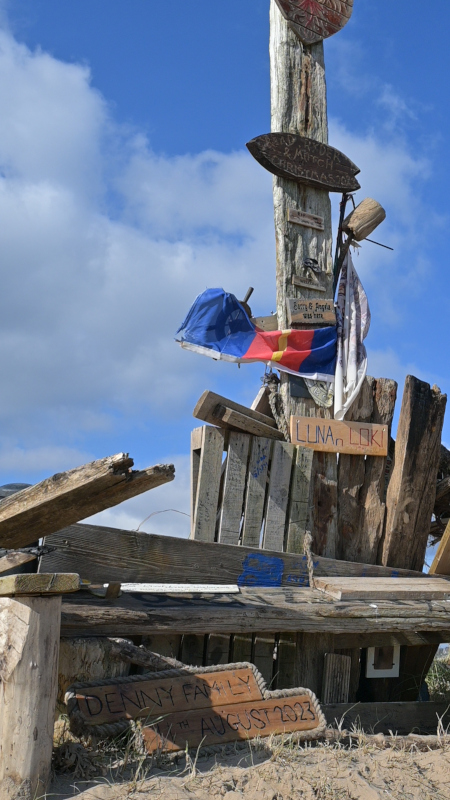
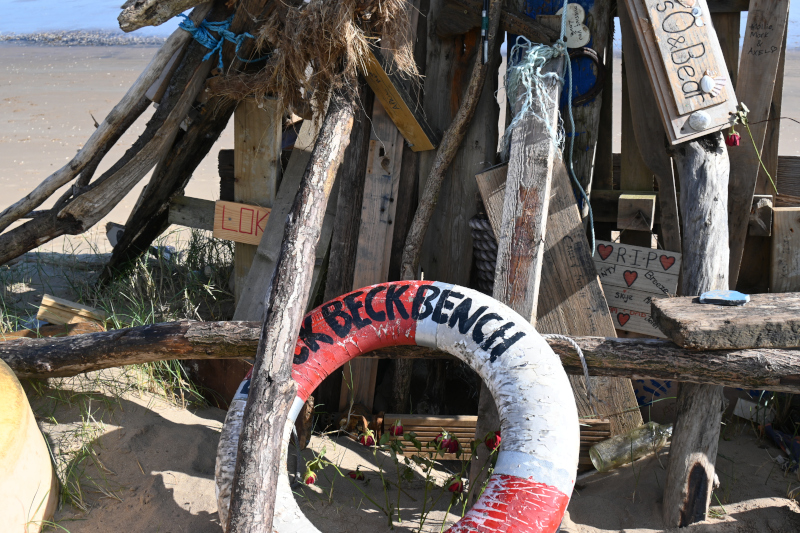
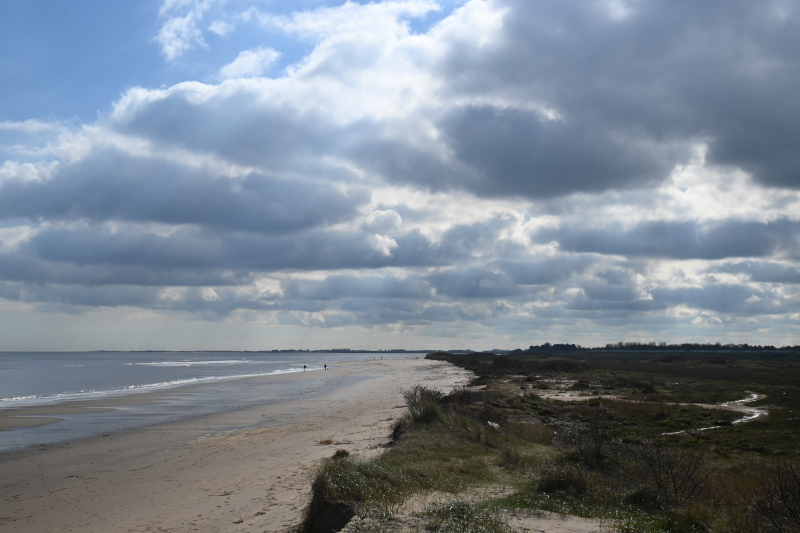
Regular readers might remember that two or three years back, I visited the Buck Beck Beach Bench, a strange and delightful bench built up from driftwood on one of the remoter stretches of Cleethorpes Beach. I haven’t been back very much since that visit, what for one reason and another, but I did keep following the Bench and its creators on social media. Because of that, I knew that twice since, it had been completely destroyed by storms; and then, rebuilt. After all, the Bench first started as a ramshackle, makeshift affair for dog-walkers to sit on whilst they waited for the tide to turn, and it was created by slow, organic growth rather than some grand plan. When it is destroyed, it comes back, recreated with the same impulse to create something, build something, and create a record that people stood in a particular spot and stared out at the ever-changing ocean.

A view of the Buck Beck Beach Bench

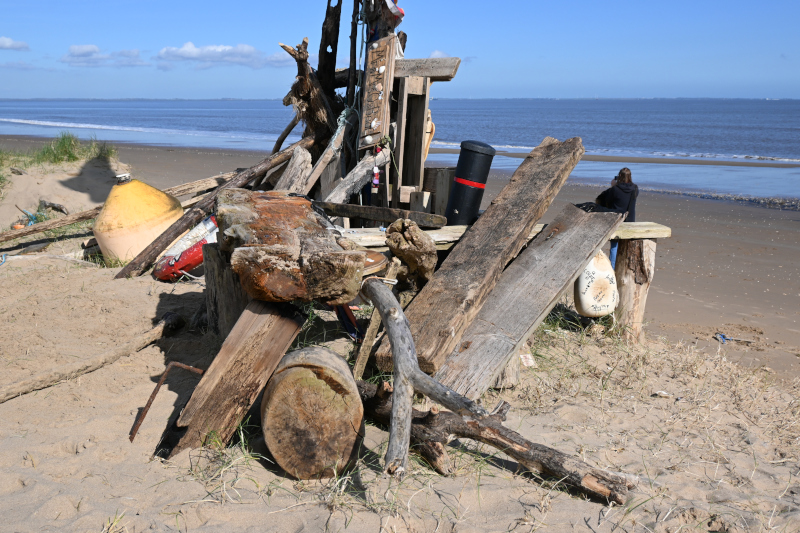
The bench is smaller now, much smaller than it was before, small enough that it can almost be captured in a single photo. The bench-builders still aim for everything the bench is made from to be safely degradable, something that will rot away harmlessly when it is washed away, as it inevitably will be.

A view of the Buck Beck Beach Bench

The new bench has moved a little from its previous spot which can still be identified from fragments of the previous bench lying about and projecting from the sand. It is on higher ground, now, higher above the waves. This does give it a more commanding view, but I doubt it will last as long as its previous incarnations. This is because it stands on top of a dune, close to its edge, and before very long that edge will have eroded away. It will erode quickly, both from the action of the sea at the spring tide and the footsteps of people climbing up and down from the shore to the bench and back to the shore again. I only give it a few months, before it is undermined and topples down into the water.

Closeup of the Buck Beck Beach Bench

But when it does, it will be rebuilt. And I’ll go down there again, take photos of what its latest regeneration looks like, at once the same but entirely, completely different. And then I will turn, homeward and landward, picking my path carefully back through the marsh.

View from the Buck Beck Beach Bench

How to cross the same river twice

Or, returning to the scenes of your youth

They say you can never go back again. Never cross the same river twice. The past is a foreign country, as the famous quotation goes. Sometimes, it can’t be avoided. Sometimes, though, it can be worth doing just for yourself.

When I was small, our summer holidays followed the same pattern, from when I was three through to when I was about 14 or 15 or so—I can’t remember the exact year it stopped. We would go camping for a fortnight, either two weeks in Sussex, two weeks in Kent, or more often than not, one week in each. The amount of equipment and comfort changed over the years, from smaller tents to larger tents, trailer tents through to caravans, but the destinations were always the same, the same two campsites in the same two parts of England. Wherever else we went, every holiday would include at least one day trip to Hastings, the south eastern seaside town that feels almost like a genteel resort, a noisy arcades town and a West Country fishing village all rolled into a single ball and mixed together. Here’s a photo I took when I was eleven, of the cliffs in Hastings Country Park, looking towards Fairlight Glen.

The cliffs east of Hastings

And then, in my mid teens, we stopped going. We had a couple more family holidays, where I asked for Gwynedd to replace Sussex, but I never again went back to Hastings.

Until last week.

I took The Children away for a summer holiday; and where better to go than a classic seaside town that has a beach that’s great for paddling, arcades, a miniature railway you can ride on, castles, caves, cliffs, the lot. OK, you can’t really build sandcastles, but building sandcastles is something The Children really enjoy in theory far more than in practice, and at least the sea never disappears to the horizon, the beach being steep enough to let it merely retreat a respectful few yards from the prom and the arcades. And: they loved it. I took them around all the same places I’d been taken when I was a kid myself: the miniature railway, the crazy golf, the cliff railway, the castle, and they loved absolutely all of it. We barely even left town for the week. The Child Who Loves Animals would have had us go to the aquarium every day if he’d had his way. I just enjoyed the chance to walk around and practice a bit with my new camera.

Hastings seafront seen from the pier

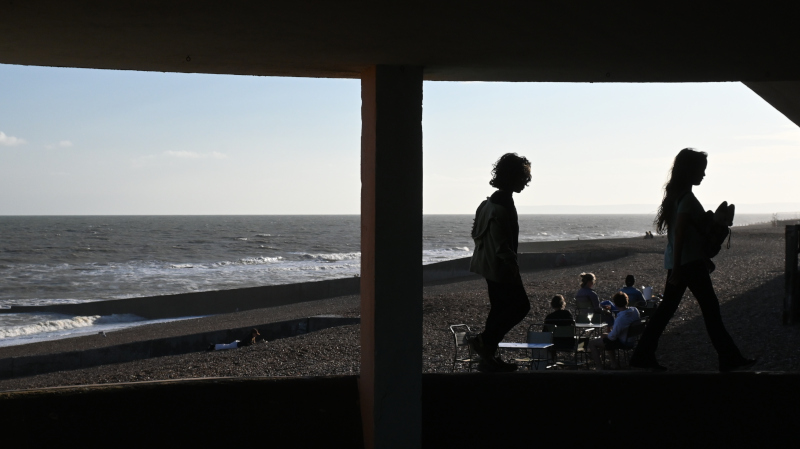
Bottle Alley, the covered promenade linking Hastings and St Leonards

The town? As a child your priorities are naturally a bit different to those of a middle-aged adult; but, even I could see that it has changed in the past thirty years. It has improved, a lot. So many places to eat out in the evening! So much craft beer everywhere. So many Pride flags flying, even from the flagpole in the castle. But it was still recognisably the same place, the same old shape, new flesh on old bones. The 1930s railway station might have been demolished and replaced, but the walk from it down to the beach was still unchanged. The art deco promenade by the pier has artwork now, but still the same concrete lines. The miniature railway might have nicer trains, but they still go between the same two spots, past a boating lake now cleared of boats and pedalos, but to a crazy golf course that still has its windmill and watermill obstacles and where hitting the bell at the end still scores you a free round. It’s hard to say, but I’m fairly sure the fish and chips is better.

The main thing that’s changed, though? Probably me. And it made me quite emotional. The last time I went there, I had a fairly good idea of the sort of person I wanted to be as an adult. Going back, walking down the promenade, I almost drew tears as I thought about just how much of my envisaged self, the me I imagined back in my early teens, is present in the woman I am today. Even if it does mean that I have to walk along the shingle in heels now.

Because the East Hill Lift was closed for major track repairs, we didn’t go up to the Country Park so I could replicate the picture at the top of this piece. Here, though, is a view of the town from the West Hill, the castle site, still the same odd little mixture of holidaymaking and industry that it was when I was a preschooler.

View of Hastings from the castle

Sunset at St Leonards beach

Oh, I said we barely did leave the town, but we did go for a couple of days out, to Battle and to Hythe. Here’s a couple of photos of Hythe railway station, one I took age 9 (I think) and one from last week, just to show you that in some ways I haven’t changed that much at all.

Hythe railway station in the mid 1980s

Hythe railway station in August 2023