+++*

Symbolic Forest

A homage to loading screens.

Blog : Page 97

Sudden

In which we come to terms

The last couple of posts make me sound like an old curmudgeon. I try not to be.

Too many people have died this year. When you’re in your 20s still, you don’t expect people your own age, people you know, to go. A dead friend comes at you like a kick to the ribs.

In the past six months, two people I got to know from the Sinister mailing list have died suddenly and unexpectedly, in very different ways. The second death was yesterday: sudden, unexpected heart failure. We hadn’t been in touch for a couple of years, but even so to know she’s gone was a sudden, nasty shock. I keep thinking of all the greetings and apologies that I should have said, but didn’t.

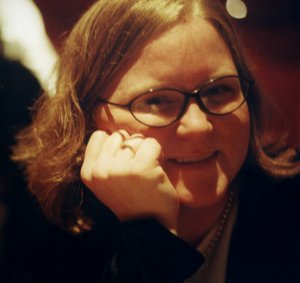
I’m not sure that I should be posting this picture – I’m not sure that it’s what she would have wanted. I want to show you it, though, because I think it shows what a lovely, lively person she was.

Amy

Rest in peace, Amy

Superfluous

In which children should possibly be heard somewhat less

Walking through the town centre, I heard a piercing scream, loud enough to make me jump. “What the hell?” I thought, worried that something horrible was going on.

Turning the next corner, I found that something horrible was going on. “HOW LOUD IS YOUR CHILD COMPETITION,” said the sign. “WIN A BEAR.”

That’s really not necessary, I thought. Children are loud enough already. They don’t need encouragement to scream as loud as they possibly can, because it happens often enough in any case. If only it was a real bear.

The creature

In which we discuss the natural history of the gruntlebeast

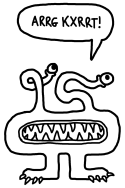
Someone recently said they thought the mysterious creature at the top right was myself. Strangely enough, it isn’t. Here’s a slightly better picture of it:

Gruntlebeast

The creature isn’t me, but it does have a name. This is a gruntlebeast. Although shy,* and so rarely seen on camera, these rather sad monsters are unfortunately rather common.

Their name comes from their main food: gruntles. They will often attack lonely strangers, using those vicious teeth to remove the victim’s gruntles. Often, the victim will not even notice the beast’s attack, only realising that they now feel rather disgruntled.

Clearly, these things are a menace. They account for a large proportion of the disgruntled people in the world, in turn leading to large-scale outbreaks of annoyance, irritation, depression and Being A Twat. You should watch out for them, and be particularly wary if you hear their distinctive hunting cry: “Arrg kxrrt!” If you see any, or hear of any sightings, then let me know. Be safe out there.

* and also, according to some accounts, sometimes invisible; which may account for the partially see-through appearance of the one in the picture.

Bring out the dead

In which we remember Elvis

A news story from the other day: Elvis Presley is the world’s highest-earning dead celebrity yet again. Partly, I assume, because of the effort his record company is putting into milking his back-catalogue as heavily as they possibly can.

Whether or not you think that the Presley estate is being overly grasping and moneygrabbing with its constant record re-releasing; things could, you know, be much much worse. There’s an awful amount of Elvis-related tat out there in the world, but how much of it routes income back to Graceland? If his estate really wanted to exploit its history, they easily could. Re-releasing old 7” singles is the tasteful option.

Books I Haven’t Read (part three)

In which we haven't read “The System Of The World” by Neal Stephenson

Update, August 20th 2020: A number of posts on this site have a minor update at the bottom, but not many have an update at the top.

It’s now 2020, nearly fifteen years since I first wrote this post, and I’m going through the archives doing a few updates. Tidying things up, fixing now-broken stale links and ancient typos, and excising anything that, at fifteen years distance, feels slightly too pointless or humiliating. And then, I come to this. And I’m not entirely sure what to do with it.

Posts that can be tidied up stylistically, they’re easy to deal with. Posts that are just too maudlin or self-obsessive: they can get right out of here. But posts and series of posts that I quite like, they’re staying, and I quite like the whole “Books I Haven’t Read” series. The problem is: how to deal with a post which openly admits that I used to enjoy reading Neal Stephenson?

At some point I will write a proper post for this site about why I used to enjoy reading Stephenson, why now I don’t any more, and what I actually think about his writing. There could well be another Books I Haven’t Read about a Stephenson book: Anathem, which arrived onto my bookshelves and then departed off my bookshelves several years later without me even managing to open it. But rewriting this post to take that into account would turn it into something entirely different now to what it originally was then, which goes rather against the idea that this is just a minor tidying-up exercise. I’ve decided, therefore, to keep this post pretty much as it originally was back in 2005, but with this great disclaimer at the start, a disclaimer that may well be larger than the post itself by the time I have finished writing it. This post is a museum piece. Read it, but please don’t believe it reflects my views now. Well, apart from what I think of the ridiculous implausible zipwire scene in The System Of The World, which is one of the few things I can actually remember being in the book.

Now, shaky back-in-time dissolve effect, read on…

This week’s Book I Haven’t Managed To Finish Reading is both a book, and a series of books, and also something that follows on neatly from the previous Book I Haven’t Read. It’s The System Of The World by Neal Stephenson, the final part of his Baroque Cycle trilogy.

Now, the trilogy is in itself a sequel to the earlier, 20th-century book Cryptonomicon, which I read and loved. The Baroque Cycle is set in the 17th and 18th centuries, filled with real-world characters such as Isaac Newton and Sam Pepys, and is somewhere between 2,500 and 3,000 pages long. The length isn’t a problem, though;* I seem to have a problem with the way the style of the books changes through the series, even though that change isn’t itself something I can put into words.

The first book, Quicksilver, I read and, again, loved. The second book, The Confusion, took two goes to get to the end. It’s not any longer, its intertwined-but-unrelated plotlines aren’t any denser or more complex, but for some reason it was a lot harder to finish. The System Of The World I’ve tried to read three times, and each time I haven’t got very far at all.

If there is anything I can put my finger on, it’s that somehow The System Of The World feels slightly cartoonish compared to the other books. The main characters swoop into the Tower Of London in a Spiderman style, or are suddenly faced with a ticking timebomb that needs to be defused. The complex political intrigues of the earlier books are still there; and in the earlier books they were mixed with action too. However, the action sequences in the third book are somehow much less plausible. Because of this, the disparate plotlines don’t feel as connected; and the whole thing is much more difficult to finish.

* Cryptonomicon is a similar length to each of the later books, and felt too short in parts, as if large amounts of exposition had been excised by the editor. Or maybe I’m just slow at spotting plot points.

…and recovery

In which we relax

Following on from yesterday: at the end of the week, the only way to recover is to spend Saturday not thinking about anything, not doing anything serious, just slowly relaxing until my brain eventually starts to return.

Tiredness

In which I fall asleep

I start the week alert and active. As it goes on, the alertness slowly fades away. I find myself yawning in public. I find myself staring into space more. By the time I reach Friday evening, all I want to do is rest. It’s a good thing we don’t have six-day weeks, because if we did I’d just end u…

…zzzzzzzz

Two posts today, to make up for yesterday

In which I look like a typical boffin, again

Following on from the vague theme of: does it matter what I look like? A couple of weeks ago, at work, Colleague M told me: “you look like the sort of person who would have a website“. Today, I had the chance to talk to M again, so I asked why I do.

“Well,” said M, “you’re a computer geek, and I assumed that all computer geeks have websites.”

“But do I look like the sort of person who does.”

“I don’t know, really.”

“I was hoping you’d say something interesting!” I said. “So I could write about it on the website!”

“Well, say that you look like a computer boffin, and all computer boffins have websites.”

We talked about the sort of things I write on the site, and, if I was more sensible, the conversation would have stopped there. However, being me, I blundered on.

“You can read it if you want. I don’t really want people here to know about it – so I can write about them – but I trust you not to tell anyone else.”

“Well, I’ll have a look,” said M, “but it sounds like it might be a bit boring.”

I wrote down the address on a scrap of paper, and M burst out laughing.

“What’s so funny about it?” I asked.

“It just is! Partly because you wouldn’t see why it’s funny!”

So, hello M, if you’re reading.

In other, geekier news, the site stats reached 10,000 page views some time today.* Woo!

* that’s when the logs are analysed by Analog, at least. Webalizer thinks it happened a few days ago – presumably they disagree on which files count as pages.

Byline

In which we think about design and credibility

Going back on last week’s post on Jakob Nielsen‘s top ten blog design mistakes: his Number Two Mistake is: no author photo on the site. Thinking about it, out of all the mistakes on his list, that’s almost certainly the most commonly-made.

Faces are better-remembered than names, he says. People will come up to you because they recognise you from your photo, he says. How many bloggers actually want that to happen to them, though? I know I don’t. It makes you personable; it improves your credibility if people know who you are.

I said before that I don’t believe it would give me any extra credibility. I don’t think you need to know what I look like in order to believe the stuff I write here; and frankly, I don’t care whether you believe it or not; I know myself how true it all is. Thinking about it again, though, I’m a bit suspicious of his reasoning; and what makes me suspicious is: comparing his theories to the way newspapers work.

If you look at most national newspapers – I mean, British ones – their regular columnists will have byline photos. You know what they look like, so, the theory goes, you should trust them more. Columnists, though, aren’t there to write things you need to trust them about. They’re there to write down their opinions, which may well be – and often are – complete bollocks. The news pages, which are the parts you’re supposed to believe are true, don’t bother with byline photos. They don’t always bother with bylines. These people, though, are the ones you’re supposed to trust, and their words are supposedly more trustworthy because of their relative anonymity.

Of course, this all breaks down when you consider that most bloggers see their role in life as over-opinionated commentators, not the byline-free just-the-facts news types. I wanted to mention it, though, because it’s a different angle on how trust works in the media. Who do you trust more?

Autumn days when the grass is jewelled (again)

In which we remember an old school hymn

I’ve noticed, recently, a lot of people finding this site because they’re searching for the lyrics to the song Autumn Days, the primary school assembly staple by Estelle White. So, I thought I may as well post at least part of them:

Autumn days when the grass is jewelled
And the silk inside a chestnut shell
Jet planes meeting in the air to be refuelled
All these things I love so well

(Chorus)
So I mustn’t forget
No I mustn’t forget
To say a great big thank you
I mustn’t forget

You can find the rest of the lyrics here, although there’s a small mistake in the second verse.*

I’m sure it became a classic assembly hymn-singing staple because it’s only vaguely religious. It is to hymns what Intelligent Design dogma is to creationism – it implies we’re talking about some sort of god here, but the details aren’t just vague, they’re not there at all. In other words, it fits in perfectly in your average non-sectarian British school, forced by law to hold regular “religious” assemblies, but forced by common sense to make them as non-religious as they can get away with.

* it should be “and the song the milkman sings,” I’m sure.