+++*

Symbolic Forest

A homage to loading screens.

Blog : Page 98

Being Nosy

Or, getting suspicious

Big Dave is up to something.

Big Dave is my main co-worker. He’s a big chap, and he’s called Dave. And he’s pretty open about stuff. Just lately, though, he’s definitely been up to something.

He asked if I could cover for him and stay late yesterday, so he could leave early. “If I leave when you normally do,” he said, “I can get to the gym an hour earlier. It would be nice to have a change.” Not having any plans myself, I agreed.

Back in this morning. “How was the gym last night, then?”

“Didn’t actually go to the gym,” he says. “Had something else to do.”

“Oh yes?”

“Mmm. I was busy.”

So, something’s definitely going on. It sounds like Big Dave’s got a date.

Vote for … um … noone!

In which we think about the Tories, but try not to think about them for very long

All politicians are evil, but Tories tend to be more evil than the others. I’m mostly interested in the current leadership contest purely out of a grim kind of schadenfreude: they are an aging party which is slowly pulling itself apart. I can’t help thinking that the main reason for their lengthy, baroque leadership election process is purely to help the party stay in the public eye* for longer.

* above the Government in the headlines, I mean.

Mistakes

In which we consider how well this site scores against Nielsen’s standard

Website design and usability expert Dr Jakob Nielsen has published his list of the top ten blog design mistakes. So, I thought I’d go through the list and see how many of them I’m making.

No author biography, no author photo. Well, there’s a kind of biography, but certainly no photo. I don’t want you to know who I am. It wouldn’t mean anything unless you already know me in real life. Telling you more about myself wouldn’t gain me anything in credibility, which seems to be the most important point here.

Nondescript posting titles – I do this all the time. Mostly because, as he says, writing good headlines is hard work. Partly, though, because this isn’t a news site. If you look at a newspaper, the concise descriptive headlines Nielsen favours are all over the news pages; but the comment sections’ headlines are deliberately vaguer and enticing.

Links don’t say where they go – I try not to do this, because I know it’s bad for search engines.

Classic hits are buried. If I ever write some, I might think about doing something about this.

The calendar is the only navigation – in other words, you should try to categorise everything properly. I’d say I score half-marks on this one.

Irregular publishing frequency is about the only thing on the list you can’t accuse me of, unless you want to complain about me not always posting at the same time every day.

Mixing topics. Hah. I don’t even have a topic.

Forgetting that you write for your future boss – this is why I don’t tell you much about who I am, in the hope of avoiding this problem. Nielsen thinks that trying to avoid this is hopeless given the march of technology, though.

Finally, Having a domain name owned by a weblog service – lots of well-known, well-respected sites do do this. I see the point, though: you need to control your domain to control your reputation. Not something I need to worry about, though.

Totting up, I seem to have hit six (and a half) of the top mistakes in weblog design. All of them, though, are all very good points when made about a different sort of site to mine. I just don’t feel that those six mistakes I’ve made are a problem for me at the moment – and some of them might be mistakes, but they’re decisions that I deliberately took. I’m fairly happy with the nature of this site at the moment, whatever an expert might say.

Books I *have* managed to read

In which I finish something for once

This week’s Book I Haven’t Managed To Read was going to be about a Neal Stephenson novel, The System Of The World. However, that’s been postponed, just because I wanted to brag about finishing another Book I Haven’t Managed To Read.

The book was one many, many people have read with no trouble at all. Harry Potter And The Goblet Of Fire. However, the first time I read it, in a hurry, I’d just tried to read two other Harry Potter books very quickly too. I got as far as Chapter Three of Goblet Of Fire, stopped, and didn’t pick any J K Rowling books up for a few years.

Anyway, last week, Colleague M said: “what? You’ve only read three Harry Potter books?” So, I picked up Goblet of Fire again, and read it. I didn’t get stuck. I didn’t forget where I was. I read it and I finished it. Hurrah!

Everything is out there

In which The Mother learns something

My mother is still beavering away at the family tree, on various genealogy websites. She still hasn’t really got the hang of the internet yet, though…

“What’s a GEDCOM file?”

“Have you looked it up?” Google, google. “It’s a file format developed by the Mormons to store genealogical data.”

“That was quick! I didn’t know you could use it as an encyclopedia! Can you look anything up on it? I mean, if I didn’t know what an elephant was, could I look it up on the internet?”

The thing I try not to think about is: this is probably the level that most internet users work at.

Organisation

Or, knowing where to find things

My life is a disorganised mess, and so I’m always on the lookout for ways to sort that out. Most of them seem overly-complex, self-evidently simple, or just too much work. However, I did rather like the look of a link posted on Boing Boing recently: an article from a few years ago about the Noguchi filing system.

The basic principle of the Noguchi system is: labelled files are kept on a shelf with no dividers. Files aren’t sorted, indexed, ordered or categorised at all. Instead, when a file is returned to the shelf after use, it’s always returned to one end. Therefore, the only ordering is by date of last use,* making it very easy to spot which files you can safely dispose of, or remove into storage.

That’s all well and good for paper file storage – it sounds like a rather good idea, to me. I was wondering, though, if it’s any use for computer file storage.

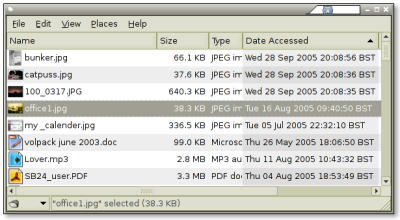
At first, it seems like an obvious candidate for computer file management. All you need to do is switch all your windows to sort files by date of access. So, I tried it; and quickly found that it’s more complicated than that. Here’s a picture of my home folder, which usually stores files I haven’t been able to categorise:

Home directory

The first problem jumped out at me straight away. I haven’t looked at those top files recently at all – certainly not as recently as September. The computer may well have done – probably to update its icon cache, as they’re images – but I didn’t, and the computer can’t tell that. This would be even worse for folders of files on the office network, used by multiple people at once. Secondly – and it took me a minute or two to notice this – my computer has a bug! The files aren’t even in the correct order, according to the printed dates.

So, clearly, I can’t use the Noguchi system for organising my computer files, at least not with the tools I have available. Creating new tools is possible, but beyond my own skills. Maybe I should just make a big “metadata” file, to track where all my important working files are and how often I’m using them.

* Or by date of last desk-tidy-session, as it probably would be in my case.

Reasoning

In which I am easily (and correctly) stereotyped

A strange day at work yesterday, and one in which I was instantly, quickly, and very correctly stereotyped.

Taking a shortcut through the warehouse behind the office, I got talking to Colleague M. Colleague M is fairly new, so tends to get all the rubbish jobs, such as sitting out in the cold of the warehouse sorting through boxes of stuff before it goes upstairs. We ended up talking for a while, and for some reason I ended up having to mention that I have a website.**

“Yes,” said M, “you look like the sort of person who would have a website.”

Frankly, I was a bit baffled. M may be right, but I have no idea why. What do people who have websites look like?

The Internet Will Kill Us All!!!

In which we learn something which could harm your health

According to this story in The Guardian, the government thinks that we shouldn’t be looking at websites that can show us how to kill ourselves. So, they want ISPs to stop us. Search engines should alter their results so that the first hit for “suicide” is The Samaritans. We shouldn’t be allowed to discuss ways to kill ourselves with each other.

This has all started because of two people, who met via the net, and killed themselves together. The Guardian is so concerned for our own safety that it won’t even tell you that they killed themselves by using charcoal to produce carbon monoxide. Careful. Now you know that – and you read it on the internet, too – you might go out and do something stupid.

The whole idea that people are more likely to kill themselves just because of the internet is very, very silly. People who want to kill themselves will do it unless they receive support or medical attention; the internet is just a scapegoat; and if it can persuade people to kill themselves in peaceful, non-disruptive ways, then so much the better.* The worrying thing, from my point of view, is the risk that this could be the thin end of the wedge. If the government can persuade ISPs to filter one topic, or can warp the results page for one search request, then they can do it for others. It doesn’t matter how well-meaning they are; they’ve crossed a line. The second time they want to do it, it might not be for such a well-meaning reason.

* Jumping in front of a train doesn’t just kill you, it will scar the driver for life too. Not to mention all the people who have to hose your fragmented remains off the track.

You’re It

In which we consider the mechanics of tagging

Feeling at a loose end, I’ve been experimenting with possible ways of adding Technorati tags to the posts here, without making them unreadable. There are three ideas I’m trying:

  1. using a different class of link for links that identify tags
  2. additionally, confining tags to a footnote-like section at the bottom of each post
  3. putting tags inside an “invisible” block inside each post (using ‘display: none’ to hide the tag paragraph)

This post uses Idea 1; and I’ve also edited Friday’s post to use a combination of ideas 1 and 2. Thursday’s post, on the other hand, has been edited with Idea 2 alone. My first reaction is that including the tags in the post body makes the post look a bit too messy, and not many people will realise the difference between the two sorts of link. If you have an opinion, let me know what you think. Would Idea 3 even work, or would it just be ignored?

Update, later that day: I’ve emailed Technorati Support to ask if Idea 3 would actually work. It does feel like a bit of a dirty, underhand trick to pull though.

Update, some years later – Jan 24th ’09 to be precise: I eventually decided on a method combining Ideas 1 and 2. And – pending a redesign – I still use it. However, I’m currently rewriting all the tags so they don’t go to Technorati any more, they go to “tag pages” within this site instead. It’s demonstrated, for one thing, that lots of people do actually click on the tags. Incidentally, as part of this, I’ve regularised the “test posts” described above; the “(b) test” no longer looks as described.

This is the revolution, honest

In which we consider what modern blogging is and isn’t

More from The Guardian: in the UK, an entire third of the 14-21 age group have started their own blog.

However, what that doesn’t say is that most of these blogs aren’t very interesting to outsiders; just pages of teenage gossip and bitching.* The Guardian has been over-hyping blogs for a while now, and “look, they’ve all got them!” really isn’t the important part of this story.

You’ll pick up on the important aspect of this, though, if you read the whole thing. It’s communication. The blogs the article mentions aren’t the big new revolution in publishing – they’re the big new revolution in Keeping In Touch. Most of the blogs on the internet now aren’t the sort of thing that the general public want to read. They’re online diaries to keep in touch with your friends, to tell them what you’ve been doing. The general public don’t read them, either – only the blogger’s friends do. In fact, they’re just the same as the traditional Personal Home Page of 1994 – the only difference is that they’re much easier to create.

* As opposed to this site, which is pages and pages of twentysomething gossip and bitching.