+++*

Symbolic Forest

A homage to loading screens.

Blog : Page 39

The Detail

In which we look at the detailed plans of the Guided Busway

Long-term readers will recall that, particularly last November, I’ve been covering the local guided busway developments: to whit, the West Of England Partnership, the quango which is, you could say, the haunting ghost of Avon County Council, and its plans to turn an old railway line into a private buses-only road. Sort of. Railway lines, of course, aren’t generally wide enough for that sort of thing; so they will mostly be building half a road.

Well, all has been quiet for a while; the consultation was completed, and the Partnership wrote off to the Department for Transport to say “can we have some money, please? Oh, go on.” A reader of this site, the other day, tipped me off to the fact that WEP have published their persuasions on their website. So, finally, we can read all the details which were conspicuously absent from the public consultation documents.

Firstly, there seems to be a change as to where the money is coming from. In the past, it was mooted that this application would be to the Transport Innovation Fund,* and therefore would need to have a congestion charge element to it. That’s not the case: the application is for Major Scheme Funding. So, no congestion charge: nothing is going to be done directly to reduce traffic. All we get is a new, shiny, park-and-ride service which replaces the still-shiny existing park-and-ride service, but serving Spike Island instead of Hotwells.

Secondly, it includes documentation on service frequencies. And half of the buses using the route won’t be the shiny new “Rapid Transit” buses; they’ll be the same old buses to Weston and Nailsea that already exist. Another thing which isn’t going to make the guided busway scheme any friends: it’s being marketed to the government as the first stage of a Rapid Transit Network, in which it becomes the Ashton Vale-Emerson’s Green route. In other words, the old let’s-pave-over-the-Railway-Path scheme which attracted large amounts of protest.

One of the most interesting bits, though, is the detailed plan of the new route. We learn, for example, that the rather worn and tired old swing bridge across the New Cut is to be “refurbished” – it sounds cheaper, after all – with a new footbridge alongside it. The small Butterfly Junction nature reserve is to be flattened and paved over – it isn’t even marked on the maps – and the Bristol Harbour Railway’s stop there is to be replaced by a new one.
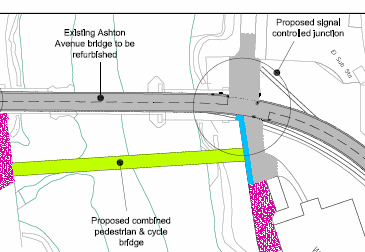
Plan of guided busway at Butterfly Junction

The Bristol Harbour Railway is where it gets most silly. The plans finally confirm what was hinted at in the consultation: it is to be turned into a tramway, with buses running on top of it. According to the bid documents:

The tracks for the heritage railway will be retained to provide for seasonal Sunday services and events such as the Harbourside Festival. When these infrequent events occur, services will run on Cumberland Road.

In other words, trains on the Harbour Railway will run on about half as many days as they do now, and along a tramway, which doesn’t quite tally with what my local councillor has told me in the past. As the railway is only just wide enough for one bus, one bus there will be; outbound buses will run along the road all the time, not just on Sundays. To squeeze under Cumberland Road and keep the cycle path, the busway will be narrowed to a single-track road/tramway with traffic lights.

One of the vaguest parts of the consultation documents was: what happens at Prince St Bridge, which isn’t currently strong enough and probably not wide enough to take buses. The consultation map was hard to read; the Evening Post reported that there would be a new bridge. Some people suspected that the current “trial” arrangement of having cars on one side of the bridge and pedestrians on the other was a taste of things to come, ready for the guided bus scheme. Well, it turns out they were right.
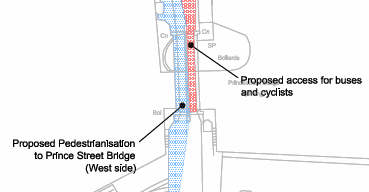
Guided bus plan for Prince St Bridge

Red in that diagram means “bus lane”. Prince St Bridge will be closed to cars; with this scheme, it will be divided between pedestrians on one carriageway, and buses and cyclists on the other. Instead of cyclists being able to run into pedestrians whilst dodging opposing traffic, as now, they’ll be able to get flattened by buses instead. It’s also quite hard to work out how much money has been set aside for Prince St Bridge works, because the costs aren’t itemised very clearly – indeed, the surveyors who reviewed the WEP costings also had trouble on that point.

I don’t think the busway scheme is going to go ahead. That’s partly because the funding bid includes a convenient “low cost alternative” scheme. It is, essentially, the same scheme, same nice new buses, new bus stops, but using the existing park-and-ride route with no new infrastructure. The funding bid says:

A key element of the [Low Cost Alternative] route is the avoidance of the main bridge structures at Ashton Avenue and Prince Street … in order to reduce the construction costs.

The infrastructure will, they say, halve travel times along the park-and-ride route. Whether the Department for Transport think that that will make it worth the money remains to be seen. I’m not convinced they’re going to go for it. In a few months, though, we will all find out.

* as you can see from this Joint Transport Forum presentation released under FOI. Thanks to correspondant Gareth for pointing me to that URL.
Coalition

In which we consider the people who take to the streets

Last week the news was full of reports of demonstrations in London, over the G20 summit conference out in the Docklands. And I, for one, was a bit puzzled. The protesters seemed to be something of a strange coalition.

Generally the demonstrators were summed up as “anti-capitalists”, as always happens at these events; probably because the Socialist Workers are always on hand to provide lots of placards in the hope of furthering the Trotskyite Revolution that they’re expecting, in true millennialist fashion, any day now. And there were plenty of such placards visible in the news reports. But that wasn’t the picture I gathered from the protesters who were actually interviewed on TV. They all seemed to be died-in-the-wool capitalists, people who truly believed in capitalism, people who were upset that their bankers had disappointed them.

These people were saying: “all our money has gone”. Because these were all people who had money, and had invested it. They had been living off their savings income,* and were protesting that the drop in interest rates has wiped that income out. Whether their capital is gone too, of course, depends where they’d invested it and how risky they were prepared to be. But risk is an inherent part of the system.

These people were well off, by any measure; at one time, at least. If they weren’t, then they wouldn’t have had money to invest to begin with. The vast majority of people, around the world, don’t have that complaint to make, because they’ve never been rich enough to save. You don’t have to worry about the return on your investment, or about the risk to your capital, if you’re in the great majority who don’t have any capital to invest. And if you’re an anti-capitalist, I’d have thought you’d be celebrating the failings of the capitalist system, trying to tell the world all about them. These people I’d class maybe as Voodoo Capitalists, people who assume that if they make an investment, they are guaranteed an income, because That’s Just How It Works. The value of their investments may go down as well as up, but that was buried in the small print, so they feel it’s their natural right that their money should keep on coming in. Not anti-capitalists, not Trotskyists, just overly-trusting people.

* A “private income”, to use the old-fashioned term

Foolish

In which we confuse people

As it’s April 1st, here’s some almost-but-not-quite-believable information. Some of it is true, some of it isn’t. See if you can guess which is which.

  1. A firm from Skegness once offered a mail-order service supplying potatoes sliced and braised in cream, and other similar dishes.
  2. French revolutionary politician and Terror leader Maximilien Robespierre was obsessive about wearing exactly the right sort of silk stockings every day.
  3. Some Ancient Greeks believed that beans were haunted, and that eating them could cause pregnancy.
  4. I have a tattoo of a steam train on the inside of my left thigh.
  5. The British government for many years maintained a secret stash of spare steam engines, hidden in an old quarry just outside Bath.
  6. Sir Alan Sugar’s company Amstrad once sold a range of home computers whose graphics chip used trinary, not binary, arithmetic.
  7. The term “bug” for a computer fault dates from someone finding a moth stuck in an early electromechanical computer.
  8. The tracks of the London Underground were originally about 2′ 3″ wider than they are now.

Broadcast

In which we recommend some telly

Regular readers might remember that, back in the mists of time – well, December – I mentioned that we’d been watching The Wire on DVD. And that it was very good. None of the bogus and ridiculous “science” you get on CSI;* not much patronising or heartstring-tugging, no deus ex machina and no wrapping the plotlines up inside an hour; just lots of what was – to someone who doesn’t know anything about the real thing, like me – lots of realistic investigative work.

Well, we’ve finally finished watching Season One, just as it finally makes its way onto the BBC. And, to be honest, I’m glad we had the DVDs to watch it from. It took us six months to do, twice as long as it will take BBC2 to show it. It’s a complicated programme, and we ended up watching several episodes twice because we hadn’t been concentrating the first time. In the end, we had to make sure that we only tried to watch it when we were definitely wide awake, otherwise we’d end up missing half of what went on. If we’d tried watching an episode on late night TV every week, we’d have been baffled – we had enough trouble with Dexter season two, just finished on ITV1,** and as unlike The Wire as it is possible for a cop show to be.***

I did wonder, idly, about recommending The Wire to The Parents. They’ve always liked police procedurals, both on telly and in books, and long-form dramas, so, I thought, they’d probably love it.**** But then, I remembered, how much The Mother tuts at the slightest hint of a bad word. The Wire has realistic dialogue.***** It wouldn’t work out. Before they were ten minutes into the first episode, she’d have asked to turn it off.

If you’ve seen the mysterious trailers for The Wire on the BBC, and you’ve not heard of it, go and watch it. It really is good. Very good. As for us: we’ve had the Season 2 DVDs sitting on the bookshelf since Christmas. As soon as we’re properly awake, they’re going in the DVD player. Hurrah!

Update, April 2nd 2009: BBC2 currently seem to be showing episodes of The Wire daily. Meaning that, for one thing, they will whip through the whole series in under three weeks; and for another, if you didn’t start watching on Monday then it’s already too late. Tonight is Episode 4, and the plot is already well under way.

* insert your favourite “CSI [somewhere]” joke here. I’ve mentioned CSI Bedminster myself before, and Half Man Half Biscuit have produced CSI:Ambleside.

** I’m still not used to the name “ITV1″. In my mind it’s still the old federated network – Yorkshire TV where I grew up.

*** Dexter, though, certainly had more tension. Even though we knew full well that there are at least three more series after the one ITV have just been showing, we were still on edge at practically every cliffhanger.

**** Unlike us, they have a DVD recorder, so it would still be compatible with their in-bed-by-10 lifestyle.

***** And at least one scene where every single word of dialogue is a swear word. Every word. A bit like the opening scene in Four Weddings And A Funeral, but set at a scene-of-crime.

Equinox (and a week)

In which spring is arriving

The weather does not know what it wants to do at the moment. As spring comes in, we sat by the harbour, eating ice cream, and felt uncomfortably cold and hot at the same time. The sun shone brightly down, as a sharp wind nipped up from the water. We shivered, but were too hot to wear our coats.

Calling Dr Jones (part four)

In which we finally finish talking about Tudor Parfitt and the Ark of the Covenant

Series of posts, on here, always seem to take me longer to write than I had planned. It’s now, ooh, at least six weeks since I wrote the first post in this series, so I really should tidy it up and finish it off. For people who aren’t regular readers: some time ago, a Jewish Studies professor called Tudor Parfitt made a documentary about the lost Ark of the Covenant, the Biblical artefact which starred in Raiders of the Lost Ark, which in reality has been missing for well over 2 millennia. Professor Parfitt’s theory is that, although the original ark is probably long destroyed, it passed into east Africa, into the possession of a Jewish tribe there called the Lemba, and that its replacement is a war drum now sitting in storage in an Harare museum. Feel free to go back and read what I’ve written so far, if you’re a new reader.

All that is so well and good. It may well, indeed, be true, so far as I’m concerned. However, that’s not the end of the theory. Its logic goes as follows: the ark’s descendant is a war drum; therefore, the original ark must have been a drum too. Even though all the evidence for its existance states that it wasn’t a drum, a drum it is now, so a drum it must have been. In part three, I discussed how, in some ways, this theory is typical of what I suppose you could call “primitive archaeology”: the traditional diffusionist archaeology that held sway until the 1960s. Change was seen as a hard thing to do, and the possibility of cultural change tended to get swept under the carpet.

Change happens, though, in the real world: we can see it every day. It’s hard to see it occurring in the archaeological record, though; and very hard to determine its cause. Archaeological change and historical change are very different beasts.

There is one case in the British archaeological record where archaeology and history match up, and together provide evidence for inward migration. It’s in a small area of East Yorkshire, and archaeologically it’s known as the Arras Culture. It’s distinctive because of its chariot burials, unique in Britain. The nearest parallels are with similar cemetaries in the Ile-de-France region and the surrounding area.* Some of the riding gear buried with the chariots – the bits, for example – also resemble continental riding gear more than British.**

Fast forward to the end of the Iron Age; and the Romans arrive in the area. They have historians with them, and said historians write down the names of the various British tribes that the Romans encounter. The tribe that lives in East Yorkshire? They’re called the Parisii. They’re not the only tribe of that name, though. The Romans had discovered Parisii before, in the Ile-de-France, where they even had a city named after them.*** On the face of it, then, an obvious link. One of the few clear examples of cultural change in the British archaeological record which has matching historical evidence for a migration.

It’s not quite that simple, though. The Yorkshire Parisii and the French Parisii both buried people in chariots, and they used similar riding gear. But if you put a Yorkshire horse bit next to a French horse bit then, although the Yorkshire one looks suspiciously Continental in its general design, it’s still also clearly separate from the French one. Its detail design work will still be distinctively British. Overall, the Arras Culture is something of a hybrid of British and Continental Iron Age styles.

How does this fit in with Tudor Parfitt’s Ark of the Covenant theories? Well, archaeologists have tried to explain the Arras Culture in various ways other than straightforward migration. For example, a British tribe might have been trying to adopt Continental styles and fashions.**** Or, it might reflect a limited migration: a small number of leaders move, bringing their technology with them; but the craftsmen and engineers doing the actual work are British and use the same styles as their ancestors did. And, curiously, this is exactly what the Lemba say happened to them. A small number of priests came down from the north, bringing with them Jewish traditions, laws, and their holy war drum.

It’s entirely possible that this happened. There aren’t many other ways to explain the Lemba’s existence, after all. However, we do know that the priests from the north didn’t bring all the Jewish traditions with them. The Hebrew language, for one thing: the Lemba speak a Bantu language. Just like in Yorkshire, the new leaders brought with them the outline of a culture but not the detail. They brought with them an idea of the Ark, if not the Ark itself, as a holy object through which God could speak and smite, to be carried into battle in front of the tribe. But the concept of the Ark as a reliquary didn’t survive. In the Lemba culture, it became a drum, the literal and thunderous voice of God.

Professor Parfitt is forced to admit that the Harare drum is definitely not the Biblical Ark, because, being wood, it’s straightforward to date. He wants to stick with the idea, though, that the Harare drum is as close to the real Ark as we can get now. It may well be the closest surviving object to the Ark we have, yes. But that doesn’t mean that the Ark was always a drum. Cultural change happens, details of culture get left behind, and things change and adapt. The Lemba’s religion isn’t Judaism as the rest of the world practises it: it is Judaism filtered and absorbed through a small group of priests and the African tribe they evangelised. There’s no reason why we should follow their lead and say that the Ark of the Covenant was a drum, when the rest of Judaism***** says it was a reliquary. Tudor Parfitt’s theory may be partly right, but it is also very flawed, because of his inability to consider how the Lemba culture developed, and how cultures can adapt and change.

* Confusingly, the “Arras Culture” name is nothing to do with France at all; it refers to a place in Yorkshire.

** Specifically: the number of joints in the bit mouthpiece.

*** It’s still there today, apparently.

**** Even today, I can see why, if you came from Hull you might want to imagine you were from Paris instead.

***** Not to mention Christianity, and Islam.

Sound and music

In which we go to see The Boy Least Likely To

As soon as we get home, we’re out again. To a gig, at the Louisiana, to see The Boy Least Likely To, hard at work promoting their new album that’s just been released. We were slightly confused when we arrived, to see that according to the posters the gig was on Monday, March 24th, and we’d turned up on a Tuesday. After checking our calendars, we went in. Inside, there’s not much room in the Louisiana. It’s quite a cosy place, so cosy that we quickly spotted that a good chunk of the pub was taken up by support band The School tucking into their tea.

The first band that came on were The Fox And The Bramble, an electric/acoustic duo who dashed about the stage swapping instruments, and made slightly-twee twinkly sounds with children’s toys. I spent a while wondering which one was Fox and which Bramble; the internet says the name comes from Aesop, though.

They were followed by The School, as I mentioned. We’ve seen The School before, so we knew what to expect; but we were slightly disappointed. They didn’t seem as good as they did in November. The sound didn’t seem to be mixed quite right, with keyboard and vocals overpowering the rest of the band.

The Boy Least Likely To had sound troubles of their own. “Violin isn’t plugged in,” one of them shouted, after the first song. “Too much violin,” he shouted after the second. They are apparently only a duo normally, but on-stage they mysteriously expand to a full band, like one of those toys for dropping in water. I have to admit to not knowing very much about them; but the gig left me wanting to find out more. Their frontman smiled broadly, and flicked balloons back and forth with the audience in a genial way, never missing a beat.

Brokenness

In which things go wrong in hard-to-diagnose ways

We go away for the weekend. We come back. And the house is cold. Turn on the hot water tap: freezing. The boiler has given up the ghost.

I turn on the PC this morning: and that refuses to come on, too. Which, to be honest, is a recurrence of a problem I was already aware of. Sometimes, on start up, it gets partway and loses contact with the disk drive. Or, sometimes, if you ask it to do too much disk-thrashing just after booting, the same thing happens. On the other hand, if it starts up all its services and is fine for 15 minutes, it will probably stay fine until it’s switched off.

All that points to something like a loose contact somewhere, if you ask me. As I say, it’s been happening for months now; but today I was in the mood to sort it. The computer now has a new hard disk cable. It booted up first time, and it’s still running. Let’s see if it still works in the morning.

The boiler might be suffering from something similar. The gas engineer came out, poked around at it, and fixed it. The chap wasn’t sure what the problem was, or how he fixed it, but fix it he did. Maybe. It’s working now, but we still have to see if that, too, will come on again come tomorrow.