+++*

Symbolic Forest

A homage to loading screens.

Blog : Page 28

Monetising Friendship

In which I'm going to sell you all something you don’t really need

I’m inviting a few friends round one night. We’ll have a few drinks, a bit of a laugh, and I’ll show them a pile of stuff that I’m trying to sell. Hopefully, they’ll buy some, and I’ll make a tidy profit.

NB: the above paragraph is not actually true. I am not going to do this, and I don’t have anything to sell.* As a scenario, though, it’s a pretty common one. People all over the place are handing out Avon catalogues, Christmas hamper brochures, and organising parties for Foreverware storage; or cheap-looking expensively-priced nylon lingerie and sex toys. It makes me wonder: do some people really value money that much over friendship, that they see their friends as a source of income?

On the face of it, evidently so. I hope that maybe I’m just being pessimistic in my analysis. Maybe the people organising these events really do mostly believe that they’re doing their friends a favour, giving them the opportunity to buy Impressive Things at almost-bargain prices; and the money they make back for themselves doesn’t really make any difference to them. Certainly, in the true “multi-level marketing” organisations that are scarcely different to pyramid schemes, most of the bottom-rung salesforce are unlikely to come out of it in profit. On the other hand: I have known people, setting up these events, to excitedly say: “and it means that I can buy them for myself, cheap!” It makes me slightly uncomfortable, seeing people trying to use their friends in this way: it’s more than a little manipulative.

In one way, this is the root of the current fashionable trends in marketing: using the social network to save the marketeers the hard work. Viral marketing, for example, where you, J. Random Netuser, sends the latest cool advert you’ve seen on to all your friends: you receive a frisson of group-bonding pleasure in return for doing an ad agency’s work for free, just as if you’d invited them all round to your house to sell them the product. Facebook games are also similar: little money-churning devices that you, game player, spread awareness of among your social network. Maybe it’s going to become a long-term trend: I suspect the reason it’s so popular is that, after all, it’s cheap; or, at least, the costs are passed on to other people and other companies. It’s slightly different, too, to selling things directly to your friends through a catalogue or at a party: if you’re playing Farmville, your Facebook friends might have to put up with being told how your farm’s doing every few hours, but that’s as far as it goes. You’re not expected to buy things, yourself, until after you’ve been sucked in. You’re not expected to make your friends money, directly.

Maybe that’s the reason I feel so uncomfortable about this technique of monetising friendship: it is about directly turning your social relationships into monetary ones. It probably works best in social networks with a clear or semi-open hierarchy, because it’s potential very much about reinforcing that social hierarchy with money. I know such hierarchical social networks exist — I see them everywhere — but I do tend to feel that the world would be a nicer place if they didn’t.

* Although, if I was going to do that, I suppose we could always knock up some “I visited Symbolic Towers and all I could buy was this beautiful high-quality clothing product” t-shirts.


Counterfactual

In which we pose an anniversary question

Today: the anniversary of the one date in English history that just about everybody knows. It is – as you’ve probably realised – the 944th anniversary of the Battle of Hastings, which occurred on October 14th, 1066. And, of course, all that: the death of King Harold II at the hands of Duke William of Normandy, which led to the duke’s coronation as King of England on Christmas Day that year.

It is, of course, slightly silly to posit: what would the world be like now if the Battle of Hastings* had turned out differently. Counterfactual history can always be true, as the narrator of an Umberto Eco novel almost said, because the premise you’re starting from is always false. Nevertheless, it’s an ever-interesting exercise, particularly with an event like Hastings which turned on a rather narrower pivot than you might think. The standard history of the battle, after all, was written for the victor’s brother, and follows a firm melodramatic template: our hero is promised his future inheritance by a pious elder, and our dastardly villain swears loyalty to him. Come the pious elder’s death, our dastardly villain grabs power, God shows his displeasure, and the plot ends with the villain dying a perjurer’s death and our hero getting his just reward.

The battle was a long battle, though, for the time; and it certainly didn’t start off as a rout. At one point, in the confused melee, things definitely seemed to be going the English way: some of the Norman troops had fled, and Duke William appeared to have been killed, disappearing down into the miry slaughter. However, it was only his horse that had been killed, and somehow he survived, climbing up and throwing off his helmet to persuade his troops he was still there to fight for. There were a good proportion of mercenaries in the Norman army, after all, and you can imagine how willing they would be to go on fighting once they thought the chap paying the money out was down. It was a very narrow escape, it seems, but from there he eventually succeeded in turning the battle round; and thus, English history proper started.**

Would we be living in a very different world if the battle had been won by the English? Undoubtedly, in both large and tiny ways. The English we speak would be a rather different English, for one thing: probably none of those legal paired phrases like “cease and desist”, “goods and chattels”, and so on. We’d have one fewer national park: the New Forest would never have been built. Moreover, we may well have had a rather more decentralised country. King William overthrew a system of English nobility which had slowly grown up from a loose grouping of tribes sharing a common North Sea culture, a system in which no single family was dominant over the long term, there was no automatic hereditary throne, and the individual royally-qualified families had strong regional power bases. He replaced this with a single dynastic line; in the following thousand years, there have only been three major breaks in the line of succession.*** He made sure this happened by carrying out an economic conquest alongside his military one: destroying the entire economy of Yorkshire and Durham, for a start, and thoroughly replacing the English land-ownership structure, taking economic power out of the hands of the English and giving it over to the new nobility.****

Would England have been very different if this hadn’t happened? Would rural Yorkshire have denser settlement patterns, and would we still have a single Royal Family? Naturally, it’s impossible to say: on the first point, the Black Death would still have happened, so by 1400 the population in our projected Anglo-Saxon Yorkshire may well have been around the same as it actually was. We’d probably have different northern cities: York, Durham, Newcastle and (probably) Grimsby were already well-established by 1066; Manchester, Leeds and Middlesbrough were nowhere, and Sheffield was a Norman foundation. I like to think, though, that overall the country would have been more like Germany: still with its capital as the nation’s hub, but with a much greater sense of regionalism, and the importance of the regional cities. We’d still have been English, but we might have been English in a rather different England. Whether it would have been a better England, of course, is another of those things that’s impossible to say.

* Which, of course, didn’t happen in pier-bereft Hastings, but in the handily-named nearby town of Battle.

** Or at least it felt as if we were taught that in schools 25 years ago. I particularly remember, at the age of 5, watching a Norman Conquest-themed series of the educational TV show Zig Zag, featuring a “will the peasant forced into poaching really get his hand chopped off?” cliffhanger.

*** There was something of a hiccup after all William’s own sons had died, largely because some leaders at the time did not like the idea of a queen regnant. The outline of the start of that phase of history, strangely enough, is almost the same as the story of the Bayeux Tapestry: dastardly villain swears oath but goes on to seize throne, etc. However, instead of the dastardly villain dying within the year during a short and decisive military campaign, this story ends with 19 years of on-off civil war until the villain, King Stephen, died a natural death.

**** And those people who can trace their ancestry back to that newly-founded nobility are, of course, still very proud.

Adaptation

In which we discuss the Scott Pilgrim movie, one case of a comic-to-film adaptation that keeps all the spirit of the comic it came from.

Back, back in the mists of time — well, in December 2007 — I posted a review of Scott Pilgrim Gets It Together, the fourth, and at that point, the latest, book in the Scott Pilgrim series by Bryan Lee O’Malley.

Since then, of course, the world has moved on. In Spring 2009 the fifth book, Scott Pilgrim vs. The Universe was published, with shiny metallic cover. We quickly bought it,* and I intended to write about it on here, but somehow other things kept coming along and SP5 never got its review.

Forward to this year, and publicity started to appear for Scott Pilgrim, the movie version. The sixth and final book, Scott Pilgrim’s Finest Hour, was published this summer. “I really must write on the blog about this one,” thought I, “before the film comes out.” But it didn’t happen. So, last weekend, we went to see the film, not sure if we would love it or hate it.

Quick recap for people who have never heard of Scott Pilgrim, never seen it, never read the books: Scott Pilgrim is a 20-something slacker geek with no job, in a rather bad band, who starts dreaming about a mysterious girl. She turns out to be a real girl, a delivery courier called Ramona who knows the secret of using people’s dreams as shortcuts between places in the real world. Scott immediately falls in love, but quickly discovers that her emotional baggage is somewhat more real than most people’s, as she has a whole league of Evil Exes she’s dated in the past, who Scott must defeat in video-game-style fights before he can win her heart. Now, read on…

Adaptations often get a bad press. What works well in one medium, after all, doesn’t always translate; but if an adaptation’s not faithful, it can end up pleasing nobody. Scott Pilgrim vs The World, though, is one of the most faithful adaptations I’ve ever seen, despite the fact it has to cut six books’ worth of action down into one single film. From the moment it started, with the same fonts onscreen as in the book, it was, I think, as close to the comic as any live-action adaptation could get. Lots had to be cut out, of course – the books are set over the course of a year, the film over a few weeks at most – and due to release schedules the last act is radically different to the final book; but, overall, the spirit of the books is captured extremely well. Some subplots were pruned entirely; some of the backstory was moved to an animated short; and some of the characters’ emotional lives are simplified or made less explicit; none of it feels missing from the film, though. Moreover, the film uses a lot of the books’ stylistic quirks. Just like in the books, each new character gets a little black caption explaining who they are and what they’re up to. Just like the books, the film is full of cunning references and semi-hidden jokes. The film does a very good job, like the books, of portraying a realistic world in which, nevertheless, video-game events can happen.

There are a couple of places where you could argue that the film’s better than the books: in plot terms, there are two places where the story is told in a slightly better way.** In general, though, I still prefer the books: a much fuller story, because there’s more space to tell it in. At some point, I should write an essay about the ending of the series, and what I think it says about life; that’s not for today, but it says something that the books can inspire me to consider something like that.

Some reviews of Scott Pilgrim vs The World have said that it’s “too hyperactive”. It is, definitely, a fast-moving film: that’s what you get when you compress that much shelf-space into one movie. Philip French, in the Observer, complained that at 1 hour 52 it’s “overlong” – maybe that was the effect of the various fight scenes, which do come close together. Myself, I found it both witty and touching; but I did worry that a newcomer, someone who’s never read the books, would have no clue what was going on at all.

In general, for both me and K, it’s the case that we can’t watch films too often. Once we’ve seen something, even a film we both love, it has to sit on the shelf for a few months before we can happily watch it again. As we walked out of the cinema after seeing Scott Pilgrim vs The World, almost the first thing we did was: work out when we have some time free to go back and watch it again. If that isn’t a recommendation, I’m not sure what is.

* Coincidentally, the day I bought it was also the day I auditioned to go on Mastermind – I stopped off at Forbidden Planet on the way home.

** Spoilers: the defeat of Todd, the third Evil Ex is directly caused by Scott in the film; in the book, it’s a bit of a deus ex machina. It’s set up earlier, so not a complete bolt from the blue, but Scott doesn’t really have much involvement with it. Secondly, the treatment of Scott’s extra life is handled better in the film, in that he has to “replay” the previous few scenes a second time, but knows how to handle them better; in the book he returns to consciousness straight after the dream/afterlife sequence with Ramona. You can, of course, find examples of video games that work in either way, but I preferred the film version.

Why We Now Have A Frost-Free Fridge

In which things got icy

When we first moved to Bristol, we moved into an unfurnished flat that came supplied with white goods, partly because it made life much easier for us when moving. No worries about having to find a cooker, a washing machine or a fridge: but the downside was, we didn’t get to choose them.

When we moved in, the fridge was nice and clean and empty.

A few days later, though, we noticed that a bit of frost had started to build up on the back of the fridge. No problem, we thought. When we get chance, we’ll defrost it; it’s normal, after all, for fridges to get a bit of frost at the back.

A few weeks later, we noticed that a can of Kopparberg at the back of the fridge was looking rather iced-up too. We turned the fridge down (or is it up?) to its warmest setting, to give the ice a chance to melt away a bit. The fridge was still perfectly cold enough to keep everything, even on that setting. The Kopparberg, though, stayed icy. Indeed, it almost seemed as if the ice was still growing.

A few months later, I remembered I had some Kopparberg in the fridge. Except … it didn’t seem to be there any more. And there was, now, quite a lot of ice at the back. It seemed to have a shadow in it at one end.

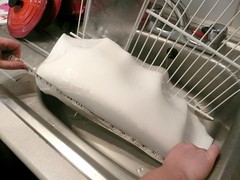
Twenty-one months or so after we first switched the fridge on, we suddenly realised we were about to move out. So, we’d better switch the fridge off now, and maybe, just maybe, we might have a chance of defrosting it. We stuffed the bottom of the fridge with towels, turned the power off, and waited. Slowly, ever so slowly, the ice started to drip. The can of Kopparberg started to reappear; when I prised it out of its icy prison, and shook the tin, the ice inside it klunked against the edges. After about twelve hours of melting, I gave the block of ice a jolt. The whole thing, along with one of the fridge shelves, came free. I moved it to the sink.

Ice from the fridge

Ice from the fridge

Ice from the fridge

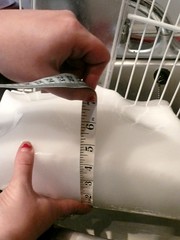
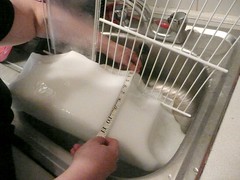
We hunted down a tape measure, and K measured it whilst I took photos:

Ice from the fridge

Ice from the fridge

Ice from the fridge

That’s about 4 inches deep, 14 wide and 11 tall. It’s not a cube, of course; on the other hand, it had already lost several inches in size. Overall, I think we must have had at least 6 or 7 litres of water stuck to the back of our fridge.

Moving to somewhere new, we had to buy ourselves a fridge, along with all the other kitchen equipment. As soon as we went shopping for one, we made a bee-line straight in the direction of the frost-free refrigeration section. I think, from the pictures, you can probably see why.

Collodion

In which we go to London for the photography

Back in the mists of time, I used to think it would be a nice idea to move to London. There’s always something going on, of course. Always plenty to do, and always plenty to keep me entertained.

When I lived in a remoter part of the country, with not much to fill my spare time, this seemed like a Good Plan. Now that we live in a reasonably-civilised city, though, we have far too much to do as it is. And I just know that, if we did live in London, it would go one of two ways. Either we would spend all our time feeling sad about the events that we just didn’t get chance to make it to, or we’d retreat into a bubble and never do much at all. When we do visit, we can easily manage to fill a day and have plenty of things left over that we could have done.

Yesterday, for example: we almost managed to avoid the day’s main event and tourist attraction, the Pride March.* We did have to scoot around a few barriers, though, and avoid a few crowds of pre-march spectators, because the main reason we wanted to go to London was for the current exhibition at The Photographers Gallery: The Family And The Land, a retrospective on the American photographer Sally Mann. Mann became well-known** for a series of photos she took of her children, growing up, twenty-five years ago. From there, as the exhibition title suggests, she moved on to the past of her homeland, taking landscapes of American Civil War locations, before, more recently, producing a series on death and decay, literally: decaying bodies, outdoors, at a forensics research lab. Much of her work has been produced using 19th-century techniques: the wet-plate process, which requires its own portable darkroom. The photographer dips a glass plate firstly in a solution of nitrocellulose, then in one of the usual photographic silver salt solutions; then it is exposed, quickly, before it dries.

When we look at a photograph, we respond to subconscious cues as much as we do to our conscious view of the image. That’s why photos taken with tilt-shift lenses, or fiddled to look like they have been, look like photos of tiny models. Moreover, wet-plate photographs have a very particular look to them: a sharpness of grain but a softness from the antique lens; a time-exposure blur and a particular tonal range. So, if you know a little photography and you look at a Sally Mann photograph, it looks like something that has jumped out of the past. A valley whose river is time-blurred to mercury smoothness looks like something produced by a 19th-century war reporter; and a decaying corpse could have died decade after decade ago.

After visiting the Photographers Gallery, we wandered across London to the Truman Brewery on Brick Lane, to see the Free Range graduation art show, collecting new art graduates from all over the country. It is an utterly massive show, its displays changing weekly, and each display enormous in itself. We were amused to see places we recognised in a handful of the works: line-drawings of buildings in Bristol, and photos of UFOs over Inverkeithing.*** Being a graduation show, it did seem slightly discordant and mixed-together; possibly even patchy in parts. I found myself wondering, at one point, what art students do when their ideas don’t match their budget, and if any of them ever felt constrained by the limits of their budget and their courses’ deadlines. I wondered what the photography graduates would have done with a wet-plate camera, and whether modern photography is the better for being less of a craft.

By the time we left Free Range, we were, I have to say, almost entirely arted out. We did manage to fit in another couple of smaller shows; but the amount of art we’d seen had filled our heads up to the brim. We filled the rest of our evening by ambling around on London buses; again, avoiding the crowds. London might be a nice place to visit; but if we lived there, we’d end up always finding too much to do. Best to keep it at a distance: we can always pop over for a day, when we want to be inspired

* although we did spot one butch lesbian in bondage gear and rubber hotpants having her photo taken by a passing tourist.

** indeed, infamous.

*** The UFOs over Inverkeithing were by an Edinburgh College of Art graduate called Andrew Jay Harvey; and we think the Bristol buildings were by Emily Ejderos.

Obituary

In which the cat, finally, is not going to return

The phone rang on Saturday morning, and The Mother was on the end. “I’ve got some bad news,” she said.

As a conversation opener, it’s not exactly ideal; but it is, at least, straight to the point. “What is it?”

“The cat’s died.”

The cat has been in The Parents’ care for the past 18 months or so, ever since we moved down to Bristol. Nevertheless, he was still always My Cat, and there was always the thought that one day he might move back in with us, once we had a house in a cat-friendly area (check) and cat-flap-friendly doors (uncheck).

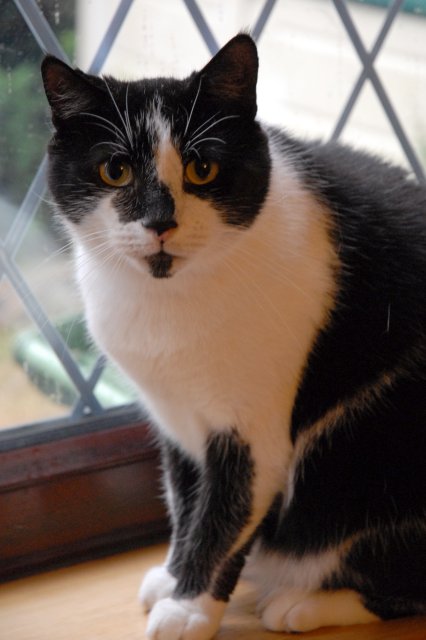
Cat at Christmas

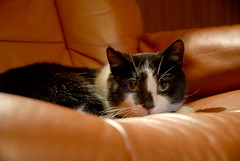
My dad found him, on Saturday morning, stretched out dead just inside the cat flap. No signs of injury. The night before, he’d been happy, relaxed and purring; the parents did not try to find out why he had died. He was about a month or so short of his tenth birthday.

Sad to think that I’ll never again be woken by him climbing on top of me and miaowing. He was, I always thought, an unusually intelligent cat: it’s hard to be sure, but I’m confident he understood at least five or six words of English, and when he was a bit younger he regularly wanted to play fetch. He also managed to survive three months living wild, a few years back, after The Mother lost him en route to the vet. Maybe there will be other cats one day, but they’re all distinct.

In a few months time, I might suggest to The Parents that they take on a rescue cat, because I’m sure The Mother is going to miss having him around the house. For now, though, I’ll content myself with getting annoyed at the random neighbourhood cats that dig up our back garden; and remember lying back in bed stroking one cat in particular.

The cat

Brute Force and Ignorance

In which an Ikea Antonius takes rather more effort than normal

Hurrah! A week after it was ordered, our connection to the Internet is all jumpered up and working again. We are connected to the outside world; it’s just a shame that there’s all that unpacking and sorting out to do still.

Talking of unpacking and sorting out: well, it’s not just that. We have new rooms, different storage, so there’s new furniture to buy and arrange. Because of this, my hands are now rather sore-feeling. Not because of the furniture in general, though: because of one particular thing that was slightly harder than normal.

I always thought I was quite good with Ikea furniture. Give me a LACK table or a LERBERG shelf unit, and I can slot it together in minutes. The other day, we put together a HELMER filing cabinet with no problems at all, even despite the metal-bending skills required. So, I thought an ANTONIUS system shelf unit would be a doddle, particularly as we were trying to create the simplest type of ANTONIUS there is, a small rack of shelves to fit under the kitchen worktop.

The thing itself, when you take it out of the packaging, is indeed simple. Two side frames, rectangular, made of rectangular-section steel tube uprights joined with U-section drawer runners. Four bars, made of the same stuff, which join the two sides together. Each bar ends in a pair of Zamak (or possibly Mazak or some other similar alloy) corner pieces. The assembly instructions are simple: hammer each of the corner pieces at the end of each bar into the ends of the uprights, then screw the feet on.

So, nothing particularly tricky. I find some chunks of wood to stand it on so I don’t wreck the floor, and pick up one side and one of the bars. I try it as a push-fit: it doesn’t go. Not really surprising: after all, you want it to be a nice tight fit so the thing stays together. So, I bash it with the hammer. Nothing apparently happens, other than a loud bang.

I look carefully at the work. A bit of paint has chipped off the inside of the upright, but other than that, nothing has moved. The Zamak connector has a half-inch-deep block of metal that has to be hammered inside the tubular upright, but it isn’t going anywhere. I give it a few more (loud) bangs, and take another look. The connector has budged maybe a millimetre or so, and the paint is a bit more chipped.

Maybe that paint on the inside is getting in the way a bit. I hunt around in the tool-cupboard, and find a needle file and a file handle. A few strokes with that, on the inside edge of the upright, should get rid of the errant paint. Bash bash bash, again. Still barely any movement. I give it another good hard stare, and I can see where the edge of the upright has started to cut into the connecting block, and shave metal off its edge.

To cut a long story short, then: to get the thing together took much more work with a flat file. Each of the 8 Zamak blocks needed each side filing down to get the thing vaguely close to fitting together; I didn’t take measurements, partly because I haven’t seen my vernier calipers since before the house move before last, but I’d say each block needed to be taken down by about a quarter of a millimetre overall in each direction. With only a little needle file, that took some time to do; and without a proper workbench, I jabbed my fingers and hands a few times in the process. Eventually, I’d filed off enough metal that the connectors could be hammered home. It still took considerable hammering to do it, and they’re very firmly in there; I have no idea how it was supposed to fit out-of-the-box.

Maybe the connector castings didn’t shrink as much as the mould-makers expected. Maybe the thing was designed with Swedish sub-arctic temperatures in mind, not a hot English June evening; and I’d have had more luck if I’d left the sides in the sun for a few hours and put the crossbars in the freezer. Maybe I just had one of a bad batch. I was still rather disappointed, though. As I said, I’m used to Ikea furniture fitting together Just So; I wasn’t expecting to have to start filing down castings to make them a reasonable fit.

Vampire-Spotting

In which we suspect that some TV cameras might be taking the train

Regular readers over the past couple of years might have noticed that I quite enjoy spotting the filming locations of the paranormal TV drama* Being Human, filmed in a variety of easily-recognisable Bristol locations: Totterdown, Bedminster, Clifton, St George, College Green, and so on. Not for much longer, though, we thought: although the first two series were Bristol-based, the third series is apparently being moved over to Cardiff. Whether it will be the recognisable Cardiff Cardiff of Torchwood, or the generic anycity of Doctor Who, remains to be seen; but this was all clearly set up when, at the end of Series Two, the protagonists were forced to flee the house on the corner of Henry St and Windsor Terrace for an anonymous rural hideout. No more Bristol locations for us to spot, we thought.

Over the past week, we’ve been doing a lot of driving about moving house; we now know every intimate corner of every sensible route from south Bristol to east Bristol, or at least it feels like we do. So we were slightly surprised to see that, about a week ago, some more of these pink signs have popped up. “BH LOC” and “BH BASE”, as before.

We spotted them on Albert Road, near the Black Castle. “BH BASE” points along Bath Road, towards the Paintworks and the ITV studios. “BH LOC”, though, is intriguing. It points down the very last turning off Albert Road before the Black Castle end. That entrance only goes to two places: a KFC branch, and St Philips Marsh railway depot.

If you watched the second series of Being Human, you might remember that there was, indeed, a rather brutal train-based scene in a First Great Western carriage.** So, expect the third series to include, at the very least, an extension of that scene, if not a spin-off plotline. Or, alternatively, those signs aren’t really anything to do with Being Human at all, and it’s just coincidence that they pop up around Bristol a few months before each series appears on the telly.*** My money’s on that train from Series Two being the root of part of the Series Three plot; but, I guess, we’ll just have to wait, watch and see.

* Well, it started off as a comedy, and got more serious as it went along.

** I was impressed that the programme’s fidelity-to-location included shooting that scene in a genuine local train, rather than just finding any railway prepared to get a carriage soaked with fake blood. Of course, it was probably a convenient location too.

*** The third possibility, of course, is that someone in Series Three tries to cure vampires and werewolves of their respective curses by getting them to eat large amounts of fried chicken.

Photo Post Of The Week

In which we go to the seaside

By the time you read this, we will be in internet-connection limbo. The broadband will be down for a few days. No up-to-the-minute topical blogposts. No uploading photos, although, as I’m on a several-months backlog as per usual, nobody is likely to notice.

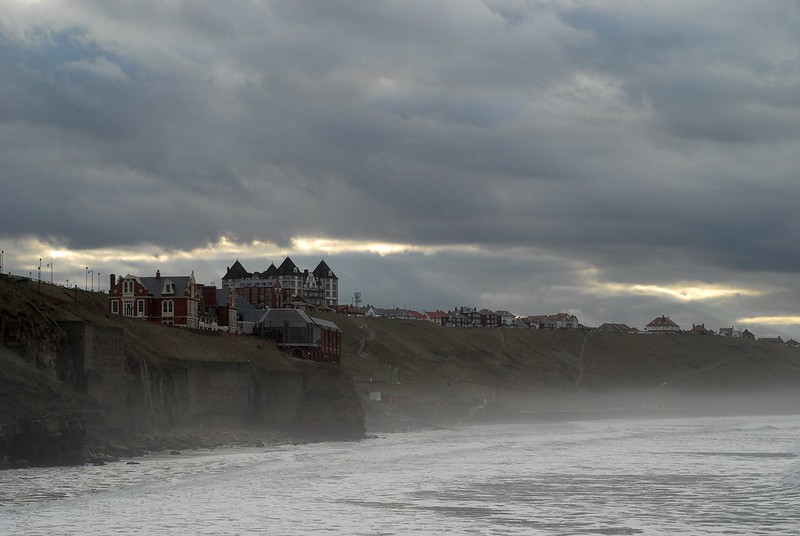
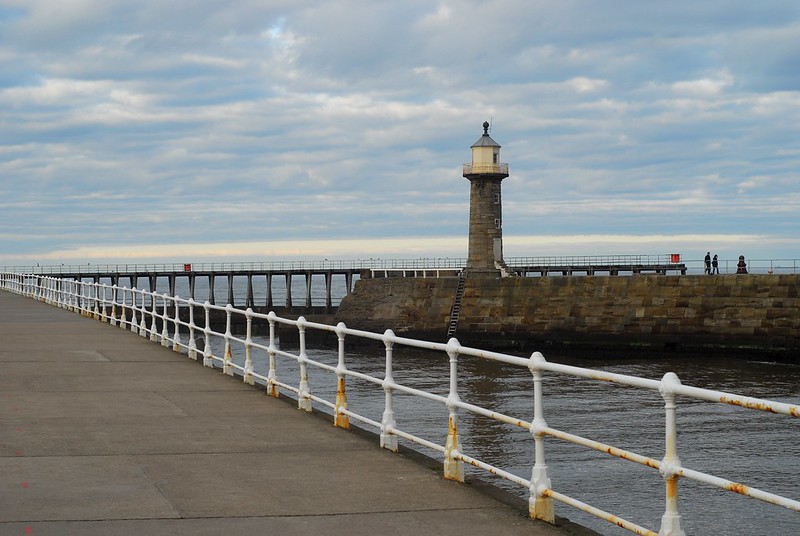
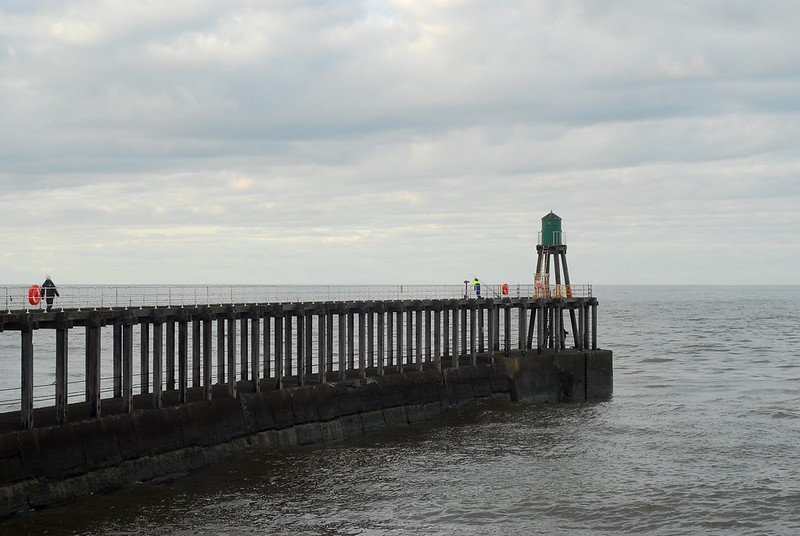
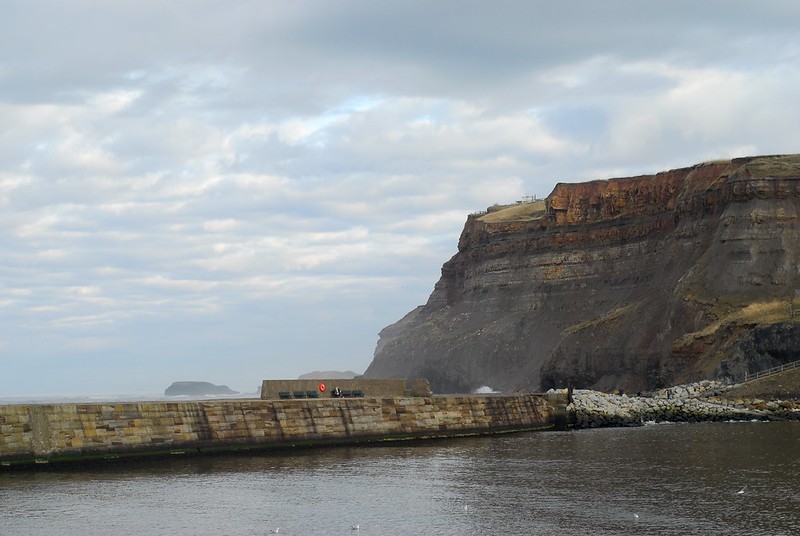
So, here’s something that’s easy to write in advance. Photo Post Of The Week. Beside the sea side, beside the sea.

Cliffs, Whitby

Whitby harbour

Pier, Whitby harbour

Cliffs, Whitby

Not In My Back Garden

In which we talk about redevelopment and green space

Having just moved house, we’re very aware right now that in the south-west, affordable housing is hard to find. It might be getting harder, too. Yesterday’s news included an announcement that local councils will be able to block developments on garden land.

Note that the article there is rather optimistic as to whether that type of development will be stopped. It won’t be; the decision on whether to allow it will be devolved to local government, which is in democratic terms a Good Thing that’s hard to argue against. In practical terms, though, it means that developments will be stopped in areas where residents have the means and inclination to be influential and to lean on their councillors; and will be concentrated in areas where nobody’s going to complain. In other words, another polarisation policy, to increase the economic differentiation of our towns and suburbs.

At first sight, I thought, it sounds like it might be a good idea. After all, I grew up in a leafy suburb, built in a time and place when housing plots included reasonable gardens, and so I quite enjoy tree-lined avenues and verdant cul-de-sacs that help you forget you’re in a city. But, thinking about it, I’m not so sure it’s a good idea. Verdant cul-de-sacs are nice, but affordable housing is better. A blanket ban on building over gardens isn’t what’s needed; what would be more useful is a more general control on maximum density of housing. If the planning regulations included a rule that every X square metres of new housing must include Y square metres of private or public garden space, then developers would be as free as they liked to demolish old houses and replace them with flats; the open space and the greenery would be preserved, just in a slightly different form.

It doesn’t take much, after all, to give an area the greenery it needs. Symbolic Towers, from the front, has no green space at all, one house in a line of terrace with virtually every front yard concreted, tiled or gravelled over.* At the back, we only have a small square of garden, too. But despite its small size, the garden and the gardens alongside are a quiet, peaceful, green space, sheltered from the inner city with trees and bushes.

It’s easy to forget, when a development is fresh and harsh, how time mellows a landscape. As I said, I grew up in a tree-lined surburban estate, and that’s how it is in my memory. When I look back at photos from my childhood, though, I’m shocked by how bare it looks. There’s hardly any greenery to be seen: it’s a stark landscape of red-brick houses, bare, plain lawns and sticky saplings staked into the ground here and there. In my memory it’s always as it is now, those saplings all fleshed out into fully-grown trees, and gardens grown up to fill in the spaces.** We forget that gardens take time to grow and mature; we forget, indeed, that Britain has no such thing as natural countryside at all, even our “ancient woodlands” being to some extent man-made.*** Developing on garden space isn’t necessarily a bad thing, so long as some green space remains; and it’s easy for “we don’t want to lose the green space next door” to be a cover for “we don’t want flats that just anyone can afford next door!” If we have rules that ensure that some green space will remain, we can redevelop our cities in a sensible and healthy way. And in thirty years time, those new flats will be surrounded by greenery, and people will wonder that their street was ever any different.

* Do not ask about the gravel. Unless, that is, you would like some free gravel.

** Memo to my parents, 30 years ago: think twice about moving into a house with a horse chestnut sapling planted at the end of the driveway, because before it’s a third fully-grown it will already have buggered up the drains.

*** They are still ancient, of course. But pollen analysis shows firstly that their mixture of trees is rather different to the genuine primaeval forest that grew up between the end of the recent ice age and the start of farming; and, secondly, that we probably have rather more woodland today than we did 2,000 years or so ago.