+++*

Symbolic Forest

A homage to loading screens.

Blog : Post Category : Dear Diary : Page 4

Finally, spring

In which The Mother is persuaded a fresh start might come in handy

For years, The Mother has been telling me the house needs cleaning out. “It’ll be too late when I’m gone,” she has said. “You should get started on it now.” And I should get started on it, of course, because for years she has had the false assumption that all of the mess and clutter in the house is mine, or is my fault somehow. This is patently untrue. Things, for example, in my bedroom right now include:

  • a vacuum cleaner
  • a steam cleaner
  • a late 90s CRT monitor (large)
  • a box of parish church paperwork
  • a set of suitcases
  • a set of cigarette cards (framed)
  • several large bags full of used jiffy bags, just in case they came in useful one day

None of these things, you have probably guessed, are actually mine.

Until recently, my bedroom also contained a pull-along shopping trolley, a considerable quantity of winter coats, and a mid-80s portable CD player, the first one my family owned. That, at least, I can claim some responsibility for, as it was my main means of listening to music in my teens. Still, no need for it to be there now. It’s time to bite the bullet, I decided. Time to actually persuade The Mother to get rid of something.

I loaded the coats into a bag, put the CD player in the back of the car, and took the trolley down to the kitchen to start loading it up with unnecessary stuff. Now, the kitchen is full of unnecessary stuff. The Mother has never seen a flat surface without wanting to hoard things on it, so virtually all of the kitchen countertops are covered in piles and piles of things: food that she hasn’t put into the cupboard, crockery that she hasn’t put away, stacks of empty takeaway containers that have been kept just in case they “come in useful”. I start loading the empty plastic into a recycling box.

“You can’t throw those out!” says The Mother, who has crept up behind me. “I’m saving those for your uncle!”

“When is he coming to collect them?” I ask. “They’ve not moved for a few months.”

“Well he comes now and again,” she replies, “and he said he uses plastic tubs to keep them in.”

“He can buy takeaways too, though,” says I, and they go. Behind them I discover gadgetry I’ve never even seen: a slow cooker, and a Nutribullet.

“I didn’t know you had a Nutribullet,” I say.

“What’s a Nutribullet?”

“It’s grey,” I say, because I’m not feeling in a particularly familial, caring mood, “and it says ‘Nutribullet’ on the side. You use it to make smoothies.”

“Oh we tried it,” she replies, “and I used it to make soup. But it was too much of a faff. It’s a right pain to clean.”

“Which is what 99% of people who buy a Nutribullet say,” I told her. “It’s going to the shop too.”

So, out of the house went: the Nutribullet, a coffee machine, the coats, the ancient CD player, a stack of CDs of Dad’s that nobody else in the family wanted, and about a third of The Mother’s excessively large supply of plain, cheap, white coffee mugs. She bought a bulk order, a few years back, so that when my dad’s old colleagues came to see him and have a natter, she could give them some cheap crockery she didn’t care about. I removed a third, on the theory that The Mother doesn’t actually know how many there are and never sees them all in one place; and so far, it seems to be working. The charity shop people were extremely excited about the CD player, it being a vintage piece, but as yet its highest bid is still under a fiver.

Naturally, the house looks barely changed. One car-load, after all, isn’t going to make a dent in many decades worth of hoarding—there is stuff hoarded by my grandparents that has been passed down the line, a line which I am going to be the one to break. Still, psychologically, it’s definitely a start.

Corvids, redux

No, I still can't tell the difference

As I have written more than once in the past, I can’t tell the difference between a crow and a raven. I still can’t.

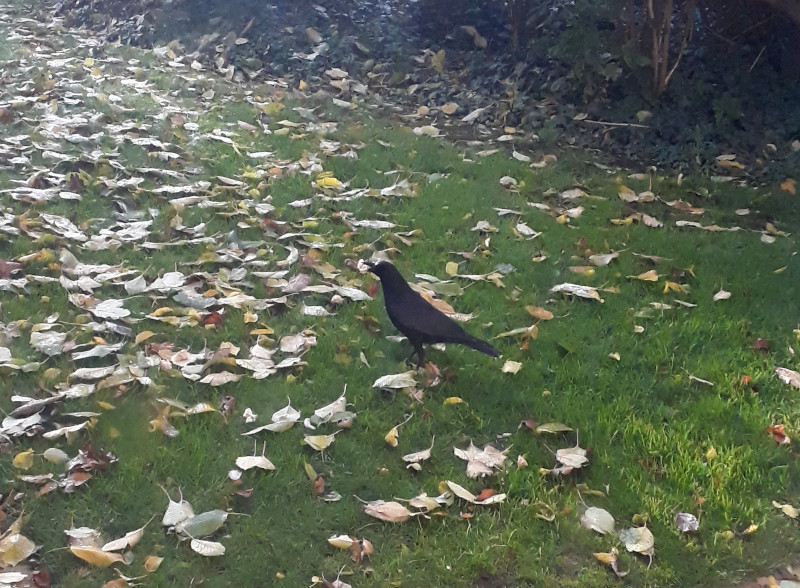
Making a cup of tea today, I spotted a huge black thing in the garden out of the corner of my eye. Enormous, it was, or seemed to be at least, having a vicious fight with a seagull over some item of food. The seagull gave up, and the big black bird stalked the grass on its own for a little while. I snapped a picture. That’s got to be a raven, I thought, if it’s that size.

Sky beast

But looking at the picture, comparing it against identification guides, it’s obviously a crow. A big one, maybe, but not really that big in the photo. Still a crow. I still haven’t managed to genuinely identify a raven close-up, although not for want of looking. But then, when I do, maybe I’ll just assume it’s an extra big crow that time? Who knows? Certainly not me, at this rate.

A prelude

Or, some prehistory

A couple of times recently, I’ve mentioned that I’ve been pulling data off the hard drive of my old desktop computer, nested inside which was the home folders from the previous desktop computer, and nested inside those, those from the one before that. So, lots of rather old files to go through, and there will be more photos to post I promise. One thing I’ve uncovered that I didn’t think I had, though, was a text-only archive of the posts from my old blog.

Back in August I noted that this blog had turned sixteen. This was, in a way, a slight piece of misdirection. I had another blog before that, hosted by an online friend, which had run for a few years prior. Next spring, it will be twenty years since I started writing that site; it lasted just over three before, due to one reason and another, I dropped it and began this one.

Looking back at some of the posts, for the first time in a very long time, I’m slightly surprised by the tone of some of the writing. I had essentially no filter, and openly talked about exactly what I’d been doing, where I would be, visits to the doctor, what clubs and gigs I would be at, things I would never think of mentioning now. I refer to myself by name, which I never do now.

This blog, since its restart, has tended towards fairly long, rambling, in-depth posts in which I can go into a single topic in detail; and partly that’s down to its publish process, which makes it straightforward and simple* to host and manage, at a cost of being slightly clunky to add a new article. Every new post, essentially, requires the whole site to be re-uploaded so that the menus on every page are still correct, and that takes time to do. So, I don’t tend to write small posts. The old blog, managed using Movable Type, was full of one-liner diary entries about what I’d had for my tea, or what clothes I’d just bought.

Not all of the posts are like that, though; aside from some of the very personal things, there is for example a very fun and cheery account of my first proper trip abroad. I think I might actually get around to doing something I’ve been threatening to do ever since this blog first started. The first post on this site is itself a piece of misdirection, claiming to be a clean fresh start whilst at the same time saying that earlier writing might at some point make an appearance. If I can edit them into a format that fits this blog—changing people’s names to make them all consistent, bringing in The Plain People Of The Internet to handle the “fake outside reader” voice which was already occasionally present—without actually losing their style and flavour, I might some time soon get around to doing it.

* Not to mention cheap.

On Cleethorpes Beach (part two)

A postapocalyptic folk-art wonder

A month or so ago, I wrote about going walking on Cleethorpes Beach in the early morning, and I said at the time that as the tide goes out and comes back in, I would come back here with more to say about it. Well, I’m not the only one. Yesterday The Guardian published a travel article about just how nice a place Cleethorpes is to visit, including the beach of course, and including the thing I was always planning to write about in Part Two. So, before you click on that link there, read this first.

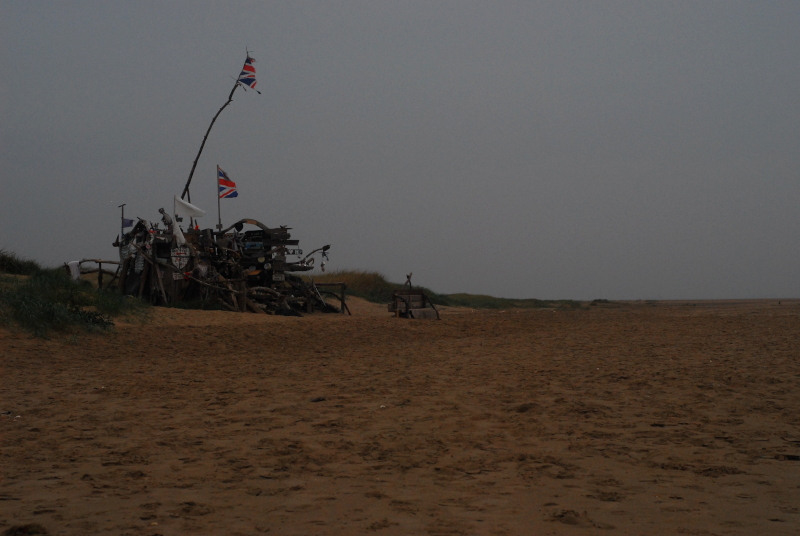
If you walk along the cycle path that divides dry land (and miniature railway) from marshland, and look out to see, you might from some spots see a flag fluttering out in the dunes beyond the marshes. If you wander along the tideline, let the marsh fall between you and the dry land, and wade across the beck, then you will start to see a strange, organic growth on the horizon, between the dunes and the smooth tide-washed sand, with flags flying above it. The flags are usually tattered and torn, because they don’t last long in such a windy spot.

A growth on the horizon

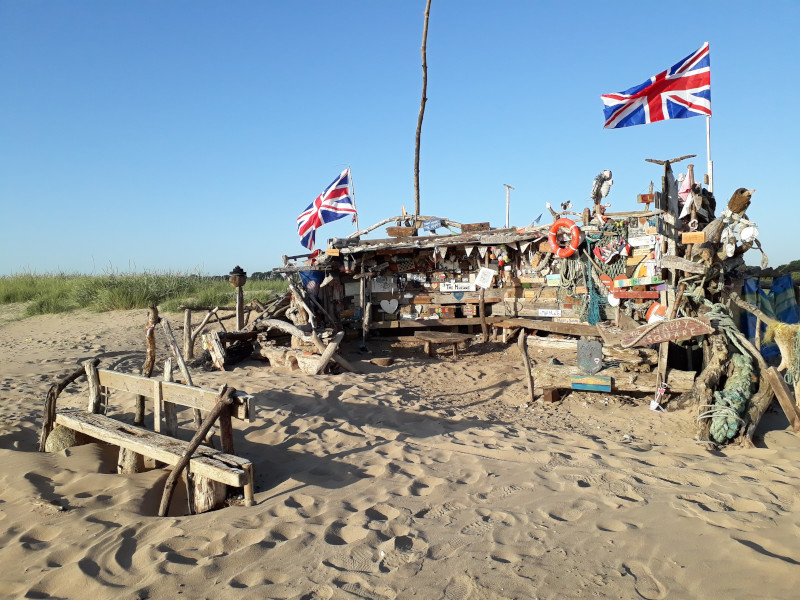
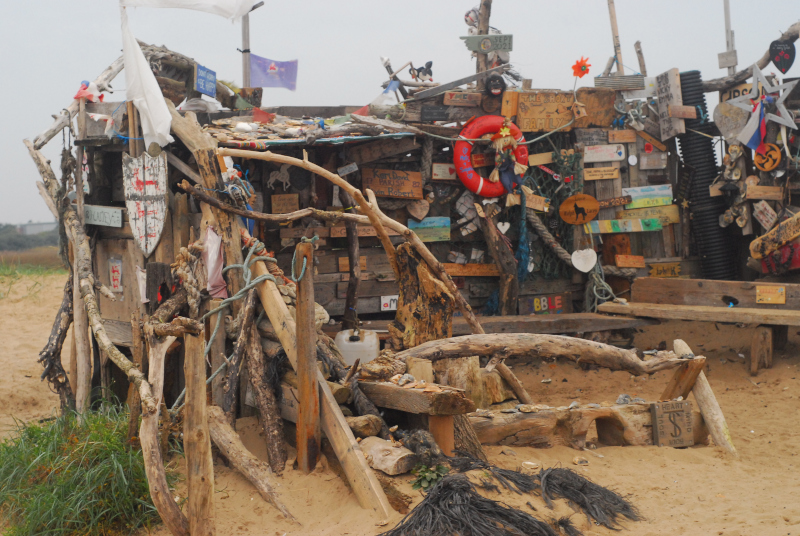
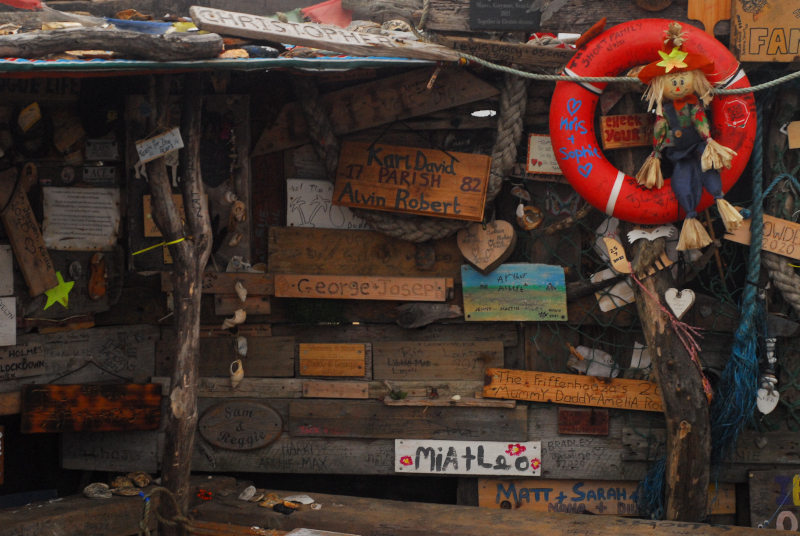
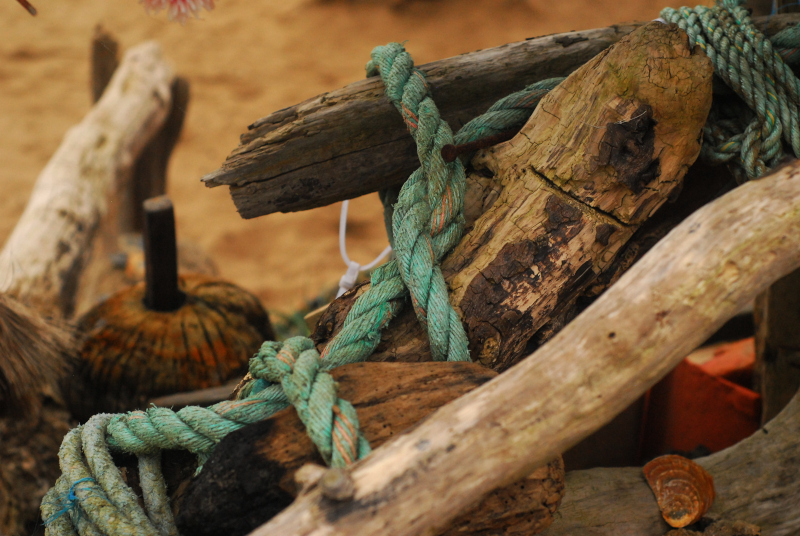
As you get closer it becomes a strange agglomoration, as if something has grown out of a strange affair between the sea and the marshland. Every surface is covered with something, with writing, with ornament, with rope, with decoration.

The bench

This is the Buck Beck Beach Bench, named after the beck which we waded across on our way here. If you look closely, you can see there are places to sit, although they are hugely overshadowed by all the other decorative parts of the structure.

The bench

It all started, apparently, a few years ago. A couple of the local dog walkers, who visit the spot regularly, fancied having somewhere to sit and take a break midway through their walk. They pulled together a few big pieces of driftwood, and made a rough bench, which they could sit on when passing. And from there: it just grew. More people added new parts, and started to nail and screw it together to make it a bit more robust. People started to bring decoration, to specially make signs with their name on and add it to the bench. Slowly, without any single guiding hand, it turned into the structure that’s there today.

The bench

You might be able to see changes between one of the photos in this post and the rest, because one was taken several months before the others: the tattiness of the flags is a clue. Some people must bring things a long distance, must bring hammers and nails to make their mark on it. Every winter parts get blown down or washed away, and each time people come and try to mend things, try to bring the bench back the same but different. A community has built up around it now to take care of it, to try to ensure that it is built up from wood and that plastic parts are if possible removed, and to generally make sure it stays safe and well-maintained.

The bench

If you are at the bench, it looks as if there is a tempting direct path straight back in a line to dry land. It’s not. What looks like a path actually leads straight through a bed of thick, sticky, black mud, as my friend Ms T. found when she tried it. The safe route is much longer and contorted, with a large double-back to it, and still is rather dangerous at times due to the creeks winding through the marsh, several feet deep at high tide. As I said I prefer to wade across the beck at low tide, when it spreads out across the sands into a delta a mere few inches deep. The most dangerous route of all is to cut directly across to Cleethorpes seafront, through a maze of flooded channels and sticky mud. There is a firm bar of sand out near the bench itself, but walking from that bar across to the Prom is much more hazardous than any other option.

Nothing lasts forever, of course, everything grows and then fades once more. Maybe the bench will become a victim of its own success, now it’s appeared in the national press. Maybe it will keep growing and evolving and changing until it is unrecognisable; until it will become almost a castle of gnarls and tangles, or picks up its feet and begins to walk. Right now, though, it is a lovely spot to visit, a lovely spot to clear your mind, a spot to sit and watch the waves go by. May it stay so, at least for now.

Sailing away

A visit to an iconic place

A trip away last weekend, to what is arguably one of the most iconic sites in British, or at least Anglo-Saxon, archaeology. It’s been famous since the 1930s, there have been TV series made about it, and it has shaped the way we see Anglo-Saxon Britain ever since. The site I’m talking about is: Sutton Hoo.

Sutton Hoo

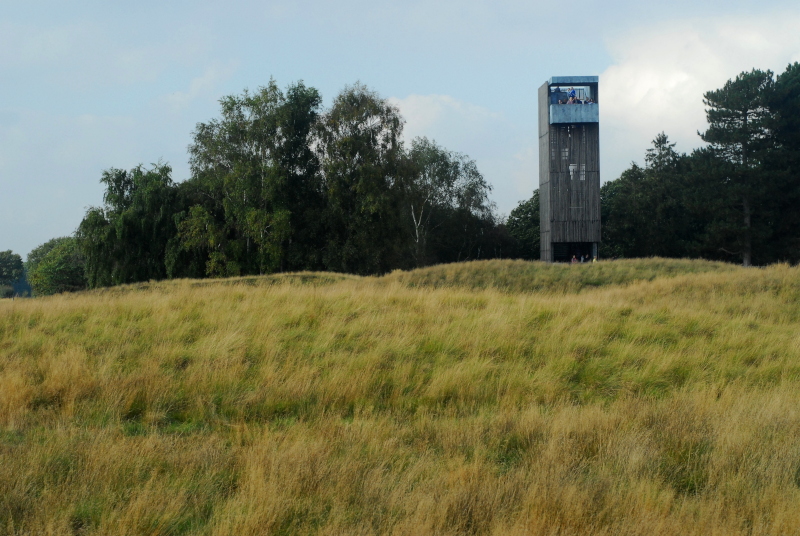
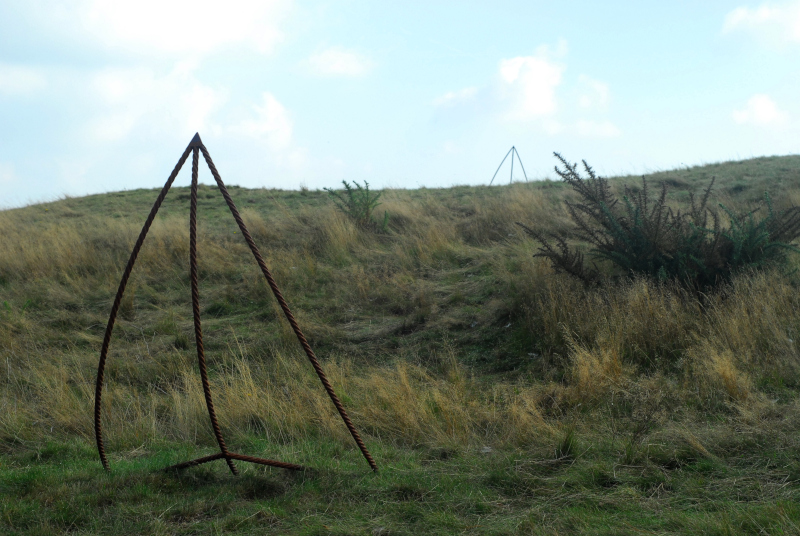
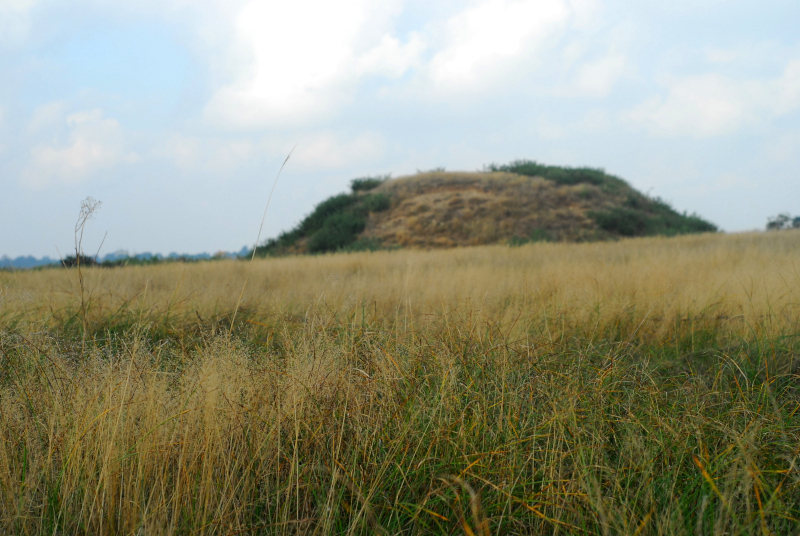
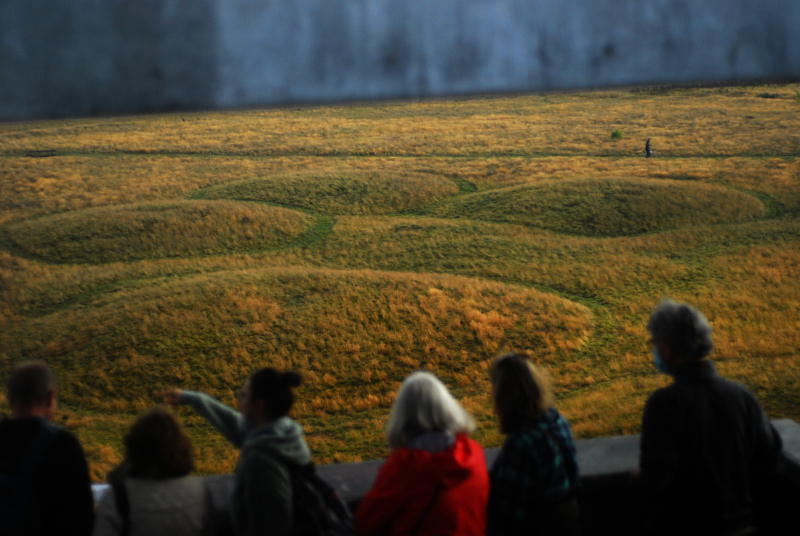
Given that Sutton Hoo is only a few miles outside Ipswich, I met up with regular correspondant Sarah from Ipswich and her husband and dog. Sarah is almost as fascinated by archaeology as I am, which is probably a good thing because at first sight there isn’t much to see at Sutton Hoo itself. The “royal burial ground”, the field where all the famous archaeology was found, is a particularly lumpy and humpy fallow field, covered in long grass with a scattering of gorse and broom bushes, and with a stark, narrow viewing tower watching over it. The famous ship burial, Mound 1, is marked by steel rods where the prow and stern of the ship originally were.

Mound 1 at Sutton Hoo

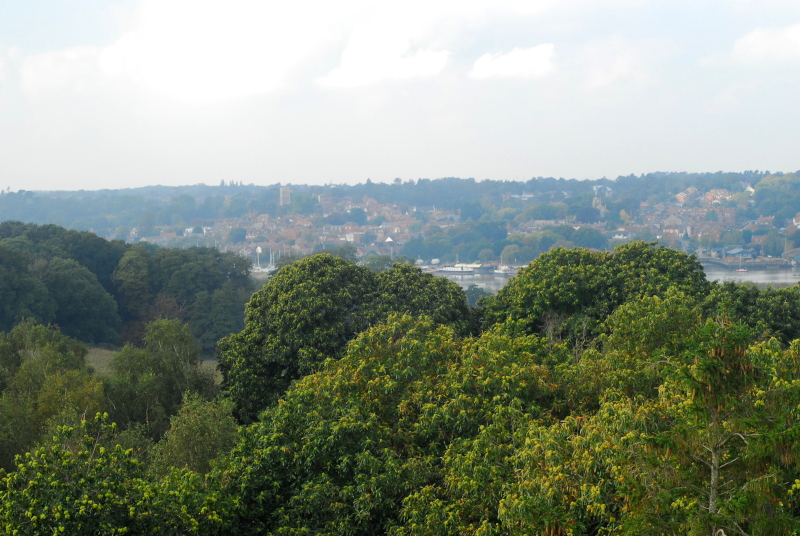
If you’re interested in history, there’s always an awful lot to be gained from visiting a site in person, not just reading about it. Archaeological literature, particularly the older sort, tends to focus very much on the confines of sites themselves without considering their wider perspective in the landscape. I hadn’t realised, for example, just how high up the burial site is above the river. When you think of a ship burial, you tend to assume it would be close to a riverbank. Sutton Hoo does overlook a river, but it’s quite a long way from it: about half a mile away and, more importantly, about a hundred feet up. In modern times a wood has grown up, but when it was built the burial mounds would have been a commanding sight from a ship on the river. One of the mounds has been reconstructed to roughly its original height, to give visitors some idea of how it might have looked within a decade or two of construction.

View of Woodbridge and the River Deben from Sutton Hoo

Mound 2 sits in the long grass

In the nearby National Trust museum, they are unequivocal that the king buried in the ship burial was Raedwald of East Anglia. This is something we will never know for certain, whatever techniques of analysis we manage to develop in the future. The chances are it was likely Raedwald, or his son Eorpwald, or with an outside chance his other son Sigebehrt. We’ll never really know, but we do know that, whoever it was, he was left-handed.

Watching from the viewing tower

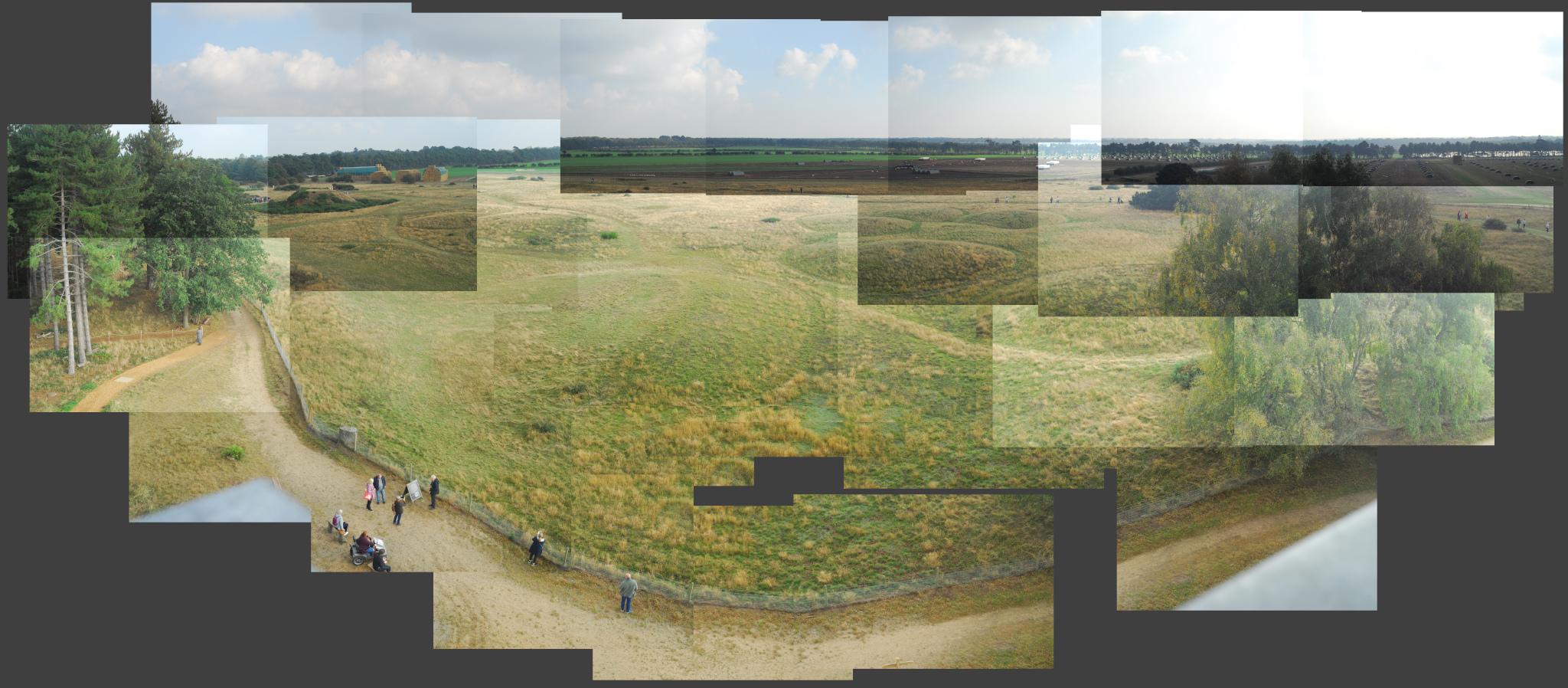
The new viewing tower, built from galvanised steel, gives an excellent bird’s eye view of the site. I couldn’t resist spending a few minutes taking photos of the scene so I could stitch it together into a panorama-collage, to give you some idea of what the whole place looks like. The view a seagull would have got, maybe, the day that Raedwald-or-whoever was interred in his warship under a great mound of bare earth.

![The cemetery](shpan-small.jpg “The cemetery”)

No person would have seen it that way at the time, of course; very few until this year, in fact. And now we can.

Do we get a better idea of Sutton Hoo by visiting these mounds, instead of going to London and seeing the artefacts in the British Museum? I think we do. This was an important place, one which has to some degree survived when many other similar important places have been lost to us forever. It might have changed significantly in the last 1,500 years, but nevertheless, you can’t understand the site, you can’t feel its relationship with the sea, with the river, with the surrounding landscape, unless you have actually been there and seen it. It might be a field of grassy lumps, but it is definitely worth the trip.

The exercise book

Or, a meander

My exercise routine, minimal as it is, has changed a few times this year.

At the start of the year, living in Bristol, I didn’t do much exercise at all in the week. At the weekend I would go out and do things such as investigating local cemeteries, some of which ended up as posts on here. In the week, though: well, I’d got bored of walking around all the nearby streets, over twelve months of ongoing international pandemic, and had given up on leaving the house during the week at all.

Moving to Wales, I started out going for walks on my lunch break, as in my old job I could get away with having a longish lunch whenever I wanted. When I changed jobs, though, the working day became a bit shorter, so those walks moved to the morning instead. From half past six, I would go for a ramble around the neighbourhood, through the gloom of the early-morning woods or along the riverbank.

Now, things have changed again. In the morning I drive down to the coast, and go for a ramble along the shoreline. It’s certainly enjoyable, but it’s not really strenuous. So, in the evening, I’ve been going for a second walk, around the village. At the moment, the equinox a couple of weeks behind us but the clocks still on summer time, this happens at dusk. When I leave the house the sky is starting to darken; when I am halfway along my route it is properly dark.

Tonight, it was a clear sky when I set out, with the sun just falling below the western horizon and Jupiter just visible in the south. As I walked the sky grew darker, into a deeper blue, and more things started to become visible. Saturn, just to the west of Jupiter. Cassiopeia and Pegasus in the western sky. When I was almost home, I realised it was fully dark, with Vega up near the zenith and Arcturus over in the west. There was a fainter star just east and below Jupiter, which I think must have been δ Capricorni, or Deneb Algedi, magnitude 2.85. Fairly good seeing then, even with the streetlights on. I didn’t feel in a stargazing mood, but I felt peaceful, watching the transition from the day and watching the stars come out.

Self-protection

Or, you could say, self-awakening

It’s fair to say that I don’t always consciousnessly do the right thing in life. I’m getting better at that, and maybe there will be more posts to come on that at a future date, but historically I’ve always been either a wee bit too hesitant, or a wee bit too eager to not resist the wrong thing.

Still, it’s nice to know that this doesn’t always apply to my subconscious brain. Last night I was peacefully sleeping, going through a rather strange and incoherent dream when I suddenly became aware than one of my worst fears was on its way. I suddenly became aware, through a quick flash of an image, that a horde of zombies were on their way and were about to break into my dreamscape.

Zombies are one of my worst fears. Any dream with a substantial amount of them would quickly become a nightmare, and a bad one. My brain, though, knows this. And so at the first flash of them last night, I found myself suddenly hauled out of sleep and checking the time. It was just gone 3am: being awake just gone 3am isn’t ideal, and I knew I might not properly get back to sleep again, but it was better than than the alternative. Better than being stuck inside a nightmare still. I should, I think, be giving my brain a bit of a pat on the back.

Another anniversary

A more recent one this time

A few weeks ago, I noted it was sixteen years since I first started writing this blog. Well, today, it’s a whole year since I relaunched it, as something of a lockdown exercise. It had taken most of my spare time in the summer, to go through all of the old posts, edit them, redesign the sight, and get the whole production pipeline up and running.

Since then there have been a hundred and forty-two posts, including this one; about mountains, beaches, trains, castles, cemeteries, trains, Lego, trains, computing, and trains. Have many people read them? No, probably not. That’s not really the point, though: not whether people read them, but whether I enjoy writing them. I have. So doing it has been worth it.

Despite it being the pandemic years, still, a lot has happened and a lot has changed over the past year. There will, I am sure, be more changes over the next year too. We won’t know, until they happen.

On Cleethorpes Beach (part one)

Or, some walks in the early morning

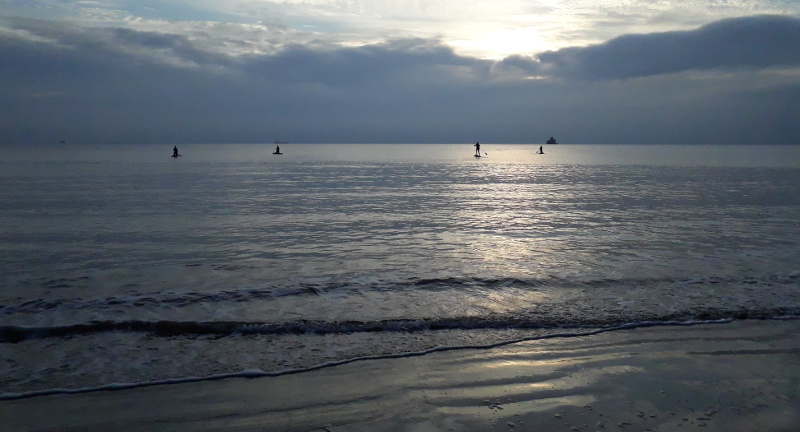
Since changing jobs, I’ve been going for early morning walks most workdays. For about an hour or so, I’ve been walking up to the woods overlooking the village, or following the riverbank and canalbank, or walking across the fields to the next village and back. It’s a really good way to start the day. When I go to visit The Mother, though: well, there aren’t really any interesting places to walk and back in an hour. There aren’t actually very many public footpaths outside the village itself; there’s no river, and the woods are too far away. I was at a bit of a loss.

“Why don’t you drive down to the beach and go for a walk there?” suggested The Cute Accountant.* It made complete sense. The beach is only 15 minutes drive away from The Mother’s house; I could easily stretch my morning walk to be 90 minutes without really having to rush. So, since starting the new job, when I’ve been at The Mother’s every morning I have gone down to the beach for a walk on the sand.

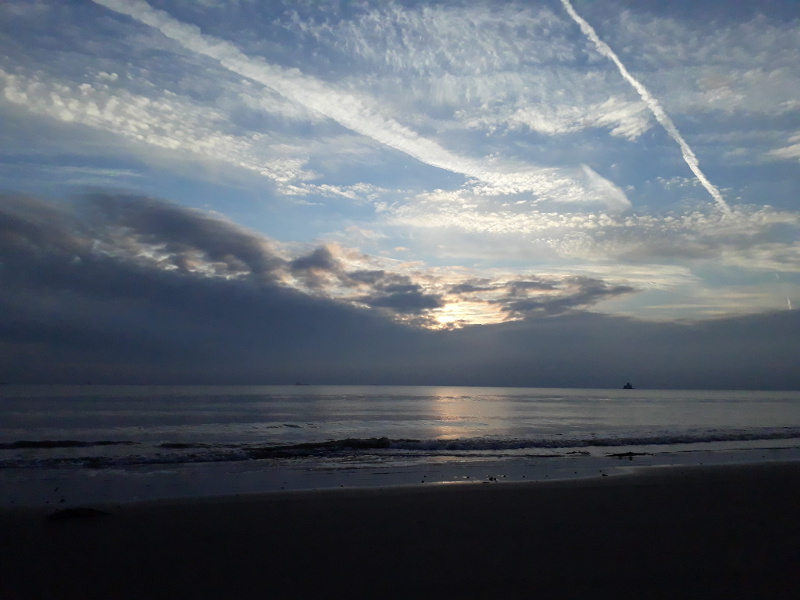
The beach just after dawn

Cleethorpes Prom is your fairly standard seaside prom: pier, arcades, amusement rides and chip shops. All the signs of seaside civilisation, with the sand raked daily and the high concrete wall of the prom separating town and sea. If you head a couple of miles south, though, down past the leisure centre and the miniature railway to where the holiday parks start, then things feel much more remote. A broad band of salt marsh separates the dry land from the open water, and you can wander along the tideline or through the marshes feeling completely apart from the world, feeling as if it is some ancient unpopulated coastline. Look the other way, though, and behind the freewheeling seabirds, you can see the lighthouse on the far side of the river mouth, and always ship after ship standing at anchor and waiting for their upstream pilot.

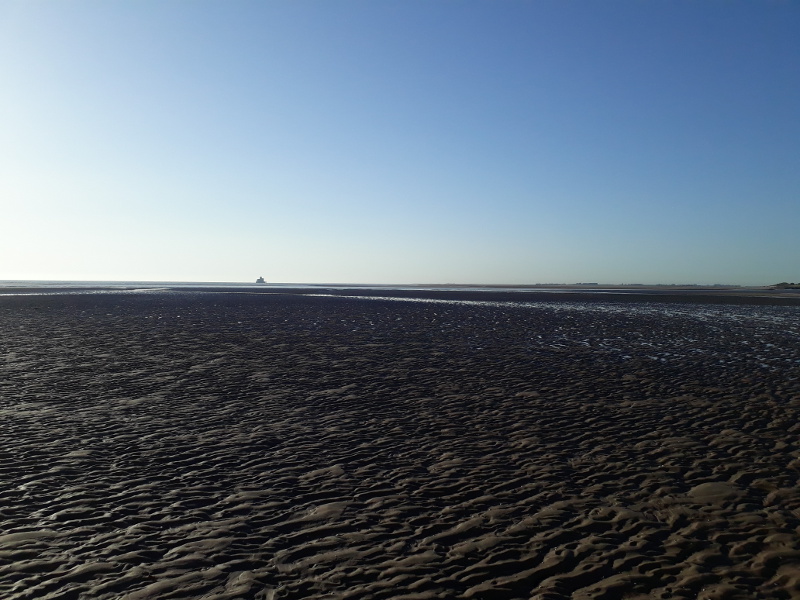
Rippled sand

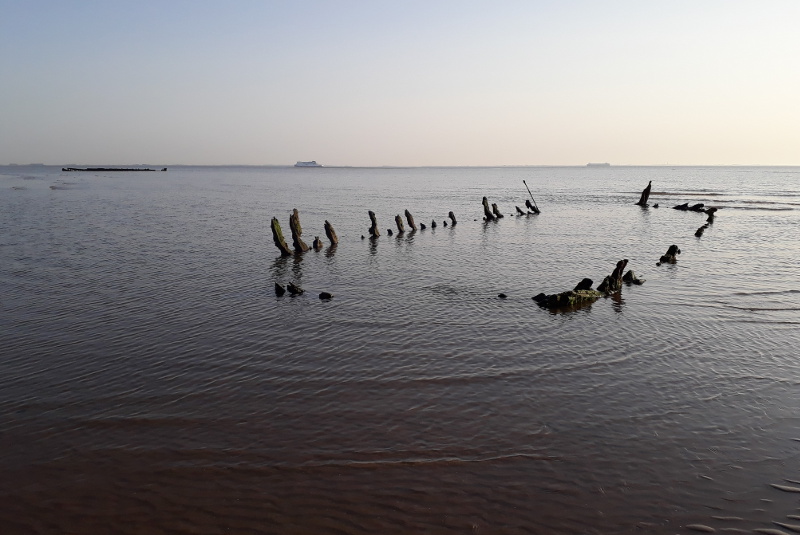
At low tide, there is a vast expanse of rippled sand and mud, cut across by channels and with endless slight variations in height. When I was a kid, the dangers of the beach were always drummed into me heavily. Never go out too far. Never cross one of the channels. You’ll get cut off. The Mother would tell me lurid stories from her days as a 999 operator, of people finding bodies washed up on the shore after going out at low tide and getting confused by fast-descending fog. “The most dangerous beach in the country,” she’d said, which I’m not sure is the truth. Nevertheless, you have to be careful going down to the low tide line, always sure all the water you see is flowing out, not back behind you. If you do go all the way, you find the remains of shipwrecks, the gaunt ribcages of old wooden ships sticking stumpily out of the sand.

Two shipwrecks

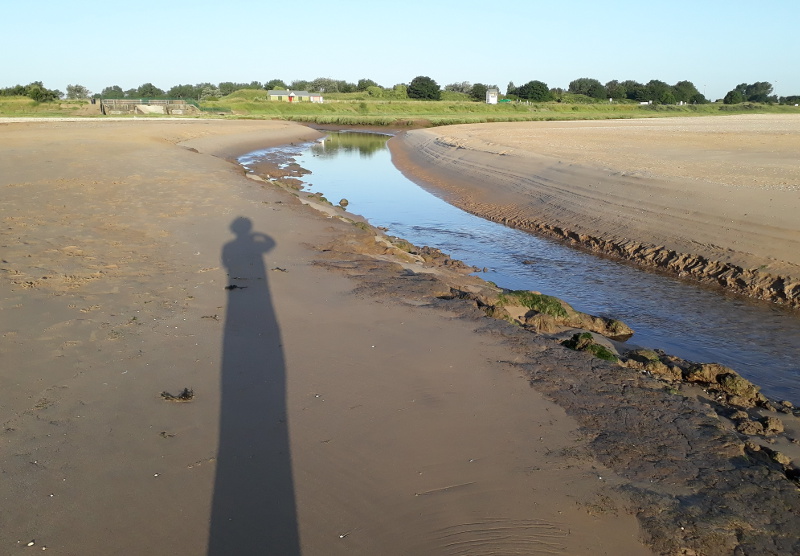
Navigating all the way along the tideline, without heading back to the nearest concrete path, can be tricky. The outflow of one of the local becks cuts across the sand, in a surprisingly deep channel. At low tide it can be crossed with care, if you can find a shallow spot, if you don’t mind getting your feet a little wet and having to jump over the deeper parts. At higher tides, you have no chance, and have to find a way to cut back through the marshes, themselves riddled with deep, steep-sided channels of water with thick mud at the bottom. It’s far too easy to slip over at their edge and end up with a very wet and muddy arse. I hate to think what the marshes are like to navigate at the very highest tides: I suspect I’d have to sit on the thin line of dunes at the seaward edge of the marsh and wait the tide out a few hours. It wouldn’t be much of a hardship.

The beck at low tide

I could keep on here posting photos of the wilder parts of the beach, much as I could sit for hours on the dunes listening to the waves breaking. I’m going to pause this post here, though, before coming back again soon with more pictures and more to say. Think of it as the tide going out and returning again.

Paddleboarders

* For the really long-term readers: it’s career progression.

Taken by the flood

An impressive onrush of current

Last January, I wrote about how I keep track of ideas for topics to write about. I said, when I have an idea, I create a “ticket” a bit like a “bug ticket” in a software development process, to keep track of it. What I didn’t say, though, is something that applies to writing ideas just as much as to bugs: it’s important to be descriptive. Things you think, now, are always going to be seared in your mind, will be over and gone in a few hours. Unfortunately, when I create a “writing ticket”, I will often only write down a few words and rely on my memory to know what the post was actually going to be about. When I come back to it later: baffled.

Take, for example, an idea I also wrote down back in January, a few weeks before writing that post. “Post about the fast-flowing waters of Stockholm.” Post what about them, exactly? I have no idea.

It’s true that the centre of Stockholm does have impressive fast-flowing water, a rushing, churning torrent that pours constantly in two streams, either side of Helgeandsholmen, the island taken up almost entirely by the Swedish parliament building. When I visited Stockholm, I walked through the old town and down to visit the museum of medieval Stockholm which lies underground, beneath the gardens in front of the parliament. When I reached the narrow channel of water separating the parliament building from Stockholm Palace, I was shocked and amazed by the speed and power of the water. It flowed from east to west in a solid, smooth-surfaced grey-green mass, as if it had an enormous weight behind it. It felt dangerous, unstoppable, and irresistable.

I already knew that Stockholm, and the Baltic in general, doesn’t really believe very much in having tides. Stockholm’s harbour is technically seawater, but there are many kilometres of archipelago between the city and the open sea, and to get to open ocean you have to go all the way around past Copenhagen and the tip of Jutland. Because of that, the Baltic isn’t particularly salty and doesn’t have very dramatic tides. This couldn’t, then, be a tidal flow. It took maps to show what it was.

OpenStreetMap map of Stockholm

The above extract from OpenStreetMap is © OpenStreetMap contributors and is licensed as CC BY-SA.

You can see how Stockholm is built around a relatively narrow point in the archipelago. What you can’t really see at this scale, though, is that all the channels of water to the right of the city centre are the main archipelago, leading out to see, but the channels of water to the left of the city centre are all part of Mälaren, a freshwater lake some 120km long and with an area of over a thousand square kilometres. Most significantly, its average altitude is about 70cm above sea level. That slight-sounding difference adds up to roughly 800 billion litres of water above sea level, all trying to flow downhill and restricted to the two channels, Norrström and Stallkanalen, the second narrow, the first wide, around Helgeandsholmen. Norrström, in particular, is a constant rush of choppy white water.

Norrström

Why only those two channels? Although you can’t really see from the map, the other paths of blue that look like channels of open water, around Stadsholmen and Södermalm, were long ago canalised, blocked off with large locks. The two northernmost channels are the only free-flowing ones.

So, you might be wondering, what was the point of this post? Was there going to be some deeper meaning I had uncovered, some great symbolism or relevance to my everyday life? Frankly, it’s entirely possible, but I have no memory at all of what I was thinking when I wrote that note originally.

Right now, it’s tempting to say that sometimes, instead of trying to understand life and everything around you, instead of trying to predict what will happen and what the best course of action to take will be, it’s better just to sit back and ride the rollercoaster, and tht the sight of the massive onrush of water through the centre of Stockholm made me think of just jumping in a small boat and shooting the rapids without worrying about what happens next. Equally, I might have been thinking of how you can find such a powerful force of nature right in the heart of somewhere as civilised as a modern European capital city. For that matter, it could have been a contrast between how placid, still and mirrorlike the waters of Mälaren a few hundred metres away outside Stockholm City Hall are, compared with the loud, rushing, foaming rapids we’re talking about here.

A few hundred metres away all is peaceful

To be honest, I really don’t know. I know which of those thoughts seems most apt right now, but it might not even have occurred to me in January. At least, now I’ve written this, I can close that ticket happy in the knowledge that something fitting, in one sense, has been written under that heading. Now I’ve done that, I can flow onwards to the sea.