+++*

Symbolic Forest

A homage to loading screens.

Blog : Posts from March 2026

Intermission

Time for a bugfix

Since the start of the year, I’ve been trying to publish about one post per week, and with ten posts so far (including this one) I’ve come pretty close to the target.

Given I missed last week’s post, I was keen to make sure I got one out today. However. I’ve found a problem.

As I’ve said before, this site is generated using Iceforge, a static site generator that, essentially, I wrote myself (with a lot of inspiration from elsewhere). Because of that, I’m responsible for fixing it myself. And I’ve discovered that at some point, I’ve brought in a bug that I wasn’t testing for.

The post I started drafting for today includes a map image, which I wanted to link back to an actual map itself. Straightforward, although the Markdown syntax can be a bit thorny. Testing the post out, though, I discovered that at some point Iceforge has gained a bug: the Markdown parser doesn’t render images inside links properly. Although Iceforge uses a dependency library for Markdown parsing, it includes custom code to rewrite image links in posts so that they always become site-absolute, which is important when an individual post gets embedded into other pages like the home page or an archive page. Somewhere in that, there must be a bug.

Potentially, I can find a workaround. Or, I can fix the bug. Or, to be honest, rewriting that whole area of Iceforge is on my Iceforge to-do list, because the dependency library is a couple of versions behind current. Because of breaking changes in the dependency, the image-link-rewrite code needs to be updated at the same time.

In other words, the post I’d written for this week is on hold, for now. Before long, hopefully, I’ll find the spare time to fix it. Until then, I’ll write about something else.
World of trains

But which trains are important for Cait's plans?

Over some recent posts, I’ve been talking about how easy it would be to build a model of the Brecon & Merthyr Railway towards the end of its life, in N gauge. And specifically, how easy is it if you start with a train set? For one thing, I’ll need to have more than just one train to play with! But is it easy to get models of the right types of train in N gauge?

As it happens, there weren’t actually that many different types of steam engine used on the Brecon & Merthyr in the 1950s. Many trains were operated by pannier tank locos: now, there were multiple different classes of pannier tank engine, but given my train set came with one, I think I can put that to one side for now. What other types of steam engine were used between Brecon and Newport?

Firstly, there’s the Dean Goods, or 2301 Class. These were small 0-6-0 tender locos, with a pretty long life: they were originally designed in the 1880s, and lasted through until the late 1950s, specifically because they were small enough to run on a number of meandering Welsh railway routes with strict weight limits. Quite a few were requisitioned by the Army in both the First World War and Second World War, and ended up operating across Europe and in Turkey as a result.

Secondly, comes the GWR 2251 Class, a small 0-6-0 tender loco from the 1930s which was intended as the Dean Goods’ replacement. It was more powerful, but slightly heavier as a result, so didn’t quite have the same range that a Dean Goods did. Nevertheless, they survived until after the Brecon & Merthyr lines had largely closed.

Thirdly, the Ivatt 2MT Class, a lightweight 2-6-0 tender loco design from the late 1940s sometimes known as the “Mickey Mouse” classs. These were brought in to the Brecon & Merthyr from the early 1950s until the line closed; indeed, they operated on all of the lines radiating from Brecon.

You could, frankly, operate a realistic model of the Brecon & Merthyr in the late 50s using only the 2251 Class, the 2MT Class, and a pannier tank or two. If you want to go back a little bit earlier, you’d need a Dean Goods as well. There were still a handful of the Brecon & Merthyr’s own engines surviving at that date, but they were relatively rarely used on the Brecon line itself; you’d be more likely to see them heading up through Risca on the Western Valleys lines.

Moreover, N gauge models of all of these locos have been produced! The Ivatt 2MT class is, indeed, still available in the shops at the time of writing. The others aren’t, but it should in theory be not too hard for me to find them on the second-hand market.

In other words, with the right time period, this aspect of the model railway shouldn’t actually be a problem. Other problems will be much harder! I’m glad, though, that the project hasn’t immediately become too hard for me to consider. On, I suppose, to the next steps.

Something on the radio

A random Lego project

One issue with writing this blog for so long—especially given it’s not long since I had a hiatus for a year—there’s a lot of draft posts and ideas-for-posts that I’ve logged, and never done anything with. Write about The Mother being taken to hospital in May 2022, for example, which was overtaken by events when she died a few months later. Some of them I have no context on at all, such as writing about The History of Grimsby by Edward Gillett. Yes, it is a classic work of local history from the 1960s. No, I don’t know what significant or interesting things I had to say about it.

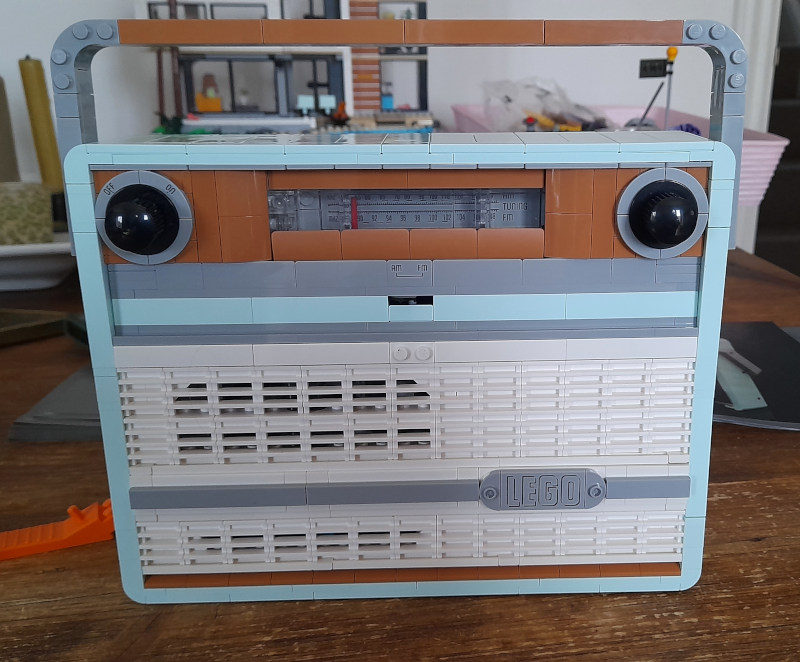
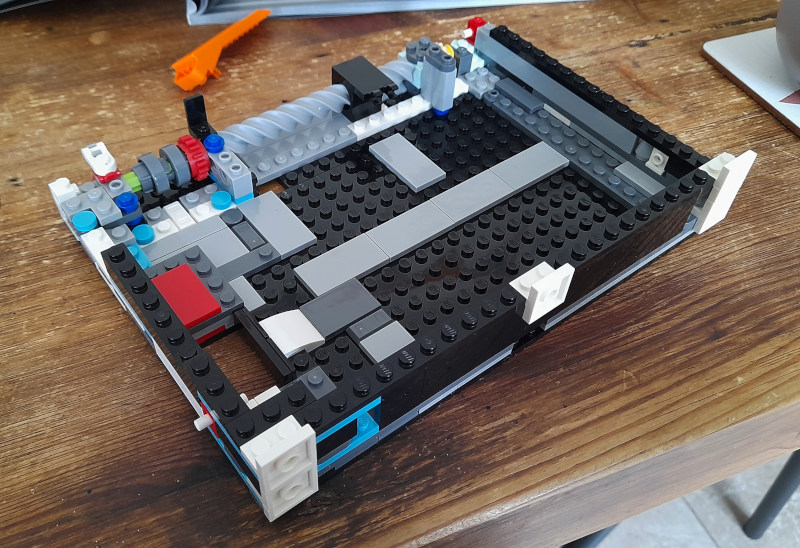
A more recent note, though, should be easier for me to turn into a post! About eighteen months ago, I noted “Post about Lego radio”. Which is nice and straightforward, because I took plenty of pictures whilst I built it.

The early stages of a Lego radio

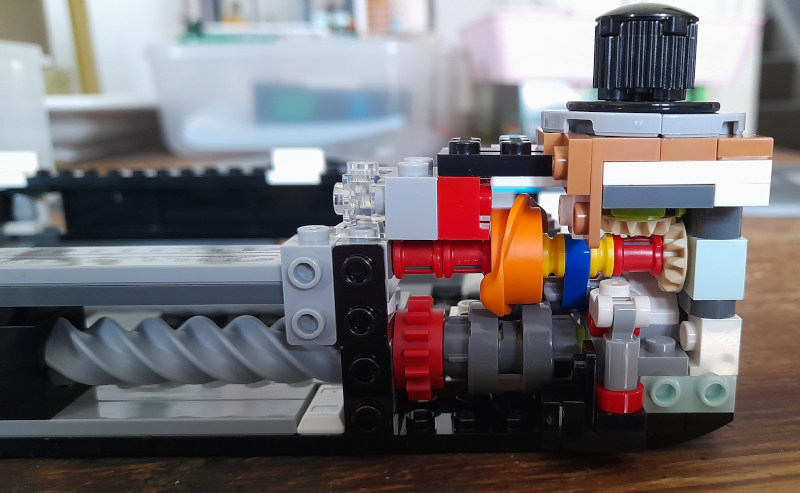
Like a real radio, it does have a couple of controls: a “tuning knob” to move a needle against a frequency scale, and a switch which turns a sound brick on and off. The switch’s mechanism was both fun to build and tactile to fiddle with afterwards.

A compact Lego mechanism consisting of a small number of gears and cams

Alternatively, the back of the radio comes off, and there’s a Lego-build phone holder inside, so you can use your phone as a speaker. I dare say, if you have a Bluetooth speaker that resembles a phone in physical size and shape, it would sound even better. It can be rather louder than the built in sound brick too.

A finished 1950s style Lego radio

I have to admit, this was the sort of project where I buy it purely because I’m in the shop and feel like I’d be too disappointed to leave with nothing. It’s a fun little build, true, but not really one that, for me, is worth keeping on display. It comes back to the start of this post: given I found it a fairly routine build, why did I want to write a blog post about it? I honestly don’t know at this point, other than the ever-present sense that I should document everything I build. I did have a nice time building it, but I haven’t really thought about it at all since it was finished; very different to other Lego sets like the lighthouse or the Swiss Crocodile locomotive. Writing this does, at least, cross the idea off the list!

The space between the lines

Pondering on what scale, exactly, to build the model railway

A week or so ago, I wrote about the train set I’d recently bought, as the nucleus of a model railway inspired by the Brecon & Merthyr line in South Wales. The train set is N Gauge, or N Scale. Is this, though, the best scale for me to build it in?

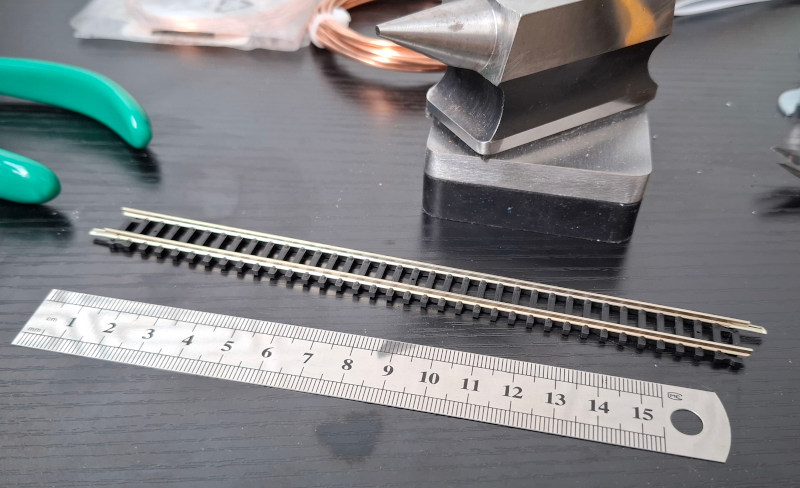
The term “gauge” means the distance between the inside edges of the rails, just as it does on a normal train. Model trains come in a huge variety of scales and gauges, ranging from those large enough to sit on, to those barely large enough to see. N Gauge was created by the Bavarian toy company K. Arnold in the early 1960s, and is named for the fact its gauge is nine millimetres—or neun Millimeter, I suppose. If I put a piece of the track that came with the train set next to a ruler, you can get a rough idea of its size.

A piece of model train track on a black workbench, next to a 15cm steel ruler.  You can see, by comparing the ruler and the track, that the track gauge is around nine millimetres.  The track is quite chunky, with thick rails and sleepers.

Because it’s so small, you can fit more train into a tight space; that’s always been one of the reasons I’ve struggled to build myself a model railway.

Lots of trains are made in N Gauge, off the shelf; and train sets, like the one I bought, to give you an easy start. However, it’s not the only gauge or scale that’s roughly this sort of size. The other one, in fact, is even older.

N Gauge’s scale, for British models, is 1 to 148; or a fraction over 2mm of model to every real-world foot. However, since the 1930s, modellers had already been handbuilding models to exactly 2mm to the foot. It’s an extremely similar scale, roughly 1 to 152. Given the trains are so small to begin with, the difference is barely even visible. One pioneering 2mm Scale model railway built in the 1940s, the Inversnecky & Drambuie Railway, has survived and is partially on display in the National Railway Museum in York.

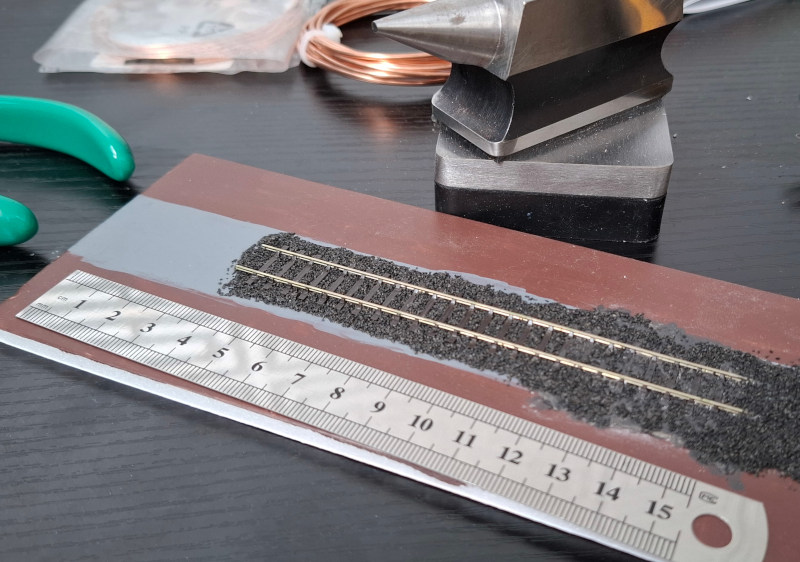
Unlike N Gauge, you can’t buy any trains or train sets in 2mm Scale. There is, however, a 2mm Scale Association who produce various different products to help modellers build their own 2mm Scale trains. A while ago now, I bought one of their “starter packs”, which includes a short length of track, which you assemble yourself from rails and a plastic base. It’s much more fragile than train set track, so I glued it down to a piece of foamboard and tried to make it look ballasted.

A piece of model train track, stuck down to a small piece of painted foamboard, on the same workbench as the last picture and next to the same ruler.  You can see that the track gauge is roughly the same, but the rails are much smaller and thinner, and the sleepers are spaced more widely apart.

The track gauge isn’t 9mm, though; it’s 9.42mm instead. Very very close, but not close enough to run the same trains reliably. You can see it has much thinner rails; that’s because it tries to be an exact scale model of real track. For most of the twentieth century, most British railway line was made of individual 60-foot panels; so this piece of track is 12cm long as a result. 9.42mm is the exact width of real track, scaled down to 2mm scale; N Gauge, on the other hand, if you scaled it up to real life, would be about 10cm too narrow.

The question, then, is: which way should I go with this model? Go with N Gauge and trains I can just buy; or 2mm Scale and have to build an awful lot of stuff on my own. With the trains, at least, it’s possible to get N Gauge trains and just give them 2mm wheels; because as I said, they’re so close in size that few people can tell the difference. It might be an awkward, fiddly job though.

At the moment, I’m just not sure. Before things go much further, I’ll have to make a decision, and choose to go one way or the other. At least for now.