
+++*

Symbolic Forest

A homage to loading screens.

Blog : Page 97

Two posts today, to make up for yesterday

In which I look like a typical boffin, again

Following on from the vague theme of: does it matter what I look like? A couple of weeks ago, at work, Colleague M told me: “you look like the sort of person who would have a website“. Today, I had the chance to talk to M again, so I asked why I do.

“Well,” said M, “you’re a computer geek, and I assumed that all computer geeks have websites.”

“But do I look like the sort of person who does.”

“I don’t know, really.”

“I was hoping you’d say something interesting!” I said. “So I could write about it on the website!”

“Well, say that you look like a computer boffin, and all computer boffins have websites.”

We talked about the sort of things I write on the site, and, if I was more sensible, the conversation would have stopped there. However, being me, I blundered on.

“You can read it if you want. I don’t really want people here to know about it – so I can write about them – but I trust you not to tell anyone else.”

“Well, I’ll have a look,” said M, “but it sounds like it might be a bit boring.”

I wrote down the address on a scrap of paper, and M burst out laughing.

“What’s so funny about it?” I asked.

“It just is! Partly because you wouldn’t see why it’s funny!”

So, hello M, if you’re reading.

In other, geekier news, the site stats reached 10,000 page views some time today.* Woo!

* that’s when the logs are analysed by Analog, at least. Webalizer thinks it happened a few days ago – presumably they disagree on which files count as pages.
Byline

In which we think about design and credibility

Going back on last week’s post on Jakob Nielsen‘s top ten blog design mistakes: his Number Two Mistake is: no author photo on the site. Thinking about it, out of all the mistakes on his list, that’s almost certainly the most commonly-made.

Faces are better-remembered than names, he says. People will come up to you because they recognise you from your photo, he says. How many bloggers actually want that to happen to them, though? I know I don’t. It makes you personable; it improves your credibility if people know who you are.

I said before that I don’t believe it would give me any extra credibility. I don’t think you need to know what I look like in order to believe the stuff I write here; and frankly, I don’t care whether you believe it or not; I know myself how true it all is. Thinking about it again, though, I’m a bit suspicious of his reasoning; and what makes me suspicious is: comparing his theories to the way newspapers work.

If you look at most national newspapers – I mean, British ones – their regular columnists will have byline photos. You know what they look like, so, the theory goes, you should trust them more. Columnists, though, aren’t there to write things you need to trust them about. They’re there to write down their opinions, which may well be – and often are – complete bollocks. The news pages, which are the parts you’re supposed to believe are true, don’t bother with byline photos. They don’t always bother with bylines. These people, though, are the ones you’re supposed to trust, and their words are supposedly more trustworthy because of their relative anonymity.

Of course, this all breaks down when you consider that most bloggers see their role in life as over-opinionated commentators, not the byline-free just-the-facts news types. I wanted to mention it, though, because it’s a different angle on how trust works in the media. Who do you trust more?

Autumn days when the grass is jewelled (again)

In which we remember an old school hymn

I’ve noticed, recently, a lot of people finding this site because they’re searching for the lyrics to the song Autumn Days, the primary school assembly staple by Estelle White. So, I thought I may as well post at least part of them:

Autumn days when the grass is jewelled
And the silk inside a chestnut shell
Jet planes meeting in the air to be refuelled
All these things I love so well

(Chorus)
So I mustn’t forget
No I mustn’t forget
To say a great big thank you
I mustn’t forget

You can find the rest of the lyrics here, although there’s a small mistake in the second verse.*

I’m sure it became a classic assembly hymn-singing staple because it’s only vaguely religious. It is to hymns what Intelligent Design dogma is to creationism – it implies we’re talking about some sort of god here, but the details aren’t just vague, they’re not there at all. In other words, it fits in perfectly in your average non-sectarian British school, forced by law to hold regular “religious” assemblies, but forced by common sense to make them as non-religious as they can get away with.

* it should be “and the song the milkman sings,” I’m sure.

Being Nosy

Or, getting suspicious

Big Dave is up to something.

Big Dave is my main co-worker. He’s a big chap, and he’s called Dave. And he’s pretty open about stuff. Just lately, though, he’s definitely been up to something.

He asked if I could cover for him and stay late yesterday, so he could leave early. “If I leave when you normally do,” he said, “I can get to the gym an hour earlier. It would be nice to have a change.” Not having any plans myself, I agreed.

Back in this morning. “How was the gym last night, then?”

“Didn’t actually go to the gym,” he says. “Had something else to do.”

“Oh yes?”

“Mmm. I was busy.”

So, something’s definitely going on. It sounds like Big Dave’s got a date.

Vote for … um … noone!

In which we think about the Tories, but try not to think about them for very long

All politicians are evil, but Tories tend to be more evil than the others. I’m mostly interested in the current leadership contest purely out of a grim kind of schadenfreude: they are an aging party which is slowly pulling itself apart. I can’t help thinking that the main reason for their lengthy, baroque leadership election process is purely to help the party stay in the public eye* for longer.

* above the Government in the headlines, I mean.

Mistakes

In which we consider how well this site scores against Nielsen’s standard

Website design and usability expert Dr Jakob Nielsen has published his list of the top ten blog design mistakes. So, I thought I’d go through the list and see how many of them I’m making.

No author biography, no author photo. Well, there’s a kind of biography, but certainly no photo. I don’t want you to know who I am. It wouldn’t mean anything unless you already know me in real life. Telling you more about myself wouldn’t gain me anything in credibility, which seems to be the most important point here.

Nondescript posting titles – I do this all the time. Mostly because, as he says, writing good headlines is hard work. Partly, though, because this isn’t a news site. If you look at a newspaper, the concise descriptive headlines Nielsen favours are all over the news pages; but the comment sections’ headlines are deliberately vaguer and enticing.

Links don’t say where they go – I try not to do this, because I know it’s bad for search engines.

Classic hits are buried. If I ever write some, I might think about doing something about this.

The calendar is the only navigation – in other words, you should try to categorise everything properly. I’d say I score half-marks on this one.

Irregular publishing frequency is about the only thing on the list you can’t accuse me of, unless you want to complain about me not always posting at the same time every day.

Mixing topics. Hah. I don’t even have a topic.

Forgetting that you write for your future boss – this is why I don’t tell you much about who I am, in the hope of avoiding this problem. Nielsen thinks that trying to avoid this is hopeless given the march of technology, though.

Finally, Having a domain name owned by a weblog service – lots of well-known, well-respected sites do do this. I see the point, though: you need to control your domain to control your reputation. Not something I need to worry about, though.

Totting up, I seem to have hit six (and a half) of the top mistakes in weblog design. All of them, though, are all very good points when made about a different sort of site to mine. I just don’t feel that those six mistakes I’ve made are a problem for me at the moment – and some of them might be mistakes, but they’re decisions that I deliberately took. I’m fairly happy with the nature of this site at the moment, whatever an expert might say.

Books I *have* managed to read

In which I finish something for once

This week’s Book I Haven’t Managed To Read was going to be about a Neal Stephenson novel, The System Of The World. However, that’s been postponed, just because I wanted to brag about finishing another Book I Haven’t Managed To Read.

The book was one many, many people have read with no trouble at all. Harry Potter And The Goblet Of Fire. However, the first time I read it, in a hurry, I’d just tried to read two other Harry Potter books very quickly too. I got as far as Chapter Three of Goblet Of Fire, stopped, and didn’t pick any J K Rowling books up for a few years.

Anyway, last week, Colleague M said: “what? You’ve only read three Harry Potter books?” So, I picked up Goblet of Fire again, and read it. I didn’t get stuck. I didn’t forget where I was. I read it and I finished it. Hurrah!

Everything is out there

In which The Mother learns something

My mother is still beavering away at the family tree, on various genealogy websites. She still hasn’t really got the hang of the internet yet, though…

“What’s a GEDCOM file?”

“Have you looked it up?” Google, google. “It’s a file format developed by the Mormons to store genealogical data.”

“That was quick! I didn’t know you could use it as an encyclopedia! Can you look anything up on it? I mean, if I didn’t know what an elephant was, could I look it up on the internet?”

The thing I try not to think about is: this is probably the level that most internet users work at.

Organisation

Or, knowing where to find things

My life is a disorganised mess, and so I’m always on the lookout for ways to sort that out. Most of them seem overly-complex, self-evidently simple, or just too much work. However, I did rather like the look of a link posted on Boing Boing recently: an article from a few years ago about the Noguchi filing system.

The basic principle of the Noguchi system is: labelled files are kept on a shelf with no dividers. Files aren’t sorted, indexed, ordered or categorised at all. Instead, when a file is returned to the shelf after use, it’s always returned to one end. Therefore, the only ordering is by date of last use,* making it very easy to spot which files you can safely dispose of, or remove into storage.

That’s all well and good for paper file storage – it sounds like a rather good idea, to me. I was wondering, though, if it’s any use for computer file storage.

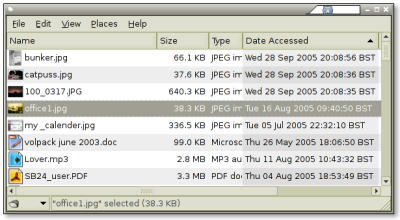
At first, it seems like an obvious candidate for computer file management. All you need to do is switch all your windows to sort files by date of access. So, I tried it; and quickly found that it’s more complicated than that. Here’s a picture of my home folder, which usually stores files I haven’t been able to categorise:

Home directory

The first problem jumped out at me straight away. I haven’t looked at those top files recently at all – certainly not as recently as September. The computer may well have done – probably to update its icon cache, as they’re images – but I didn’t, and the computer can’t tell that. This would be even worse for folders of files on the office network, used by multiple people at once. Secondly – and it took me a minute or two to notice this – my computer has a bug! The files aren’t even in the correct order, according to the printed dates.

So, clearly, I can’t use the Noguchi system for organising my computer files, at least not with the tools I have available. Creating new tools is possible, but beyond my own skills. Maybe I should just make a big “metadata” file, to track where all my important working files are and how often I’m using them.

* Or by date of last desk-tidy-session, as it probably would be in my case.

Reasoning

In which I am easily (and correctly) stereotyped

A strange day at work yesterday, and one in which I was instantly, quickly, and very correctly stereotyped.

Taking a shortcut through the warehouse behind the office, I got talking to Colleague M. Colleague M is fairly new, so tends to get all the rubbish jobs, such as sitting out in the cold of the warehouse sorting through boxes of stuff before it goes upstairs. We ended up talking for a while, and for some reason I ended up having to mention that I have a website.**

“Yes,” said M, “you look like the sort of person who would have a website.”

Frankly, I was a bit baffled. M may be right, but I have no idea why. What do people who have websites look like?