+++*

Symbolic Forest

A homage to loading screens.

Blog : Page 52

Notes on Riga (part 2)

In which we're warm on holiday

“Ooh, how are you going to cope with the weather,” everyone said, when I told them I was going to Riga. “You’d better get some warm clothes.”

So I went out, shopping. I bought an all-enveloping thick wooly jumper (in the sale, Burtons in Middlesbrough) and a rather nice brown wool coat (in the sale, Debenhams at the Metro Centre), and, well, that was it. “That’s no good,” said The Mother. “You should have been going to sports shops. You should have got some skiing clothes, lots of layers, something waterproof, make sure you’re properly insulated.”

“Have you packed any sunglasses?” said Dad. “You’ll need sunglasses if you’re going somewhere like that in winter, otherwise you’ll get snow-blindness.”

“That’s a nice coat,” said someone at work. And then she laughed. “You’re going to freeze if you’re wearing that to Riga.”

Take a moment to spot the common theme here. Lots and lots of advice, on what to wear, from people who have never ever been east of Margate.* We do have a Resident Pole in the office, though, who has travelled up that way, and she thought I’d be fine. “I always think it feels colder here,” she said, “than on the Baltic. It’s something about the dampness here.”

And, it turns out, she was almost right. It was certainly damp and grey in Riga, with overcast skies most days, and sometimes a fine misty rain; but it didn’t feel any colder than Britain in winter. No frost, no snow. Chunks of ice floating on the river and the City Canal, but otherwise just like home. If I’d taken skiing clothes, I’d have melted.** As for needing sunglasses – the thought still makes me giggle.

* Well, The Mother went to the Dalmatian coast in 1972, but that doesn’t exactly count.

** One thing we found: every building in Riga, every shop, museum and restaurant, keeps the heating turned up on full blast. On the other hand, when you come inside wrapped up for winter, you’re expected to take your clothes off. All the museums we visited had free cloakrooms at the door, and restaurants and cafes all have communal coat-racks that everyone happily uses.
Notes from Riga

In which we enjoy ourselves on the Baltic

Don’t drink the water.

I only poured one glass of water from the tap in the hotel. It was a murky shade of brown. After I let it run for a while. One of the notes in the hotel room said, I think, “don’t drink the water,” in Latvian. I’m not entirely sure, but the bathroom and the water were definitely mentioned. As a bottle of water cost about 30p from a shop,* we weren’t overly bothered.

The hotel, though, was sumptuous. A big room, an enormous bed, and lots of dark wood, carved with lions and cherubs. The combination reminded me of Western European Iron Age art; some Iron Age cults apparently worshipped fierce tigers and severed heads, as far as we can tell. Every morning we woke up to lions baring their teeth at us from the wardrobe.

* or over £1 from the hotel minibar

Water in pictures

In which we stand by the riverside

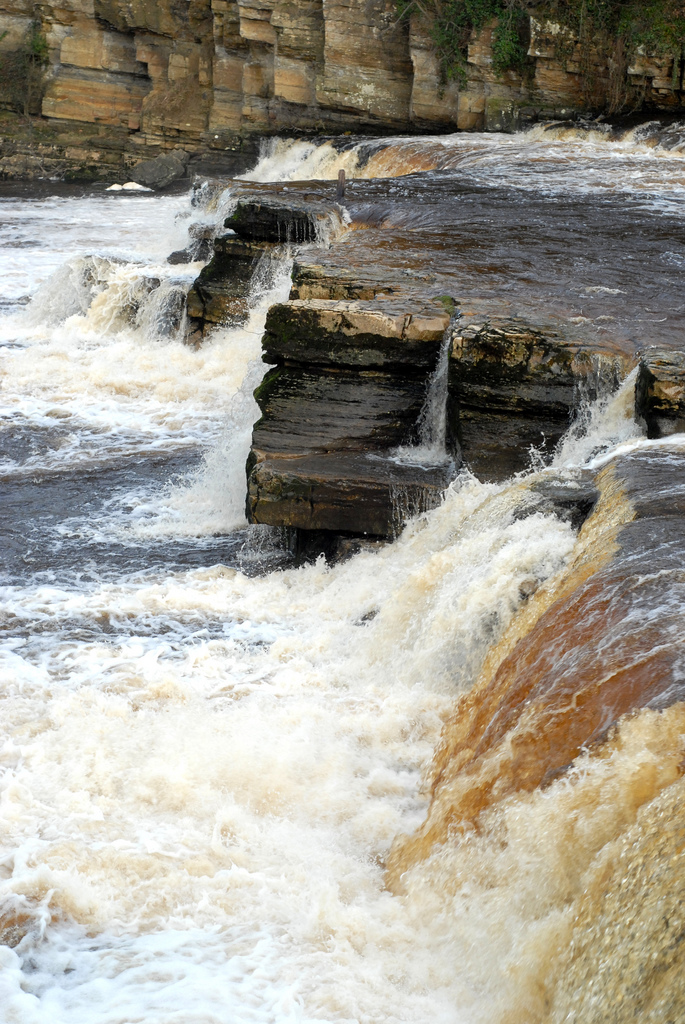
“Water” was the title of a photography series I did back at school, back when I was 17 and in the darkroom, wearing torn, fixer-stained jeans,* and getting my Art GCSE. I spent the February bank holiday travelling round the Pennines with the parents, taking photos of waterfalls; then augmented it with studio shots of dripping water against a dark background.

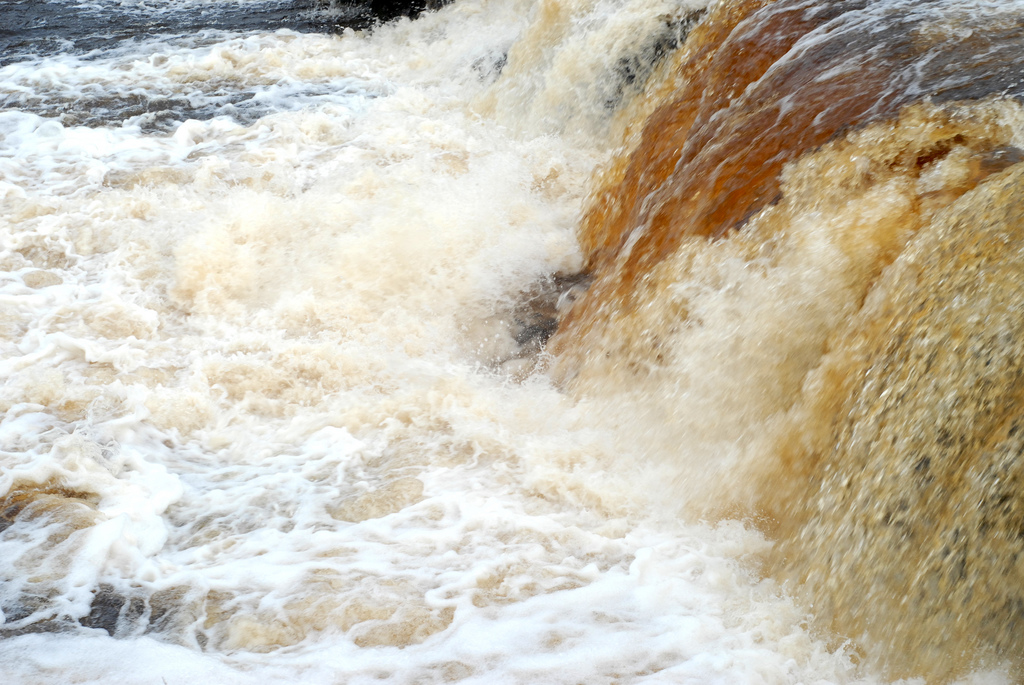
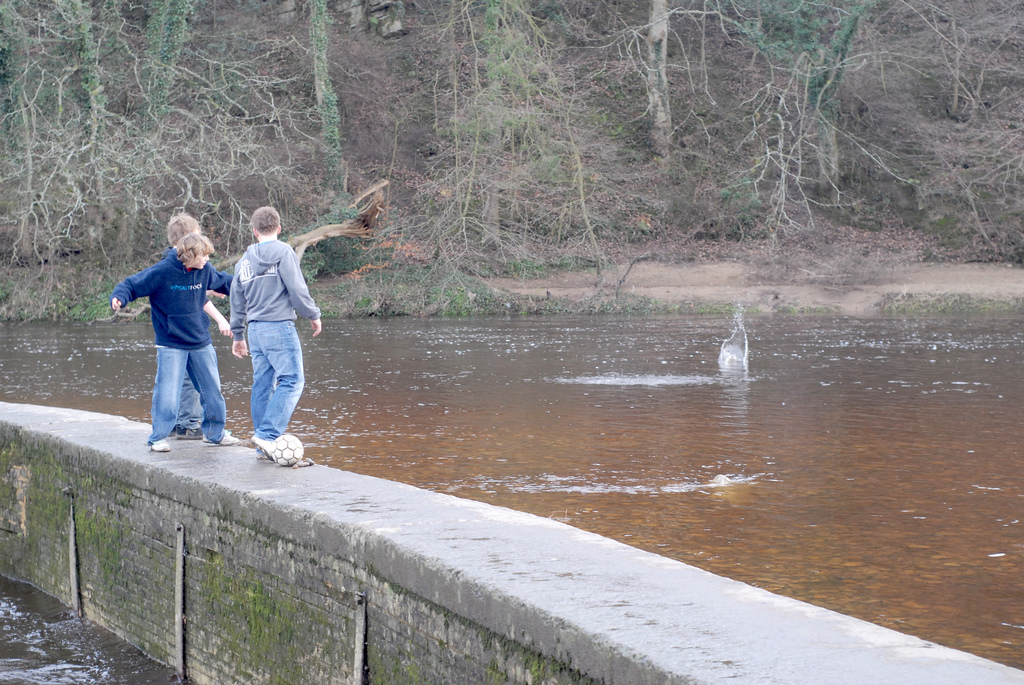
So, the other weekend, when the rain had been heavy and the rivers were expected to flood, I went into town with my camera to see just how high it was, and how it poured over the falls below the castle. I was slightly disappointed, in that there was no flooding at all; but we stood by the river as young boys threw stones and things in the water and watched the floating things race down over the falls.

Winter sunlight

River Swale

Waterfall

Boys throwing stones

* and with bleached-white patches from A-level chemistry spills, too. The Art GCSE was a sideline whilst doing my A-levels.

Cutthroat

In which we go all grand guignol

Before going off on holiday, we popped down to York to see *Sweeney Todd*, the new Tim Burton version of the Sondheim musical. It contains, as you might expect from a Tim Burton film, a lovely, dark, damp and grimy version of 19th-century London, albeit one with a rather anachronistic Tower Bridge opening near the start.*

I’m not normally a fan of musicals, but I rather liked this one, despite feeling slightly ill by the end at the amount of blood spurting around in best grand guignol style.** I loved Sacha Baron Cohen’s performance as a barber-showman with prominant genitalia, and I even guessed the ending twist (although not the direction it would be coming from). He’s a very good mechanic, too, Sweeney Todd, knocking up a mechanical barber’s chair overnight; I never did work out where he got all his pinions from. And as Mrs Lovett explained how all the blood and waste was poured down into the sewer, it occurred to me that back then nobody would have noticed anyway. Back then the sewer was the River Fleet, which daily ran red with blood and offal from Smithfield Market upstream.

Above all, though, the film reminded me of one of my favourite books, Alasdair Gray’s Lanark. On a superficial level: the almost constantly dark and smoky London of the film reminded me of Lanark‘s fictional and Hadean city of Unthank, with its constantly dark skies. Moreover, though, it was the film’s sense of alienation, between rich and poor, between ruler and oppressed, which made me think of the book.*** Todd’s alienation and disconnection from the London population, caused by his unjust transportation to Australia, lead directly to his sociopathy and psychopathy. It echoes the defining line that isn’t actually in Lanark**** but which sums up much the themes of that novel: “Man is the pie that bakes and eats itself, and the recipe is separation.”

* it wasn’t built until about 90 years after Todd was supposedly around, in most of the versions of the story which give him a date.

** “It looked more like paint,” said Mystery Filmgoer afterwards, laughing. “It was too brightly coloured, more like the blood you get from superficial cuts – arterial blood is darker.”

*** Some of the lyrics also echo George Orwell’s famous quote about “a boot stamping on a human face forever”.

**** The line never appears whole and complete as I’ve quoted it here, but fragments of it are repeated many times through the book.

Cartography

In which we wish for better maps

Maps are wonderful, lovely artefacts. I love to spread one out and read it like a book, analysing every square. Nowadays, though, I only do it for pleasure. Because, for practical reasons, if I want to plan a route or look somewhere up, it’s usually much much easier to go online for it.

There are downsides to this. Google Maps are nowhere near as good as a paper map. Their cartography just isn’t up to the same standard. They include roads, railways, rivers, and that’s about all. No buildings, no landmarks, no landscape. In Britain, Google Maps have the slightly odd habit of only including railway lines with passenger services,* and there seems to be no contours and few footpaths.

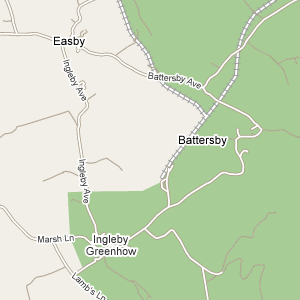
Google, though, are nowhere near as low-quality as Yahoo Maps. Since I bought a full Flickr account, I’ve used Yahoo Maps a lot, to record where I take my photos; and there are just so many places where Yahoo’s map doesn’t match reality. Take, for example, somewhere I visited recently with my camera: Battersby, on the edge of the North York Moors national park. This is Google:

Battersby, from Google Maps

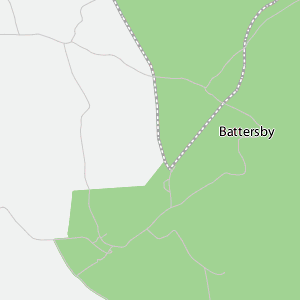
For comparison, this is the Yahoo version at the same scale:

Battersby, from Yahoo Maps

Never mind the lack of street names, and the general lack of contrast which makes it difficult to see where the roads run, especially within the National Park. Where exactly does that railway run? Where is the park boundary? The park boundary does indeed follow the line of the railway; but what shape is it? There’s a big difference there, just because Yahoo’s maps don’t include enough detail, apart from for roads, to be at all accurate when zoomed in. Rivers are just as bad, and apparently have zero width too.

If you really wanted to know the answer to the park boundary question, incidentally: it’s Google that’s right, as you can see by looking at Streetmap, who license the Ordnance Survey’s maps. Now that’s what a map is supposed to look like.

* It probably derives from the Ordnance Survey’s long-standing division between “railways” and “freight lines, sidings or tramways”, which dates right back to the start of the One-Inch series. It was bad enough when Landrangers, at I think the Second Edition, dropped the distinction between single-track and multiple-track railways. I have some First and Second Edition Landrangers somewhere, so I’ll have to check when the single-track railway symbol disappeared. First Edition were the last One-Inch maps photographically enlarged, which leads to some odd discrepancies on them;** the Second Edition were redrawn.

** for example, on the First Edition Sheffield and Huddersfield Landranger map (sheet 110), a chunk towards the south of the map is lettered in a different, older, font, which suggests that part of the map was derived from a rather earlier original than the rest of the series. I’ll scan a section some time to show you.

Update, August 30th 2020: At some point in the last 10 years, Google Maps’ coverage of railways became much better, not only including non-passenger railways, but detailing the coverage down to individual tracks, not just lines of route. So hurrah, on that point at least!

Update, October 19th 2020: Some twelve years later, I have finally got around to writing the blog post I promised in the second footnote.

Infamy

In which we discover more people read this site than we thought

I went for a drink with people from the office. This may have been a mistake – on the other hand, it’s better to know things.

“Oh, we all read your blog,” said someone from the Accounts department. “Your boss told us he reads it too. We know you change all the names, so we try and work out who everyone is. ______ was convinced that she was ‘the cute one from the Accounts office’ and we kept trying to persuade her that it wasn’t her.”

Maybe it’s a good thing I haven’t mentioned work much in the past few months, then. Or, alternatively, now I know they’re reading, that might mean I can mention them more. With it all understood and on the level.

Good friends

In which we think suicide clusters are overhyped; and try not to be a drama llama

There’s been a lot in the news recently about young people killing themselves, allegedly to draw attention to themselves online. The whole story seems slightly odd, with little evidence for it, but it’s been raised by an MP so it got itself in the news. Most of the people in the alleged suicide cluster are young men, the highest-risk suicide group. I fully support raising suicide awareness and suicide prevention, but it seems rather like fear-mongering to try to place blame on social networking. There were teen suicides and “suicide clusters” years ago, long before social networking was invented.

I know from experience that suicidal feelings are something which people should always take seriously, and that internet messaging, by both its speed and lack of emotion, could easily make worse. But nevertheless – and because it is that serious – I don’t like the feel of people jumping on the exaggeration bandwagon without evidence, or trying to use the threat of others’ suicide to gallop off on their own over-dramatic high horse.* I’ve been on the internet for a while now,** I was a chatroom user quite a lot when I was a student, and I’ve seen people come into chatrooms and make darkly deniable threats like: “you shouldn’t be so nasty to X. If you keep being nasty to people in here and people end up dying, how would you feel?” Whether X is in the pits of depression, or just mildly irked, and whatever your intentions are, that’s a childish and nasty thing to do.

If you’re a friend to someone, and you think they’re being upset because of people on the internet, then the only thing to do is get them offline. Get them to put down the keyboard, go outside, and get some fresh air. Go and take away their network cable yourself if you really have to. But don’t just go around telling other people what they’re about to do. Don’t go around trying to amplify the drama, because people are only going to think that at heart you’re trying to make yourself the centre of attention. If you’re a real friend, go and help them, quietly and without fuss. Because help is what friends are for.

* or “drama llama”, as one internet friend memorably said.

** I can’t believe it’s over ten years since I first got online. The internet was in black and white back in those days – no, really: this was on a Macintosh Classic II, one of the last black and white only Apple models.

Pride

In which we note the Grimsby Telegraph’s latest marketing campaign

The rather news-thin Grimsby Telegraph newspaper has decided to jump on a fish-marketing bandwagon and declare today to be Great Grimsby Day. A day to be proud of the Grimsby area! Its scenic mudflats! Its thriving heroin-injecting scene! The active support for boxing and extreme wrestling seen in the town centre every Saturday night! The wide range of chain-based shopping opportunities, and the picturesquely decaying industrial areas. Be proud, people!

It’s a good thing, I suppose, that they didn’t get it confused with National Fetish Day, which – equally arbitrarily – was yesterday. I hate to think what would have happened. There’s not much of a fetish scene in Grimsby, after all; a couple of the regulars in the Lloyds Arms and that’s about it. I can quite easily imagine the Grimsby Telegraph’s staffers not understanding what the word means.

Statistics and probability

In which we think about flooding and chance

In the summer, we had big floods up here, worse floods than anyone in this village could remember. It was, apparently, a once in fifty years event.

Now: we’ve got floods again, six months later. Maybe not a once in fifty years event, true, but let’s say (for the sake of argument) that this is a once-in-twenty-five year flood.

Maths time: in any 6 months, your chance of having a 1-in-50 year flood is 1/100. 1/50 for the more likely 25-year flood. The chance of having both, though, is those numbers multiplied together. 1 in 5000. Which doesn’t, at face value, look like a particularly big number; but that’s because we’re not great at judging magnitude. Something that has that chance of happening within 6 months should, on average, have happened once in the last 2,500 years. That’s once, since the start of the Iron Age.*

The problem with probability, though, is that you can’t say: this will definitely only happen once. It could happen three times within a week,** and still be within the bounds of probability. It could still happen, within the rules of our simple model; it is just highly unlikely to happen. If it does, you’ve just seen something amazing, but it doesn’t necessarily mean that your starting figures are off. On the other hand: if something happens that, according to your figures, is highly unlikely, it does make more sense sometimes to decide that the numbers you’re basing your statistics on are out of date. Suddenly, big floods aren’t rare any more.

* slightly more than once, to be honest, because the Iron Age started about 2,700 years ago.

** Hull was flooded twice, 14 days apart, in summer 2007. Some of the floodwaters in unimportant places, such as verges and parks, still hadn’t drained from the first flood when the second (and worse) flood came. That, though, means that normal “multiply the two numbers together” probabilities don’t work. The two floods weren’t independent of each other, because of all that water lying about, so the probability of the second was rather lower than it would have been.

Fear

In which we think scary thoughts

We’ve just been watching Nosferatu, the classic silent vampire movie, and one little touch jumped out at me. The menu screen of the DVD shows the cover image, a stylised pastel portrait of the titular vampire, but with one small difference: every couple of minutes, he blinks. The sort of thing that: when you see it, you’re not sure if it really happened.

It got me thinking about the nature of fear; and, particularly, fear of images. When I was younger, I had a book* full of exciting information for children and suggestions for fun activities. It had everything from face painting and magic tricks, to the colour wheel and the platonic solids.** I loved it – but one page, I was terrified by. The page – well, double-spread – on toxic and dangerous animals. I didn’t really mind the tarantula, and I can’t even remember anything else on the page: but what terrified me was the picture of a piranha down in the corner. It scared me so much that I wouldn’t dare touch it, even though I knew it was only a picture. I’d find a different way to turn that page, without going near the piranha. I can’t explain why I found a picture, essentially a picture of a fish with big teeth, quite so frightening, but I wouldn’t touch that picture for years.

* A pedant writes: as I rarely get rid of books, I still have it, and it’s still on the primary Bedroom Shelves rather than relegated to storage somewhere.

** Tetrahedron, cube, octahedron, dodecahedron and icosahedron, I think. I might have missed one. My favourite part of the book was also the longest: a project to build your own electrical trivia game with questions about the solar system. I never did try to build it.