Home
HomePhoto post of the week
In which it's still summer
As it’s Friday again, some more summer photos.
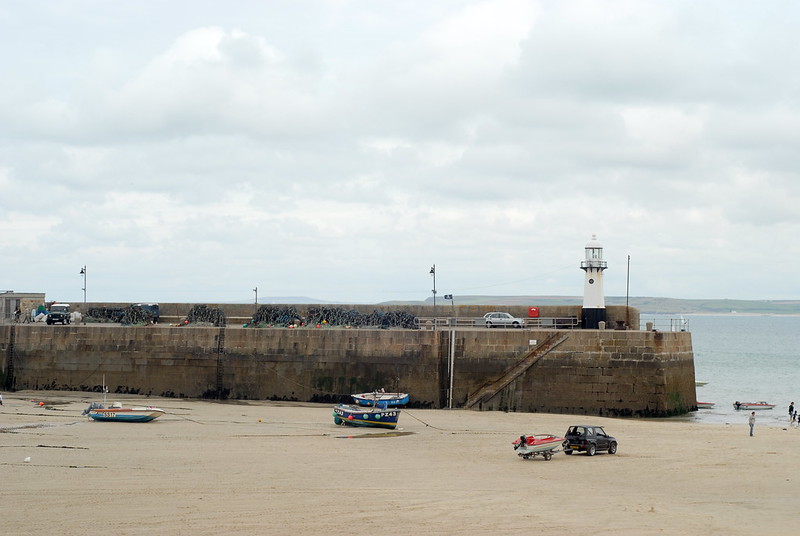
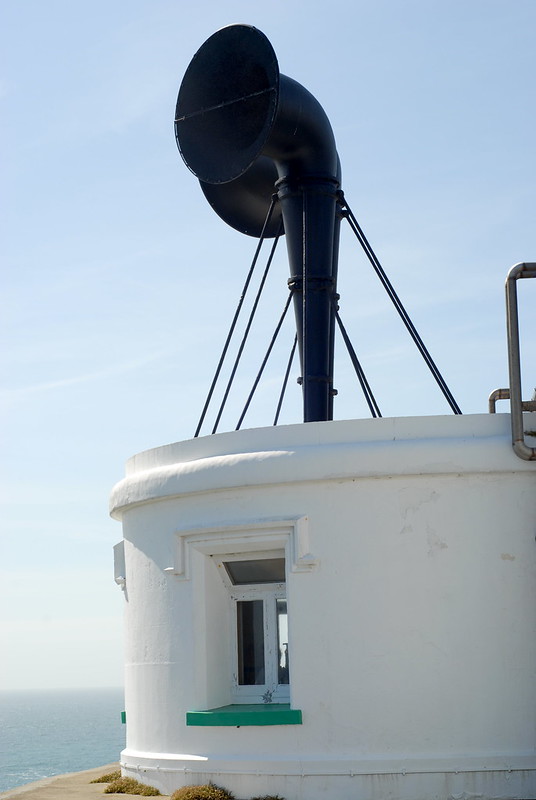
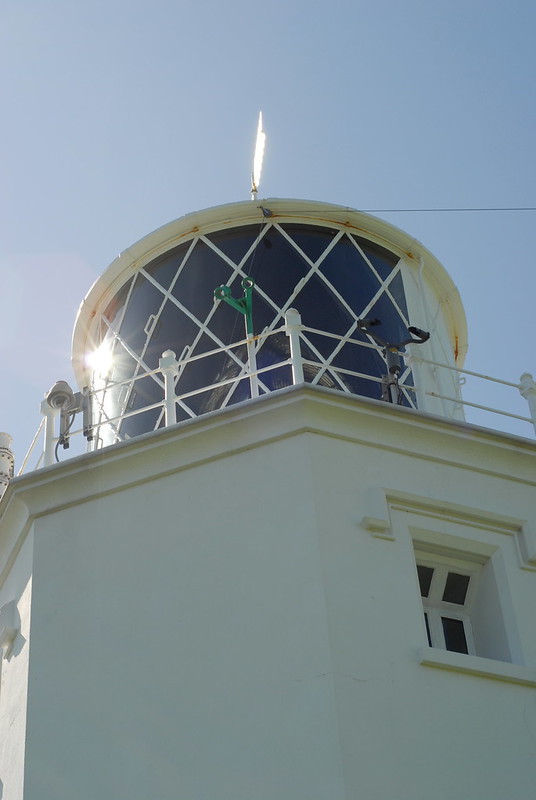
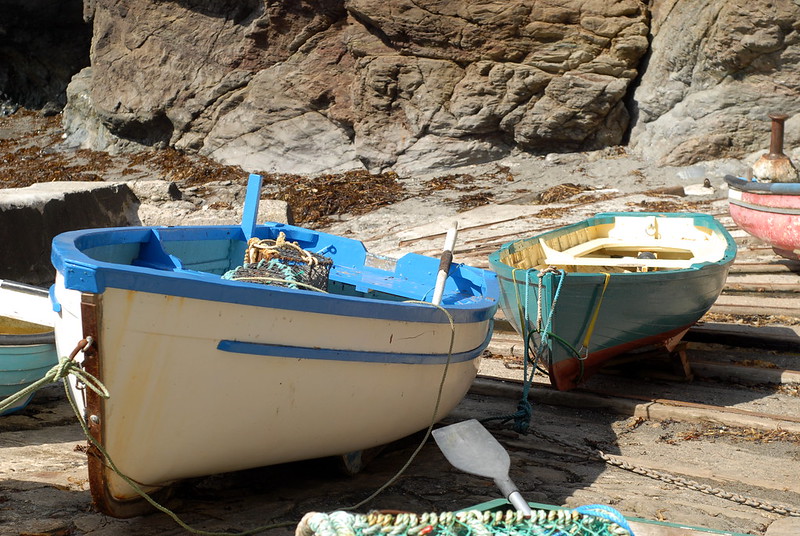
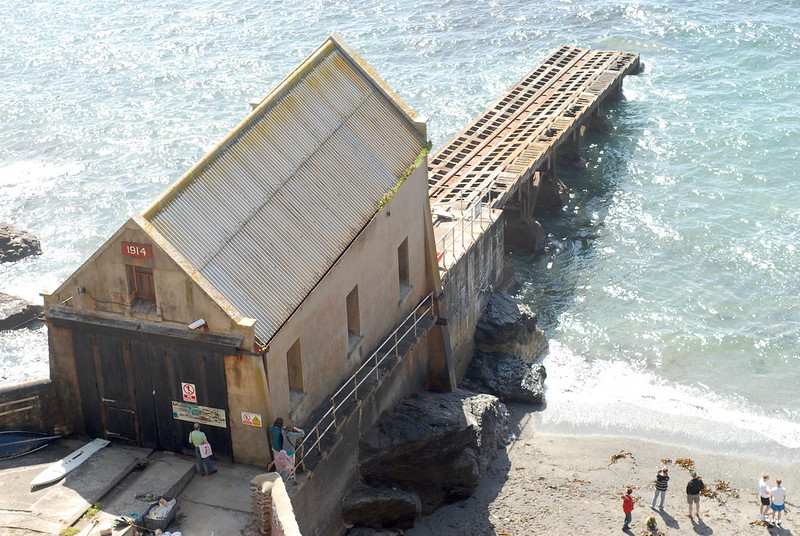

A homage to loading screens.
In which it's still summer
As it’s Friday again, some more summer photos.
In which we go to a Death Cab gig
I wonder, sometimes, how much music reviewers know about the bands they review. Some, it’s obvious, are fans. Some are at least knowledgeable. But there must be some, surely, who turn up knowing nothing and leave knowing less.
We went to see Death Cab For Cutie play the other night. “Ah,” I thought, “I’ll write about them for the blog.” It’s the second time we’ve seen them this year, having seen them already a few months back at the Manchester Apollo. I even recognised some of their tunes. But, nevertheless, I still don’t feel qualified to have an opinion about them.
The stage felt slightly odd at Sunday’s gig. A big, wide stage, the band set themselves up at opposite corners of it, with a vast empty area in the middle through which their bass guitarist romped, jumping about wildly. We were pressed up against the front barrier, so I amused myself by watching the local photographers jumping about in pretty much the same way, grabbing photos before they had to leave. Nice cameras, coincidentally all Nikons. I wasn’t entirely sure one of them had chosen the right lens – it looked a bit slow for the job. But I was supposed to be listening to the music.
They’re not the best band if you want onstage banter. They launch straight from one song to the next without leaving any applause room, sometimes stopping briefly to change guitars. We learned: they think that British and American Pizza Hut branches are just as bad as each other. We learned that the band learned: swimming in the harbour is not a good idea.* And that, as far as banter went, was that.** Their music, though, is good. They’re a tight band, even though they practically needed telescopes to see each other on stage. People don’t necessarily go for talk, do they? They go to listen to the music. Benjamin Gibbard danced about on the balls of his feet, a roadie in the wings paying out and reeling in his guitar lead as he went, to stop him tripping up on it; not knowing the music, I liked watching the little details like that. After the very full set – twenty-odd songs, including a 4-track encore, not just stuff from their current album – we went home filled up with feedback and our ears ringing.
* Possibly they saw the same thing as I saw the other day: the Big Issue seller whose pitch is on Pero’s Bridge, standing and pissing off the bridge into the water, about 10ft below.
** unless you count the Barack Obama campaign sticker on one of Benjamin Gibbard’s guitars. If you don’t say much, even a single sticker can count as a statement.
In which we wonder how the Misguided Bus will fit along Winterstoke Road
Time to return to the West Of England Partnership’s misguided Bristol Guided Bus project,* I think, although Councillor Bradshaw never did reply to my last email. The rude chap. In the meantime, I’ve been poking my nose around the Winterstoke Road area.
Whilst I was doing so, the Evening Post, as I’d done, interpreted the scheme’s maps to read that a new bridge was going to be built over the harbour. It apparently isn’t, although you have to look at the maps very very carefully to spot this. Which is a sign of how poor this whole “consultation exercise” is, if the main local press outlet is allowed to get the wrong impression like that. In the same story, the partnership admitted that they have only a vague idea of the cost of the scheme. And then, Cumberland Road was closed for emergency repairs, due to a burst water main. At present the road’s mostly used by cars, with relatively few buses. What’s going to happen to it when there are buses putting much, much more stress on it every few minutes?** Moreover, this, like any other traffic incident on either Cumberland Road or Coronation Road,*** froze the rush-hour traffic trying to get south out of the city centre. What’s going to happen when the westbound side of Cumberland Road is taken up by bus lane?
Anyway, pressing on. Winterstoke Road, where the new bus road is due to run alongside the railway to Portbury. This railway line was only used occasionally for the best part of thirty years, before being rebuilt for heavy coal traffic from the docks. When that happened, it was singled, so there’s plenty of space alongside the line. Plenty of space for a new road, you might think. Let’s look.
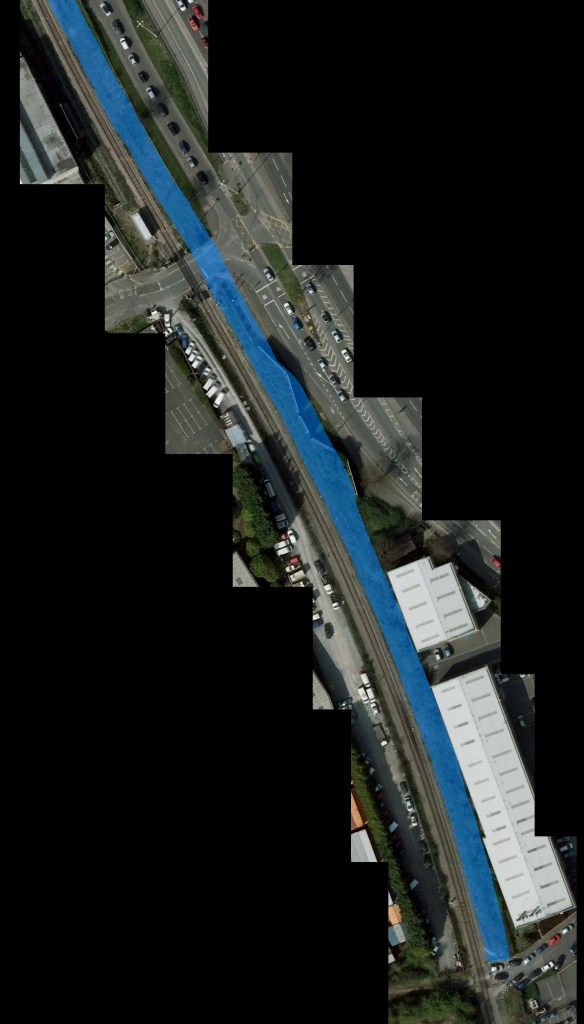
Not much room there at all, really. That blue band is the width of two guided busways, with a narrow kerb at the side for access and evacuation. I’ve drawn it right up to the edge of the still-active railway; and it takes up, well, pretty much all the space available. No room at all for the promised cycleways alongside the road. I’ve widened it a bit at the site of the Ashton Gate stop shown on the maps;**** if it’s any bigger than I’ve drawn, it then starts to swallow up the existing (and rather poor-quality) cycle/footpath too.
What’s going to happen to that building alongside the line? The partnership’s simulation video shows it on the ground and unaffected by the busway – which, at the bottom of that picture, is due to ramp up onto a flyover and, at the top, execute a sharp turn across the railway and off to the left. Is there really enough room for that, though? Without scraping the side of the building every time a bus passes? I’m not very convinced.
* You know, the one they like to call “Bus Rapid Transit”, or just “Rapid Transit”, to gloss over the fact that it’s nothing more than a slightly-altered bus route.
** Some useful information here: the stress caused on a road varies with the fourth power of the axle loading, more or less. In non-maths language: if you double the weight on a wheel, that wheel will cause 16 times as much damage to the road. A car’s axle loading isn’t likely to be above 1.5 tonnes even for something big; a bus will be more like 9 or 10 tonnes on its heaviest axle. That six-times weight multiple turns into a 1296-times damage multiple. So, a stream of cars with one passing every couple of seconds – supposedly the safe separation, according to the Highway Code – causes roughly the same amount of road damage as one or two buses per hour. That’s a very rough back-of-envelope calculation, but gives you an idea of the scale of difference we’re talking about. Trucks, of course, are even worse.
*** such as the fatal motorbike accident at the Coronation Road/Dean Lane junction a few weeks ago.
**** using the size of the Leeds guided busway stops as a guideline
In which we muse what book to abandon reading next
Getting this website going again, and posting things regularly, I was thinking that maybe I should resurrect Books I Haven’t Read, an ongoing series of posts in which I reviewed books that I hadn’t managed to finish reading, and briefly discussed why. This was on the grounds that reviews of bad books are often more interesting than reviews of good books;* many book reviewers probably get away without reading the whole thing; and if I’m going to talk about something, I may as well be honest about whether I’ve read it or not. Hence, Books I Haven’t Read, which annoyed at least one author who discovered it and couldn’t resist responding.**
The problem, though, is that it’s been a while since I’ve managed to fail to finish a book. The only candidate at the moment is Robert Graves’ The White Goddess, which has to be described as a masterpiece, even though in many ways it is mistaken and wrong-headed.*** It’s also a very hard read, and I’ve got such a small way into such a long book that I feel I can hardly do it justice.
Everything else I’ve started reading, I’ve finished reading. Books that I’ve already told you I haven’t read, I’ve since completed. I’ve even got to the stage where I’m considering going back to some of the books I’ve written about here, getting them out of the library, and finishing them off. Which is a good thing, I suppose; but it leaves me at a loss for things to criticise. Maybe I should try to be a lazier reader.
Things might be solved by a book I came across in the local Oxfam bookshop the other day: Christopher Hill’s The World Turned Upside Down: Radical Ideas During The English Revolution. I’ve always been slightly confused by the history of the Civil War – or the Great Rebellion, or the English Revolution, or the Wars Of The Three Kingdoms – see even the list of names it’s been called are confusing, or whether there’s an “it” to start with. I’ve also never really got on with Marxist historians that well, so I’m thinking that there’s a good chance it’s going to completely baffle me sideways and leave me ranting about Ranters and Levellers.**** Let’s see how far I manage to get.
* For the ultimate good review of a bad book, the exemplar has to be Slacktivist‘s ongoing page-by-page and scene-by-scene reviews of the Left Behind books and movies, which many of you have probably already heard of.
** not to mention, a second response about how I was too pathetic to deserve a response. Hurrah!
*** much like Graves’ Greek Myths, which is somewhere close to being a standard work on the subject – even though much of the author’s commentary on the myths is now extremely outdated, given that it was based on a poor understanding of outdated archaeology and anthropology.
**** Now I have heard of Levellers – but not, I suspect, the ones that were around in the seventeeth century.
In which we photograph the deep blue sea
I grew up not far from the sea. I didn’t go down to the beach or the seafront very often, but I was close enough that you could see out to sea from the top deck of my school bus. I’ve always felt good by the sea.*
On the other hand, I grew up in an area where the sea is the colour of weak milky tea. So it’s always nice to go somewhere and find that the sea can, actually, sometimes be storybook blue.**
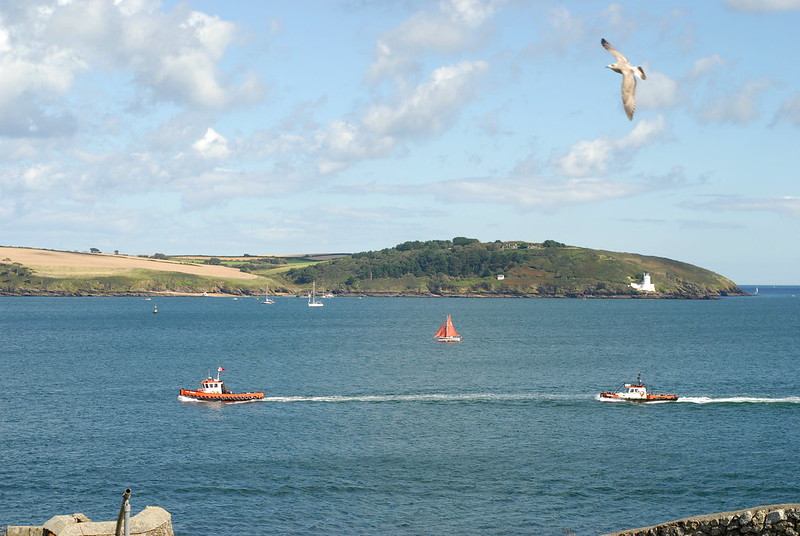
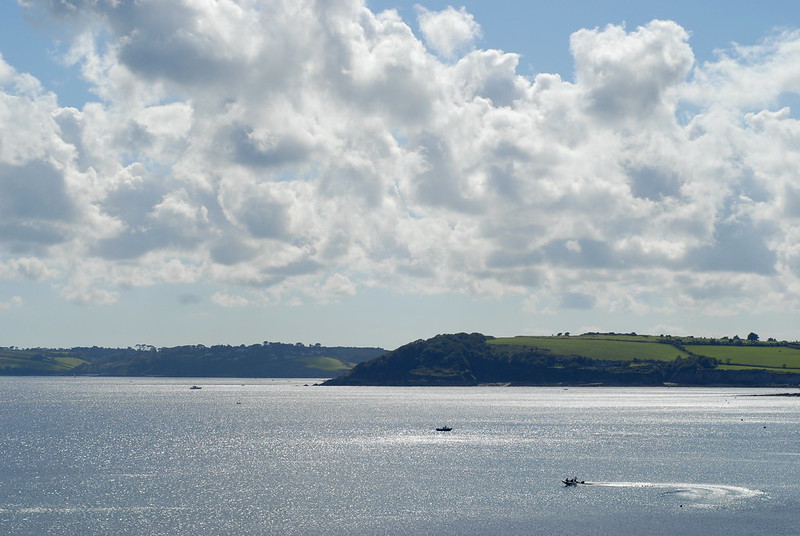
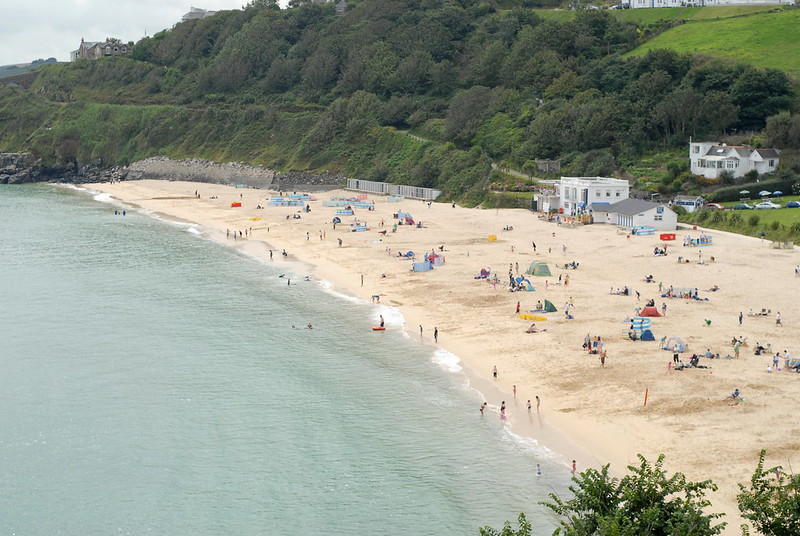
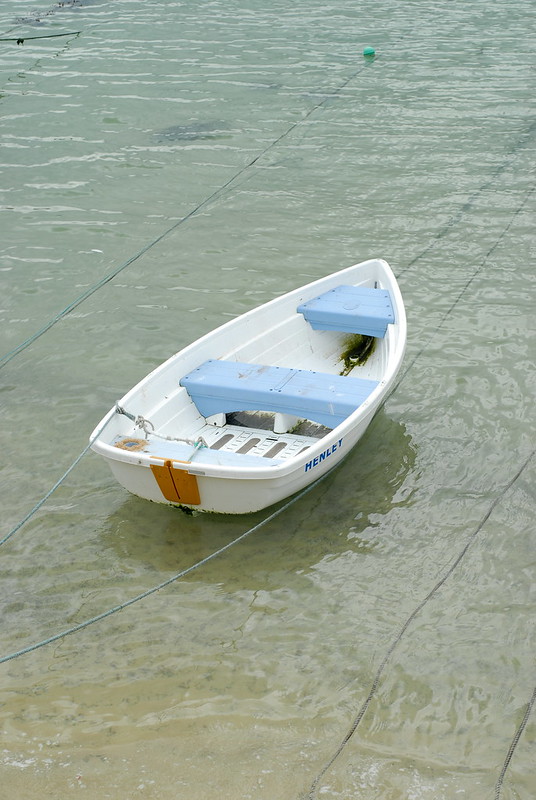
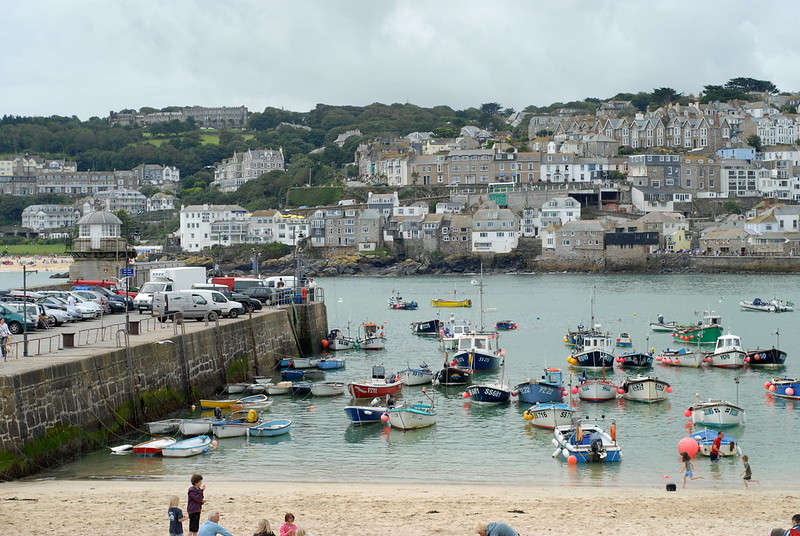
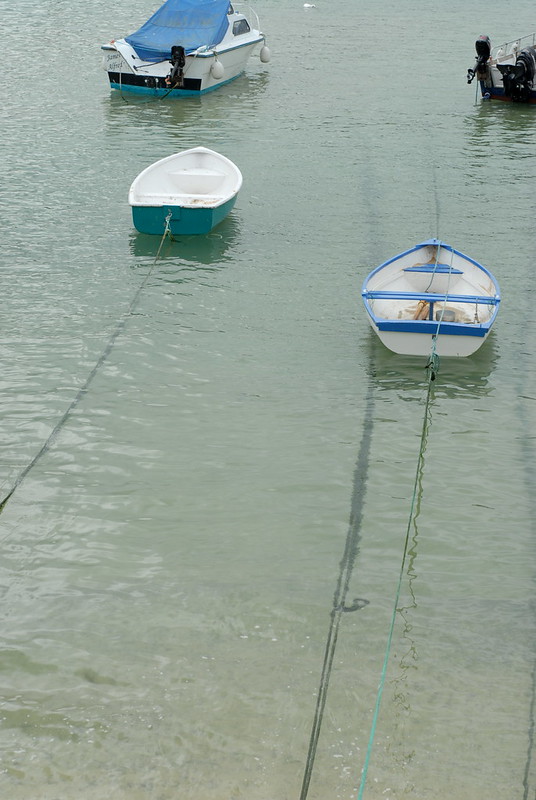
In other sea-related (or, at least, tidal) news: the mystery words on the shore of the Avon, which we spotted last weekend and posted about, have been identified: an artwork to highlight litter in the sea, by an artist called Pete Dolby. Thanks to Liz for writing and letting me know.
* You could argue some sort of genetic memory, because my mum’s family’s descended from a bunch of 19th-century Cornish fishermen (and smugglers, no doubt), from Looe and Polperro. On the other hand, my dad’s family’s from Derby, which is as unmaritime as you can get.
** Pure water is, as a matter of fact, very very slightly a pale blue colour. You can see it, just about, if you run a bathful of water in a white bath. That’s not the main reason the sea can look blue, though. And different cultures have seen it different ways; the Homeric adjective for it is “wine-dark”, and you know how dark Greek wine can be. I’ve heard that the ancient Greeks didn’t quite distinguish between blue and green in the same way as we do; but I don’t know enough Greek to tell you how true that is.
In which we confront Mario Reading, an author who got things wrong
No news on the Bristol guided busway (“Bus Rapid Transit”) scheme today, you’ll be relieved to hear.
Today, though, I thought it would be time to revisit something I wrote, back in the mists of time, when this blog was (relatively) newly-minted - insert wavy dissolve effect here. I spotted, on the telly, a chap called Mario Reading, who had just published a book claiming that according to Nostradamus, George W Bush would suffer an assassination attempt before the end of his presidency.
Lots of people have, of course, interpreted what Nostradamus wrote in different ways; and they have, consistently, been entirely and completely wrong when they produce predictions for events which haven’t happened yet. The recent US Election reminded me of Mr Reading: it reminded me that there’s not very long left for his prediction – sorry, Nostradamus’s prediction to come true – in any case, according to the table of contents of his book, it was due to have happened already by now.
I have a vague recollection at the time of Reading stating, on the telly, that he hoped that his book would be a warning to the US Secret Service, and that they would be able to use his book to foil any such assassination attempt. So maybe he’ll just say “ahh, well, clearly he would have been assassinated if it wasn’t for me.” Which begs an interesting question: what, then, for Nostradamus’s role in it all? If you publish a book that says “Nostradamus predicted that X will happen, but if you read this book you can stop it!” then does that mean Nostradamus was right or wrong? I dreamt the other night that I was going to bake myself a cheesecake for tea. I told my girlfriend – so she made us pasta instead. Clearly, this means I can see the future!
Reading’s book – Nostradamus: The Complete Prophecies For The Future – is still available on Amazon. Indeed, at a discount, which seems reasonable enough considering that now a good three years of the book’s future is our past; so we can easily judge for ourselves how accurate Mr Reading’s – sorry, Nostradamus’s future-prophesying skill is. He also has another book: Nostradamus: The Good News – all the cheerful bits. Its first prediction of the future isn’t due to occur (or not) until 2021, sadly. It turns out, too, that Reading has recently started writing a blog.* He’s got a Nostradamus-themed thriller coming out next year, and a third non-fiction Nostradamus book. How you’re meant to tell the difference between fiction and non-fiction in this context, I’m not entirely sure, but he’s clearly found a vein and is mining it for all he’s worth. Unfortunately, his blog doesn’t seem to have private contact details on it, which is a shame, because I wanted to get in touch with him. Ah, well. I’ll have to put an open letter here instead:
Dear Mr Reading,
I notice your book Nostradamus: The Complete Prophecies For The Future is still on sale, and apparently selling well according to your website. However, I note that it’s now 3 years since it was written; and that many of the events which it predicted to occur between its publication date and the present day have not, in fact, happened as you – sorry, Nostradamus predicted. Do you intend to keep the book on sale even though it contains information you now know to be wrong? Will your forthcoming Nostradamus book contain revised versions of these prophecies, and will you acknowledge the mistakes, or be issuing errata for, The Complete Prophecies For The Future?
Yours, etc…
Now, if you’ll excuse me, I’m going to go into a trance to try to predict whether or not I’ll get a reply.
Update, September 1st 2020: I’ve removed the link, because following Mario Reading’s death in 2017 his blog and indeed his entire website was taken offline. At the time of his death, he’d written a total of five allegedly-non-fiction books about Nostradamus, three Nostradamus-related novels, and three more novels apparently about the Templars (because who doesn’t love novels about Templar-related conspiracies). As I haven’t read the last three “non-fiction” books, I have no idea whether or not they did address the things he’d predicted in his first book that already hadn’t happened. Clearly, though, he found a good income-generator and milked it.
More on the guided busway, as it paves over the Bristol Harbour Railway and replaces most of Cumberland Road
As promised yesterday, I’ve been doing some closer looking at the West Of England Partnership’s guided busway – sorry, I mean “Bus Rapid Transit” plans, and some measuring up on aerial photos. It seems I made a couple of misconceptions, though. Firstly: some of the plans show the Harbour Railway converted into a sort of tramway running along the same road as the buses. Secondly, I was slightly wrong about the route in the Winterstoke Road area. My mistake was to assume that it might actually serve a residential area; I was wrong, it doesn’t, and its sole use is as a replacement for the current park-and-ride services. The council have also said it will serve the football ground; but that slightly contradicts other things they’ve said.
Anyway, here we go: what does a guided busway actually look like? Never mind the Partnership’s shiny traffic-free plan: here’s a real one. This is the A64 on the outskirts of Leeds, which has a single-carriageway busway down its central reservation.
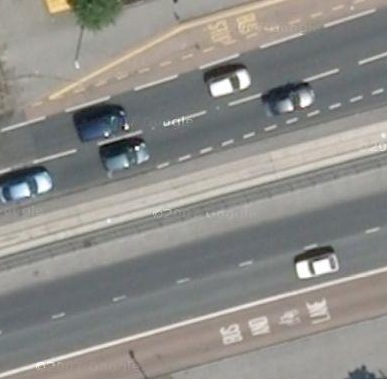
Never mind the bus lanes at top and bottom; the busway is that lovely expanse of concrete in the middle. The width of the whole thing, by my calculations,* comes out at about 3.8m. So, for a two-way busway such as the council wants to build in Bristol, you’re looking at 8m width. That’s for plain road without stops. Here’s a picture of where the council wants to build it: Cumberland Road. To the same scale, as you can tell by the cars.
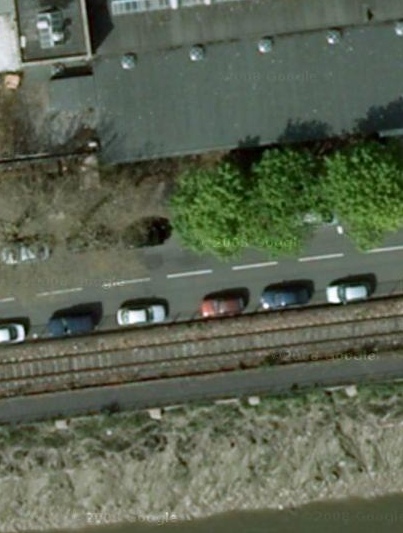
From the top: road, railway, cycle track, river.
The plans include building over the railway for one side of the bus route. Remember what Councillor Bradshaw told me: the plans “do not prevent” trains being run. Does that mean no bus services at weekends when the railway’s running? Or fewer trains? Who, at present, knows? Anyway, that means, for our Militant Invective Laboratories simulation (better value that the Partnership’s, I’m sure), we only need paint over part of the road:
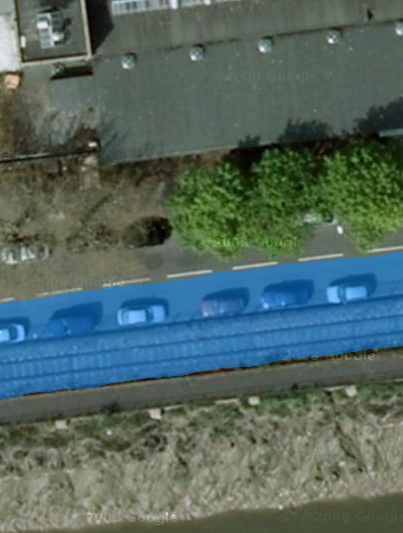
There goes the railway and just under 4m of the road, painted over in wobbly freehand. That’s the amount of land the council’s planning to concrete over for its posh new buses (and all the older ones which will also be allowed to use the busway).
So, goodbye to half of Cumberland Road – even by narrowing the pavement on the north side, there wouldn’t be enough room to make the road full-width. The council’s simulation does seem to show there being a bus lane in the road at this point, rather than a proper busway. However, there’s a slight problem with that: the buses and the road traffic would be going in opposite directions, unless one were to drive on the right, so no space gets saved. The published proposals go on and muddy this point by showing both buses and normal traffic driving on the right at this point – which, of course, would be no help at all.
Still to come: the even more awkward pinch-point where the busway is due to run alongside the Portbury Dock railway line, at Winterstoke Road, with a stop which will take up even more space. They seem to be planning to run the busway over Network Rail land – I wondered if Network Rail knew about that, so I’ve asked them. For that matter, I wonder who owns the land the rest of the busway will run on – presumably either Network Rail or BRB Residuary, the organisation that is one of the last remaining stubs of British Rail. BRBR’s website is a bit broken at the moment, so I can’t search their property listings to see what they do or don’t own.
* including the small width of kerb separating bus and road on the buses’ left, which is presumably needed for safety reasons.
In which we discuss the West Of England Partnership’s misguided bus proposals
Through my door the other day: a leaflet from the West Of England Partnership, the organisation made up of local councils* that replaced the dead and unlamented Avon County Council. It’s about their proposals for a guided busway scheme in this part of the city. A new road, in other words, limited to buses only. Some of the buses on it would be expensive new buses cunningly disguised to look like trams, and running on “sustainable fuel”;** the rest would be the boring ordinary diesel ones that already serve this area. It would replace the current park-and-ride buses in this area, which are already the nicest and most modern buses in this part of the city. So, frankly, I don’t see why that’s the bus route that most urgently needs replacing.*** You can see their proposals for yourself, on the Partnership’s website – they very carefully avoid using the term “guided busway”, and instead call it “rapid transit”, using the word “bus” as little as possible.
The route isn’t really any more useful than the current park-and-ride scheme, either. It’s going to be built along the old railway line that served Bristol Harbour. A small part of this is disused; some is still used by trains to the docks that are still open, but most is used by the Bristol Harbour Railway, a council-owned steam railway that chugs up and down the Avon and the Harbourside, and does a pretty good trade. Here’s an extract from the map on the website:
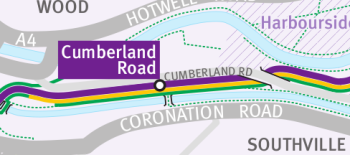
The purple line there is the new bus route, and the yellow line is the railway. The black blob there, looking like a station, is a proposed Cumberland Road bus stop – handy for Southville, because there’s a footbridge across the river there. The green line is a cycle path.
Now, so far, this is just a line on a map. Not much detail design work seems to have been done – one of the councillors responsible, Mark Bradshaw, said as much to the local paper with the words: “Residents, businesses and other stakeholders are invited to engage in this work and help shape the detail of the proposals.” However, the Partnership have gone as far as producing a mockup of the proposed Cumberland Road bus stop. Here’s their design. On the right: the new bus stop. On the left: a photo I took a few days ago from almost the same location, although I didn’t quite get the angle right.
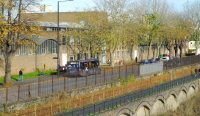
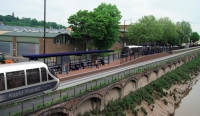
You can see, on my “present day” photo, the railway line – it’s behind the yellow fence and in front of the road, and you can make out the rails if you look carefully. More interestingly, you can see that on the Partnership’s artist’s impression, the railway isn’t there any more. The cycle path along the riverbank is still there; but the railway line on the other side of it has been paved over and turned into busway. So, in fact, has half of the road on the other side – you can see, the busway near the platform comes out almost as far as the centre-line of the road.
Mark Bradshaw is, as it happens, one of the councillors for my ward. I wrote to him, and my other councillor, before I’d realised that he was on the relevant West Of England Partnership committee that has put these proposals forward. Based on that artist’s impression, I wrote:
The project will be hugely expensive in infrastructure costs, [and] will apparently destroy the popular tourist attraction that is the Harbour Railway and replace it with a buses-only road
I must have been writing in Pompous Mode that day. You can see, based on the above, why I’d think that. Councillor Bradshaw replied:
The Harbour train service will continue and the BRT services will not prevent this (see yellow line on map in consultation leaflet)
Which is fair enough – you’ve already seen that yellow line on the map. The problem I have, though, is that building a busway isn’t quite as simple as drawing a line on a map, as the artist’s impression shows. If the Harbour Railway is still going to be there, why did the Partnership put out proposals for consultation that show it paved over? And how is the busway going to fit between the railway and the road? Something will have to be moved, for sure.
If this scheme does go ahead, I strongly suspect that the guided busway along that section of the route will have to be dropped, purely because there isn’t room to build it. In the meantime, I’ve replied to Councillor Bradshaw and asked why that artist’s impression shows the buses running over the site of the railway when the railway is, according to the map, still going to be there; when he replies, I’ll update this post. Tomorrow, I’ll show you – with the aid of Google Maps and existing guided busways – just how much room the proposals would need on the ground, and how much land it might take up.
UPDATE: local blogger SteveL has, in the comments, pointed me to the Partnership’s video of the scheme. Which apparently shows the railway being turned into a tramway along the southbound busway, something that wasn’t apparent on the still images. So, the busway won’t prevent trains from being run, so long as trains only want to run when there aren’t any buses about. I see.
* and “a range of social, economic and environmental partners”, they say. Personally, I think it’s a bit of a grand name for what is, in land area, only a small part of the West of England, but it’s hard to think what else they could have called it – anything with Avon in it was and is taboo, and “Greater Bristol”, although that’s essentially what it is, would no doubt irritate everyone out in the hinterlands.
** They haven’t decided what fuel, only that it will definitely be Sustainable. Buzzwordtastic!
*** except the political reason. This is going to be built in Bristol, but funded partly by the local councils in the surrounding area. Hence, it serves commuters from North Somerset who might want to park-and-ride more than it serves Bristolians.
In which we are briefly puzzled by some art
A few weeks ago, exploring the local area, we started walking up the Ashton-Pill path. It runs along the side of the railway up the south bank of the Avon, along the Avon Gorge and under the famous Suspension Bridge, downriver towards Pill.* We walked along it until we got bored and turned around.** En-route, though, we saw something slightly unusual. A big pile of plastic bottles, on the shore, below the path but above the tide line, corralled together.
Presumably, we thought, some sort of anti-littering campaign, fishing non-degradable bottles out of the river or out of the undergrowth. But then, the other day, we were up on the Downs on the far bank, and noticed the bottles—or, what we assume is those bottles—again. They’ve been arranged into words.
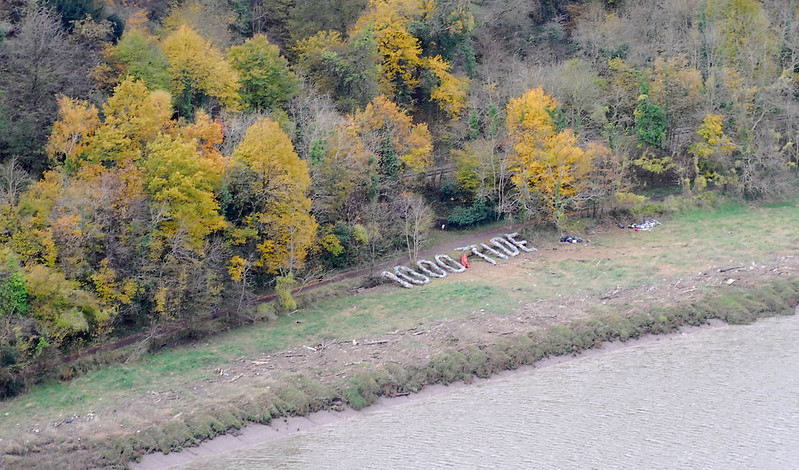
We have no idea, though, what it is. An art project? An advertising slogan? An anti-littering project as we originally thought? The internet doesn’t seem to be helping – the only relevant search hit at the moment is, er, that photo. We’re puzzled.
UPDATE:, November 14th 2008: Thank you to a correspondant called Liz – who was also puzzled by it – for letting me know what it is. It is, indeed, an anti-littering art project; there are apparently 1000 plastic bottles washed up on every tide,*** hence the text. It does, though, change regularly, and eventually the artist, whose name is Pete Dolby, is going to make them all into a raft. So now we know.
* as you might expect, given its name
** after all, walking down towards Pill and back another way would have been a very long walk; and any other circular routes would have involved a stiff climb through the woods.
*** in the Avon Gorge, that is. I’m not sure what the number per mile of coastline is.
In which we go to Cornwall
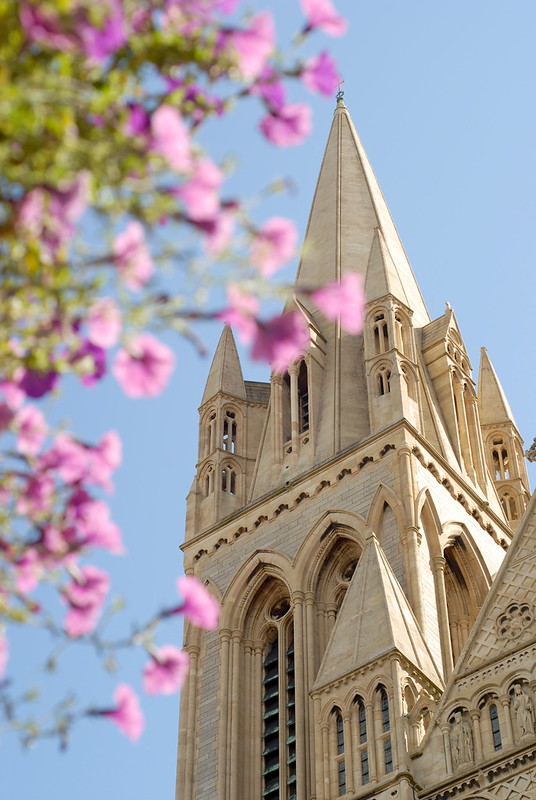
Not only have I been behind on updating this site, I’ve been getting behind on posting photos online. I generally stick to posting 6 to 8 photos per day, partly because uploading them is such a slow and tedious job that I can’t be bothered doing any more. This, however, means that I’m still only at the start of posting photos of our summer camping trip, down to Cornwall. That was: August. It’s now: November. That’s some delay. Here, though, are some examples, of hot, sunny, summer Cornish weather.