+++*

Symbolic Forest

A homage to loading screens.

Blog : Page 29

Solidity

In which your author becomes a rather paranoid architectural historian

In field archaeology, there’s a subtle process that field workers undergo called “getting your eye in”. A plain brown swathe of earth, after a few hours’ work, becomes suddenly a complex landscape of shade and texture. A mass of tumbled stone becomes a distinct sequence of structural building and collapse. All of a sudden, the things on the ground start to make sense.

When you’re buying a house, I’ve found, the same sort of thing starts happening on an architectural level. All of a sudden I can spot cracks in plaster I’d never have noticed before, or the slight dimples in walls that can indicate buried wires. All this, of course, is a result of reading surveyors’ reports, reports that are paranoid to mention every slight little thing that could potentially cause a future problem.

“Large degree of springing in floorboard” first makes me think: oh no! We only have to jump too hard and we’ll disappear into the basement. But then, I think back, and start comparing it to other places. I start walking lighter and paying more attention to my feet in every building I enter. The flat we live in now, for example, has very springy floorboards. If you walk too heavily in the living room, you can see the bookshelves moving slightly. In the hallway there’s a big gap between two boards that you can feel through the carpet with your toes, and another patch where you can feel the boards have been cut then never put back securely. And even this isn’t as bad as another flat I lived in briefly a few years back, with floors so uneven I always think of it as: not so much a flat, as a slightly rippled.

Now, I’m not saying that being sharp-eyed is a bad thing. But sometimes it’s possible to be too sharp-eyed, and spot so many little details that it worries you. This “new” house might have bouncy floorboards here and there, but of all the houses we looked at, it probably has fewer of these little flaws than any others of similar age. It is fun, getting the chance to be an archaeologist again, poking around to work out what’s under the garden gravel and how usable the chimneys are.* I hope that eventually, though, we’re going to be able to relax a little, sit back, and not worry that one moving floorboard means the house is doomed to crumble into its foundations.

* One of the chimneys is definitely still open and functional, but that fireplace appears to have had its damper plate patched up with some sort of papier-mache or cardboard, so I wouldn’t fancy lighting a fire in it.
The Knowledge

In which we plot to go on the telly again

Regular readers of this site might be aware that, in the past year or so, I’ve appeared on telly a couple of times, showing off my inner geekiness. If you weren’t aware: specifically, I was a contestant on the 2009-10 series of Mastermind, parading my knowledge of French history (I won, hurrah!) and steam trains (lost, but not because of the trains).

It was all great fun and a grand couple of days out. Indeed, if you ever get the chance, I’d recommend going on either Mastermind, Countdown or Jeremy Kyle — they’re all filmed in studios alongside each other — because, if nothing else, the backstage food is very good* and it’s always nice to get pampered.**

Now, I’d never tried doing that sort of thing before, despite people saying “oh, you’re clever, you should enter [latest popular gameshow]”. And I don’t want to turn into one of those people who goes on every quiz show going, popping up every week somewhere across the TV schedules.*** But, even so, now the “you must not go on any other telly” bit of my Mastermind contract has (I think) expired, I’ve started casting an eye across the networks and thinking “maybe I could do that”.

I’m not sure that there’s much TV that I’m suited to, though. Definitely not that Channel 4 thing with Davina McCall, if it’s coming back, just because I don’t think I’m the sort of person who would get through their auditions. The more I look at the lists of game shows that are out there, the more I’m attracted to the ones where you don’t actually win anything material. Radio 4’s Brain Of Britain, for example — not TV but you get the point. I also quite fancy the thought of applying to Only Connect on BBC4, because I think I’m quite good at spotting links between things.**** The only problem is, that’s a team game; I don’t know anybody else who would want to do it (or even who watches it, apart from K), and I never know any of their music questions.

So — does anyone have any other cunning ideas? I will have to ponder it over, and see what I can enter. And, then, watch this space.

* Apart from their meringues, which were the worst meringues I’ve ever had – they had the texture of a stale bread roll.

** There were seeming armies of runners with nothing really to do other than be nice to nervous Mastermind contestants and their families. You couldn’t even try to get yourself a cup of water without a runner saying “oh, don’t get up, we’ll get that for you”.

*** Like the woman who beat me on em>Mastermind; at least, my mother said she’s spotted her on TV a few times before. I didn’t realise. Another of the contestants, too, was on A Question Of Genius not long ago.

**** If you don’t watch it: the aim is to spot connections between words or statements. A sample question: “12:00am, 1st January, 1970″ is one clue; “Newlyn” is another; the answer is “datum points”, because the former is the time datum for Unix-based operating systems, and the latter is the site of the altitude datum used by the Ordnance Survey. The full questions have 3 or 4 clues, but you get more points if you don’t use all of them.

Summer railway

In which we have a trip out by train

Never mind “Spring Bank Holiday”: it’s June, and it feels like it’s summer already: last weekend, we had a day at the beach, and both ended up horribly sunburned. As shorts aren’t an option for work, I winced every time I moved my legs. Yesterday: a bank holiday weekend, and beautiful sunshine again, so we went off for a cream tea and a steam train ride.

The footplate of a steam locomotive on a summer’s day is a horribly hot and airless place to be. Nevertheless, riding behind a steam engine seems like such a naturally summery thing to do. So we travelled down to the South Devon Railway,* for a day’s relaxation sitting in railway carriages and watching trains go past.

The South Devon Railway is, as steam railways go, an unusually scenic one. Being in Devon it’s surrounded by lush, verdant countryside; it follows the River Dart down from Buckfastleigh, past rough, rocky rapids; weirs and once-busy mill-races; finally alongside the more placid deeper, lower stretches of the river, down to its tidal weir just by Totnes station. It doesn’t take much effort for a train to trundle downriver; as we sat in the front carriage with the windows open, we could hear the locomotive clanking its way down the valley with barely any steam on, the vacuum pump making a light chiff noise for each revolution of the wheels. Every so often, a gentle touch of speed was needed, and we heard the deeper huffhuffhuffhuff of the cylinders, four huffs to each vacuum pump chiff. We passed sleepy red cattle, wading fishermen, and groups of wading photographers standing on mid-river rocks to take photos of the passing train.

Country trains often ramble a little, and pause unexpectedly. Midway along the line, we halted in a loop, and waited quietly for another train to pass. Other passengers, not used to this sort of thing, looked around and wondered what the problem was. We were too far away from the signalbox to hear the block bells chiming; but we could hear the rattle of the signal wires as the signals for the down train were pulled off, then we watched it slowly chuff past us before we started on our way again.

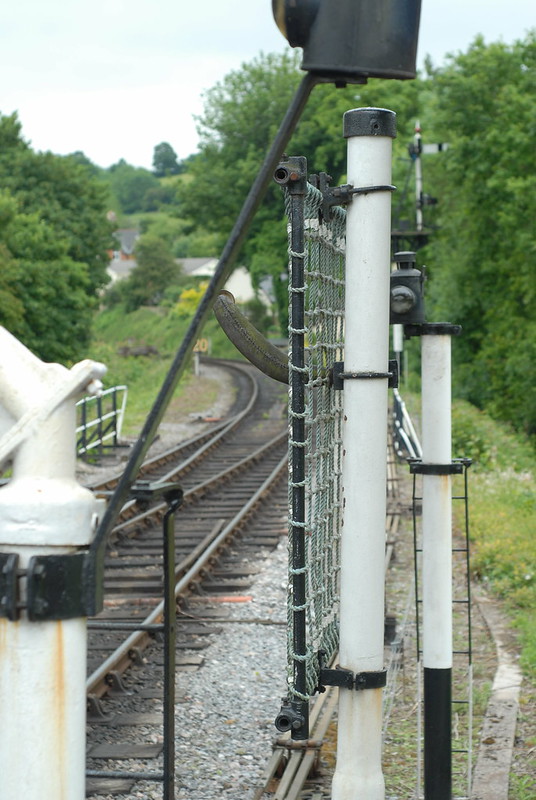
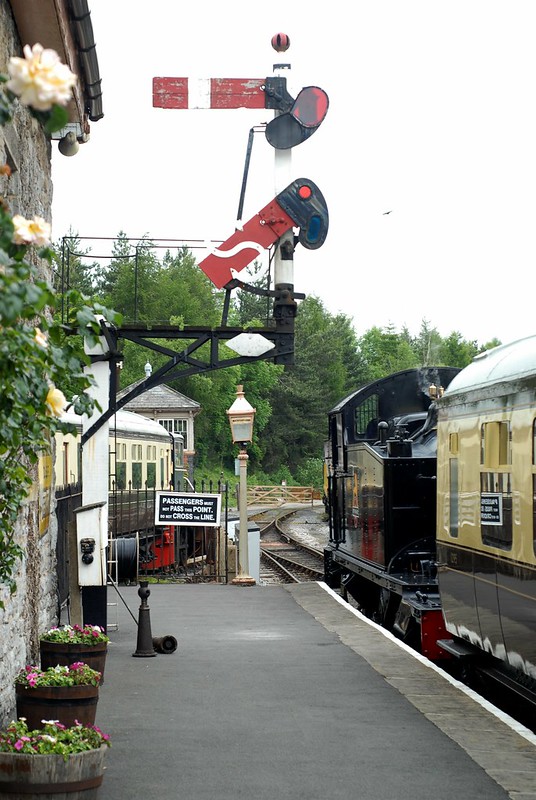
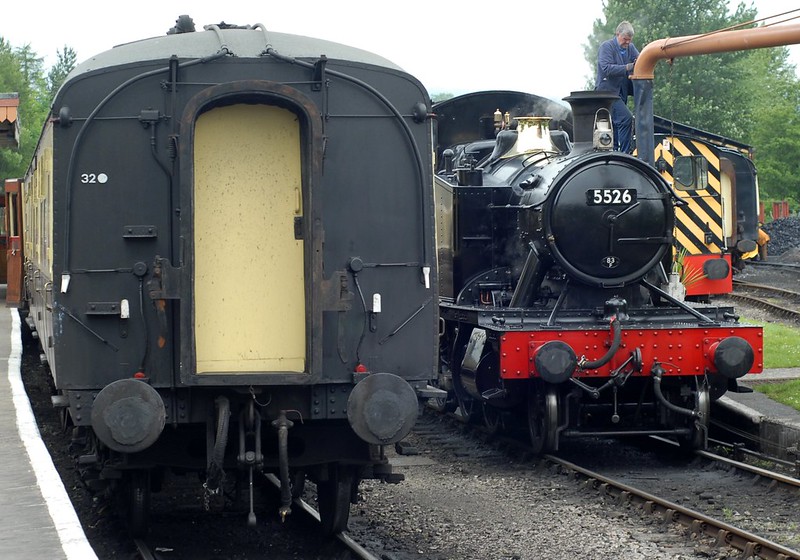
This is not Photo Post Of The Week, incidentally. That’s because the photos below aren’t ones I took yesterday; as usual, my photo uploads are far too backlogged for that. These, though, are from the last time I visited the South Devon Railway, about three years ago. The fixed stop signal has been repainted since, but not much else has changed.

Buckfastleigh station

Watering an engine whilst rounding the train

GWR tablet catcher, Buckfastleigh

* Things it is important not to confuse pt. 373: the South Devon Railway, the line from Exeter to Plymouth designed by Brunel, opened in the 1840s, and bought out by the Great Western Railway in the 1870s; with the South Devon Railway, the heritage railway formed in the early 1990s to take over the Dart Valley Railway’s tourist line from Totnes to Buckfastleigh and turn it from a business-oriented tourist attraction into a more charitably-run steam railway. You may spot a problem of similarity with the names there.

Hello, Operator

In which we consider switching OS

Right, that’s enough of politics. For now, at least, until something else pops up and ires me.

Back onto even shakier ground, so far as quasi-religious strength of feeling goes. I’m having doubts. About my operating system.

Back in about 1998 or so, I installed Linux on my PC. There was one big reason behind it: Microsoft Word 97. Word 97, as far as I can remember it, was a horribly bug-ridden release; in particular, when you printed out a long document, it would skip random pages. I was due to write a 12,000 word dissertation, with long appendices and bibliography,* and I didn’t trust Word to do it. I’d had a flatmate who had tackled the same problem using Linux and LaTeX, so I went down the same route. Once it was all set up, and I’d written a LaTeX template to handle the university’s dissertation- and bibliography-formatting rules, everything went smoothly. And I’ve been a happy Linux user ever since.

Now, I’m not going to move away from Linux. I like Linux, I like the level of control it gives me over the PC, and the only Windows-only programs I use run happily under Wine. What I’m not sure about, though, is the precise flavour of Linux I use.

For most of the past decade, I’ve used Gentoo Linux. I picked up on it about a year after it first appeared, and liked what I saw: it gives the system’s installer a huge amount of control over what software gets installed and how it’s configured. It does this in a slightly brutal way, by building a program’s binaries from scratch when it’s installed; but that makes it very easy to install a minimal system, or a specialist system, or a system with exactly the applications, subsystems and dependancies that you want.

There are two big downsides to this. Firstly, it makes installs and updates rather slow; on my 4-year-old computer, it can take a few hours to grind through an install of Gnome or X. Secondly, although the developers do their best, there’s no way to check the stability of absolutely every possible Gentoo installation out there, and quite frequently, when a new update is released, something will break.**

I’m getting a bit bored of the number of times in the last few months that I’ve done a big update, then find that something is broken. Sometimes, that something major is broken; only being able to log in via SSH, for example, because X can’t see my keyboard any more.*** It can be something as simple as a single application being broken, because something it depends on has changed. It turns “checking for updates” into a bit of a tedious multi-step process. I do like using Gentoo, but I’m wondering if life would be easier if I switched over to Ubuntu, or Debian, or some other precompiled Linux that didn’t have Gentoo’s dependancy problems.

So: should I change or should I go stay? Can I be bothered to do a full reinstall of everything? What, essentially, would I gain, that wouldn’t be gained from any nice, clean newly-installed computer? And is it worth losing the capacity to endlessly tinker that Gentoo gives you? I’m going to have to have a ponder.

UPDATE: thanks to K for pointing out that the original closing “should I change or should I go?” doesn’t really make much sense as a contrast.

* The appendices took up the majority of the page count, in the end, because of the number of illustrations and diagrams they contained.

** Before any Gentoo-lovers write in: yes, I am using stable packages, and I do read the news items every time I run “emerge –sync”

*** I was lucky there that SSH was turned on, in fact; otherwise I’d have had to start up and break into the boot sequence before GDM was started.

Slash, slash, slash

In which spending cuts may be a good thing

Following on from yesterday’s post about government spending cuts: there is, of course, one thing that would save quite a bit more money than freeing up some unused phone numbers. Regular readers of this blog will – especially if they were regular readers about a year ago – be very bored of me droning on about the West Of England Partnership‘s* ongoing guided busway scheme, which consists essentially of turning former and current railway alignments such as the Bristol-Bath Railway Path or the Bristol Harbour Railway into private roads for the exclusive use of First Group, at public cost. Rather high public cost, at that, as for any road scheme; and the first phase of the project would have no purpose other than to replace the current Ashton park-and-ride services with new, less useful, park-and-ride services from the same car park. Follow this link to read more.

Well, the local press has suddenly noticed that cancelling this scheme might be a nice easy way to cut the Department for Transport’s budget down a bit; and other local bloggers have had similar news on another poorly-thought-out local transport scheme. That big hole in the government budget, it appears, is suddenly going to mean no money for new roads, whether that be a replacement for Hartcliffe Way, or paving over the Harbour Railway so that bus routes 903 and 352 can avoid Hotwells Road.**

You might also notice a quote from Councillor Hopkins in that article. “An alternative might be a much cheaper ultra-light rail system, which was tried out on a short stretch of Bristol’s dockside several years ago.” He’s referring to a machine called the Parry People Mover, a small lightweight railcar powered by a flywheel that gets charged up at stops. I don’t see it happening, either. Parry People Movers have been tried at various sites, including the Bristol Harbour railway, but they’ve never seemed to last very long except for one location, Stourbridge (West Mids), a very short line with no intermediate stops. They need a railway line to run on, and reinstating the railway to Ashton Gate then extending it to Ashton Vale would be as expensive, probably, as building a road. Similarly, you couldn’t extend a Parry People Mover line into the city: you’d have to lay tramlines, for one thing, and if you were doing that, you may as well go with a real tram that doesn’t have to wait for a 5- or 10-minute recharge at each stop.

So: a short-for-cash government means no new buses and no new roads. In the long run, no new public transport is a Bad Thing; but new roads, public or private, always mean more traffic, higher emissions, and more oil used up. Hopefully, an enforced pause will mean we can wait for a while, until we can design a transport scheme that’s actually useful, not just one that’s easy.

* I do wonder sometimes what other local councils, like, say, Somerset, Devon, Dorset or Cornwall think of the CUBA local authorities claiming the name “West of England” for themselves and themselves alone.

** Because that, essentially, is all that first phase of the “Bus Rapid Transit” scheme, for all the work it needs, amounts to.

Snip, snip, snip

In which we reveal that there really are hundreds of government helplines that nobody ever phones - but cutting them won't actually have any effect

Today’s big news story: the government has started on its grand crusade to save money and thereby rescue the nation. Whether it will work remains to be seen, of course. I was intrigued, though, by one assertion which I heard on the news this morning: the government will save money by cutting back on call centres and helplines, because there are, apparently, many many government helplines which have barely even received a single call.*

Which sounds, on the face of it, shocking. Hundreds of phone lines that have never taken a call? Surely there must be warehouses full of call-centre staff sitting waiting for the phone to ring, sitting with their feet up reading magazines and flicking balls of paper at each other, because they have hundreds of phone lines but no calls to take?

Er, no. Despite the image put across there, it is completely false. I know this because: well, I have worked for such phone lines. Yes, there are indeed hundreds of government-funded phone numbers that have never, ever taken a call. That’s because that’s how marketing people like it. The total extra cost of it, per phone line, is peanuts – maybe it gets into whole tens of pounds if you add up absolutely all the figures, but that’s about it.

This is how it works. When the government’s marketing people** think they might want to run a new advertising campaign, they buy up a block of phone numbers, 0800, 0845, or whatever. Then, they produce their TV adverts, print adverts, leaflets, whatever: and each one gets a different phone number on it. All of these numbers will point to the same team – who will usually be already handling a similar type of helpline – and, it’s true, someone does have to go through a spreadsheet of phone numbers and route them to the right call centre. It’s not tricky work. When a call comes in, the hard-worked call-centre staff look at their screen, and make a note of which line it came in on. That information all gets collated, filed, and sent back to the government marketeers, who will graph it all carefully and say “ooh, Leaflet 72B didn’t work very well, it only got half the calls-per-leaflet of Leaflet 72C.”

The reason they do it this way is: it gives them reliable data, not data that relies on the caller’s memory. If you actually ask the caller where they saw the advert, then a) it annoys them, and b) they can’t remember. Even if they think they can remember, they can’t remember. If you say “can you remember what you were watching when you saw it,” you’d be amazed how many people will tell you, in all sincerity, that they saw your advert in the middle of Eastenders. But, on the other hand, it does mean that there are lots and lots of phone numbers that have been bought up in readiness, but which don’t get used; they’re there, just in case more numbers are needed. Having them sitting and programmed-in to the phone network, though, doesn’t really hurt. It certainly wouldn’t save the government money if they weren’t there. Indeed, I’m sure that a marketing expert would argue that it wastes money. An advert that doesn’t get a response, after all, is an advert wasted; and if you’re going to pay for a prime-time ad slot, or to print x million leaflets of your latest advertising wonder, you will want to know what sort of response rate it’s getting. The less accurate the data you’re getting back is, the bigger the risk that you’re pouring your ad budget down the drain.

In the long term, a hurried cut in the wrong place could cost you millions further down the line. So: sometimes, something that looks like a simple saving isn’t one. Especially when it’s something that’s hardly a big saving at all. There are indeed many government-owned phone numbers that have never, once, been called. That doesn’t mean they’re costing us anything to have, though; and it doesn’t mean that somehow the government is doing something wrong, that it’s set all these call centres up then forgotten to tell anyone; or that it’s set up lines that nobody wants to call. Those people, waiting for you to ring, are already busy enough.

* This would have been on Today at some point, but I wasn’t really paying attention. I can’t really find any news stories online that refer to this particular claim, apart from this one in the Shropshire Star; The Guardian refers to it more obliquely.

** The Central Office of Information, who sound slightly Soviet but are really the government’s advertising and marketing arm. They are the people who sit between the media, the advertising agencies and the call centre companies on the one hand, and the government departments who want to put their message across on the other; whether it be an NHS public health campaign like “don’t get swine flu”, HMRC trying to get you to send your tax return in on time, or the MoD trying to get people to join up.

Greenwash

In which we consider how to package coffee sustainably

When I was growing up, back in the heyday of capitalism, “caring for the environment” was seen as a bit of a fringe activity. In school, we were all taught how important it was; but in the real world, nobody really paid much attention.

Fast forward to today: companies are falling over themselves to be Environmental, and to show that they Care with big green hugs, pretty flowers and all that. But in many cases this is pure greenwash: an attempt to look caring because they know that caring sells, because ticking the “environmental!” box makes their company look good. Look at the details, and there’s often no real benefit.

One advert that’s been out recently has been particularly annoying us. Kenco, who make reasonably tasty coffee, but whose advertising campaign is annoying, silly, and patronising. “We tried using 100% less packaging,” they lie, “but it didn’t work. So we’re using 97% less packaging instead.”

All well and good: less packaging equals less materials used equals less weight equals less fuel used in distribution. Sounds nice, on the surface. If you look at it with a longer-term eye, though, things aren’t quite so clear-cut. The traditional packaging, as you probably know,* was: glass jars. One of the oldest packaging forms there is, and one of the greenest. It’s so easy to recycle that we’ve been recycling it ever since it was first invented; all you do is clean it and melt it. OK, there was a period of 200 years or so when we didn’t bother; but glass recycling was one of the first forms of recycling to be widespread in this country in the modern period. Even back in the days when, as I said, I was growing up and nobody really worried too much about the environment, we would still take a trip to the village “bottle bank” once a week. I loved to take each jar from the bag, and jump up to get it in the hole, trying to get as loud a smash as I could.**

What have Kenco replaced their glass jars with? Plastic packets. What’s the recyclability of plastic packets in this country? Virtually nil. Can you reuse them for anything? Virtually nothing. So, we go from glass jars which can be easily reused or recycled, to plastic packets which are useless after you get them home, and have to go for landfill. Change in packaging weight: a 97% drop. Change in waste produced: an increase of enormous proportions. Not quite such a good-looking result. Moreover, glass is made from sand, of which there’s no great shortage; plastic is made from oil, which is getting harder and harder to find. Oh dear.

The big disadvantages of glass packaging, of course, are weight and bulk. Less packaging weight means lower transport costs, and less fuel used. Yes, true, this is a good thing for the environment. It’s even better for Kenco, though. I suspect there’s one single big purpose behind this change: cutting Kenco’s transport costs. Their purpose in the world, after all, isn’t to heal the environment, and it isn’t even to make reasonable-tasting coffee. It’s to make money for their owners, by a) selling more coffee and b) lowering the cost of producing that coffee. Trying to persuade us that their cost-cutting is good for the environment will, I assume, help them sell more coffee to some people. In the long run, though, it’s a much less sustainable way to package. It’s not really as good for the environment, as they’d like us to think.

* And still being produced of course

** And that’s not counting glass milk bottles and fizzy drink bottles, sold on deposit and reused many times over by the manufacturers since, ooh, the railways first came along and made large-scale distribution practical.

The art of walking

In which we look around other people's houses and other people's art

As I said last week, I’ve been planning to write something about this year’s Southbank Bristol Arts Trail. Because, well, it’s a local event, a local grassroots event, and the sort of thing that more people should know about.

The idea, if you’ve not come across it before, is: local artists either open up their homes, or exhibit in local community spaces, studios, workshops and so on. The rest of the local community spend the weekend rambling around the area, getting slightly lost, hunting down these little artistic spaces and finding out what’s inside. I’m not entirely sure I’d want to open my house up, because if we did, we wouldn’t get any chance to go and investigate anyone else’s place. That’s half the fun of it. That, and poking around strange, unexpected corners of the neighbourhood. I’d never thought that the back of North Street can be so rural: but turning the corner of Sydney St mid-afternoon, we surprised a startled-looking fox, who had been trying to quietly plot a route into a henhouse.

There are so many places on the trail – 54 venues, most of which we managed to reach over the course of the weekend – that it is tricky just to summarise all of the ones we saw. But I’ll try: there was stained glass at the Southville Glass Studio, photography at the Spanish bar just by it; a First Crush Wall on Ashton Gate Terrace; pottery and photography in a B&B on Green Bank Road;* various artists and furniture at the ambulance station on Raleigh Road;** seascapes painted by someone called Shirley Gosling who has an impressively-decorated house; a set of prints by a group of designers, and a DJ in their kitchen; Terry Williams, who I’ve already mentioned; bedroom music in Rachael Dadd’s house on Birch Road; decorated china on Hamilton Road; interesting bird prints on Leighton Road; tiles and various other things further along the street; some pretty handmade jewellery on Beauley Road; an intriguing and bloody installation piece above the reclamation yard on Park Road;*** some excellent screen prints on Howard Road; too much to mention at the Southville Centre; a variety of art and sculpture in a flat on Stackpool Road; typographical artwork on Greville Road; free happiness to take home on Mount Pleasant Terrace; pottery and photography in a garage further along the street; are you still reading?; close-up abstract photography in a flat on North Street; a variety of things including photography, live pottery and well-known printmaker Lucie Sheridan at the old pickle factory that’s now a bed factory on Braunton Road; drawings on South Street; illustration on Agate Street; a delightful little sculpture garden tucked away on North Street; live printmaking of seascapes on Chessel Street; landscape paintings all the way down on Thanet Road; stuffed toys on Aubrey Road; an illustrator whose work I’m sure I recognised on the opposite side of the street; an empty house with “NO ART THIS YEAR, MAYBE NEXT YEAR” in the window on Balfour Road; and a variety of art and things on Truro Road. And breathe. If you read all the way through that, well done. Personally, I recommend spacing it out over a weekend.

At some point I will go back over all that and fill it out with links. It demonstrates, though, what a variety of creativity and artwork there is in a relatively small part of this city, not to mention what a variety of homes people have.**** And, too, it makes me think: “why aren’t we doing more of that?” I’m sure we could, if we were willing to stay in and show other people our home, instead of going out and looking at everyone else’s.

* Confusing geography moment: I discovered Bristol has a Greenbank Road and a Green Bank Road, nowhere near each other.

** Including some nature photography, an artist who had published a book about his leukaemia, and some rather homoerotic studies of men in showers. None of whose names I can remember: this is why I should write my blog posts straight away.

*** Not just in the attic space above the reclamation yard, either; it continued down the stairs and out into the street.

**** I was particularly impressed with one artist who had a copy of McDermott & Clinker’s classic History Of The Great Western Railway on their bookshelves.

Political Football

In which we consider the World Cup bid

There’s been lots in the news lately about Britain’s 2018 World Cup bid getting into an embarrassing sticky patch, the FA chairman resigning after some unflattering private conversations were published, and of course there’s speculation that the bid may be over before it’s barely begun. Well, hurrah for that, I have to say.

I’m guessing that England’s bid has some rather flaky patches hidden underneath the glitz, anyway. This is because part of it involves Bristol, and the flakiness of Bristol’s part of the bid has already been well-publicised locally. To summarise for non-Bristolian readers: the bid depends on a new football stadium being built on a greenfield site. Part of it still doesn’t have planning permission, and campaigners are still trying to block the rest. The football club have previously claimed that they could only afford to build the thing by also building a housing estate – permission refused – and by selling their old stadium site to Tesco, which generated a rather big local anti-Tesco campaign. Tesco, presumably not wanting to be seen on the losing side of an argument, pulled out of the deal just before their planning application was due to be heard. Their place has been replaced by Sainsburys, who have a shiny website but not much else likely to swing opinion in their favour.

I’ll nail my colours to the mast straight away and say that I’m not in favour of the World Cup coming to England. I’m not in favour of it existing at all, in fact; but if it has to exist, I definitely don’t want it getting in the way of real life. Particularly, though, I’m not in favour of having to pay for it, which undoubtedly all of us will, especially if we live in a Host City. I’m also not really looking forward to having my home city turned into a corporate-sponsored advertising opportunity for a couple of months; because, let’s face it, if you follow the money-trail then the World Cup is nothing to do with football and everything to do with advertising the highest-bidding corporations; part of that involves turning the host cities into corporate monocultures where anything referring to those corporations’ competitors is strictly forbidden.

The local press sneaked a darkly threatening line into one of their recent World Cup stories: the bid is legally binding on the city council. In other words, if England is unlucky enough to make a successful bid, that’s it. It goes ahead, and the city council is bound to deliver what they’ve promised. If Bristol City FC are telling the truth, if they really can’t afford to build a stadium without a supermarket, and the supermarket plans get thrown out, then presumably the city will somehow have to find a way to build it. The council could be in a nasty trap, either to approve an unpopular and unwanted supermarket or to fund a stadium they’re obliged to ensure exists. Of course, there may be a way for them to get out of it; I really do hope there is.

That’s one of the problems, I suppose, in making a bid for something on the grounds that you have a nice stadium which doesn’t exist yet and doesn’t have funding in place. Presumably the people at FIFA who are going through all the bids with a fine-tooth comb will spot that England’s bid depends on at least one stadium which consists solely of pretty pictures and promises so far; and will want to know what’s going to happen should the money to build it not turn up as expected. Fingers crossed. Even so, I feel like patting Lord Triesman on the back; when it comes to England losing the bid, everything will help.