+++*

Symbolic Forest

A homage to loading screens.

Blog : Post Category : Dear Diary : Page 6

Casting the runes

And exercising my rights

The line was certainly longer than usual. More spaced out. Not that I knew what “usual” meant, of course. Yesterday was the first time I’d been to this polling station—the first time anybody had, I think, because the city council has reviewed and rebalanced and rejigged where they all are.
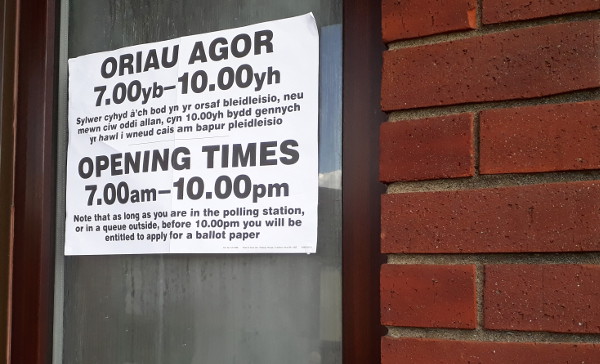
Oriau Agor

You could say I was lucky, really, moving house just a few months before a Senedd election. Getting to vote for my national representatives straight away, rather than having to wait a few years. It was all very well organised, to be honest. In general in my experience people in this part of Wales have been doing social distancing and similar much better than people in Bristol; here, for example, people will cross the street or walk into the middle of the road to avoid passing someone on the pavement, whereas I don’t think I’ve never seen that happen in Bristol. The queue was nicely spaced out, with most people wearing facemasks well before they reached the chapel door. A woman on the door was carefully regulating admission, making sure there were never more than three voters inside the station at once, one collecting their ballot papers and two actually voting.

So who to vote for? As I said a few months ago, British politics is in a fairly terrible state right now; a dangerous state, you could say, in which populist reactionary Kulturkampf seems to be winning out over any sort of belief in honesty or integrity. It’s a depressing sight, in a situation where however awfully the Prime Minister behaves, however angry he gets at the thought of being held to account, any attempts to try to hold him even slightly to account seem to fail to make any impact on the voting public.

However, the awful state of British politics is very much the awful state of English politics. In Scotland and Wales the situation is somewhat different. In the former reactionaries are desperately trying to stop the country following its natural path to independence; here in Cymru, the Labour government is in the strange position of dealing with one opposition whose main selling point seems to be pride in their own inability. “We want to be leaders,” they seem to be saying, “who know we’re no good at leading, who want to give all our power away.” It’s embarrassing, every time the Welsh Tory leader speaks, to hear just how much he shows off his own anxieties of inadequacy and incompetence. On the other front, support for independence is understandably growing but it doesn’t seem to translate into support for Plaid Cymru.*

At the time of publishing this post, only a handful of the Senedd results have been declared and it’s far too early to say what the final numbers for this Senedd will be once the regional papers have all been counted and seats allotted. Hopefully, though, we’ll continue to have a sensible and compassionate centre-left government, ruling for the benefit of everyone in the country. If only England was so lucky.

* As an aside, one thing that annoys me slightly is the habit the press have of abbreviating PC’s name to “Plaid”, because that just means “Party”.
The needle

Or, an appointment with the nurse

“NO PHOTOGRAPHY” said the sign at the door in big, bold letters. So this post doesn’t have any images in it; no photographs, at any rate.

It’s curious, the banality that major events can sometimes carry with them. The extent to which a world-changing event becomes a matter for paperwork. I walked through the chicane of barriers to the door of the leisure centre; was given hand sanitiser and had my ID and my temperature checked, before joining the end of the first queue.

Many, clearly, had gone before me. Almost three-quarters of the adult population of Wales have now had their first vaccination dose. For everyone who does it, though, it’s a significant step. Each queue, each desk that takes your name and details and gives you a different leaflet to read. I’m not sure quite why there had to be two separate desks to take the same details each time, with a new queue between each one.

My local vaccination centre is in the local leisure centre, its sports hall converted into a production line for vaccinating the masses. After the final check of who you are and where you live, you enter a long, fat holding chicane, fat to make sure each strip of the queue stays well apart. Plenty of time to appreciate the details of the production line arrangements. The hall split half and half between the stations for giving jabs, and the seating for patients to sit and wait afterwards. At the side of the room, desks for the Clinical Controller and the Admin Controller. Each of the numbered trestle tables had two nurses, two seats for patients, two computers and two big yellow sharps disposal bins. Whenever a nurse is free, they hold up their hand, and the nurse at the head of the queue directs the patient where to go, which route to follow to avoid stepping through someone else’s exhaled breath.

After you’ve been injected, after giving your name and details yet another time, you are moved over to the waiting area, to sit to ensure no serious side effects ensue in the first few minutes after the jab. Sitting in a sports hall, at a well-spaced chair, staring at a slowly-moving clock on the wall: naturally, it feels more like some sort of school exam than anything else. Possibly one of those dream-logic exams from years after you have left school, where there is no desk and no exam paper ever comes. Of course, in an exam, you still can’t sit and read your phone. I counted the minutes around the dial of the clock, turned my chair the regulation ninety degrees to flag it for disinfection, and walked out ready for the rest of the day.

Yet another crafting project (part seven)

Or, the bee takes shape

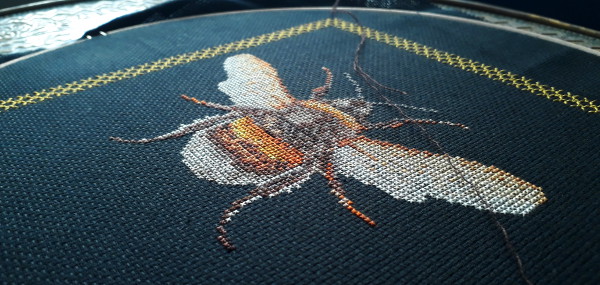
We’re a couple of weeks on from the previous post, so it’s time for another update on my current cross-stitch project. This weekend just past, I finished off the last of the cross-stitch itself on this project. Now, I just have the back stitch to do.

Bee

The back stitch that makes up the border (and the lettering at the bottom) will be nice and straightforwards; the back stitch that provides the veining on the wings is going to be rather harder, as it’s in a dark brown thread that doesn’t stand out very well at all against the fabric. By the time of the next update, I suspect I’ll be getting somewhat frustrated.

The previous parts in this series were *part four*, *part five* and *part six*. The final part is *part eight*.

Corvids again

But the question is still there

Today, when I went for my daily walk,* I took my camera with me, intending to take shots for a planned series of posts about railway history that I’m slowly putting together. However, this post is more of a follow-up to the one from the other day on the various types of corvid you can see in this area.

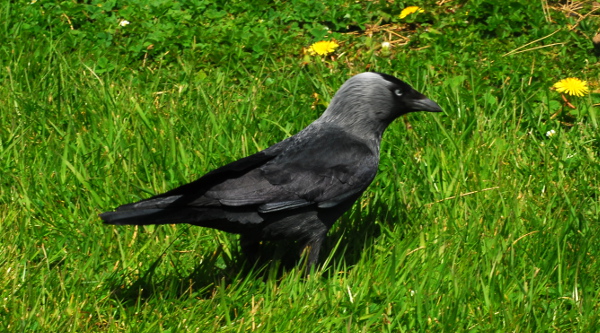
I mentioned in that post that, around here, jackdaws nest in the girders of railway bridges in much the same way that pigeons do elsewhere. I’d only just passed under the railway bridge that I was thinking of when writing that, when I realised that I was walking along a few feet away from a jackdaw, at head height but on the other side of some iron railings. The ground on the other side of the wall was rather higher than by the footpath, so as I walked, the jackdaw was walking too, stopping to look for things in the grass. I tried taking a photo, and it didn’t seem overly bothered. I took a few before eventually it flew away.

A jackdaw

You can see the significant feature of jackdaws that makes them easy to recognise: the silvery-grey head and neck.

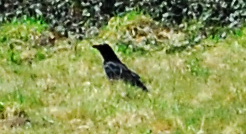
Later on, as I was on a slightly more rural part of the walk, I spotted a much larger bird on the far side of a meadow. This is what I was talking about before: sometimes I see larger black birds, that might be ravens, but they are never quite close enough to get a definite identification. Even with the good camera, this is the best I could do.

A raven, maybe

To my eyes, that could well be a raven. It seems to have a raven-like profile to the head, and it seemed to be quite a big bird too. Whether it really was a raven: well, I’m no birdwatcher. If I do manage any better, more definite raven identifications, I’ll let you know.

* Daily in aspiration if not in fact.

Corvid awareness

Or, there's been a murder

You might think that moving from an inner-city house to a suburban house, only about thirty or forty miles apart, you’d not see much change in the wildlife you see in the area. It’s been interesting, though, since moving, noticing the changes.

Take birds for example. In Bristol, the most common large birds were seagulls, and the most common small birds house sparrows; every house along our terrace had one or two house sparrow nests under the tiles at the edge of the roof. Occasionally a sparrowhawk would come and perch on the garden fence. The most common corvids were magpies, a family of them in most streets. When I started working from home, sitting at the window with a telegraph pole just outside it, one local magpie would regularly come to investigate me: perching on a rung of the pole at my eye-level, making eye contact and giving me a good curious look.

Here in the new house, the fauna is actually quite different. There are still seagulls, occasionally, coming up the valley; but the most frequent large birds are buzzards, slowly soaring over the neighbourhood sending all the other birds into a panic. The most common small birds are blackbirds and wagtails; pied wagtails in the garden and grey wagtails along the riverbank. In between, though, I often hear the calls of wood pigeons, but the most common birds of all are corvids of various types. I have been trying to sit down, watch them, and work out exactly which are which.

Magpies, of course, are easy to recognise, both by sight and by call. There are a few magpies here that come into the garden occasionally, but they’re not common as they were in Bristol. The most common birds here, though, are jackdaws. They arrive in pairs or in bigger flocks, and now I’ve learned to spot them, their silver heads are very recognisable. They nest here almost like pigeons do in a city, in spare ledges, under railway bridges and suchlike, as well as in more traditional spots such as in the hollow end of a sawn-off tree branch. They fill the main “medium-sized scavenger” niche taken by pigeons in a city centre.

There are, though, a few larger corvids, and these are the ones I’m having trouble with. Basically: are the larger black corvids I can see occasionally ravens, rooks or crows?

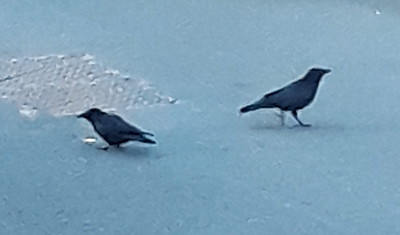
They’re probably not rooks. Rooks have pale beaks, and I haven’t seen any of those. Rooks, like jackdaws, tend to nest and travel in flocks; when I see a black bird larger than a jackdaw it’s usually on its own. Crows, then? Some of them probably are. The problem I have identifying any of these birds is: they have a distinct aversion to photography, if they spot you doing it, and I’m not someone with any specialist long lenses or other bird-photography equipment. If I see a bird from the window, in any case, by the time I’ve gone to get the SLR it’s probably flown off. If I photograph it with my phone, it’s either an indistinct black blob, or it sees me pointing my phone at it and, as you might expect, flies off. These birds, of the “indistinct black blob” category, I’m pretty sure are crows.

Crows, probably

Every so often, though, I see a much larger black bird, usually much further away. I see it sitting on the peak of a roof, in the next street, and it looks much larger than a crow should look in my approximate mental map of these things. Is it a raven? Or just a particularly big crow? The problem there is, I’ve never seen it close-up, I think. Is it just an optical illusion, the sort of thing where somebody sees a black cat crossing their path a few hundred yards away and thinks it’s a panther?

If it is a raven, I suspect there’s probably only one of it. It doesn’t visit very often, and I don’t think I’ve seen it flying. Could it just be a big crow? I suppose it could. If I don’t get any closer sightings of it, maybe that’s a sign that it really is just a mirage; that, in my hand, it would just be the size of an ordinary crow. I’m going to keep looking. There might not be any sightings, but if there is, I’ll keep you updated.

This is not a bee blog

But now you say that...

This is not a bee blog, despite the bee-themed cross-stitch in the previous post and the burrowing bumblebee in the one before that. However, having said that, I did come across an interesting bee whilst out walking today.

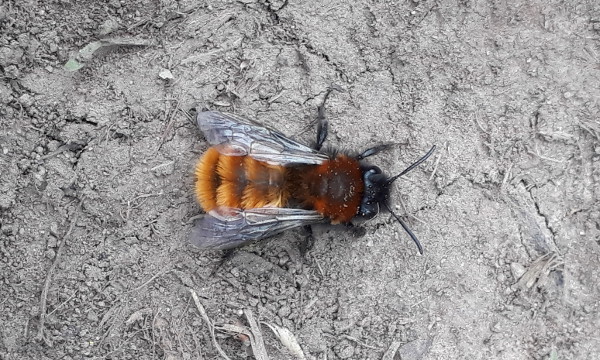
Tawny mining bee

This is a female Andrena fulva, the tawny mining bee. She was stumbling sleepily across the path in the spring sun, her golden orange abdomen standing out very strongly against the soil and grass. You could almost take the photo for a selective colour one.

Yet another crafting project (part six)

Arguably, part three

In lieu of a more informative post—I’m in the middle of researching something in-depth and historical, but everyday life and tiredness keep getting in the way—here’s an update on the current cross-stitch project, a couple of weeks on from the previous one.

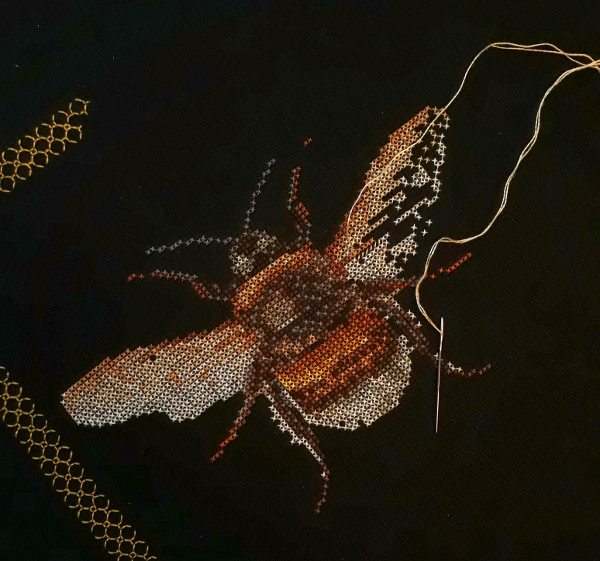
It's still a bee

As I’ve gone through it I’ve been leaving aside all the bits that feel as if they would be awkward and fiddly; but now, it feels as if there’s nothing but awkward fiddly bits left. It feels as if progress has slowed down because the overall outline hasn’t changed much; but there are an awful lot of colours now which I’m fairly sure I’ve completely ticked off the list.

The previous parts in this series were *part four* and *part five*. The next parts in this series are *part seven* and *part eight*.

Buildings in the landscape

Or, a trip to a museum

Only the other day, I wrote about heading out to visit a castle now that outdoor tourist attractions in Wales are starting to open up again. And now, along comes another post about it! This isn’t going to become a blog purely about days out I’ve taken, honest.

For the past few years, we’ve gone every spring to the museum at St Fagans, just west of Cardiff. If you’re from South Wales you will undoubtedly know of it, but I was always surprised, when we lived only just over the water in Bristol, how many English people don’t. Sain Ffagan Amgueddfa Werin Cymru, or St Fagans National Museum of History,* is a museum of Welsh buildings and Welsh life on a grand scale. It was founded back in the 1940s, modelled on the Skansen museum in Stockholm: the grounds of an aristocratic stately home, St Fagans Castle, were slowly filled with exemplars of vernacular Welsh architecture, dismantled and re-erected.

The museum also has indoor galleries, in a huge 1960s-era brutalist building which—after a full refurbishment a few years ago—is a gorgeous example of the period with a wonderfully light and airy atrium space. Naturally, none of that is open at the moment. Nor are the interiors of the historic (or replica) buildings themselves. However, given that visitor numbers are being carefully limited, this does mean that we had a great opportunity to explore the grounds in detail. I should have brought my Proper Camera, because normally you don’t get to take photos with nobody else about quite as easily.

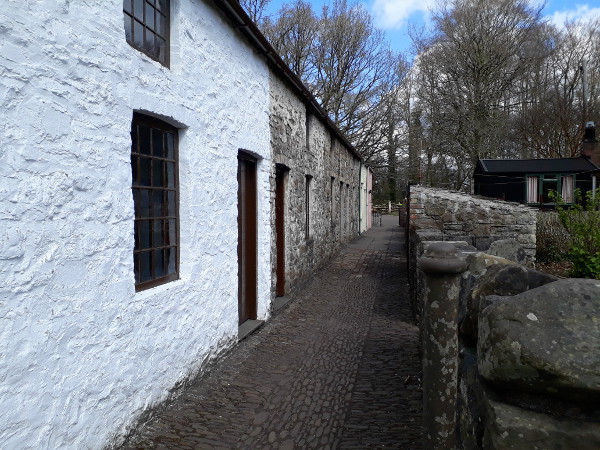
Rhyd-Y-Car Terrace

Rhyd-Y-Car Terrace

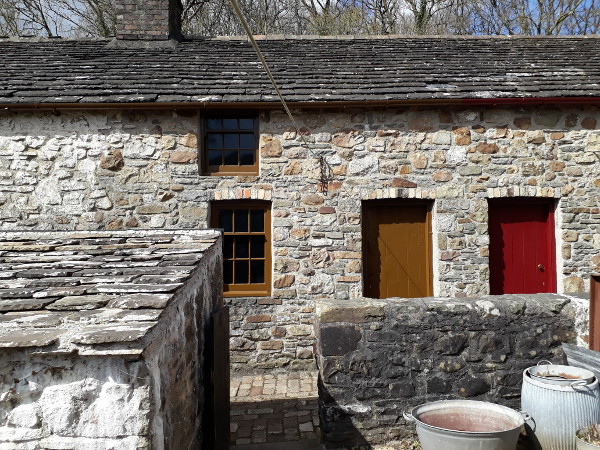
This is Rhyd-Y-Car Terrace, one of the museum’s highlights, showing the changes in a typical urban terrace over two hundred years. If nothing else, when you can go inside, it gives parents the opportunity to say “look, this is what houses looked like when I was small,” as their children gaze at a 1970s microwave, an early VCR and a model of a plate of fish fingers. The buildings themselves came from Merthyr Tydfil; railway nerds might remember that Rhyd-Y-Car Junction was the point where the Brecon & Merthyr Railway met the Great Western Railway just outside Merthyr station.

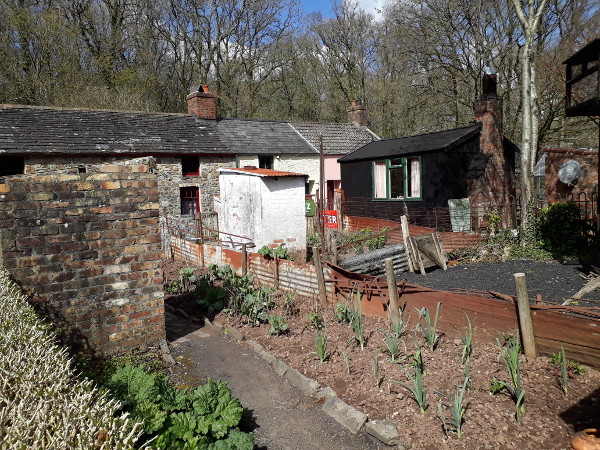
The gardens outside the terrace are similarly reconstructed and appropriate to the period of each cottage, with vegetable plots and outside toilets gaining sheds, pigeon lofts and air raid shelters, before being replaced with grass and a greenhouse.

Rhyd-Y-Car Terrace

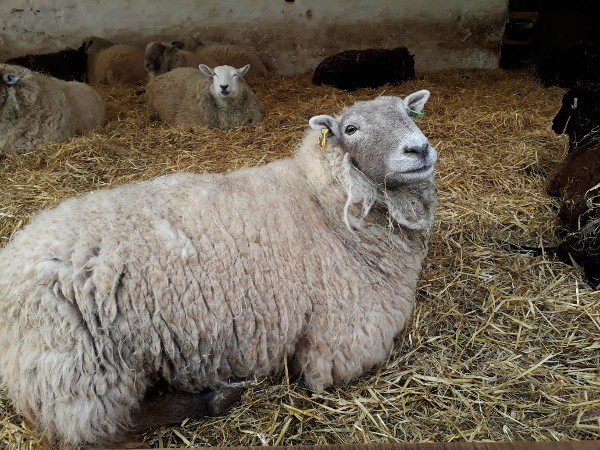
You might remember, back in the mists of time a few paragraphs ago, I said that we always tend to go to St Fagans every spring. The reason for that is: being a museum of Welsh life, it has its own sheep farm—with added geese, ducks, cows and porkers too—and every year lambing season turns into a bit of an event, complete nowadays with the lambing sheds being broadcast online on the museum’s “LambCam”. By April though lambing season is pretty much over: we could see the lambs in the fields, but not many were left indoors. Still, this one seemed happy to see us.

Sheep

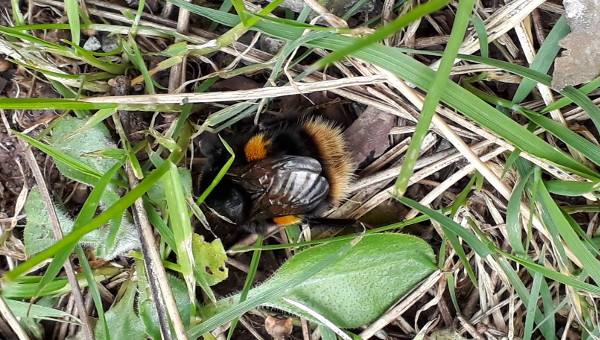
Other signs of spring were everywhere too: the ground carpeted with primroses and celandines, bluebells starting to appear in the woods, and the daffodils still in strong flower. I watched this bee flying round, scratching under grass and leaves apparently trying to dig a hole, before giving up and trying another spot.

Bee

I think she’s a queen buff-tailed bumblebee (Bombus terrestris), possibly looking for somewhere to start her nest.

* Translation note: the Welsh name doesn’t mean “Museum of History”, but it could mean “Welsh Folk Museum” or “Welsh People’s Museum”. The Welsh name has stayed the same over the years whilst the English one has changed a few times: road signs off the motorway direct you to the “Museum of Welsh Life”.

We now resume your regular programming

I'll explain the pun later

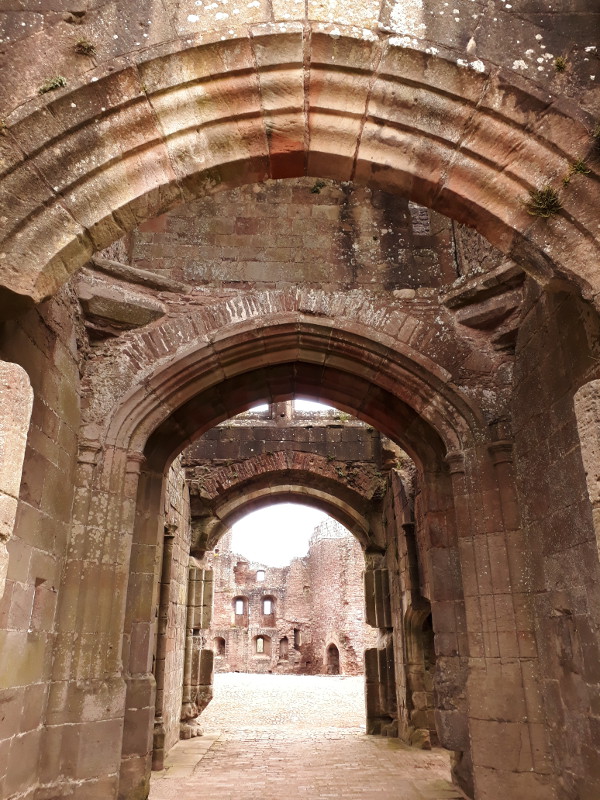
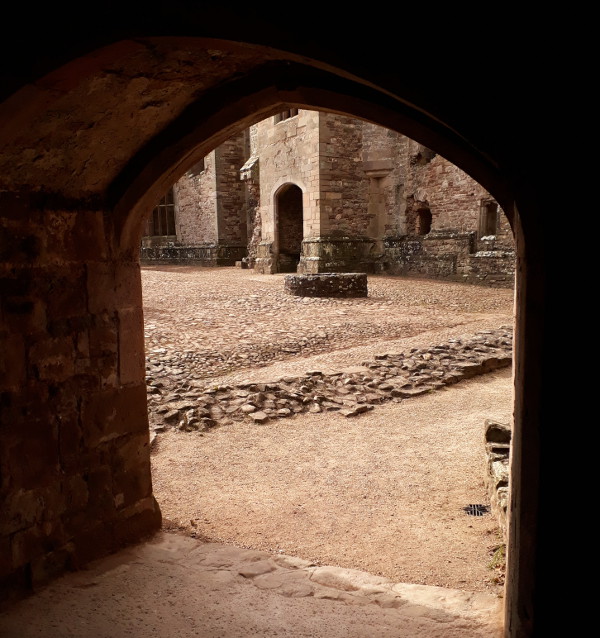
With travel now allowed within Wales, and places starting to open up, we can now go out and visit castles and suchlike again. Cadw, the Welsh historic monuments service, are starting to open up a number of their sites to carefully-controlled numbers of prebooked visitors at sites where it’s feasible. You can’t see the fantastic Victorian Gothic interiors of Castell Coch, but you can go and visit many of the famous castle ruins of Wales, the most famous being the “Edwardian subjugation” castles of the North. Caernarfon or Conwy are a bit far for a day trip from here, though. Instead, we set out for somewhere a bit more local, and walked through the complex arched gateways of Castell Rhaglan, Raglan Castle.

Castle Gateway

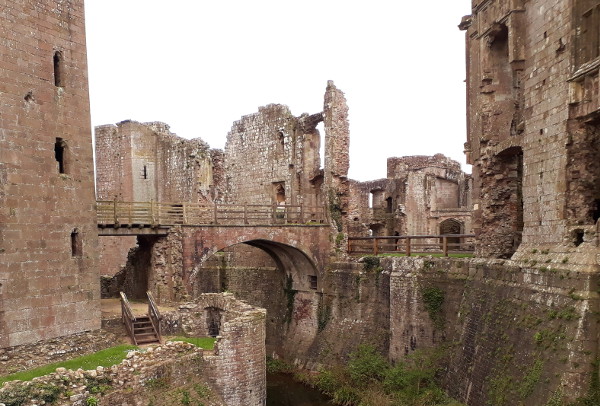
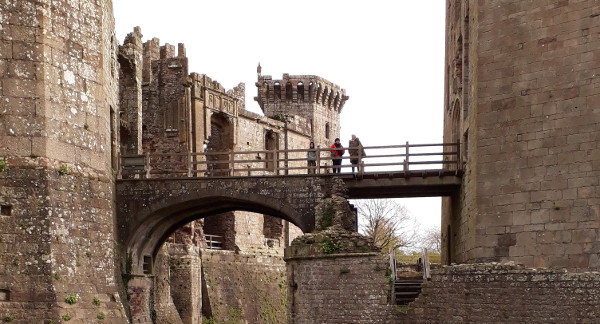
Raglan covers a large area but is rather unusual in that its keep is a moated hexagonal tower outside the main castle bailey, with a high-level bridge linking the two—in fact, in the Tudor period, it might even have been a bi-level bridge. The various levels and arches give you fantasically complex views that are almost like the works of Piranesi.

Raglan Castle

Raglan Castle

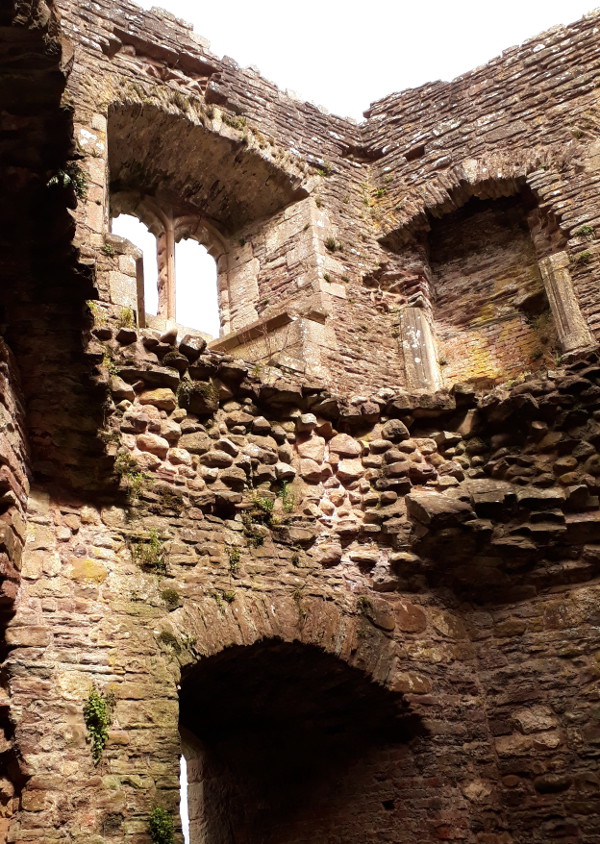
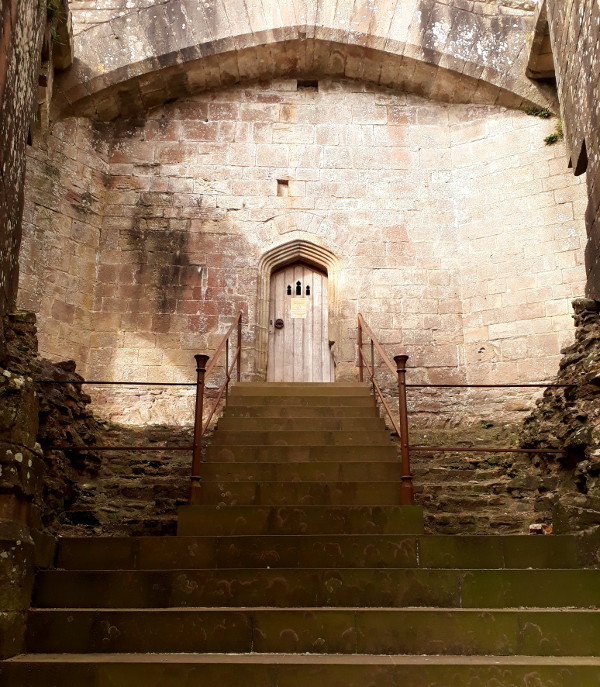
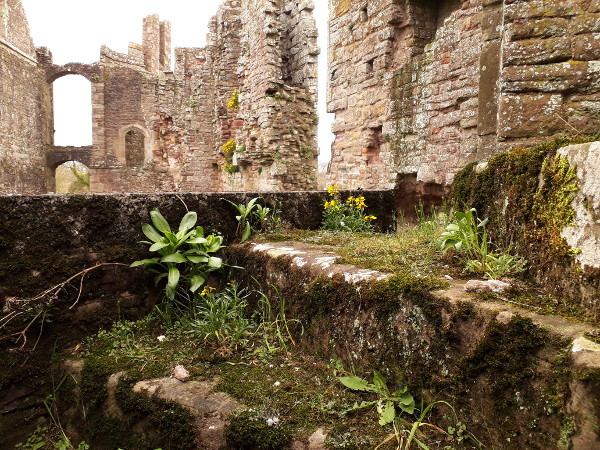
Raglan was still a sumptuous residence all through the Tudor period, right up until the Civil War. In the Stuart period, it even had a fountain powered by some form of steam engine, which must have predated the machines of Papin or of Savery. The upshot of this today is that, compared to the castles of North Wales I mentioned earlier, it has parts of rather more modern construction. There are substantial chunks rebuilt in brick, for example; finely-detailed stone carvings; and rooms with large rectangular windows. Nevertheless, it is still a ruin: in the Civil War its aristocratic owners naturally supported the King’s side, and as a result the castle surrendered to General Fairfax in the summer of 1646. The castle was made uninhabitable, and sadly, its library destroyed. It still today has no roof to speak of, few floors, and many stone stairs leading nowhere.

Raglan Castle

Raglan Castle

Raglan Castle

Raglan Castle

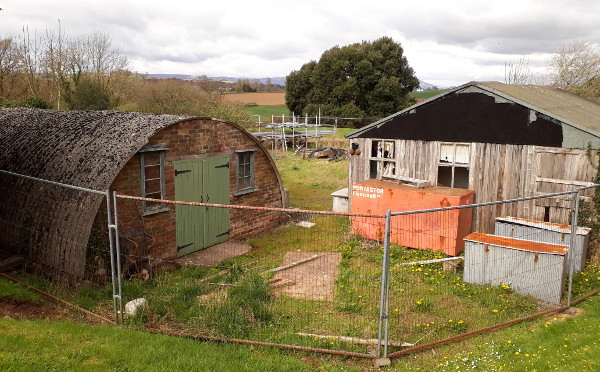
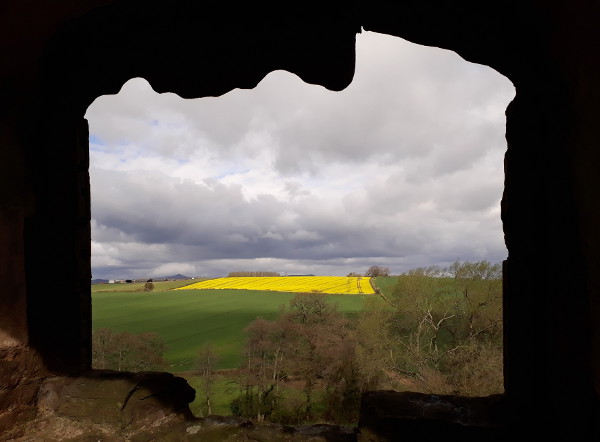
In the Tudor and Stuart periods the castle was surrounded by several terraces of formal gardens, which also no longer survive. Indeed, even if the castle had survived the Civil War, the gardens would no doubt have been lost to changes in aristocratic taste in any case; very few Tudor houses have had their original gardens survive continuously. The castle today is surrounded by the rough, rounded-off and grassed-over remains of the terraces, scattered with picnic benches, and with a shed and a Nissen hut tucked away in a discreet corner. Nevertheless, you can still look out from the castle across the rolling farmland that surrounds it, over to the Blorenge and the Sugar Loaf on the horizon.

Every castle needs a shed

Looking towards the Sugar Loaf

I must go back again some time with the Proper Camera, to take a photo which shows the Sugar Loaf as clearly as it stands out to the naked eye. Moreover, if the Sugar Loaf disappeared from sight, as it did when we were there, you know it’s time to seek shelter before the weather reaches you.

Incidentally, if you read the subtitle at the top of this post, you might still be wondering where the pun is. It’s not a very good one, but it is a bilingual one. My Welsh vocabulary is slowly improving; and all day, I had the same thought going around in my head, that if I was commissioning shows at a Welsh TV station I’d have one every day called “The Raglan Programme”, just because its title would be Y Rhaglen Rhaglan. I’ve done better, I have to admit.

Ar lan y môr

And more than once, too

As it was Easter weekend, we took a couple of trips out. “To the beach!” shouted The Child Who Likes Fairies, so to the beach it was.

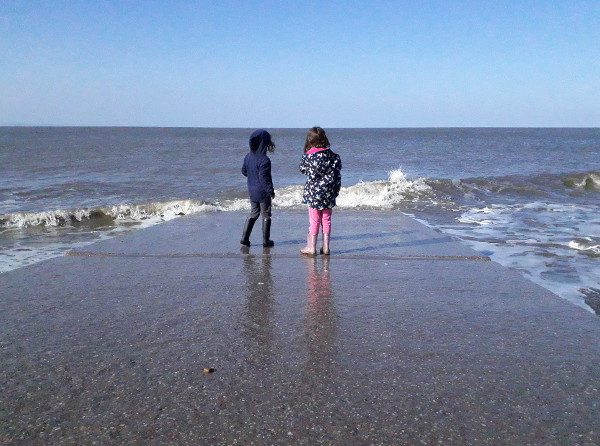
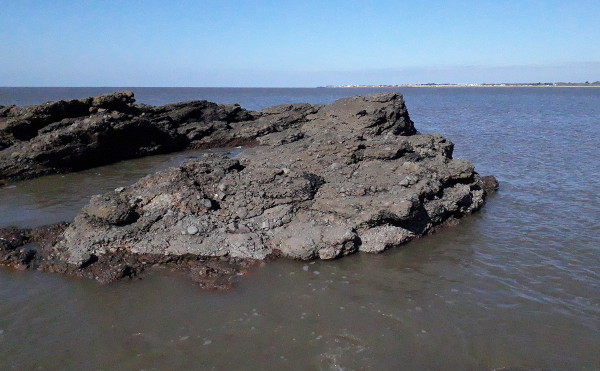
Firstly, on Friday, to Aberogwyr or Ogmore-By-Sea, a small seaside village at the mouth of the Afon Ogwyr (River Ogmore). it has a rocky shore of cliffs maybe only ten or fifteen feet high, with many paths and gulleys down through them to the pebbly beach. There isn’t much in the way of sand, especially as we arrived at high tide.

On the slipway

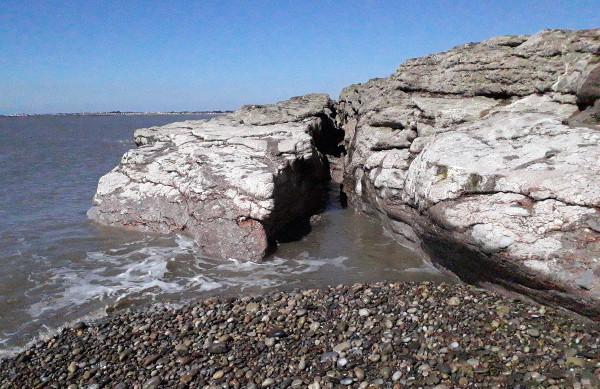
The rocks are interesting, though, with smoothly-eroded limestones overlain by a strange array of breccias. At their lowest are rocks consisting of an amalgam of limestone pebbles, as if a beach or riverbank from a few million years ago had been frozen exactly as it was. Above them are huge, rough black slabs looking for all the world like pieces of modern concrete or tarmac. If you told me that back in the Triassic, dinosaurs had worked out the basics of civil engineering, I’d now believe you.

Interesting rocks

Interesting rocks

Ogmore-by-Sea is at the eastern side of the mouth of the River Ogmore. “Can we go to that beach over there?” said The Child Who Likes Animals, pointing to the far bank of the river. Over there, is Merthyr Mawr Warren, a vast area of sand dunes stretching from the western riverbank to the town of Porthcawl, with a long, broad stretch of sandy beach, Traeth yr Afon, facing on to the sea. So, today, we went to Merthyr Mawr.

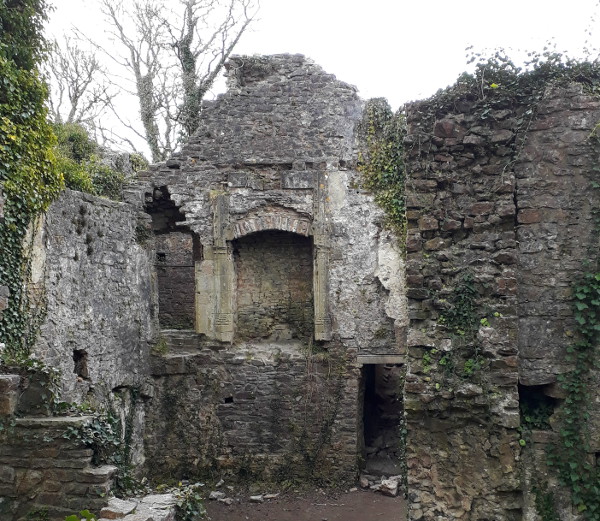
At Ogmore-By-Sea, you can park your car at the top of the cliffs and amble down onto the shingle in a matter of seconds. Merthyr Mawr is a bit more of an expedition. The car park itself is by Candleston Castle, a ruined fortified manor that is about a mile or so from the sea. It’s an interesting place in itself, though.

Candleston Castle

Walking the mile through the dunes to the beach itself is quite the exercise. Merthyr Mawr Warren has the highest dunes in Britain, the second highest in Europe. Because the paths through the dunes are frequently disturbed, they tend to be the areas with the softest sand. It becomes something of a slog, and you lose sight of all the wonder in the landscape, the unique flora and fauna that goes towards making it a very special place. Nevertheless, we managed to stop and watch huge numbers of solitary bees of some kind, going in and out of their burrows.

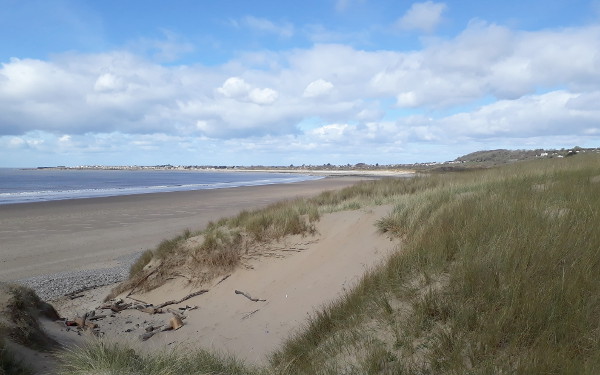
Walking through the dunes is also very disorientating; you start to wonder where you are, whether you are trapped and going around in circles. Nevertheless, if you pay attention to the details, you can begin to see how the dunes vary. Further from the shore, they are more stable, the sand is darker in colour, and there are entire bushes and trees holding the dunes together. Towards the sea, the largest plants are clumps of marram, and the sand has ever more fragments of shell in it. Eventually, breaching the final crest, you slide down onto the beach.

Merthyr Mawr Warren

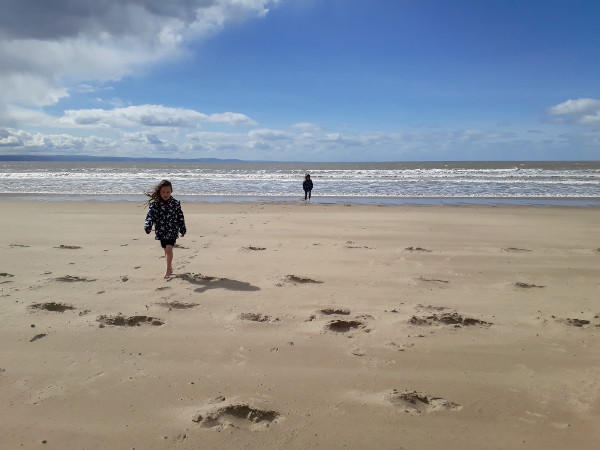
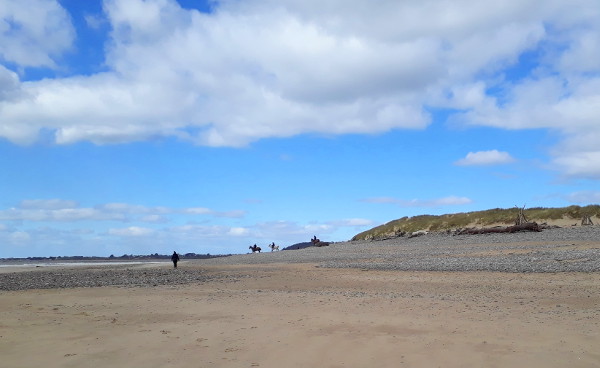
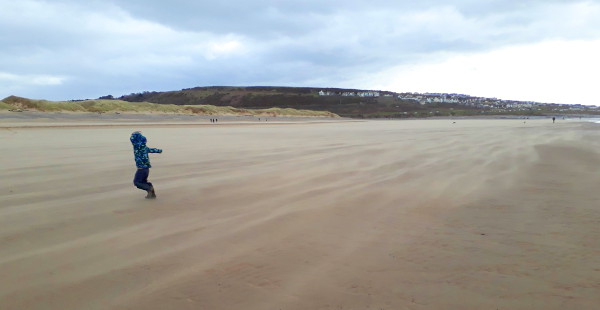
Traeth yr Afon is a very different prospect to the other side of the river. Open, windy, relatively deserted. Horses and riders gallop along through the firm sand at the shoreline. There is no coffee van, no lifeguard’s tower, no car park. Just the wind blowing fine sand along the surface, and the constant roar of the breaking waves.

Traeth yr Afon

Beach horses

Windblown sand

Which beach is better? That’s a matter of personal choice—and of your mood on any given day. Walking through the amazing dunes, allegedly so sandy and un-British they were used as a filming location for Lawrence of Arabia, is certainly hard work, compared with a beach that’s practically in a village. Walking along a deserted, windswept sandy shore, though, is generally just much more my taste. On the other hand, broad flat windswept dunes don’t also have fossil beds to go hunting in (for that, in the Vale of Glamorgan, you really want the beaches a few miles further east). There are always choices; it’s not a competition. We had two very different days out this weekend, but both were to amazing places.