+++*

Symbolic Forest

A homage to loading screens.

Blog : Post Category : Geekery : Page 17

Greetings from sunny Tipton

In which we think about science and scientists

Lounging around on a sunny Sunday morning, I was planning, plotting, and thinking of things to write here. Planning on writing about the cake K was promising to bake, or W’s upcoming birthday, or yesterday’s trip to Oxford with C and P and various other people. And I started thinking: why do I refer to people by letter like that?

I quickly realised where I might have got it from: the scientist and writer Jeremy Bernstein. I have, somewhere on my shelves, a copy of his book Experiencing Science, a compilation of articles he wrote for the New Yorker. It is mostly a series of pocket biographies of prominent scientists, from Kepler through to Oppenheimer via Lysenko, Franklin, and others; but at the end of the book is a slightly strange, partly fictional essay on the work of Turing and Gödel. In which all the main characters – the fictional ones, at any rate – are referred to by their initial letters. K, W, and so on.

I can’t say I fully understand Gödel’s theorems. My maths isn’t that good. I do love its implications, though. It underwrites and undermines the whole of computer theory; and, as someone who works in IT, I know from experience that computer theory hardly ever matters in real life. Someone once asked me, politely, to shut up, on a train, because I was trying to explain Gödel’s theory rather loudly to Δ and I hadn’t realised we were in the Quiet Coach. I try to reread Bernstein’s book every year or two, and not just for the Gödel chapter; clearly, though, it’s been a bigger influence on my own writing than I’d realised before.

Masochism

In which we go back to BASICs

No, I’m not a masochist.

I take a strange, geeky, masochistic pleasure, though, in making things hard for myself. In doing computer-based things the long way round. In solving the problems that are probably easy for some people, but hard for me. In learning new things just because it’s a new challenge.

Today, I was wrestling with a piece of Basic code in an Excel spreadsheet. I’ve not touched Basic since it had line numbers, which is a long long time ago, and I barely know any of it. I forced myself to work out, though, how to do what I wanted.* It was mentally hard work, and meant a lot of looking back and forth to the help pages, but I got it done in the end. It might not be written in the best way, the most efficient way, or the most idiomatic way.** But doing it was, strangely, fun.

* or, rather, what the consultant I was assisting wanted.

** for non-geeks: every computer language or system has its own programming idioms, which fit certain ways of programming particular problems. Someone used to language A will, on switching to language Z, often keep on programming in language A’s style even if this produces ugly and inefficient code in the other language.

End of the week again (no, really)

In which we set up something geeky

It does come around fast, doesn’t it? Here it is, a beautiful day outside, a clear blue sky, and here I am sat inside updating the blog. Still, it’s almost too hot and sunny to go out. What I could really do with: a laptop, a wireless card, and a deckchair, so I could sit in the shady bit at the bottom of the garden, surfing the web with a nice big G&T. I can’t sit in the sunshine, I burn too easily.

I’m actually going away for the weekend. Well, I haven’t gone away yet, but I’ve booked an exotic hotel for the night, in the hope of getting to bed before dawn. I’m off out for the day tomorrow, you see, and I thought I may as well spend £50 on a headstart.

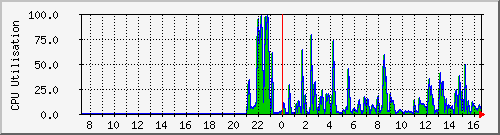
Geek news: I’ve been having fun setting up MRTG on the home computer network. NB: if you do not know what this means, do not worry – that is probably a Good Thing. The main thing it means to me is: lots of pointless graphs to look at.

My PC's CPU activity

All that information is completely useless, and unnecessary to have, but when you’re a geek that’s not the point. It will be useful if I ever bother to get it set up properly at work.

Plans of going away for the weekend reminded me that I don’t have many good luggage bags. I could really do with a nice multi-purpose over-the-shoulder bag that I can stuff with luggage when I’m setting off, and then use as a day bag when I’m off doing touristy things. If I could also use it as a makeshift gadget bag when I’m out with the camera, that would be an extra too. Something like a record bag would be good, but they’re an awkward shape for anything apart from 12″ singles – good for carrying about an A-Z, a couple of books and a notepad, but I couldn’t fit much camera kit in one. A proper photographic gadget bag would be expensive – and they’re mostly either rucksacks, or a bit ugly-looking – and a magical chest with lots of little feet would definitely be overkill. So, any better suggestions gratefully received. And now, I’m off away to pack.

End of the week

We're glad it's Friday

Hurrah, it’s Friday again. I have a busy busy weekend ahead, though, so I’ll probably be more tired on Monday than I am now.

I haven’t bothered to find out how the local elections went, but I have discovered one thing: one of the Labour candidates round here is Colleague M’s ex.* If he’s won, I’ll have to tell you more about him some time.

Tip for you, if you’re thinking of buying a digital camera: don’t get a Samsung. Big Dave did, and frankly it just didn’t work. It would crash, lock up, or just not take photos – when you went back to look at the memory card, nothing but blank black images. So it’s back at the shop now, and Big Dave has his money back. I tried to persuade him he should buy an expensive SLR, but he wasn’t having any of it.

I was thinking that my post about Flann O’Brien hasn’t made it onto the site yet – but then I remembered that neither has my planned post about the late Jan Mark. The problem with literary posts is that I feel I need to reread all the relevant books first, which really acts as nothing more than a delay…

The Plain People Of The Internet: Hang on a minute. If Jan Mark is the late Jan Mark, why isn’t Flann O’Brien late also, as they are both equally as dead as the other?

Myself: Shut up, you.

Anyway, time to get away and get on with the rest of the day. The sooner Friday’s over, the sooner it’s the weekend.

* Recent readers might not have come across Colleague M – I haven’t heard much from her at all since she became Ex-Colleague M.

Fssst

Or, fun with compressed air

Life has many simple pleasures.

One of my favourites at the moment: cleaning keyboards. Take one can of compressed air, hold can and keyboard at arms’ length, push the nozzle, and be amazed as a huge cloud of dust* is blown before you. FSSSST. FSSSST. It’s great fun, it really is.

* and biscuit crumbs, if it’s mine.

Pressurised

Or, when I am quicker than the Internet

On top of the timezone confusion, work is getting a little pressured this week. I’ve been driving about between branches carrying equipment backwards and forwards, because if you’ve got a large amount of data in the wrong place, the quickest way to sort things out is still to put your computer in the boot of your car and drive it down to Another Part Of The Forest’s branch office. Squeezing it down an internet pipeline takes all day; driving to the other side of the county only takes an hour.*

The best part of that, of course, is that an hour of driving down the motorway is an hour of not having to answer the phone to be given more work.

* Well, the other middle of the county, at any rate.

Predictive

In which we thank people and skim over a few other things

Well, I was glad Gordon Brown did take my hints on a couple of things.* I’m just disappointed that he didn’t single out blue cars for rebates.

Current small reasons to feel pleased with myself: I’ve managed to completely avoid watching anything at all to do with the Commonwealth Games, even though one of the medal-winners is a teacher at my old school. Hopefully I’ll manage to keep avoiding it until all the fuss is over again.

Current small reasons to get pissed off: the computer keeps crashing, usually at the most inappropriate moments. I know what the problem is: a very obscure bug in the disk controller driver which very few people have come across, and nobody seems to know the cause of.** Bah.

On the other hand, I do have a large box of biscuits on my desk at the moment. But not for long, I suspect. Hurrah!

* although, to be fair, everyone else in the country had already vaguely guessed the road tax changes.

*** it only comes up if you have a Promise SATA disk controller, a Maxtor SATA disk, and are running one of some Linux 2.6 subversions. But not all – the problem apparently disappeared in one revision of the driver, only to come back in the next.

Old romantic

In which we feel a community spirit

I was a little doubtful when I saw, on the front page of Friday’s Guardian, the tagline “Steam trains – the great aphrodisiac”. I do like trains, but I wouldn’t say that about them.

It turned out to be subeditor’s hyperbolae. The article, by a former director of British Rail, turned out to be about the radical romanticism of the steam engine. Eroticism was only briefly mentioned. I’m rather glad, to be honest. Train-into-tunnel might be a classic visual metaphor, but I don’t think very many people would say that the train itself is what gets them going. There are people out there who haven’t just had sex on the train, but can remember the numbers of the trains they’ve had sex on – but I somehow don’t think it was the train itself that was turning them on.*

What I do like about trains is what that article calls “the rigmarole of trains”. The ritual surrounding the railway. The little bits of peculiar terminology that you don’t get anywhere else.** The natural romanticism of rail travel, and the community feeling that can spring up around the line.

* but if it was – on balance, I think I’d rather not know!

** phrases like “not to be used outside possessions”, or “not to be loose or hump shunted”.

London Weekend Blogging: The Party

In which we join the paparazzi

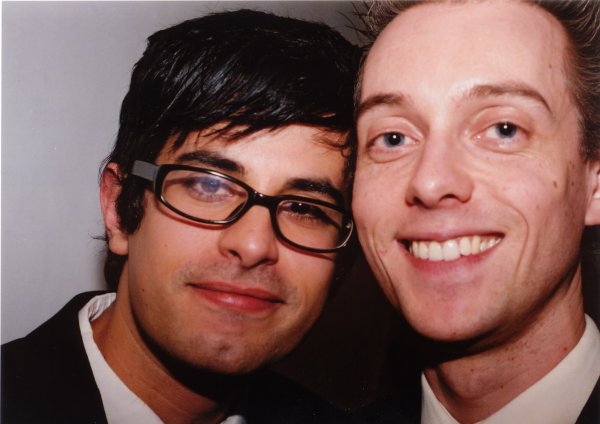
I always enjoy W’s parties, even the ones I can’t remember afterwards.* And, because it was their wedding, this one seemed extra-special.

I’d been given the job of semi-official photographer, so I tried to stay more or less sober. It also gave me an excuse to constantly rush around the building shoving my camera into people’s faces. I would probably have done this regardless, but it was nice to have an excuse for it.

Eventually, people started dancing, so there was nothing for it but to put the camera down and bounce around like a mad thing. I don’t think I did anyone any serious injuries, but equally I’m not going to be winning any dancing prizes in the near future. Then, when I was exhausted, I’d flop down on the sofa for five minutes before picking up the camera again and repeating the cycle. If I saw someone posing for someone else’s camera, I’d try to quickly grab a sneaky shot from the side. Hopefully all the other party guests think they look good in profile. The main room was lit by beautiful blue fairy lights: it looked wonderful, but it was so dark that half the time I had no idea what I was photographing.**

I was still emotional by the end of the evening. I hugged W before I left, and wanted to tell him: have a wonderful life together. W and P make an amazing couple, and everyone who knows them wants them to be happy forever after.

P and W

If you want to see the rest of the wedding photos – not that they will be of much interest unless you know P and W yourself, of course – most of them are here.

* such as the one where I got so drunk I collapsed in a flowerbed. There are quite a lot of people in London who have no clue what my name is, but if you say “you know, the one who collapsed in the flowerbed at W’s party” will know exactly who you mean.

** One technical photo tip: I was lucky that the house has very light, almost-white walls and ceilings throughout. This means that – if you have a swivel-head flashgun with good automatic metering – you can point your flash directly up at the ceiling to get nice, even, flattering lighting. It does mean, though, that the photo lighting is nothing like the original scene. This photo was taken in a room barely light enough to not walk into other people, and all the light comes from the flashgun attached to the camera.

Model Planet

In which we try to fake a tilt-shift lens effect

If you’re a Boing Boing reader, you might remember the post from a couple of weeks ago about photographs that look like tiny models. I was intrigued, partly by the photos themselves, and partly by the way we perceive them, the trick that makes our brain think they are tiny.

The pictures were taken with tilt-shift lenses, expensive things which distort the perspective of a photo and move the perspective vanishing points around. However, I don’t think it’s that which is mostly responsible for fooling the eye here. Rather, it’s the minimal depth-of-field that these photos have.

For non-photographers: depth of field is, essentially, the amount of a photo that is in sharp focus. Because of the basic physics of light and camera lenses, distance photos normally have an enormous depth-of-field, and close-ups have a tiny one.* Tilt-shift lenses, though, wreck your depth-of-field, making every photo look like a close-up.**

You can fake this effect yourself, given a suitable photo and some image-editing software. Here’s a photo I took earlier. I chose it because it shows an isolated, lonely couple on a depressing, cold, windswept beach, so it’s ideal for Valentine’s Day:
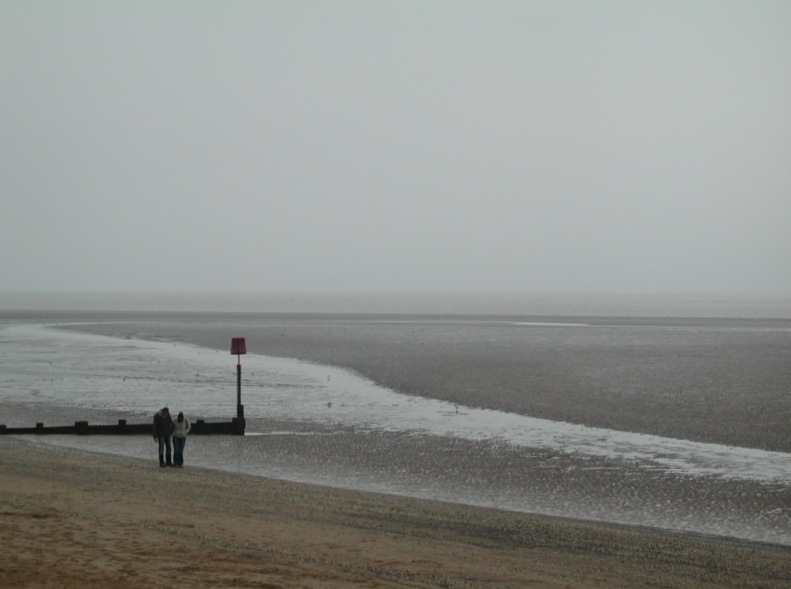
On the beach

The other reason I chose it is that as it shows a wide, flat, muddy plain, it’s ideal for mucking around with depth-of-field effects. After a bit of trickery to make sure the groyne beacon*** stayed sharp, I applied plenty of blur to the foreground and background. And – look, tiny little people on a model beach!
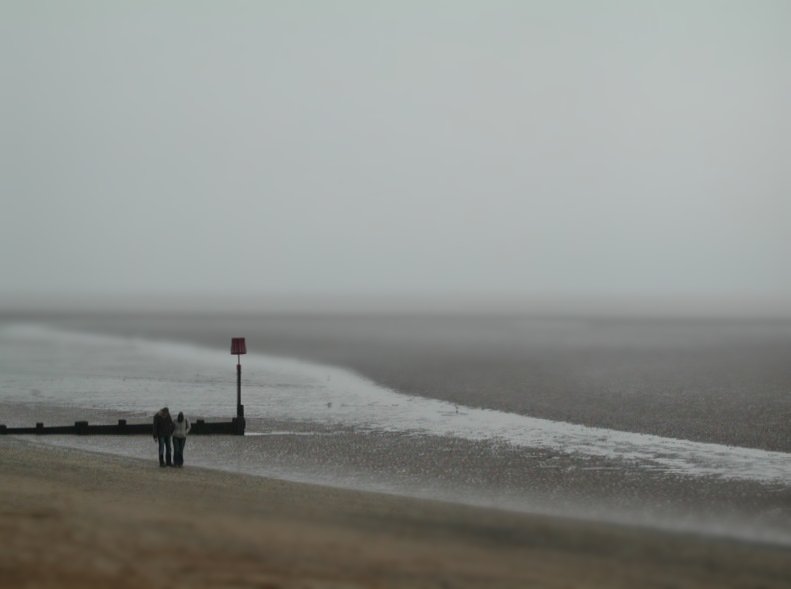
On the miniature beach

(the effect doesn’t really work in the thumbnail, so click on the link to see it properly)

It might not look as good as the photos on Boing Boing, but you can see the effect starting to appear with only a few minutes’ work. The interesting thing, though, is that you probably didn’t know all that stuff I said earlier about depth-of-field and how it varies with distance. Unless you’re interested in photography, I’d be surprised if you did. Subliminally, though, you already knew it all. It’s hard-wired deep inside the visual centres of your brain somewhere, and that’s why these photos look like models.

What I’m not sure about, though, is whether we’re used to this because it’s how our eyes work, or just because we’re so used to seeing photographic**** images. I suspect it’s the former, but I don’t know enough about eyes to be certain. For my next experiment, I’m going to take a small child who has never seen a photograph and raise them out of contact with pictures or TV, just to see how they respond. Now, does anyone have any spare babies they won’t be needing for a few years…?

* If you have a decent SLR camera lens to hand, you can confirm this, because it will probably have depth markings on the lens. For example on a 1970s Pentax lens I had to hand, with the lens focused on the horizon, it claims things 25 feet away should still be in focus – a depth-of-field measured in miles, in other words. However, if it’s focused on something 18 inches away, the depth-of-field will be about one inch either side.

** It’s all in the tilt – the lens’s imaging plane is tilted so it no longer aligns with the film plane, so the only in-focus part of the picture will be a narrow band where the planes intersect. Another experiment to try at home: if you have a projector of some kind, try tilting your projection screen, and watch the picture distort and go out-of-focus – essentially, that’s what a tilt-shift lens is doing.

*** Heheheh! Groyne! Snigger!! No, I am sophisticated and grown-up really – why do you ask?

**** Which includes TV and cinema for this purpose – the lenses aren’t that different.